Shortwave listening and everything radio including reviews, broadcasting, ham radio, field operation, DXing, maker kits, travel, emergency gear, events, and more
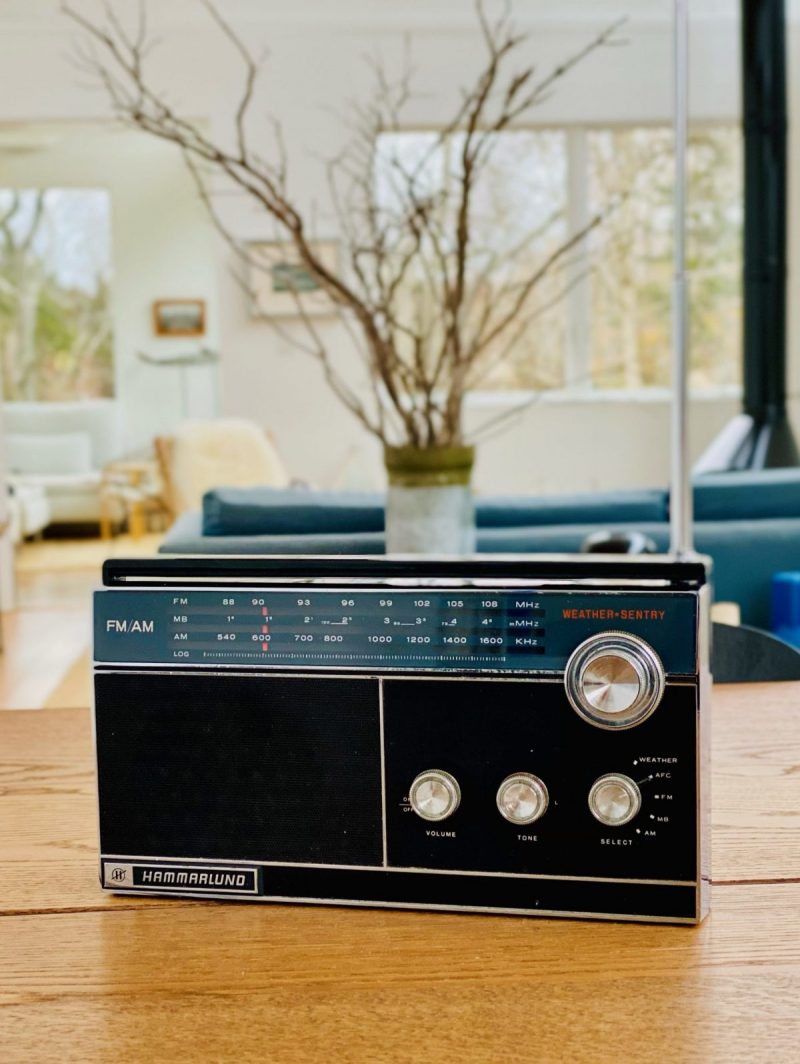
Many thanks to SWLing Post contributor, David Korchin, who needs a little advice regarding his recently restored Hammarlund HR-10:
After doing a heart transplant on my Hammarlund HR-10 Weather Sentry multi band receiver (I found a rough user on eBay and swapped out the chassis into my unspoiled case) the rig is running to spec; MW is very strong with that long bar antenna, the FM+AFC is terrific , and I’ve been sandbagging 75-80 m hams in their AM QSO’s. But the Weather band is fixed reception at 162.550 MHz—that works in New York City but the NOOA stations out here in easternmost Suffolk County NY use different frequencies. I’m wondering if the radio can be adjusted to another frequency? Or the crystal swapped?
Any ideas would be appreciated!
Please comment if you can help David sort out how he might add or modify the HR-10’s weather frequency!
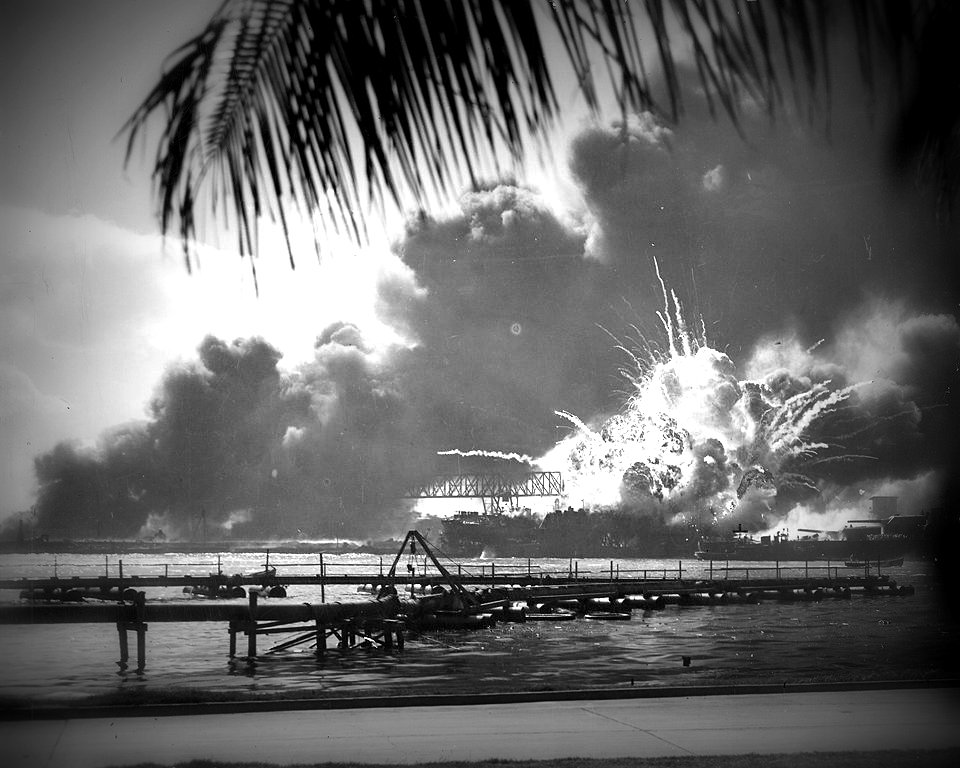
Photograph taken from a Japanese plane during the torpedo attack on ships moored on both sides of Ford Island. View looks about east, with the supply depot, submarine base and fuel tank farm in the right center distance. (Source Wikipedia)
President Franklin Roosevelt called December 7, 1941, “a date which will live in infamy”–the day Japan attacked Pearl Harbor, Hawaii by air. Today (December 7, 2020) is the 79th anniversary.
This morning, I was once again reminded of an off-air recording I made in 2013 of the pirate radio station, Radio Free Whatever. Please enjoy this bit of history from the Post archive:
USS Shaw exploding in Pearl Harbor on December 7, 1941
For your listening pleasure: one hour, seven minutes of the pirate radio station, Radio Free Whatever.
I recorded this broadcast on December 15 2013, starting around 2:40 UTC, on 6,925 kHz AM. This broadcast was a tribute to WWII and Pearl Harbor and contains news clips and music from the same time period. I believe my recording begins about five or so minutes into their broadcast.
If you’re a WWII history buff like I am, you might also appreciate this live news report audio from the Smithsonian channel:
I should add that if you’re interested in military history and, especially, the events leading up to the Pearl Harbor attack, I highly recommend the film, Tora! Tora! Tora! It’s one of my favorite military history films and is simply timeless.
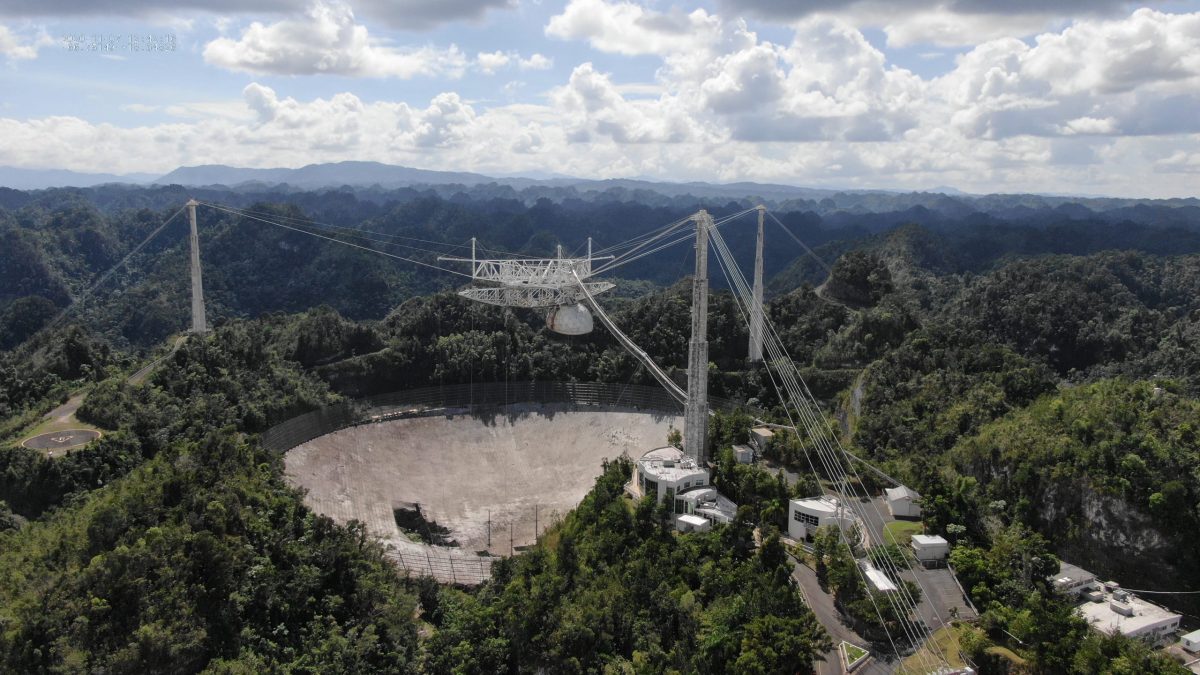
Arecibo Observatory’s 305-meter telescope in November 2020 (Credit: University of Central Florida)
Radio Waves: Stories Making Waves in the World of Radio
Because I keep my ear to the waves, as well as receive many tips from others who do the same, I find myself privy to radio-related stories that might interest SWLing Post readers. To that end: Welcome to the SWLing Post’sRadio Waves, a collection of links to interesting stories making waves in the world of radio. Enjoy!
Many thanks to SWLing Post contributors Ned Wharton, Pete Eaton, Zack Schindler, and Dave Zantow for the following tips:
Today, the National Science Foundation released video taken at the moment the Arecibo Radio Observatory’s cables failed, allowing its massive instrument platform to crash into the dish below. In describing the videos, the NSF also talked a bit about the monitoring program that had put the cameras in place, ideas it had been pursuing for stabilizing the structure pre-collapse, and prospects for building something new at the site.
A quick recap of the collapse: the Arecibo dish was designed to reflect incoming radio radiation to collectors that hung from a massive, 900-ton instrument package that was suspended above it. The suspension system was supported by three reinforced concrete towers that held cables that were anchored farther from the dish, looped over the towers, and then continued on to the platform itself. Failure of these cables eventually led to the platform dropping into the dish below it.
[…]The video of that collapse comes from a monitoring system put in place in the wake of the cable failures. Due to the danger of further cable breaks, the NSF had instituted no-go zones around each of the three towers that supported the cables. With no personnel allowed to get close enough to inspect the cables, the staff started monitoring them using daily drone flights, one of which was in progress during the collapse. In addition, a video camera was installed on top of the visitor’s center, which had a clear view of the instrument platform and one of the support towers.
Lessons of a successful electronic business—an interview with Chas Gilmore, former Heath executive.
For those of you who do not know or remember, Heath Company was the largest kit company in the world. Heath designed and put practically every type of electronic product into kit form. Its products, called Heathkits, were exceptionally popular and many are still in use today.
Over the years, Electronic Design has published many Heathkit-related articles and blogs. Recently, I had a chance to talk with Chas Gilmore, who was a Heath executive. For those of you who fondly remember Heathkit and miss its products, here’s a look back at this amazing company and the lessons it offers.
Chas, what was your affiliation with Heath?
A recent physics graduate, I joined Heath in 1966 as an engineer in the Scientific Instruments department. This was a new group designing laboratory instruments supporting the Malmstadt/Enke, Electronics for Scientists program. The kit business was making great strides.
The audio department was about to introduce the AR-15 FM receiver/amplifier. It had rave reviews, putting Heath in the top tier of the Audio/HiFi market. At the same time, the Ham (amateur radio) department was updating the phenomenally successful SB-line of an HF SSB receiver, transmitter, and transceiver, and modernizing the popular $99 single-band SSB transceiver line[…]
Found this interesting series at Radioworld called “Radio at 100”. It is 29 different articles about the history of broadcasting in the USA. A lot of your readers might enjoy these; https://www.radioworld.com/tag/radio-at-100
Another great series at Radioworld that your readers might be interested in “Roots of Radio”:
Amateur radio licensees and candidates will have to provide the FCC with an email address on applications, effective sometime in mid-2021.
If no email address is included, the FCC may dismiss the application as defective.
The FCC is fully transitioning to electronic correspondence and will no longer print or provide wireless licensees with hard-copy authorizations or registrations by mail.
A Report and Order (R&O) on “Completing the Transition to Electronic Filing, Licenses and Authorizations, and Correspondence in the Wireless Radio Services” in WT Docket 19-212 was adopted on September 16. The new rules will go into effect 6 months after publication in the Federal Register, which hasn’t happened yet, but the FCC is already strongly encouraging applicants to provide an email address.
When an email address is provided, licensees will receive an official electronic copy of their licenses when the application is granted.
Under Section 97.21 of the new rules, a person holding a valid amateur station license “must apply to the FCC for a modification of the license grant as necessary to show the correct mailing and email address, licensee name, club name, license trustee name, or license
custodian name.” For a club or military recreation station license, the application must be presented in document form to a club station call sign administrator who must submit the information to the FCC in an electronic batch file.
Under new Section 97.23, each license will have to show the grantee’s correct name, mailing address, and email address. “The email address must be an address where the grantee can receive electronic correspondence,” the amended rule will state. “Revocation of the station license or suspension of the operator license may result when correspondence from the FCC is returned as undeliverable because the grantee failed to provide the correct email address.”
NNNN
/EX[…]
Radio Waves: Stories Making Waves in the World of Radio
Because I keep my ear to the waves, as well as receive many tips from others who do the same, I find myself privy to radio-related stories that might interest SWLing Post readers. To that end: Welcome to the SWLing Post’sRadio Waves, a collection of links to interesting stories making waves in the world of radio. Enjoy!
Many thanks to SWLing Post contributors Kim Elliott, Benn Kobb, and the Southgate ARC for the following tips:
The voice seeps in as if from another dimension, hissy and distant, like an AM radio broadcaster transmitting through late-night static.
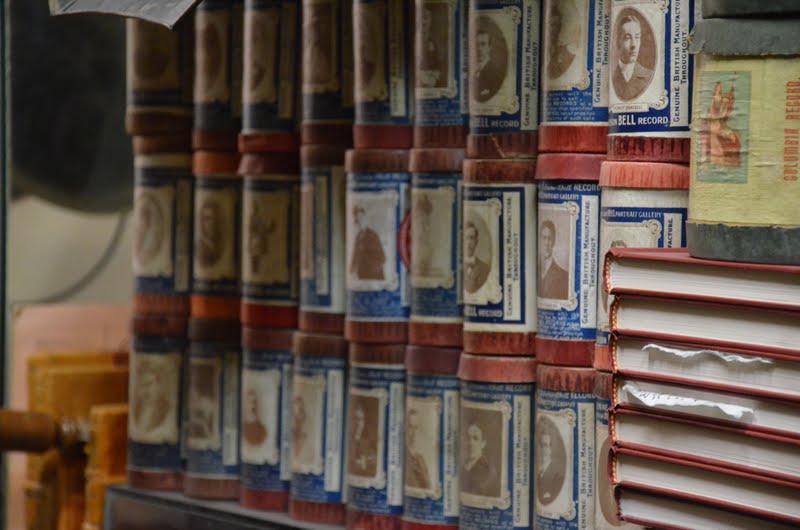
“‘The Ambassador March’ by Brown’s Orche-streee for the Los Angeles Phonograph Company of Los Angeles, California,” a man announces with a gentlemanly accent. After a moment’s scratchy pause, a violinist opens with a melody, and a small orchestra jumps in. Led by a Long Beach-based bandleader named E.R. Brown, the song dances along for two minutes.
The fidelity is primitive by today’s high-definition audio standards, a quaint toss-away. But “The Ambassador March” and the Coke-can-sized wax cylinder upon which it was etched into permanence in the late 1800s open a portal to another era.
That wax cylinder and others like it — rescued from rural estate sales and dusty attics — have survived earthquakes, heat waves, mold and indifference. They feature Mexican folk songs; military band marches; minstrelsy songs of the kind that preceded American blues, folk and country music; and the voices of former Lincoln cabinet members, Southern senators, popes, preachers and comedians. Their survival is emblematic of a revolution that allowed sound to be freed from its origins. Once untethered, the world would be forever changed.[…]
President-elect Joe Biden, who as a senator had a key interest in U.S. international broadcasting, is looking at its future.
He named Richard Stengel, former undersecretary of state for public diplomacy, to head the transition team for the U.S. Agency for Global Media (USAGM). Under USAGM are the Voice of America, Radio Free Europe/Radio Liberty Inc., Radio Free Asia Inc., Office of Cuba Broadcast (Radio/TV Martí to Cuba) and Middle East Broadcasting Networks Inc. (the Arabic-language Alhurra TV and Radio Sawa).
With government officials under President Trump instructed not to cooperate with Biden’s teams, the transition for the time being will have to be done from afar. The Trump-appointed USAGM CEO Michael Pack, whose leadership has fomented several controversies since he was installed in June, might decide to be a benign, if uncooperative, caretaker until the new management comes in. Or he could impose personnel changes and alterations in content that could diminish the credibility of the USAGM entities, a situation that could take years to repair.
During his campaign, Biden promised to fire Pack. Pack might try to serve out the three-year term stipulated in the legislation that replaced the bipartisan Broadcasting Board of Governors (BBG) with a politically appointed CEO (Pack being the first). If such an attempt ends up in court, a June Supreme Court decision overruling the fixed term of the director of the Consumer Finance Protection Bureau, a victory for the Trump administration, could, ironically, be the undoing of any plans by Pack to stay on at USAGM.
Pack has already left his mark by rescinding the firewall “rule” published in June by the outgoing BBG. The rule, however, was not an act of Congress or a presidential directive. It was simply language placed in the Federal Register “to codify and memorialize definitions and practices associated with the firewall.” On such shallow roots, this tree was easy to fall. In October, Pack issued a repeal, which waved away the firewall rule as readily as it was instituted.[…]
On October 21, 2020, DPA Mac LLC filed a FCC license application for a new, DRM-based International Broadcast Station to be located in Maple Park, IL. The principal is San Francisco entrepreneur Seth Kenvin and its technical consultant is Tamir Ostfeld of Raft Technologies, an Israeli developer of low-latency HF systems for so-called algorithmic trading.
No station devoted to algorithmic trading has ever been authorized for regular commercial operation in the U.S., as there is no formal radio service or spectrum allocation for that purpose. Several such stations have been licensed in the Experimental Radio Service (ERS), which is ostensibly for scientific studies only.
If the FCC licenses DPA Mac, it will be the first such station to make the transition from the ERS to regular, non-experimental licensing. This station would be the successor to experimental station WI2XXG. Other than the license document, the FCC has withheld most of WI2XXG’s records from public disclosure since it was first licensed in 2017.
DPA Mac is similar to other DRM stations on which we previously reported: WIPE in Alpine, NJ, which is built and is waiting on its FCC license; and WPBC, proposed for Batavia, IL. With regard to their use for non-broadcast, private data transmissions, those stations made general and non-descriptive representations to the FCC. On the other hand, DPA Mac’s license application is fairly transparent. The station aims to transmit “investment data from points within the United States to locations outside the United States carried over a channel immediately adjacent to the HF broadcasts…a low-power, low-latency digital data transmission service provided to private investors, including small- and medium-sized firms.” [Continue reading…]
Many thanks to SWLing Post contributor, Dan Robinson, for the following guest post:
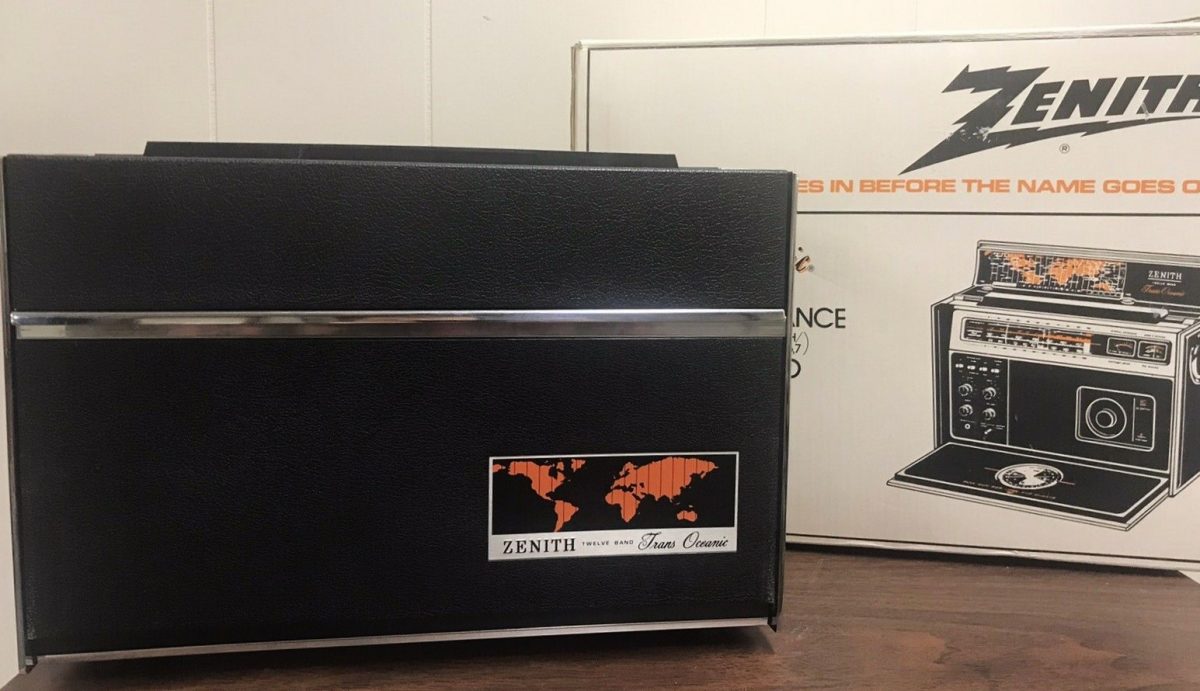
Zenith Trans Oceanics Still Command Big Prices
by Dan Robinson
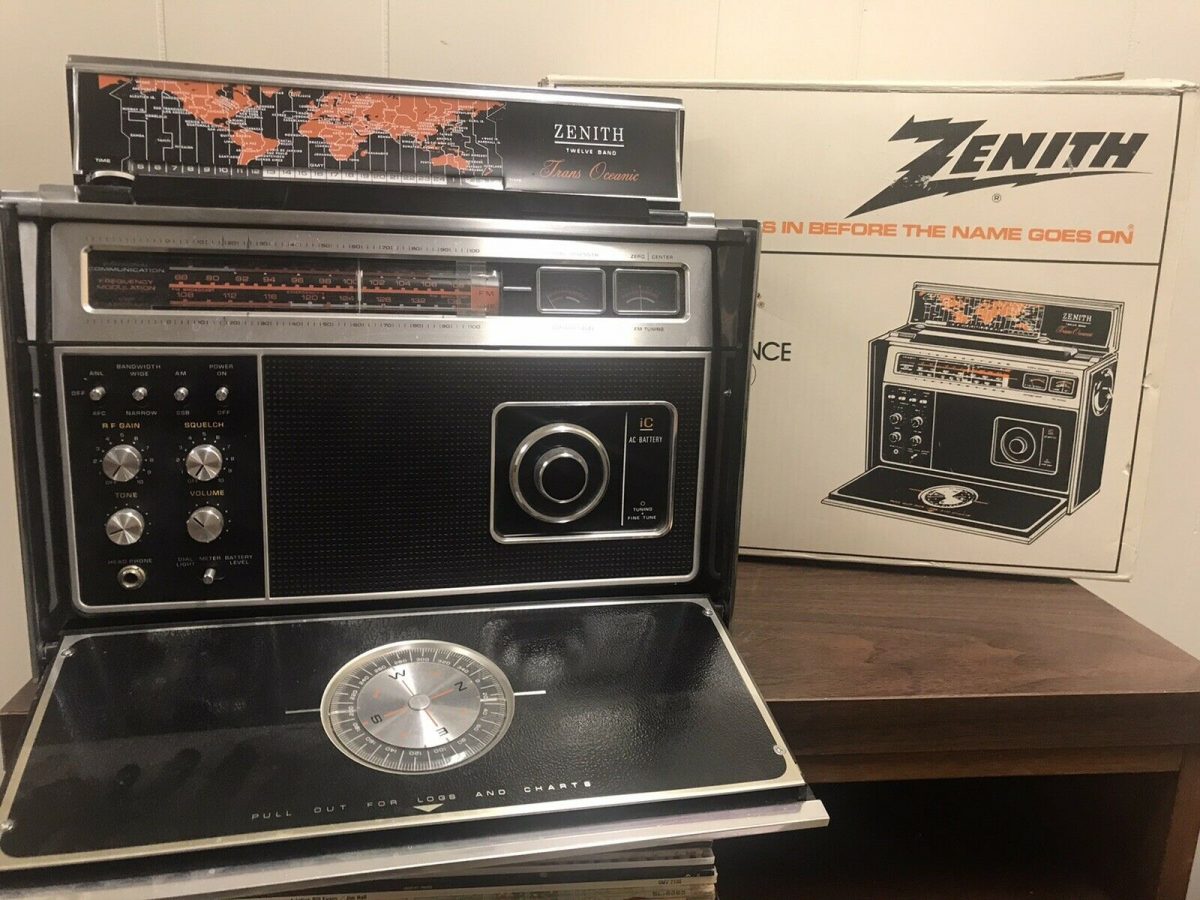
For many radio collectors and users, the Zenith Trans Oceanic R7000-2 is a must-have item in the collection. This was the final version of the Zenith Trans Oceanic line that stretched back for decades — production was shifted to Taiwan and tuning in this radio is accomplished with internal gears, with concentric knobs for main and fine tuning.
The R7000-2 has Longwave, AM, FM and importantly for fans of aircraft listening, the radio
has excellent VHF reception. The huge Zenith TO telescopic aerial is a real eye turner — it is
super tall and compares only to the SONY CRF-1 in length.
Some years ago, the used market saw a few NIB or LNIB Zenith R7000-2 every year or so.
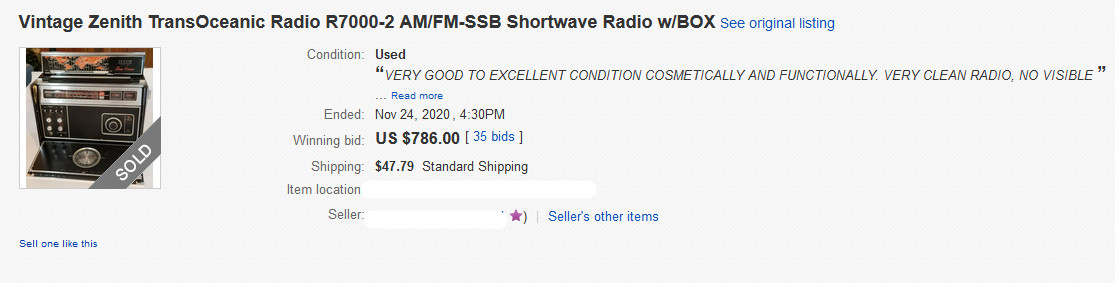
That hasn’t been the case — at least it was not until just recently when a LNIB TO appeared from a California seller.
NIB or LNIB R7000-2 radios could often bring more than $1,000 and sometimes much higher —
even as high as $1500!
That did not stop bidding on this-2 R7000-2 from topping the $700 mark and reaching nearly
$800 in this auction.
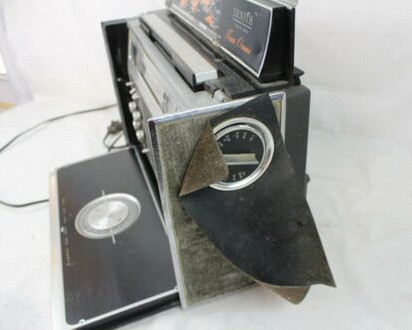
This does not mean, however, that every R7000-2 will be out of reach but other R7000-2 radios on eBay at this time suffer from cosmetic issues of one kind or another (see photos) such as detached side vinyl and missing antennas.
Amazingly, as this is being written there is yet another R7000-2 on eBay, complete with original
box and papers, and the original purchase receipt. This one could well hit the $1,000 mark.
If you’re hunting for an excellent late production Zenith TO, this may very well be the time
to pull the trigger — but for one in 9.9 to 10.0 NIB condition you will pay a price!

 Many thanks to SWLing Post contributor, David Korchin, who needs a little advice regarding his recently restored Hammarlund HR-10: