Shortwave listening and everything radio including reviews, broadcasting, ham radio, field operation, DXing, maker kits, travel, emergency gear, events, and more
Shortwave Radio Audio Archive contributor, Tom Gavaras, shares some of the most amazing off-air, studio, and personal recordings our archive.
Recently, he submitted a very unique recording. Tom notes:
Rudy Espinal of Radio Clarin (Dominican Republic) keynote speech at 1979 Association of North American Radio Clubs (ANARC) convention held in Minneapolis, Minnesota. Convention took place in June 1979.
In this recording, you’ll hear a number of familiar names (including an early shout-out to our friend Kim Elliott).
I was in elementary school at the time of this convention, so it’s amazing bit of audio time travel for me.
Do you recognize any names in this recording? Do you remember Radio Clarin? Did you attend the 1979 ANARC Convention? Inquiring minds want to know! Please comment!
Many thanks to SWLing Post contributor Pete Polanyk, who shares the following story that all started with a recording he submitted to the Shortwave Radio Audio Archive:
Remember I sent you that clip of Radio Canada (that went up on the Shortwave Radio Audio Archive) that was on the other side of a punk tape? Well I digitised and sold it on eBay. The tape featured a live gig of the band ATV (Mark Perry was the lead singer and main ideas person). A few days later I received an email from the buyer–a nice chap called Phillipe in France–who’s a big ATV fan.
“Just listened to the ATV one… I wonder, have you the faintest idea what the B-side is? It sounds like radio recordings, but on repeated listening sounds like some kind of noisy pieces or experimentation, which reminds me of similar ‘shortwave’ experiments done by ATV at the time of the second album. Do you know if this was somehow linked to the band?”
I replied saying it was a recording by me off the shortwave from the early 1980’s sadly, not the band, he wrote back:
“So, I guess playing with shortwave must have been something in the air back then?! The funny thing is that there is a very similar track from a ‘lost ATV album’ entitled The End Of Flight 182 from late ‘78.
It’s actually more Dave George (later of The Good Missionaries) than ATV but still Mark Perry contributed a bit to the recordings; and one of its tracks was released somewhere else as ATV. Anyway… the album features a ‘Shortwave’ track (entitled as such) by Dave George, and I’ve have included it here (I’ve attached the track he sent us.) Can you hear how it sounds similar to yours? The track/experimentation may also been what led ATV to write ‘The Radio Story’, but that’s just a personal assumption. Mark and George were definitely in touch back in those days since Mark contributed a bit to his album which was was recorded a few months before Dave joined ATV (which then soon became The Good Missionaries). Sadly Dave George passed a few years ago, so we won’t know much more about the album and the track.”
I wrote back and told him that I will probably send it to you as you’ll be well interested in the story. This is his last reply:
“Yeah, it could be nice and interesting Thomas’ mentions it on his site. To avoid any confusion here’re a few more details: the ‘Shortwave’ track is only Dave George, and was recorded a few months before Dave joined ATV (which then soon became The Good Missionaries), so technically it’s not ATV. But he was definitely in touch with Mark Perry back in those days since Mark contributed a bit to the album as I said; hence Thomas could also publish a youtube link to The Radio Story as well. Sadly Dave George passed a few years ago, so we won’t know much more about the album and the track.”
So that was the story! What a mad coincidence eh?
A mad coincidence indeed! Thank you for sharing the story, Pete. I love where art and shortwave meet and especially in moments of serendipity like this! Now to explore more Dave and ATV…
This autumn, I’ve received a number of emails from new readers who’ve dusted off the radio in their closet and decided to get back into shortwave radio listening and/or ham radio.
I can’t recall another time I’ve gotten so many similar messages and I can only attribute it to the fact so many people across the globe are still having to social distance due to the C-19 pandemic.
There’s.a common theme in the messages I’ve been receiving from readers. Here’s an excerpt from the latest message (note that I removed the model name from this question because, frankly, it’s irrelevant):
“[My radio] seems to be in great working order. It’s been stored in a climate controlled environment and besides needing a little DeOxit on some of the pots, it works like new. I couldn’t be happier! My question to you is, this model is from the 1990s when I used to be hot and heavy into radio. I know technology has advanced by leaps and bounds since then, so as I get back into radio maybe I should invest in a newer model? What do you think or suggest?”
It’s true that radio technology has gone through a massive number of innovations since the 1990s. We’ve seen the advent of Software Defined Radios and portable receivers/transceivers sporting DSP technology. Far be it from me to dissuade anyone from acquiring new gear!
With that said, I also believe that the best radio you have is the one in front of you. Period.
Listening is a skill
You can’t buy it. Whether you’re an SWL or ham radio operator, most of the time you’re on the air, you’re listening. And the best filter you have is the one in your head. I’ll quote from an article I posted many moons ago:
My good friend Vlado (N3CZ) is a case in point: he is one of the most capable ham radio DXers I know. His extraordinary ability to pull intelligible conversations and CW (Morse code) out of the static, even in crowded radio conditions, is simply astounding. Vlado’s main transceiver is nearly two decades old, and by no means a benchmark technically. If you ask Vlad if he uses filters and digital signal processing, he will wisely tell you, in his Macedonian accent: “Your best filter is between your ears.”
The same goes for SWLing. I have spent enough time listening to shortwave and weak DX that I can now pull conversations out of the noise that my (non-radio) friends can barely detect. I’m convinced this is healthy exercise for the old grey matter.
A seasoned radio enthusiast can grab any radio and make the most of it.
Imagine what Joe Walsh could do with a toy guitar…
Do you think the guitar makes him one of the greatest guitarists of all time?
Many of the advances in technology over the past two or three decades has, of course, given us better tools for working weak signals. But more importantly, it’s brought down the price of performance. I can invest $200 in an SDR that will perform as well as or better than multi thousand dollar benchmark receivers from the 1990s. So yes, in terms of equipment, it’s a brilliant time to be an SWL or ham radio operator.
But at the end of the day, your skills are more important your gear.
Radio Waves: Stories Making Waves in the World of Radio
Because I keep my ear to the waves, as well as receive many tips from others who do the same, I find myself privy to radio-related stories that might interest SWLing Post readers. To that end: Welcome to the SWLing Post’sRadio Waves, a collection of links to interesting stories making waves in the world of radio. Enjoy!
Many thanks to SWLing Post contributors Dennis Dura, Dan Robinson, Datta Deogaonkar, and the Southgate ARC for the following tips:
Four industry veterans weigh in on how they’d “fix” a medium that remains popular but lacks innovation
The first broadcast from a commercial radio station took place on November 2nd, 1920. Here’s how I imagine listeners responded to the debut of KDKA-AM in Pittsburgh:
Nov. 2: This is amazing! I can hear someone from hundreds of miles away talking through this device! The world will never be the same!
Nov. 3: They’re playing “Wang Wang Blues” again already?
The joke here is twofold: First, there’s a popular song called “Wang Wang Blues” from 1920. And second, by day two, KDKA had already developed the repetitive play-the-hits format that would become one of its hallmarks for the following century.
The first commercial broadcast actually related to the election — it was the idea of a radio manufacturer, Westinghouse, to offer up programming to go along with their newfangled tech (a century later, Apple and Sonos thought exactly the same thing). The first commercial broadcast featured updated results of the Harding-Cox presidential race “before [people] read about it in the newspaper,” as this PBS retrospective notes.
One hundred years later, commercial radio still holds a place in American daily life. The average American still listens to about 106 minutes of radio per day (with the coronavirus and its attendant lockdowns projected to increase that number), and there are more than 15,000 stations in this country alone.
We’re certainly listening to radio differently: according to Statista, 57% of Americans do so online, whether by streaming, downloads, satellite or digital radio. If you asked me how I listen to radio, I’d offer up services like Apple Music 1, Sonos Radio and Dash Radio; podcast downloads from ESPN Radio; online streaming of overseas entities like BBC 1 and Triple J or any occasional college station like WSOU; NPR stations for news and commentary (and music if it’s KCRW); and for new music, a DJ-free experience via Spotify’s New Release Radar playlist. In other words, while audio-only, passive-listening medium has survived and thrived for a century, which is astounding and worthy of celebration, the need for traditional, turn-the-dial “commercial” radio is decidedly on the wane.[…]
Special event station commemorating Aacharya Jagadish Chandra Bose
Sir, I want to mention with great pride that I am (VU2DSI) celebrating the birthdate 30 November of Aacharya Jagadish Chandra Bose- every year with a special callsign- AU2JCB for the last 15 years. He is well known as the “Father of Wireless Communication” in the world of science.
AU2JCB will operate from 20 Nov 2020 to 15 DEC 2020.
The Details of operation
Period: 20 NOV 2020 to 15 DEC 2020
Frequencies: 10 M– 28545, 28510,28490. 21 M—21235, 21310, 21350. 20M—14210, 14250, 14310. 40 M—7040, 7150. 80 M — 3710. IN FM MODE—– 6M –50800, 51500. 10 M—29700.
QSL— Direct to VU2DSI, “SURABHI” MEHERABAD. AHMEDNAGAR.414006. INDIA.
This year VU2EVU & VU2XPN will operate with AU3JCB & VU5JCB call-signs respectively.
From Kolkatta, VU3ZHA & VU3MZE will operate with AT2JCB & AU8JCB call-signs respectively. Ten more stations will operate from Kolkatta with JCB in the prefix.
On November 13, 2000, the ISS Expedition-1 crew turned on the ARISS Ericsson radio for the first time and completed several contacts with ARISS ground stations around the world to validate the radio communications system
These inaugural contacts launched an incredible two-decade operations journey on ISS, enabling ARISS to inspire, engage and educate our next generation of explorers and provide the ham radio community a platform for lifelong learning and experimentation.
In celebration of the ISS 20th anniversary, ARISS was part of an ISS Research and Development Conference Panel session entitled “20 years of STEM Experiments on the ISS.” The video below, developed for this panel session, describes our program, celebrates our 20th anniversary, conveys some key lessons learned over the past 20 years and describes the ARISS team’s vision for the future. Enjoy watching!
20 years of continuous operations is a phenomenal accomplishment. But what makes it even more extraordinary is that ARISS has achieved this through hundreds of volunteers that are passionate in “paying it forward” to our youth and ham radio community. On behalf of the ARISS International team, I would like to express our heartfelt thanks to every volunteer that has made ARISS such an amazing success over the past 20 years. Your passion, drive, creativity and spirit made it happen!!
Many thanks to SWLing Post contributor, Edward Ganshirt, who shares the following guest post:
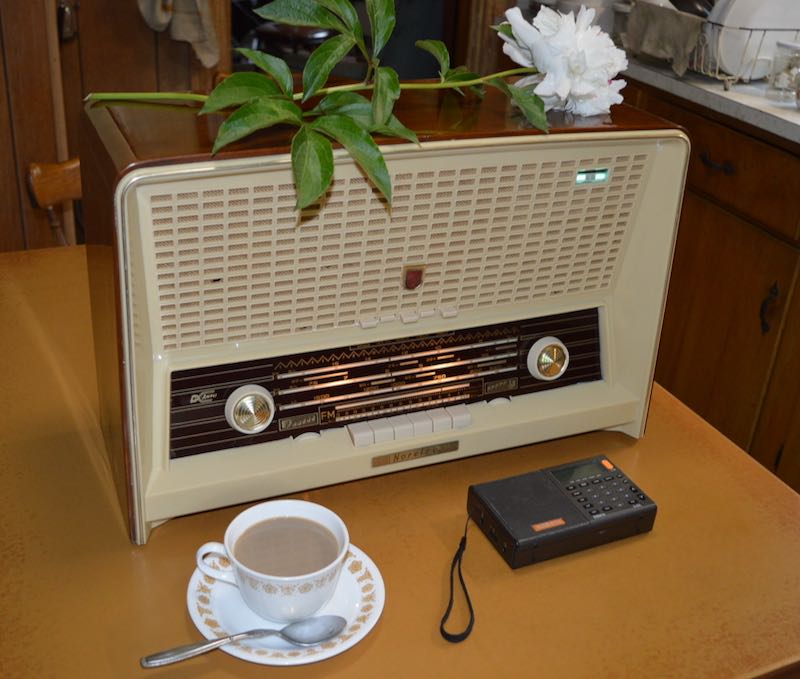
Pamela’s radio
A neighbor gave me this radio. It had a story.
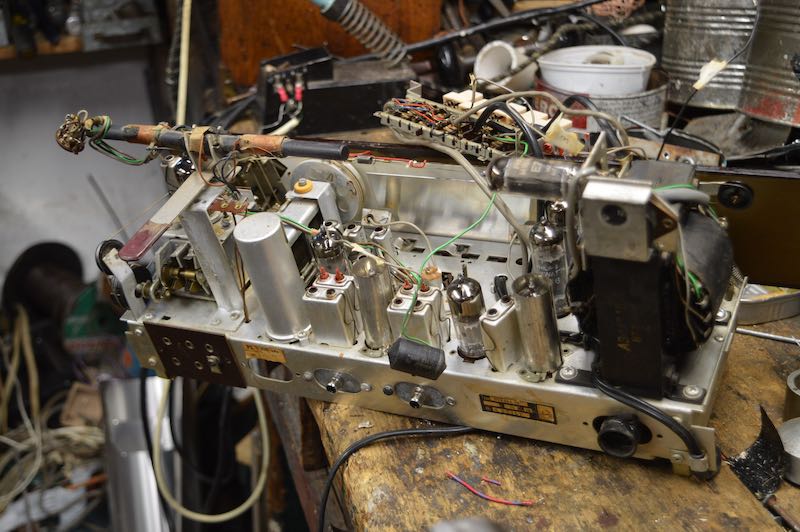
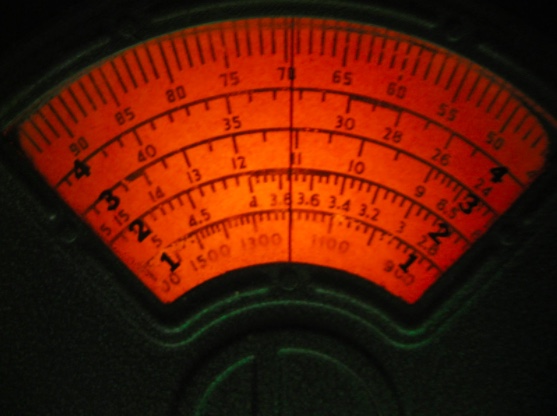
It is a Norelco B5X-88A/03 Table radio AM FM SW1 SW2. (You can see it takes up the whole kitchen table…that is why it is called a table radio). Has very good sound.
The speakers are 600 ohms, not 8 ohms, and uses bypass capacitors instead of an audio transformer.
Now about the carnation: I think my neighbor had thoughts that I may be giving it a Funeral and interring it in the backyard. (It has a nice finish you usually see on caskets)
Her Father was a Doctor who had his practice in the house and had this radio always playing low volume in the waiting room. He served in WW2 and brought this back in the late 1940’e. She inherited it and had it serviced a few times by a local repairman who since passed. Taking it apart I noticed several mechanical problems after removing an abandoned yellow jacket’’ nest.
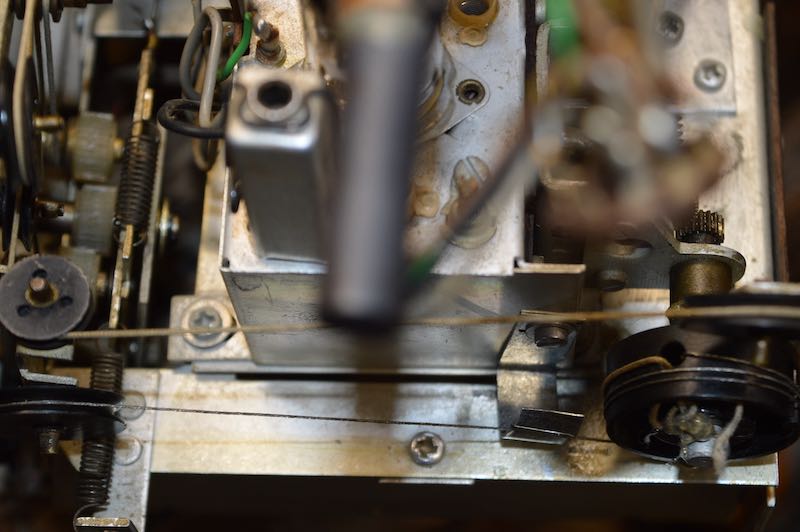
The FM dial string was wound wrong so 88 MHz is where 108 MHz should be and vice versa. I restrung the dial properly but when tuned the string flopped off the pulley, so I fabricated a string restrainer to prevent this.
Also the station selector was scratchy and intermittent. To solve this, I played the garden hose with a forceful stream of water on the switches then dried out the chassis in the hot summer sun. Sprayed volume control restorer on all the switch contacts. After that, it worked perfectly. The remaining issue was the walnut veneer I sanded with 400 grit paper then coated with clear Krylon .
Now what to do with it!
Well I used her same sweet talk charm she used on me to take it off her hands to take it back, this time fully functional and I even demo-ed it. It had the wonderful mellow sound that she remembered and was so pleased.
What a true gentleman you are, Ed! Thank you for sharing the story of this Norelco table radio–what a gorgeous machine! I’m so pleased you were able to surprise Pamela with her father’s radio, fully restored!
Many thanks to SWLing Post contributor, Kris Partridge, who writes:
Last night I sent the link to the SWLing Droitwch item to a former colleague. He replied this morning, reply below, and includes a couple of useful links. I’m very sure the SWLing Post knows about MB21.
Thinking that maybe the item on Crowbourgh will be of interest to SWLing readers. It contains the ‘magic’ word “Aspidistra” ! Lot of SW history there.

 Shortwave Radio Audio Archive contributor, Tom Gavaras, shares some of the most amazing off-air, studio, and personal recordings our archive.
 Recently, he submitted a very unique recording. Tom notes: