Category Archives: Radio History

2019 Marks the 100th Anniversary of Radio in the Netherlands

Former RNW headquarters in Hilversum, Netherlands (photo coutesty: RNW)

Many thanks to SWLing Post contributor, Bill (WD9EQD), who shares the following:

Hi Thomas,

You probably already know this, but 2019 is the 100 anniversary of radio in the Netherlands

Jonathan Marks of the Media Networks programs has a nice article about some of the history of radio Netherlands:

View at Medium.com

Click here to view.

There’s also the Media Networks Vault where you can listen to many of the original Media Networks programs:

https://jonathanmarks.libsyn.com/

For real Radio Netherland Fans, from the archives, there is an eight part audio series on the 50th anniversary:

Click here to read.

The Internet Archive is probably an easier place to down load the eight part series [we’ve also embedded each audio file below]:

Part 1:

Part 2:

Part 3:

Part 4:

Part 5:

Part 6:

Part 7:

Part 8:

Click here to listen via the Internet Archive.

Fascinating Listening.

Thanks so much for sharing this, Bill! Indeed-these are some amazing resources to explore the rich history of radio in the Netherlands!


Ultra-Rare Tristan da Cunha QSL: The Art of the Hunter-Killer QSL Pursuit

The remote South Atlantic island of Tristan Da Cunha (Image via Google Earth)

Many thanks to SWLing Post contributor, Dan Robinson, who shares the following guest post:


Ultra-Rare Tristan da Cunha QSL: The Art of the Hunter-Killer QSL Pursuit

by Dan Robinson

Those in the QSL collecting community are likely to have noticed the recent appearance on Ebay of one of the rarest QSL cards in existence.

The QSL from Tristan da Cunha showed up around March 19th with a six day auction window, by a seller in France who also listed a number of other older QSLs.

For a description, the seller wrote: “QSL card from radio station ZOE the broadcasting service of Tristan da Cunha 1973. A very rare and sought after QSL. Seldom seen on Ebay. . .”

Understatement to be sure. Along with QSL letters directly from Biafra, the breakaway state in Nigeria many decades ago, QSLs from Tristan da Cunha are pretty much NEVER seen.

ZOE Tristan was a station intensively sought by thousands of DX’ers when it occupied the 90 meter frequency of 3,290 kHz with a power of only 40 watts.

Only a handful of DX’ers ever heard and QSL’ed Tristan.  In this story still accessible online–three persons from South Africa are described as having received QSLs, along with two others, in the UK and in Florida, USA.

As a young DX’er, I remember reading the entry in the WRTH and the feeling of frustration with the reality that it was impossible to hear with my receivers, largely due to its limited broadcast time and hour of transmission which I recall was 2000 UTC.

eBay bid history

As the hours ticked away in the auction, the number of bids increased. The ending time fell in overnight hours EDT. This increased chances of obtaining the card for a lower price, though bidders in other parts of the world would surely be stationed at their PCs and on their phones in the final hours of the auction.

I have been one of the most active QSL hunters in the world, and there are specific strategies involved in competing for QSLs.

For purposes of this article, I’ll just note that these involve constant attention, especially toward the end. As an auction nears conclusion, it’s important to “test” the bid level to assess the likelihood of the item selling at that or a much higher price.

Some cards or verification letters have the potential to bring hundreds of dollars. I assessed that this Tristan card could bring as much as $500-$1,000 depending on whether someone had “gone high” with an automatic “knock out” bid using either the Ebay system or other auto-bidding site.

As you can see in the image, from a starting price of $4.00 on March 19th the Tristan card had reached only $50.00 several days later on March 23rd.  The $100 mark was reached on March 26th.  One bidder retracted his $150 bid at one point.

On the final day March 26th, it was anyone’s guess how high the Tristan card could go.  The card only inched up in small bid increments, surprising given its rarity.

If one assumed that any of the four bidders involved placed a “knock-out” auto-bid, and if two had placed such a bid, in the final seconds the Tristan QSL could quickly shoot up from the $142.50 level to whatever the extremely high maximums would be.

Due to the rarity of the card, my bid fell in the “knock out” category.  I went to sleep reasonably confident, but concerned the competition could drive the price of the card through the roof.

When I awoke the next day, I was relieved — the Tristan card, complete with its original postage stamp, rubber stamp mark, and signature by the station, was mine.  The price:  an astoundingly low $145.

Such is the excitement involved in being a “hunter-killer” QSL card collector. As I noted in SWLing Post last year, I now own three of the world’s rarest QSLs.

These include possibly the last remaining QSL letters sent directly from Radio Biafra, a QSL from Portuguese Macao, and now this wonderful ZOE Tristan da Cunha card.

That is–actually two ZOE QSLs.  About a decade ago, while scanning Ebay listings for QSLs, I was astounded to see a ZOE card listed as part of a group of amateur radio QSLs being offered by a seller in Europe.

I couldn’t believe what I was seeing. Until that point I had seen not a single ZOE QSL appear since the Ebay market for QSLs began to heat up in the late 1990s

(Source: SWL Card Museum)

This particular card, which you can see posted at the excellent “SWL Card Museum” site has “ZOE” printed in large letters, like the card that I recently won, a date of reception as “June 1, 1977” but no signature.

The card did arrive with the original envelope in which it was sent to a European DX’er, complete with a postage stamp and postal mark for Tristan.

Why that particular ZOE card was not signed by someone at the station, and why it was placed in an envelope rather than post marked on the card itself, remains a mystery.

Back to the story noted above, about the group of South African DX’ers who were among the few worldwide to have heard Tristan da Cunha.

In that article, the author notes that two other DX’ers, one in the U.S., one in Europe, had received QSLs from Tristan.

With a bit of online sleuthing, and help from some fellow DX’ers, I was able to determine that one of those two, Dave Sharp, is indeed still with us.

In response to an email inquiry, Dave provided the following history:

“I forget when exactly I heard the station, but it was 1984 or just prior, as I was still in high school. I was in Florida at the time and was using a rotatable three element beam ham antenna. [I] heard threshold talk from a woman with a deep voice and this apparently matched to voice of the Radio Tristan announcer at the time.

[I] received a reply from Pat Patterson, the Tristan postmaster and a Ham radio operator himself. Since my reception report was tentative, I felt a QSL wouldn’t have been issued if they hadn’t been reasonably confident of reception.

I received a personal letter, stamp bulletin, and a small QSL, bright green on white background, with “ZOE” across the front.

Long story, but many of my personal belongings were lost over the years and this includes my entire QSL collection (which had been left in possession of my sister).

Needless to say, I received a fair bit of ridicule after coming forward with the QSL. To emphasize, my report was tentative and they decided to issue a reply.”

It remains to be seen if other ZOE/Tristan da Cunha QSLs will surface in the future, and of course it is unknown how many of the cards that were sent out to the few DX’ers who heard, or claim to have heard, the station, still exist.


Wow! Thank you for shedding light on the history of ZOE Tristan Da Cunha QSLs. At those meager power levels, from such a remote location, and during that broadcast window, I can see why ZOE must be one of the rarest of QSL cards. I’m happy to know you obtained the card, too, Dan as you have such a long history of properly archiving and sharing your cards. As you just did.  Thank you!
Hear My Voice: Radio’s role in Hitler’s annexation of the Sudetenland

In January, when I first heard about David Vaughan’s book Hear My Voice, I knew then and there I would have to read it. So I picked up a copy on Amazon with the intention of doing so…well, soon.

However, I’ve got quite a number of books in my to-be-read stack at the moment, so Hear My Voice lay in wait on my bookshelf until this past Sunday, when I decided to read the first chapter––just to get a taste of it.

Although I had a very busy day in store––working on a home renovation and making several trips into town––nevertheless I struggled to pull it from the stack, and having rapidly consumed the first chapters, had a hard time putting the book down. By the day’s end, I found I had read the entire book.

While those who know me know I’m a bit of a WWII history buff, I only knew that Hitler’s seizure of the Czech Sudetenland was but a hint of what was to come. The history I’d read previously had provided a bit of insight into this crucial lead-up to the war, but not as Vaughan’s book does: in what feels like a first hand account, through the eyes of an interpreter and broadcaster. I was hooked.

Hear My Voice clearly indicates how transformative the medium of radio was in this era, and how deliberate and insidious Nazi propaganda became in the Sudetenland years before Czechoslovakia ever took notice.

All in all, it’s a great read. I think you’ll find Hear My Voice as intriguing as I did.

You can purchase Hear My Voice via:

Read our previous post which includes a Radio Prague audio interview with the author.

Website devoted to the history of WOWO

Photo source: historyofwowo.com

Many thanks to SWLing Post contributor, Dave Snyder, who shares the following in reply to our previous post about a chunk of the WOWO fire escape in lucite:

Thomas,

Have you ever visited “www.historyofwowo.com“–?

This site was put together by Randy Meyer and has hundreds of photos from 95+ years of broadcasting. Many pictures are from me as I worked there from 1969 to 1982. The link below is to the promotional items page where there is another picture of the “World Famous WOWO Fire Escape” chunk of steel cast in lucite.

These were made in 1978 after the station moved from the Gaskins Building to the Central Building. (By the way, the Central building is no longer there.)

The Gaskins Building was a dismal place with no windows. The air and news people had to open the door to the fire escape to see if was sunny or raining. That is why the local temperature was from the World Famous Fire Escape. My piece of fire escape is in a box in the basement.

http://www.historyofwowo.com/the_rest.html

Many thanks for sharing this, Dave! WOWO is such an iconic AM station with such a deep history–I’m grateful all of these photos and history are being archived and shared online.

Click here to view HistoryofWOWO.com.

Voice of America Museum director to present history of Bethany transmitting station

(Source: Cincinnati.com)

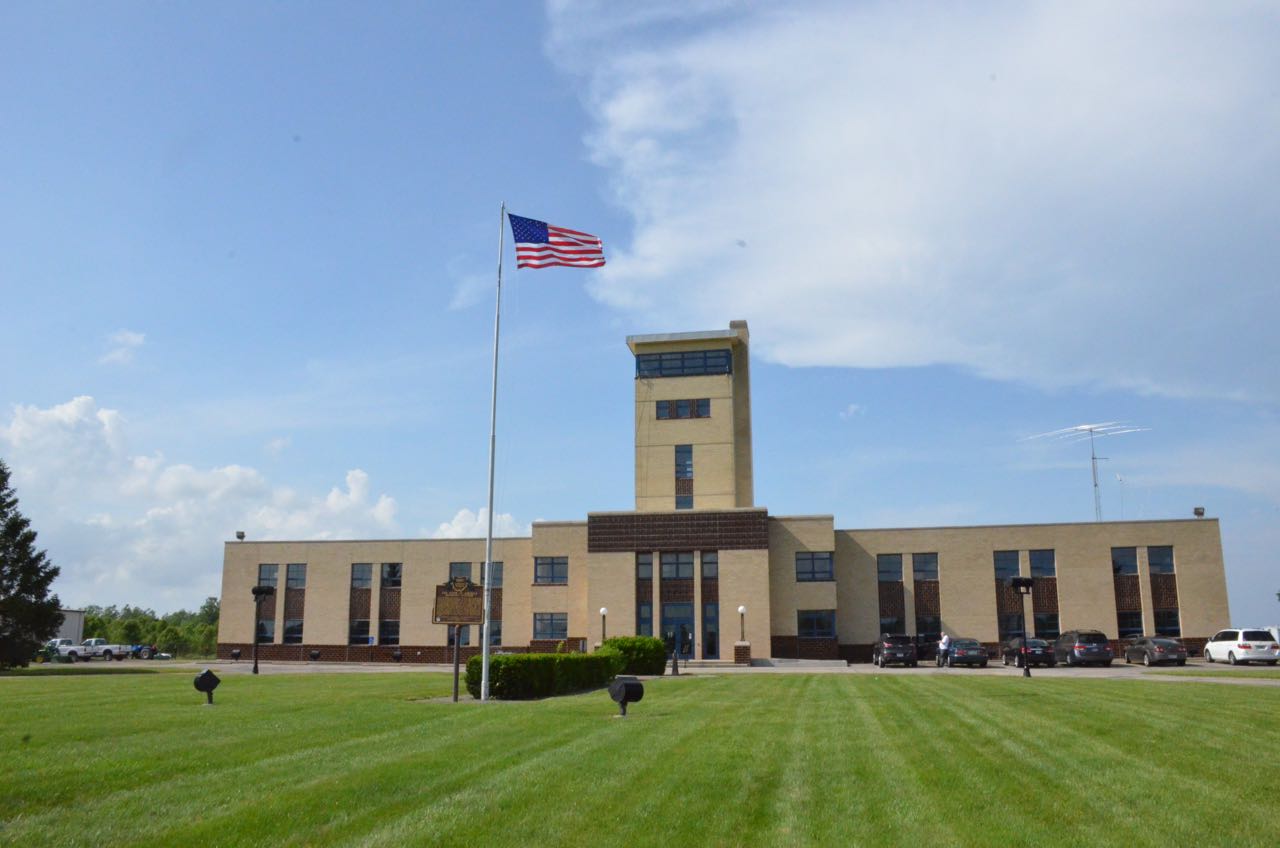
If you’ve ever wondered why the VOA-Bethany Station needed a secured, square mile of land surrounding its 1944 art deco building in West Chester, Jack Dominic has the answer.

Dominic, the National Voice of America Museum of Broadcasting director, will speak on the “History of the VOA-Bethany Station and the VOA Museum Today” Wednesday, April 3, from 7 to 8:30 p.m. at the MidPointe Library in West Chester’s community room.

The free event is the second of a four-part series, “The Voice of Truth in America: Celebrating 75 Years of the VOA Bethany Station,” with the MidPointe Library System.

The VOA museum hosts other free events this year to commemorate the 75th anniversary of the VOA-Bethany Station, which now houses the Cold War-era history and broadcasting museum.

“From World War II through the Cold War, the VOA-Bethany Station played a vastly important role in transmitting real news via shortwave radio to people living in countries that lacked a free press,” said Ken Rieser, VOA museum board president. “And it all started here in Cincinnati, with two brothers who developed the technology that evolved into the commercial radio industry.”[…]

The VOA museum will host its fourth annual “75 Years of Rockin’ the Radio” fundraiser Saturday, Sept. 21, with dinner and dancing. Sponsorships are now available.

Museum hours are 1 to 4 p.m. Saturdays and Sundays at 8070 Tylersville Road. Admission is $5 for adults and $1 for children.

For a complete schedule of 2019 VOA museum events, “The Voice of Truth in America,” series and WCARA events, visit www.voamuseum.org, www.midpointelibrary.org and www.wc8VOA.org.

Read the full new release at Cincinnati.com.

WWII Machine Shop Supervision film includes the Hammarlund Super Pro

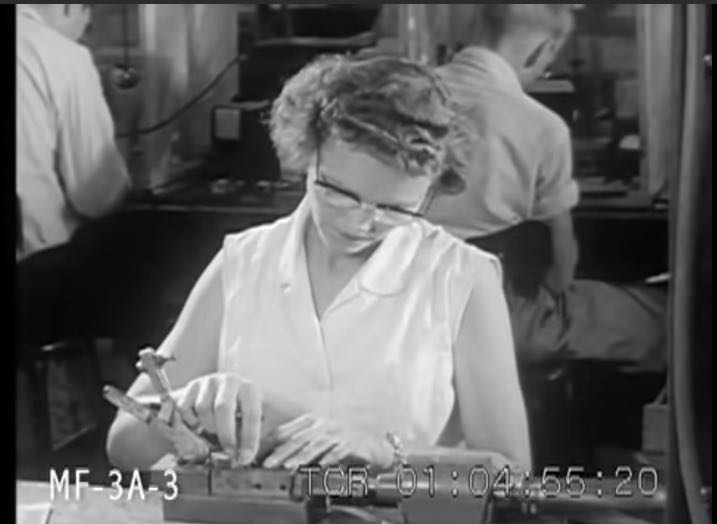
Many thanks to SWLing Post contributor, Colin Snow (KM6NTW), who notes that the following 1944 film “Maintaining Workers’ Interest” from the US Office of Education, features the Hammarlund Super Pro.

The video starts at the point in the film where the Super Pro is featured. To view the film from the beginning, click here.

https://vimeo.com/399908150

Click here to view on YouTube.

Guest Post: Indian DXer enters into Limca Book of Records

Many thanks to SWLing Post contributor, Sandipan Basu Mallick (VU3JXD), for sharing the following guest post:


Indian DXer enters into Limca Book of Records

Jose Jacob from Hyderabad, India has collected QSL from 132 different stations of All India Radio over a period of 42 years. Radio stations ranging from Shot wave, Medium wave, FM to the latest DRM mode. In the process he has achieved the feat of creating an Indian Record of collecting maximum number of QSL of different stations of a radio broadcaster in India.

As a teenager Jose started listening to radio and started to write to stations way back in 1973, when in his school days. Few years later in 1976 he first wrote to All India Radio, when his reception report was first verified with a QSL. Over next 42 years, he has used various mediums, ranging from inland letters, post cards to emails, for sending reception reporting. Currently he has over 2500 QSL from 130 different countries, many of which left the airwaves.

Over the years, with his special interest in All India Radio, he is one of key country contributors, from India, of World Radio TV Handbook updating about All India Radio to the directory of global broadcasting.

Jose Jacob, is also a licensed amateur radio operator with call sign VU2JOS currently serving as Asst. Director at the National Institute of Amateur Radio (NIAR) www.niar.org

Jose Jacob (VU2JOS) with Certificate from Limca Book of Records

Limca Book of Records is an annual reference book published in India documenting human and natural world records. The world records achieved by humans are further categorised in education, literature, agriculture, medical science, business, sports, nature, adventure, radio, and cinema with Limca book of Records rules. (https://www.coca-colaindia.com/limca-book-of-records)

Limca Book of Records has recognized the feat as one of the Indian records in the radio category and awarded the certificate acknowledging the achievement.

QSL received in 1997 from All India Radio, Nagpur

QSL received in 1988 from All India Radio, Nagpur

QSL received in 1987 from All India Radio, Nagpur


Congratulations to Jose Jacob VU2JOS for an amazing accomplishment!  Thank you for sharing this news, Sandipan!