Category Archives: Schedules and Frequencies

Sean’s A15 Season International Broadcasting Statistics

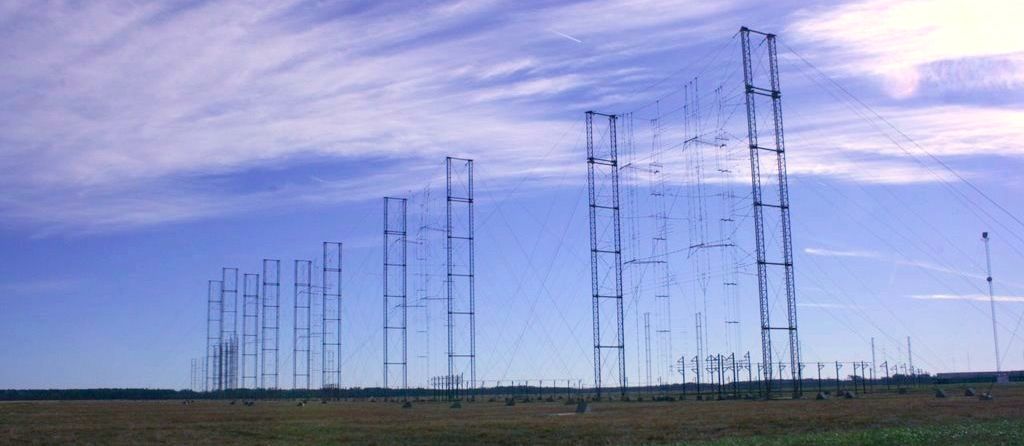
VOA-Greenville-Curtain-Antennas

Many thanks to Sean Gilbert, International Editor at the World Radio TV Handbook, who is kindly sharing some international broadcasting statistics with us again. These statistics were originally posted on the WRTH Facebook group:

Seasonal Language Output Comparison

[F]or the top 19 languages used in international (and Domestic SW) broadcasting. There are 10 seasons worth of data to compare. In those 10 seasons, we have seen an overall drop of 33%, the biggest casualties being Farsi, German, Portuguese, Spanish, Russian, English & Indonesian. Tibetan is usually fairly stable with it’s output being pretty constant over the past 9 seasons – this season, however sees a huge increase in output (+69%), mainly due to the USA hiking output of the language this season. In sheer numbers of data lines (which is how this table has always been generated), English is the biggest casualty, dropping 104 transmission periods per week.
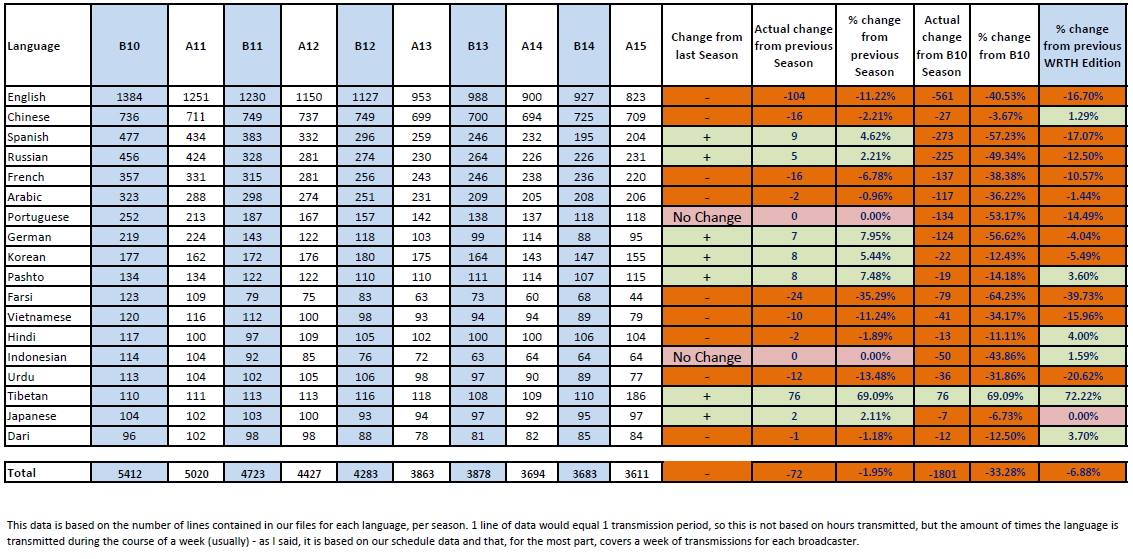
Click to enlarge.

Click to enlarge.

A transmission period is based on the following data structure:
Shown below are 2 “transmission periods” for WWCR and 1 for WWRB. 2 in English and 1 in Spanish. These transmission periods cover a weeks worth of output on that frequency at that time for that broadcaster.

WWCR 1630-2100 English wcr 100 NAm,Eu,NAf daily 15825
WWCR 2100-2200 Spanish wcr 100 NAm,Eu,NAf daily 15825
WWRB 0100-0400 English wrb 100 NAm daily 3195

So a transmission period could, in reality, be from 5 minutes on a single day to 24 hours, daily, depending on the broadcaster. There are nearly 5000 of these entries in our database for this season (When I started at WRTH back in 2000, there were over 10000 entries). Of these 5000 entries, over 3600 are taken up by just 19 languages. The other 1400 entries share somewhere in the region of 200 languages/dialects and combinations! Although this doesn’t show how many hours a particular language has decreased by, it does show the ongoing trend in International broadcasting by radio.
WRTH2015A15 International Broadcasting Season Facts
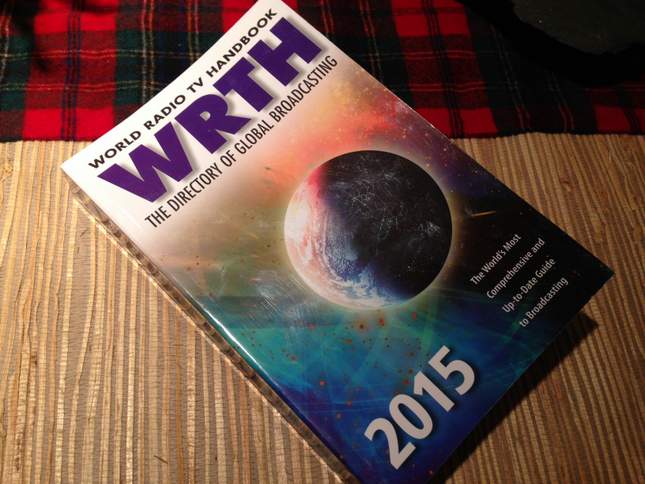
There are 191 schedules listed in the International Radio and COTB (Clandestine & Other Targeted Broadcasts) section of the WRTH A15 schedules file.

Who uses the most frequencies? CRI, with a whopping 279 frequencies in use. The next largest station, by frequency use is (probably quite surprising to many of you) Voice of the Iranian Republic of Iran (VOIRI) with 140 (that is half the amount of CRI!). Next is VOA with 126; then RFA at 112; BBC at 110 then Sound of Hope Radio International with 84 and All India Radio at 67.

Below is a list of the ‘Top 20’ broadcasters in terms of frequency usage. If you were to do a study of actual transmitted time, the list would look rather different. I will shortly post a table showing the top languages, by use, and what has changed over the past 10 broadcasting seasons.

  • CHINA RADIO INTERNATIONAL (CRI): 279 frequencies
  • VOICE OF THE ISLAMIC REPUBLIC OF IRAN (VOIRI): 140 frequencies
  • BBG – VOICE OF AMERICA (VOA): 126 frequencies
  • BBG – RADIO FREE ASIA (RFA): 112 frequencies
  • BBC WORLD SERVICE: 110 frequencies
  • SOUND OF HOPE RADIO INTERNATIONAL: 84 frequencies
  • ALL INDIA RADIO (AIR): 67 frequencies
  • RADIO ROMANIA INTERNATIONAL (RRI): 56 frequencies
  • AWR ASIA/PACIFIC: 52 frequencies
  • RADIO JAPAN (NHK WORLD): 49 frequencies
  • VOICE OF TURKEY (VOT): 43 frequencies
  • RADIO TAIWAN INTERNATIONAL (RTI): 41 frequencies
  • BBG – RADIO FREE EUROPE/RADIO LIBERTY (RFE/RL): 33 frequencies
  • KBS WORLD RADIO: 32 frequencies
  • SAUDI INTERNATIONAL RADIO: 32 frequencies
  • AWR AFRICA/EUROPE: 30 frequencies
  • VATICAN RADIO: 29 frequencies
  • RADIO CAIRO 29: frequencies
  • VOICE OF KOREA (VOK): 27 frequencies
  • FEBC PHILIPPINES: 26 frequencies

63 broadcasters, or so, use just a single frequency.

PCJ Radio International broadcasts to Europe

pcj(Source: PCJ Press Release)

Beginning April 18th, 2015, PCJ Radio International will have a week of programs broadcast to Europe. The one hour transmissions will be our service to the Pacific.

Time: 2000 – 2100 UTC

Schedule
April 18 – The Happy Station Show
April 19 – The Stuph File Program
April 20 – Focus Asia Pacific/Switzerland In Sound
April 21 – Jazz For The Asking
April 22 – Nash Holos
April 23 – Focus Asia Pacific/Vintage Media Network
April 24 – Media Network Plus/Special Program

Special QSLs will be issued for this transmissions.

Frequency: [UPDATE] 9405 kHz

Radio Exterior de España: updated shortwave broadcast schedule

RadioExteriorDeEspana

Radio Exterior de España has posted an updated broadcast schedule (in Spanish) on their website. I have translated and pasted the shortwave schedules below:

Radio Exterior de España transmits its programming from 18:00 to 22:00 hours, Coordinated Universal Time, Monday through Friday. Broadcast frequencies and coverage areas are:

  • Africa and South Atlantic, 15,450 Khz , 19 meter band.
  • South America, 17,715 Khz , 16 meter band.
  • North America, 17,855 Khz , 16 meter band.
  • Middle East and Indian, 15,490 Khz , 19 meter band.

And on Saturdays and Sundays:

  • Africa and South Atlantic, 21,620 Khz band of 13 meters (14 to 18 hours), and 15,450 kHz band of 19 meters (18 to 22 hours).
  • South America, 17,715 Khz band of 16 meters (14 to 18 hours).
  • North America, 17,855 Khz band of 16 meters (14 to 18 hours).
  • Middle East and Indian, 15,490 Khz band of 19 meters (14 to 18 hours).

(In case you’re keeping tabs: yes, REE is still on the air, though basically as a relay of RNE.)

HFCC posts A15 updated schedule

HFCCbanner

Many thanks to SWLing Post reader, Mike, who notes that the HFCC has just posted the A15 Updated Operational Transmission Schedule. Click here to open the HFCC portal, then click each broadcaster “TX” link to see full schedules.

Click here to download a zipped package containing the A15 schedule in standard ITU format and reference tables.


ERT Open shortwave schedule & news

logo-ert-open-bw-color-2Many thanks to SWLing Post reader, Merkouris, who writes:

I’ve just thought that the shortwave schedule of ERT Open, published on the 28th of February, might be of interest to you and the readers of the SWLing Post.

Here is the link in Greek and below is the translation in English [by time, region, frequency, and program]:

0000-1500 UTC, Europe/North America, 9420 kHz, ERA Athens
1500-2400 UTC, Europe/North America, 9415 kHz, ERA Athens
1100-0450 UTC, Europe/Central America, 9935 kHz, ERA Athens
0500-1050 UTC, Central & South Africa, 11645 kHz, ERA Athens
0000-0550 UTC, Russia/Japan, 15630 kHz, ERA Athens
0600-1850 UTC, Europe/Central America, 15630 kHz, ERA Athens
1900-2350 UTC, Middle East – Australia, 15650 kHz, ERA Athens

Draft Bill to Reestablish ERT?

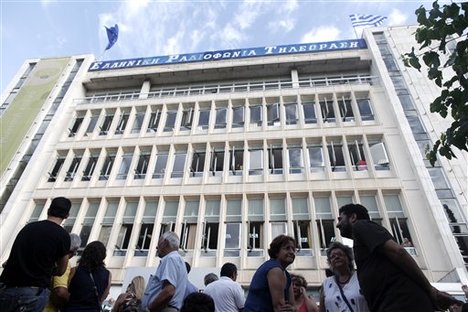
(Photo source: AP / Petros Giannakouris)

(Photo source: AP / Petros Giannakouris)

Merkouris also included links to the following reports from Greek and English language news sources.

(Source: ANAmpa.gr)

ANA – MPA — A draft bill to reestablish defunct public broadcaster ERT was released to public consultation on Monday afternoon, under the title “Regulations on issues of the state radio and television agency, Hellenic Radio and Television SA, and amendment of article 48 of Law 2190-1920.”

The consultation period will end at 10:00 a.m. on Thursday.

[…]It also said it was reinstating all the ERT staff who had permanent contracts by June 11, 2013 and said a fee of 3 euros would be introduced for ERT on PPC bills and the present name of the public broadcaster (“NERIT S.A.”) be replaced by ERT S.A.

[Click here to read full article…]

This is an interesting development for the Greek public broadcaster. Of course, even if the bill passes, it is unknown how this could affect shortwave radio relays. I must say that I’m impressed that ERT Open has been broadcasting on shortwave a good 1.5 years after they should have been closed down. (Personally, I hope they never go off the air as I love ERT Open’s weekend music programs!)

Again, many thanks Merkouris for sharing this schedule and breaking news. Please keep us informed!

Shortwave Shindig Rebroadcast: March 7, 2015

ShindigLogoWhiteI’ve just learned via @shortwaveology that the Shortwave Shindig will be rebroadcast on Saturday March 7, 2015 from 10:00-11:00 PM EST (that’s Sunday from 0300-0400 UTC) via WRMI on 7,570 khz.

Those of you who tuned into the live show last Friday noted that the audio dropped out at times–this was due to a flaky Internet connection at the hotel where the ‘Shindig was held. You will hear the full show, without interruption, in this rebroadcast.

I plan to record this show, but would certainly appreciate other recordings as well to add to the archive. On that note, a few of you have sent recordings of the original broadcast (thank you!)–I will post those as soon as I’ve caught up with work, post-‘Fest!

Shortwave Shindig broadcasting live from the 2015 Winter SWL Fest!

ShindigLogoWhite

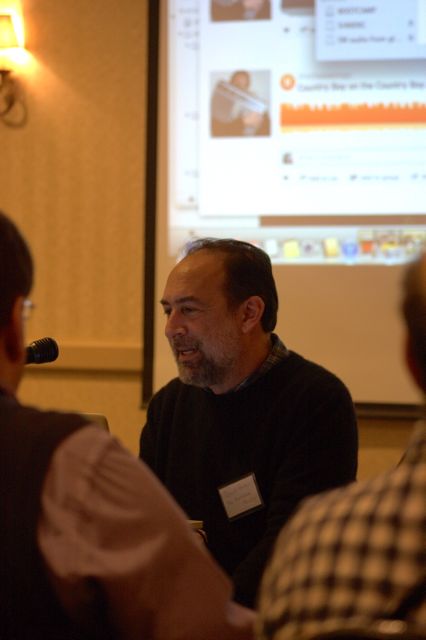
David Goren hosts the annual Shortwave Shindig

David Goren hosts the annual Shortwave Shindig

I’m happy to relay that David Goren’s Shortwave Shindig will once again broadcast live from the Winter SWL Fest in Plymouth Meeting, Pennsylvania.

Tune in on Friday, February 27, 2015 from 22:00-23:00 EST (that’s 03:00-04:00 UTC, February 28) on 7,570 kHz.

Since I will be at the Winter SWL Fest and even a part of the Shortwave Shindig live broadcast, I’m hoping a few SWLing Post readers will record the show and share with us.

Also, if you’re in the Plymouth Meeting area, please consider joining us at the Winter SWL Fest.

If you would like to hear recordings of the Shortwave Shindig from 2014, click here.

Click here to check out David Goren’s website, Shortwaveology.net.