Category Archives: Shortwave Radio

Giuseppe’s Crossed Loop and the “VariabilOne”

Many thanks to SWLing Post contributor, Giuseppe Morlè (IZ0GZW), who shares the following:

Dear Thomas and all friends of SWLing Post,

I’m Giuseppe Morlè iz0gzw from central Italy on the Tyrrhenian Sea, Formia.

A few days ago at a fair for radio amateurs in Latina, I bought an excellent very large variable capacitor–those of ancient military radios–and I found a splendid antique knob with a fantastic gear ratio.

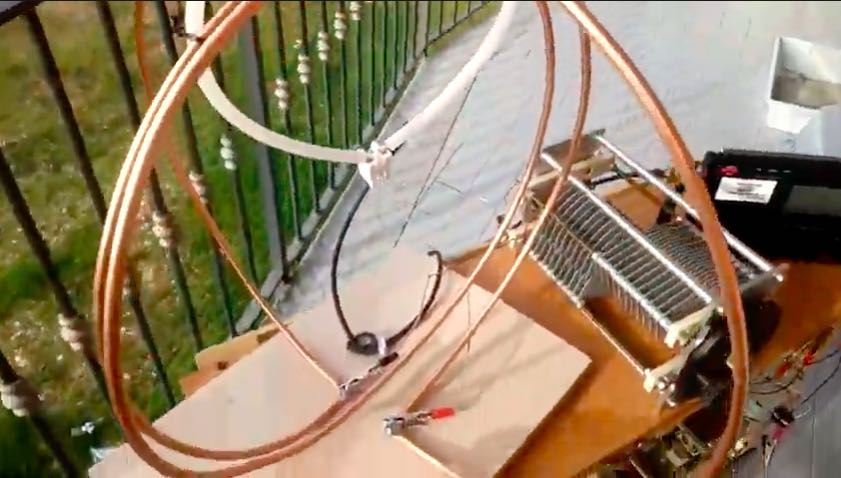
I called this VariabilOne and it consists of two sections of 250pf each. It’s very portable and can be applied to any loop with crocodile clips.

I built another cross loop made up of 2 turns the internal loop, 35 cm. and only one turn for the external loop, 40 cm.

I can tune frequencies from 3.500 to 20.0 MHz. The crossed loop is strongly directive given the two loops that work together being joined on their ends.

I have made some demonstration videos and it is a pleasure for me to share them for our entire community (see below).

Thanks to you and I wish you all the best for you and your family.
Greetings to all.
73. Giuseppe iz0gzw.

Click here to view on YouTube.

Click here to view on YouTube.

Click here to view on YouTube.

Click here to view on YouTube.

Giuseppe, thank you once again for sharing your brilliant homemade antenna projects with us. I absolutely love that monster variable cap and tuning whee! What a thing of beauty–and obviously your loop is very effective.

Thank you as always, Giuseppe!

Readers: click here to check out Giuseppe’s other antenna projects.

Carlos’ Shortwave Art and Recording of the BBC World Service

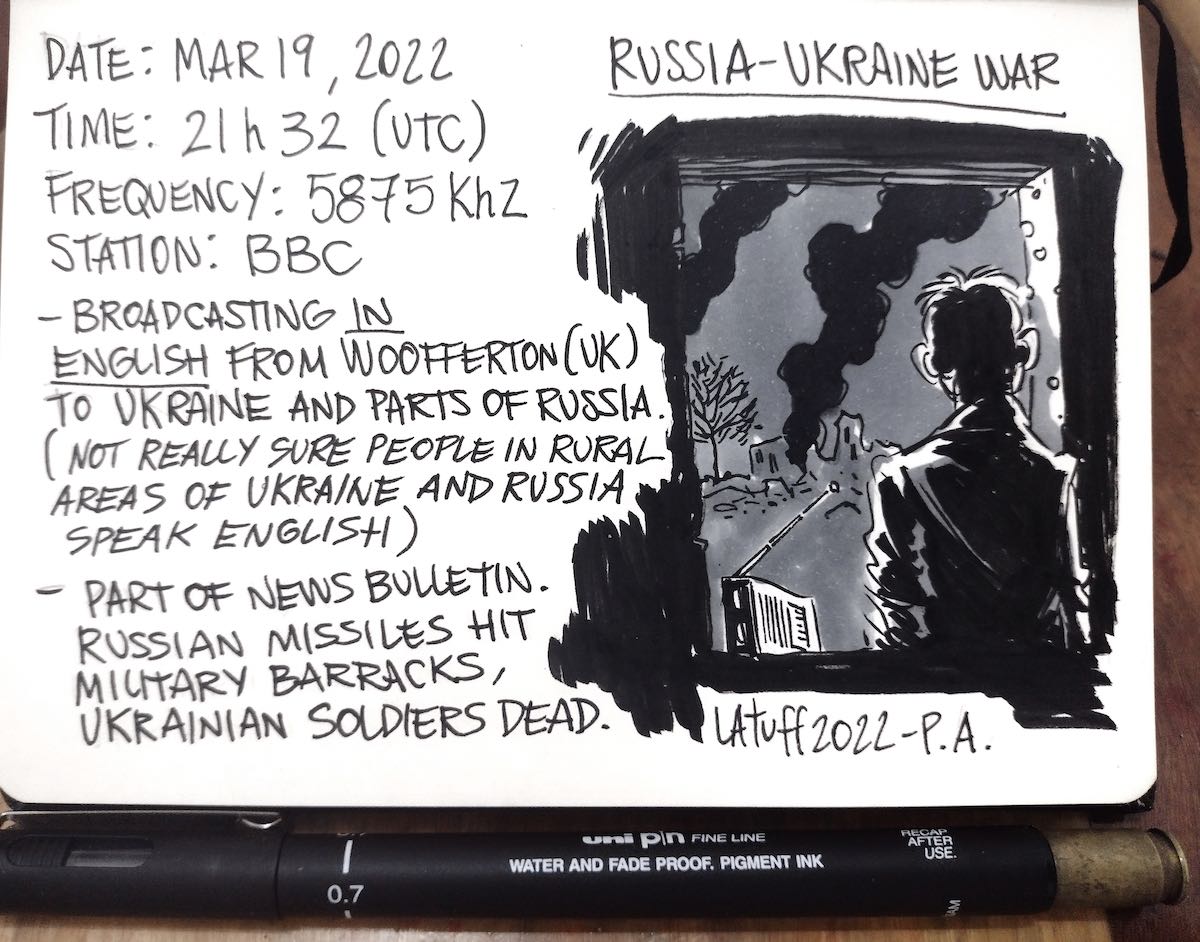
Many thanks to SWLing Post contributor and noted political cartoonist, Carlos Latuff, who shares his radio log art of a BBC World Service broadcast to Ukraine and Russia in English.


Carlos notes:

BBC, 5875 kHz, listened in Porto Alegre, Brazil, March 19, 2022, 21h32 (UTC).

Part of news bulletin: Russian missiles hit military base in Ukraine, killing soldiers.

BBC announced it’s broadcasting news to war-ravaged Ukraine and parts of Russia…in English!

Click here to listen via YouTube.

HanRongDa HRD-747: Expanding reception to include longwave

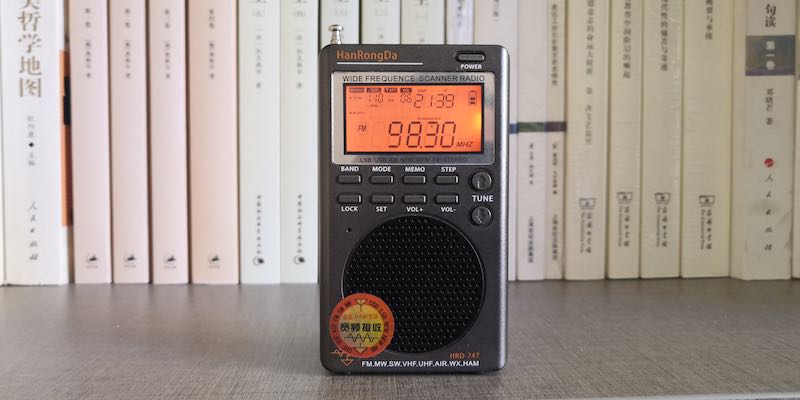
Many thanks to SWLing Post contributor, Dan Robinson, who shares the following video which shows how connecting an external antenna to the HDR-747 extends reception range down to longwave:

Click here to view on YouTube.

Thanks for the tip, Dan!

Note: Dennis adds that the antenna used in this video can be found here.

Vatican Radio insreases shortwave news broadcasts to Ukraine & Russia

Many thanks to SWLing Post contributor, David Iurescia LW4DAF, who shares a link to the following announcement from Vatican Radio:


Vatican Radio increases shortwave broadcasts to Ukraine and Russia

From next Monday the Pope’s radio station will expand its Ukrainian and Russian programmes. The increase of shortwave frequencies aims to empower the Radio’s outreach in its mission to communicate the Gospel message and to “read” current events through this perspective.

By Vatican News

From Monday, 21 March, Vatican Radio will increase its shortwave broadcasts to Ukraine and Russia. In addition to the two daily broadcasts (afternoon and evening) in the two languages, the morning programmes to Moscow and Kyiv will last twenty minutes longer.

“The decision,” Massimiliano Menichetti, head of Vatican Radio Vatican News explains, “was taken with the agreement of the entire management team of the Dicastery for Communication, at this time when war is raging, in order to better respond to our mission: to bring hope, the Pope’s words and the reading of facts through the light of the Gospel to the whole world.”

In these past weeks, he added, thanks to a network of direct contacts that support the work of our reporters, we are trying to give comfort to those who are suffering and to ensure timely information.

The frequencies of Vatican Radio, the pages and posts of Vatican News in 51 languages (including English and Italian in sign language) aim to not leave anyone alone, even in the awareness of the power of prayer”.

Vatican Radio’s new shortwave broadcasts

Until 26 March

  • Russian, CET 06:00-06:20, UTC 05:00-05:20, 7260 kHz, 9715 kHz
  • Ukrainian, CET 06:20-06:40, UTC 05:20-05:40, 7260 kHz, 9715 kHz

From Sunday, 27 March

  • Russian, CET 07:00-07:20, UTC 05:00-05:20, 7260 kHz, 9705 kHz
  • Ukrainian, CET 06:40-07:00,UTC 04:40-05:00, 7260 kHz, 9705 kHz

Click here to read this announcement at Vatican Radio.

RFE/RL Opens Offices In Latvia & Lithuania

Many thanks to SWLing Post contributor, Eric Jon Magnuson, who shares a link to the following press release from RFE/RL:


As War Transforms Media Landscape in Europe, RFE/RL Opens Offices In Latvia, Lithuania

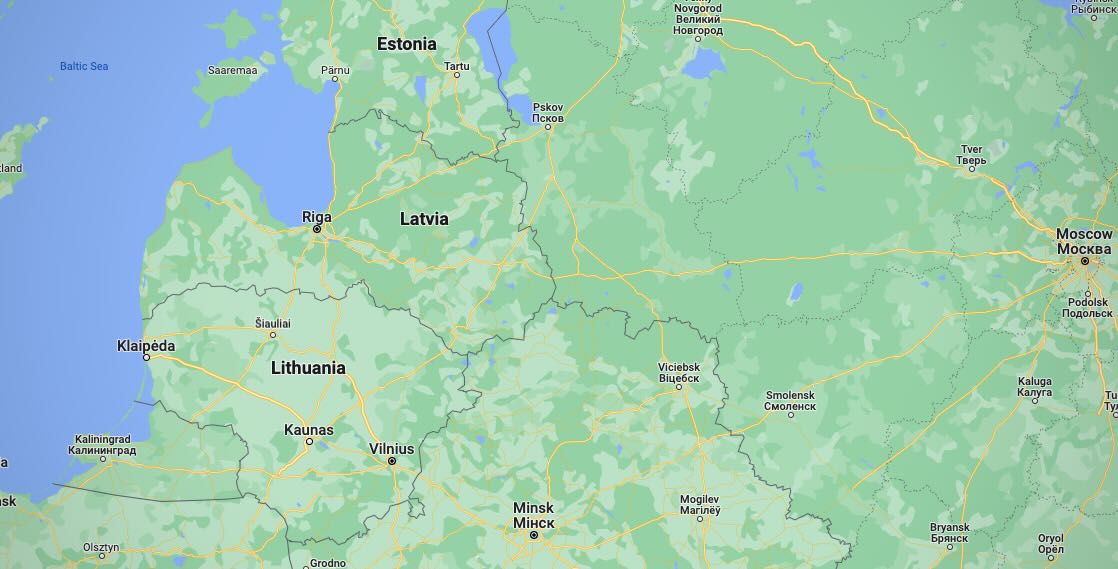
WASHINGTON—Following the forced suspension of RFE/RL operations in Russia on March 6, RFE/RL is pleased to announce the opening of news bureaus in Riga, Latvia and Vilnius, Lithuania. These offices will house teams from RFE/RL’s Russia and Belarus services and the 24/7 Current Time global digital and TV network, and also provide a base for new investigative journalism projects and digital innovation hubs.

Said RFE/RL President Jamie Fly, “These new bureaus will allow RFE/RL to continue to engage with our audiences in Russia and Belarus, despite those government’s best efforts to silence independent journalism. RFE/RL will expand its already-successful efforts to reach Russian and Belarusian audiences with the relevant news they seek, and desperately need. We are grateful to the Latvian and Lithuanian governments for their commitment to press freedom and their support for vulnerable journalists who have had to seek safe haven outside their home countries.”

In Riga, RFE/RL plans to establish a multimedia hub that will host Russian Service and Current Time staff displaced from Russia. The Latvian capital will also house a new, Russian-language investigative journalism unit and a digital innovation hub designed to counter disinformation and develop strategies to circumvent online censorship across delivery platforms. The Vilnius news bureau will primarily host displaced Belarus Service journalists forced to flee after the flawed 2020 elections, as well as a new reporting team being set up by Current Time to serve the needs of the network’s Russian-speaking audiences in Belarus.

RFE/RL’s impact during the first two weeks of Russia’s war on Ukraine demonstrates the appetite within Russia and Belarus for a credible, uncensored alternative to Kremlin media about the full scope of the conflict. Between February 24 and March 16, the number of views of RFE/RL videos on YouTube from Russia tripled to nearly 238 million, while the number of visits, page views, and unique visitors to its websites from Russia rose by 34 percent, 51 percent, and 53 percent respectively. As for Belarus, the number of RFE/RL videos viewed via YouTube from inside the country quadrupled (to 22.4 million), and the number of visits (+158%), page views (+148%), and unique visitors (+110) to RFE/RL websites from Belarus has also increased dramatically.

RFE/RL deeply appreciates the support of the governments of Latvia and Lithuania for RFE/RL’s mission and for the establishment of these new bureaus. The people of Latvia and Lithuania have for decades been enthusiastic consumers of RFE/RL programming—both of RFE/RL’s Latvian and Lithuanian services that operated from 1975 to 2004, and more recently of Current Time programming. RFE/RL President Fly visited Vilnius and Riga this past January, in part to attend the Lithuanian premiere of the award-winning, Current Time-commissioned film “Mr. Landsbergis,” about Lithuania’s struggle to restore its independence.

RFE/RL’s Russian Service is a multiplatform alternative to Russian state-controlled media, providing audiences in the Russian Federation with informed and accurate news, analysis, and opinion. The Russian Service’s websites, including its regional reporting units Siberia.Realities and North.Realities, earned a monthly average of 12.7 million visits and 20.6 million page views in 2021, while 297 million Russian Service videos were viewed on YouTube, Facebook, and Instagram.

Current Time is a 24/7 Russian-language digital and TV network led by RFE/RL in cooperation with VOA, that caters to Russian-speakers worldwide. In addition to reporting uncensored news, it is the largest provider of independent, Russian-language films to its audiences. Despite rising pressure on Current Time from the Russian government, Current Time videos were viewed over 1.3 billion times on YouTube, Facebook, and Instagram/IGTV in FY2021.

Labeled an “extremist organization” by the Belarus government, RFE/RL’s Belarus Service provides independent news and analysis to Belarusian audiences in their own language, relying on social media platforms such as Telegram, Instagram, and YouTube, as well as mirror sites and an updated news app to circumvent pervasive Internet blockages and access disruptions.

About RFE/RL
RFE/RL relies on its networks of local reporters to provide accurate news and information to more than 37 million people every week in 27 languages and 23 countries where media freedom is restricted, or where a professional press has not fully developed. Its videos were viewed 7 billion times on Facebook, YouTube, and Instagram/IGTV in FY2021. RFE/RL is an editorially independent media company funded by a grant from the U.S. Congress through the U.S. Agency for Global Media.

Click here to read  this announcement at RFE/RL.

CBS Miami features WRMI and the “Shortwaves for Freedom” campaign

Many thanks to SWLing Post contributor, Dennis Dura, who shares the following article from CBS Miami:

Shortwave Radio Signal From Florida Cow Pasture Reaches Russia Carrying Latest News (CBS Miami)

Click here to view on YouTube.

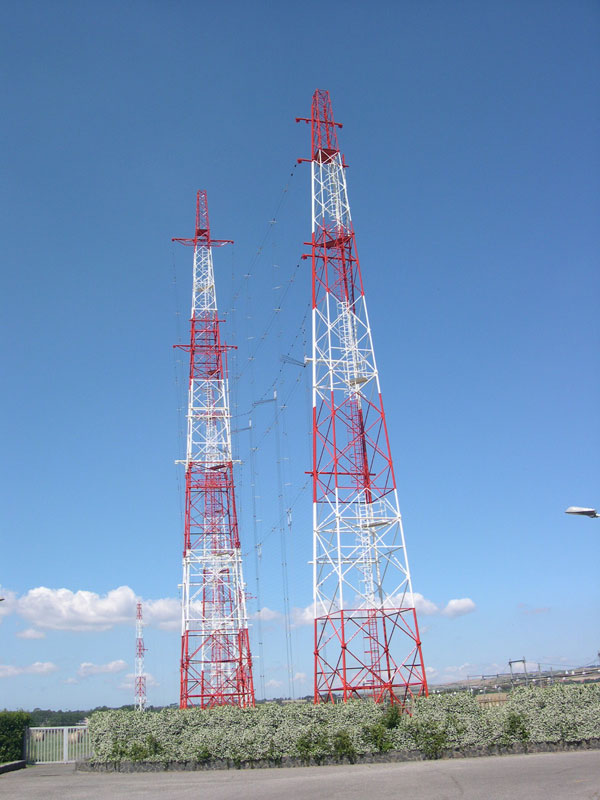
MIAMI (CBSMiami) – A massive shortwave radio antenna sits in a cow pasture north of Lake Okeechobee in Central Florida.

“We have 14, 100,000-watt transmitters and 23 antennas beaming to all parts of the world,” said Jeff White, the general manager of Miami-based WRMI.

The multi-signal station is said to be one of the largest shortwave radio operations in the world.

WRMI stands for Radio Miami International and worldwide coverage means it can easily send signals into Ukraine and Russia.

Shortwave is old school technology, think of World War II or the Cold War, as American-produced news beamed behind the iron curtain. Now, during the invasion of Ukraine, Russia has shut down journalism as we know it.

Kate Neiswender, one of the guiding lights behind funding news programming for Russian audiences, said, “they were going to pass a law making journalism essentially illegal, facing a 15-year criminal penalty.”

Neiswender and fellow former journalists formed a fundraiser to beam news into Russia, where state-controlled media, at best, does not tell the true story of the invasion and many Russian citizens have no clue about the severity of the invasion.

“This is a journalistic pursuit more than anything else,” said Neiswender. [Continue reading at CBS Miami…]

Click here to read our previous post about Shortwaves for Freedom and contribute to the campaign here.