Category Archives: Shortwave Radio

Listening to the Hurricane Watch Net on shortwave

As Hurricane Laura starts to make landfall this evening (Wednesday, August 26, 2020), it is expected to be a category four hurricane—producing extreme winds, life-threatening storm surge and flash flooding.

This has been an active and early tropical storm season here in North America and September may produce even more named systems.

A few readers have asked about frequencies to monitor the HWN, so I thought I’d share this short primer.

Hurricane Watch Net (HWN)

hwn-hurricane-watch-netThe Hurricane Watch Net is a group of amateur radio operators who are trained and organized “to provide essential communications support to the National Hurricane Center during times of Hurricane emergencies.” The HWN focuses on “ground truth” observations (much like SkyWarn nets).

The Hurricane Watch Net is activated when a hurricane is within 300 statute miles of expected land-fall. The HWN covers the Caribbean, Central America, Eastern Mexico, Eastern Canada, and all US Coastal States.

The HWN operates in both English and Spanish, and is active on 14.325 MHz (upper sideband) during the day and 7.268 MHz (lower sideband) at night. The HWN is known to operate on both frequencies if propagation allows.

The HWN provides updates on their website regarding activation times and frequencies. As an example, here’s the latest for Hurricane Laura:

The Hurricane Watch Net will activate Wednesday morning at 8:00 AM CDT (1300 UTC) on our primary frequency of 14.325.00 MHz. Beginning at 4:00 PM CDT (2100 UTC), we will begin simultaneous operations on 7.268.00 MHz. Once activated, we will remain in continuous operation on both frequencies until the bands close. We will resume operations on those bands just as soon as propagation returns.

Please keep HWN frequencies clear

If you’re an amateur radio operator, please avoid using 14.325 MHz and 7.268 MHz anytime the HWN has been activated.

Monitoring hurricane frequencies

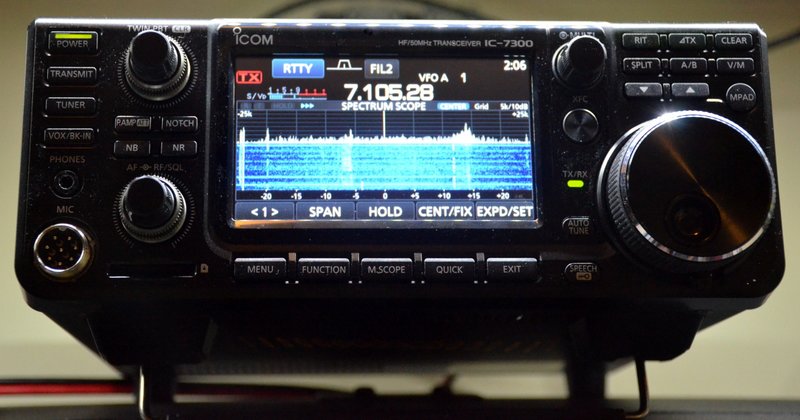
If you have a shortwave radio with a BFO/SSB mode, or a ham radio transceiver–and you live within the propagation footprint–you can monitor the Hurricane Watch Net.

Note that you’ll need to use upper sideband on 14.325 MHz and lower sideband on 7.268 MHz.

You can also monitor the Hurricane Watch Net via a number of WebSDRs on the KiwiSDR network and even potentially via the U Twente WebSDR in the Netherlands if propagation is favorable (although a WebSDR in North America would be preferable).

Click here to view the Hurricane Watch Net website.

If you live in an area prone to hurricanes, tropical storms and other natural disasters, please keep an emergency kit fully-stocked and at the ready. Click here for some ideas about building your own simple kit.

Listening to shortwave broadcasts with the lab599 Discovery TX-500

The lab599 TX-500 Discovery is a general coverage transceiver with AM mode, which means it can do double-duty as a shortwave receiver.

If you’ve been following previous TX-500 posts, you’ve seen me take this near military-grade portable transceiver to the field. I’ve activated a total of 6 parks in 6 days with it and it’s been a load of fun.

At home, I’ve also been doing a fair amount of SWLing with it in the evenings. I have a pre-production model that doesn’t include all of the accessories that will be provided with the production model. I don’t have a good way to port the audio out of the transceiver for recording at present, but I have been listening to broadcasts in the shack using a simple battery-powered amplified speaker.

I made a short video demonstrating the shortwave listening experience with the TX-500. It’s not a deep-dive by any means, but I thought it might provide a little more context. Keep in mind, I recorded this with my iPad, so the audio is far from ideal.

In general, the TX-500 is a fine radio for shortwave radio listening. It has the sensitivity and selectivity even a demanding DXer would seek. The TX-500 has a very low noise floor and an effective RF gain for mitigating summer QRN (static crashes) here in North America. I wish I had the time to tinker with the audio and see what sort of fidelity is possible. I’m not sure I’ll have time to cobble together a connection to my station monitors before I need to send it on.

Speaking of which, I’ll be sending this TX-500 to Ham Radio Outlet within the next two days. If you have any questions about it, feel free to ask now!

I will write-up a comprehensive review of the TX-500 in the October issue of The Spectrum Monitor magazine (my IQ32 overview is in the September issue).


Do you enjoy the SWLing Post?

Please consider supporting us via Patreon or our Coffee Fund!

Your support makes articles like this one possible. Thank you!

Phillip loves the Icom IC-R30, but frustrated with mono audio out

Many thanks to SWLing Post contributor, Phillip Novak, who writes:

A question or perhaps comment on the Icom IC-R30 that I’m hoping SWLing Post readers might shed some light on.

I’m a very new and extremely pleased owner of one of these units for the past 2 weeks. Aside from receive capability, usability is a big deal for me and this thing has proven to be a joy! The menus, buttons and build quality just feel great and frankly, I’m pretty happy about having made the “investment”.

So, it was with great excitement that my wife and I have the week off at the cottage – more so for me, as I was looking to really break the R30 in while sitting on the lake shore.

And then …. I was extremely disappointed to find out that the r30 headphone jack is mono (just like the IC-R6 that I already owned). On top of that, the jack is slightly recessed into the body of the unit, which renders the mono-to-stereo split adapter useless! (I really thought they would have changed it!)

Someone, please enlighten me as to why Icom would choose a mono plug!

It’s funny you mention the recessed plug as I had the same issue with a portable recently–the audio out port was recessed to the point that only the provided cheap earphones would fit!

Perhaps SWLing Post readers and IC-R30 owners can provide you with a simple solution? Of course, you can always purchase or build a mono-to-stereo adapter or patch cord–one with a slim profile to fit in the IC-R30 audio port recess (that’s the tough part, of course). But perhaps there are even earphones that have this functionality built-in? I honestly don’t know. Any ideas, readers? Please comment.

And, Phillip, we’d welcome your review of the IC-R30!

Edward R. Murrow Transmitting station notes QSL delays to international recipients

VOA transmitter site in Greenville, NC

My friend, Macon Dail (WB4PMQ), is the Transmitter Plant Supervisor for the Edward R. Murrow Transmitting Station in eastern North Carolina, USA. He recently sent the following note and asked that I post it here:

“If anyone asks about the status of their QSLs from our station, please tell them that we had several returned over the past months as not deliverable. We think that the Covid-19 pandemic may have stopped some of the international mail delivery. I plan to resend them in the next week or so to see if they can make it through the postal service. “

Thanks for sharing the update, Macon!

In fact, this is not the only shortwave station experiencing problems. If you’ve requested a QSL this year, it could take much longer to get a response. You might make a note to follow up with broadcasters once this pandemic is in the rear-view mirror. Not all will be as careful about following up like Macon.

Vlado restores Mike’s vintage Sony CRF-160

Sony CRF-160 Dial

Many thanks to SWLing Post contributor, Michael Schuster, who shares the following guest post:


Vlado works his magic on my Sony CRF-160

by Michael Schuster

Back in the 1970’s my grandfather gifted this solid-state portable to me as it was more than he needed. It was the first “real” radio I can remember owning, and it initiated my habit of scanning the dials into the wee hours of the morning. I began my serious SWLing using this set as it had excellent sensitivity, dual conversion design, big booming audio, and generous bandspread tuning for each major SW broadcast band.

One of the best-known SWL programs at the time was Happy Station on Radio Nederland, and I have distinct memories of listening in our back yard one summer afternoon when the show came up on the African Service over the Madagascar relay. My family was astonished at the program coming from so far away and even more so when Tom Meijer happened to read my letter over the air during the mailbag segment!

Fast forward many years (and two moves) later, it sat on a shelf until, trying it out again, I was dismayed to find both slide rule tuning dials, and the rotary drum band selector, to be frozen in place. And so there it sat until….

In a few online forums I kept hearing about a magician named Vlado at Ham Radio Repair. He specializes in restoring old sets, and has the courage and curiosity to tackle just about anything. Thinking this might be my last chance to bring this fossil back to life, and armed with a scanned copy of the service manual downloaded from the Radio Museum web site (the Internet is a marvelous thing) I began a several months’ long email exchange with Vlado entitled “Would you be willing to work on…”

He is chronically swamped with sets to work on, and has little room to store pending jobs, but was more than willing to have a look. Several months, and one pandemic later, we touched base again and I arranged to ship this monster off to him. Vlado is especially interested in the stories behind old hardware, so I shared its history with him as it adds that extra “human factor”.

The radio is in great shape as he noted, but needed a total rework of the tuning dials and drum selector. He also replaced all of the electrolytic capacitors (most were leaking as pictured), replaced some tiny light bulbs with LED’s, and realigned all of the circuits for maximum performance.

Unpacking and trying out the restored set was a true blast and somewhat miraculous. It performs just as I remember and now sits on the shelf, this time in use rather than in storage, booming its audio across my basement work room.

Now this set will probably outlive me as it did my grandfather; hopefully it will end up in the hands of an appreciative recipient for the next generation of radio enthusiasts.


Thank you for sharing this repair story, Mike. I visited Vlado’s home a few weeks ago and saw the box labeled “Sony CRF-160” in-line to be repaired. As Vlado worked on it, he sent me a couple of photos, too, because I believe it was the first time he had ever worked on this particular Sony model. It is certainly a gorgeous radio–wow! And I do love your philosophy as it’s the one I adopt too: keep vintage radios alive and working beyond our generation. 

Vlado is truly the most capable ham radio repair guy technician/engineer you’ll ever meet. He’s also as honest as the day is long. If you have a vintage or late-model solid-state radio that needs repair or restoration, contact him.

Click here to check out Vlado’s website HamRadio.repair.

Radio Waves: Arecibo Damage, Airchecks, Remote Ham Exams, Kids Learning CW Through LI Club, and West Bengal Ham Confirms LRA36

Radio Waves:  Stories Making Waves in the World of Radio

Because I keep my ear to the waves, as well as receive many tips from others who do the same, I find myself privy to radio-related stories that might interest SWLing Post readers.  To that end: Welcome to the SWLing Post’s Radio Waves, a collection of links to interesting stories making waves in the world of radio. Enjoy!

Many thanks to SWLing Post contributors Ron, Dave Cripe, and Trevor R for the following tips:


A Broken Cable Has Wrecked One of Earth’s Largest Radio Telescopes (Vice)

The Arecibo Observatory, one of the largest single-aperture radio telescopes in the world, has suffered extensive damage after an auxiliary cable snapped and crashed through the telescope’s reflector dish.

The accident left a 100-foot hole in the observatory, which stretches 1,000 feet over a karst sinkhole in northern Puerto Rico. The cable broke at about 2:45 AM local time on Monday, but the cause of the failure remains unknown, according to the University of Central Florida, one of three institutions that operates Arecibo.

“We have a team of experts assessing the situation,” said Francisco Cordova, Arecibo’s director, in the UCF statement. “Our focus is assuring the safety of our staff, protecting the facilities and equipment, and restoring the facility to full operations as soon as possible, so it can continue to assist scientists around the world.”

Arecibo was the largest single-dish radio telescope in the world for decades, but it was bumped into second place in 2016 by the Five hundred meter Aperture Spherical Telescope (FAST) in China. Some radio observatories, such as the Very Large Array in Chile, consist of vast networks of antennas that take up far more space than Arecibo or FAST, but the latter telescopes are the largest facilities in the world that collect light in a single big dish.

Arecibo also suffered damage during Hurricane Maria in 2017, though it was nowhere near as debilitating as the wreckage caused by the broken cable.[]

The Ever-Evolving Role of Airchecks (Radio World)

Anyone who has deejayed in radio in the past 60 years knows about airchecks. They are as much a part of top 40 radio’s legacy as spinning Led Zeppelin’s “Stairway to Heaven” and exploiting its 8:02 running time for a much-needed bathroom break.

In top 40 terms, “an aircheck is an off-air recording usually intended to showcase the talent of an announcer or programmer to a prospective employer,” said Rick Burnett, former radio deejay and owner of TwinCitiesRadioAirchecks.com in St. Paul, Minn. “Additionally, the airchecks were used for self-critique and evaluation by radio management and for legal archiving of content that is broadcast over the air.”[]

Technology and Technique Making Ham Radio Testing Possible During Pandemic (ARRL News)

Amateur radio license testing continues during the pandemic, with a combination of remote Volunteer Examiner (VE) test sessions and careful in-person session planning. In Hawaii, VE Team leader and Section Manager Joe Speroni, AH0A, said he and his team passed the 100-candidate mark on August 10 for video-supervised remote test sessions. Speroni said the most recent session administered exams to 10 candidates simultaneously.

“Candidates from all Hawaiian Islands, Puerto Rico, Guam, and US military bases in Okinawa have had an opportunity to sit for licenses,” he told the ARRL Volunteer Examiner Coordinator. “The high pass rate of 95% is most likely due to candidates having had time to prepare for the exam.” Speroni also said his VEs’ willingness to contribute their time has made the program a success and available to a wide geographical range.[]

With kids stuck home, Long Island group teaches a ‘new’ hobby: Morse code (Newsday)

Even though Alana Bernstein of Manhasset is a 17-year-old high school senior, this spring she had to learn the alphabet all over again.

Bernstein signed up for a new, free Zoom course in Morse code created by a Long Island ham radio operators’ club to offer kids a chance to learn a new skill and stay occupied during the pandemic.

“This is a good opportunity for me to connect with people around the world, make some Morse code friends and have some fun,” Bernstein says. She finished the beginner course and is now taking a summer intermediate course that meets Mondays, Wednesdays and Fridays.

The program has reached 125 children in kindergarten through high school since it launched in March, says Alana’s father, Howard Bernstein, 68, of Manhasset. He cofounded the Long Island CW Club — the CW standing for continuous wave — in 2018 with Rich Collins, 57, a UPS driver from Hicksville. The men are known by the call signs WB2UZE and K2UPS respectively when they’re on the air.[]

Radio ham picks up Argentine Antarctic base signal (Southgate ARC)

New Delhi Television (NDTV) reports a radio amateur in West Bengal received a signal from the Argentinian base in Antarctica

They say:

An amateur radio operator from West Bengal, who intercepts radio signals from far away countries as a hobby, received one from Antarctica, the southern tip of the globe, over 11,835 km away.

The feat of 65-year-old Babul Gupta is unique as it is the first successful DXing – receiving and identifying distant radio signals – with Antarctica from the state in recent memory, Secretary of West Bengal Radio Club Ambaresh Nag Biswas VU2JFA told PTI on Thursday.

Babul Gupta, a member of the club, received a radio transmission from a camp set up by an Argentine team of scientists in Antarctica when he was in Bakkhali, a seaside spot in the South 24 Parganas district, on August 8, he said.

“The transmission was made from LRA 36 camp. It was transmitted from the scientists’ camp in South Pole. I sent the recording of the audio to the Argentine team via email,” Mr Gupta said.

The Argentines have sent an acknowledgement citation to Babul Gupta referring to his tracking their radio signal on 15.476 kHz.

Read the full story at
https://www.ndtv.com/india-news/amateur-bengal-ham-radio-operator-intercepts-signal-from-antarctica-camp-2282700

A picture of Babul Gupta’s receiving station can be seen at
https://www.pinterest.co.uk/pin/358599189055138206/[]


Do you enjoy the SWLing Post?

Please consider supporting us via Patreon or our Coffee Fund!

Your support makes articles like this one possible. Thank you!

Nick compares the Icom R9000, Harris 590, WJ 8711, and Racal 6790

Many thanks to SWLing Post contributor, Nick Booras, who shares the following video and notes:

As a SW listener and radio collector I have enjoyed many hours perusing your blog and reviews. I recently started posting YouTube videos of some of my collection and thought you and your viewers might find them interesting. Please take a look at my youtube channel – dieselten01

My most recent vid included some pretty cool older surveillance type receivers.

Those are fabulous receivers! Thank you for sharing your video, Nick! Click here to check out Nick’s YouTube channel.