Shortwave listening and everything radio including reviews, broadcasting, ham radio, field operation, DXing, maker kits, travel, emergency gear, events, and more
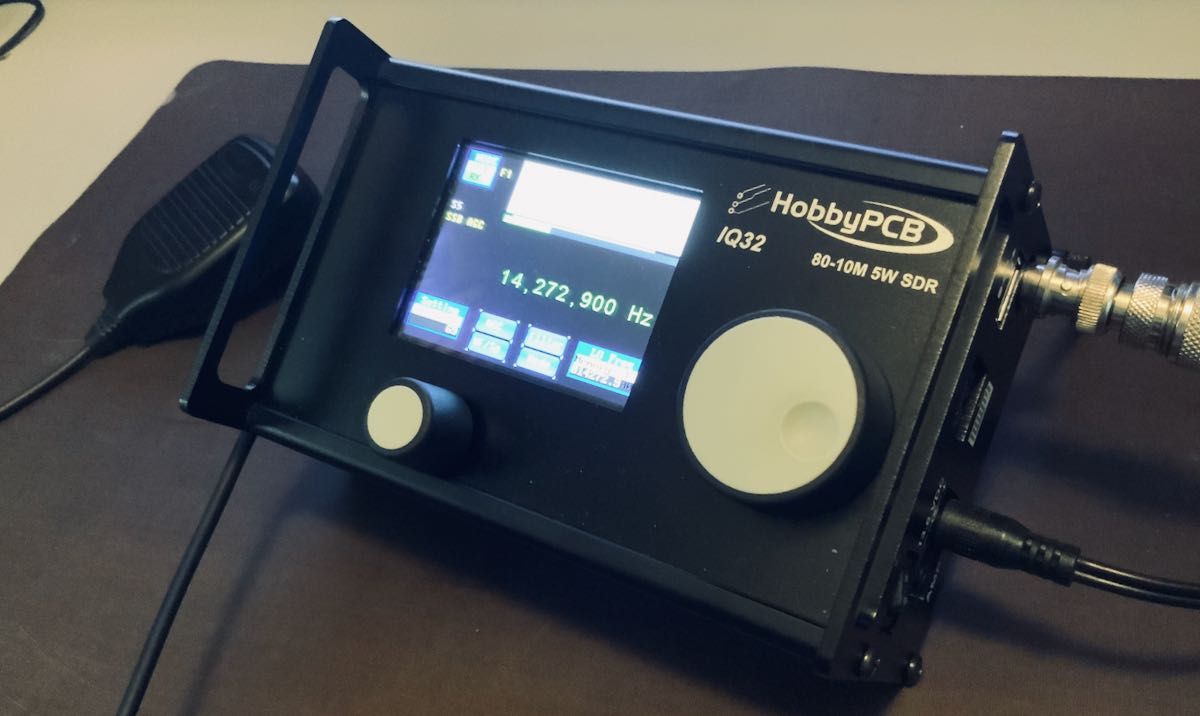
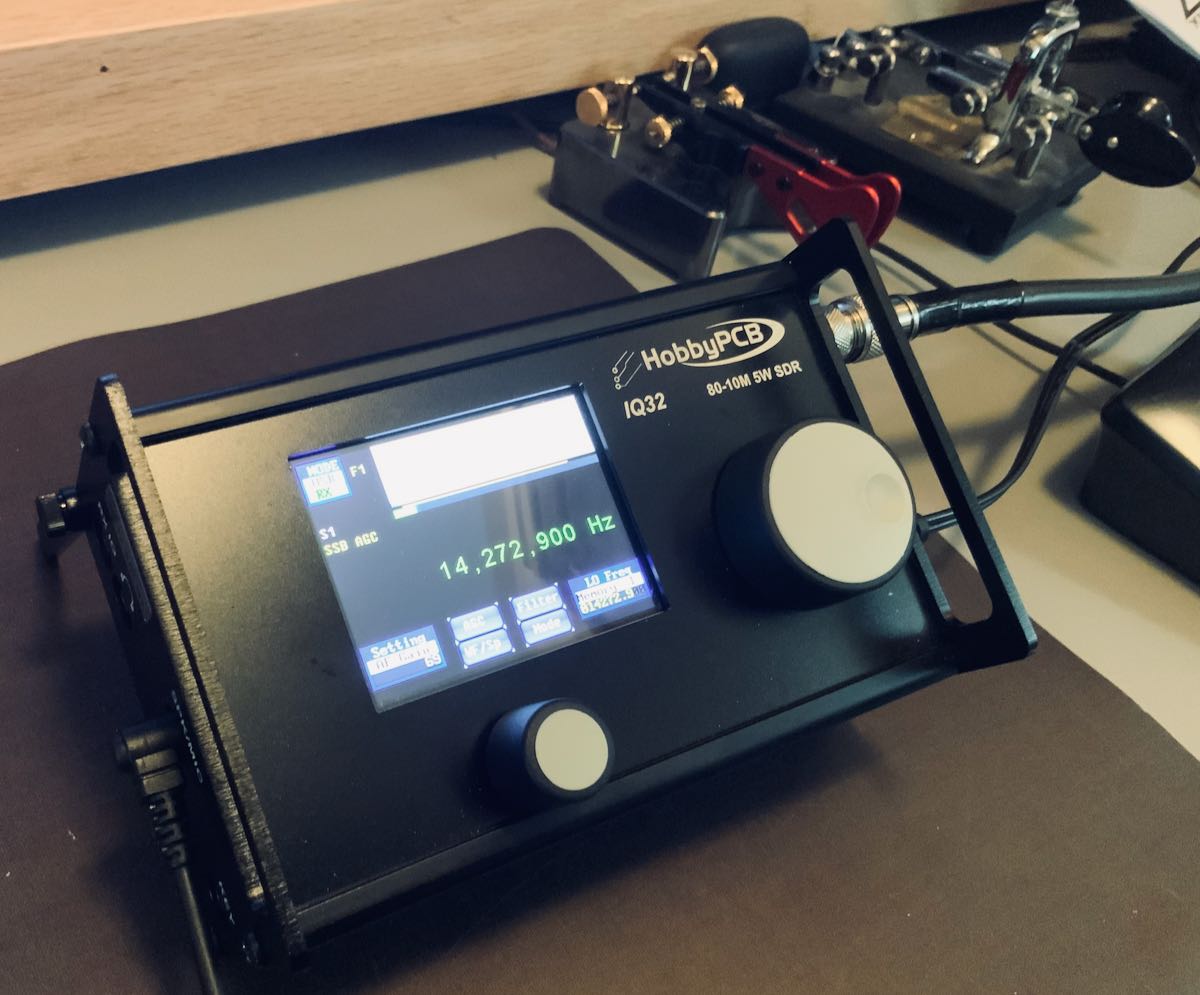
Last week, I took delivery of an IQ32 SDR Transciever on loan from HobbyPCB. The IQ32 has been on the market for a few years now and is a fusion of the HobbyPCB RS-HFIQ and the STM32-SDR.
I’ve been told by the HobbyPCB team that the STM32-SDR was developed a few years ago “when PSK31 was the digital mode du jour and PS2 keyboard roamed the land.” Cool thing is, the team is still updating the radio’s firmware. Most recently, they expanded the rig’s CW capabilities and re-worked the memory structure and organization based on user feedback.
I see the IQ32 as a collaborative transceiver project and look forward to trying a few QRP PSK-31 contacts in the field with only the transceiver, antenna and a PS2 keyboard. Need to check the shed for that keyboard!
Anyway, should be fun!
I plan to write an article for The Spectrum Monitor about the IQ32, explore how it came about, and point out some of its unique features. It’ll be less a review and more of a tour of this little rig.
Many thanks to SWLing Post contributor, April TimeLady, who writes:
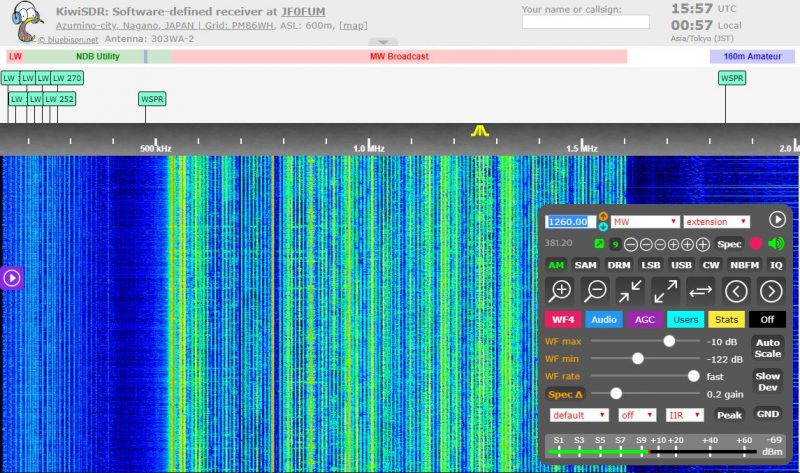
This is a collection of SDR recordings made of Japanese language radio stations for June 2020.” It may be useful to note that I had encoded them at .ogg from .wav, and archive.org automatically converts audio to .mp3 format. The great majority of the recordings are from NHK JOAK Tokyo; I have reason to believe that it broadcasts in AM Stereo. Those recordings with “sas” in the filename are in stereophonic sound, or supposed to be at least. I am unsure if what I hear are artefacts of skywave or AM interference or actually stereo, but it seems to be so when I listen to the playback of such files. The English language Wikipedia article on AM stereo is definitely not complete when it comes to Japanese radio stations, and there does not seem to be a corresponding article on the Japanese Wikipedia..
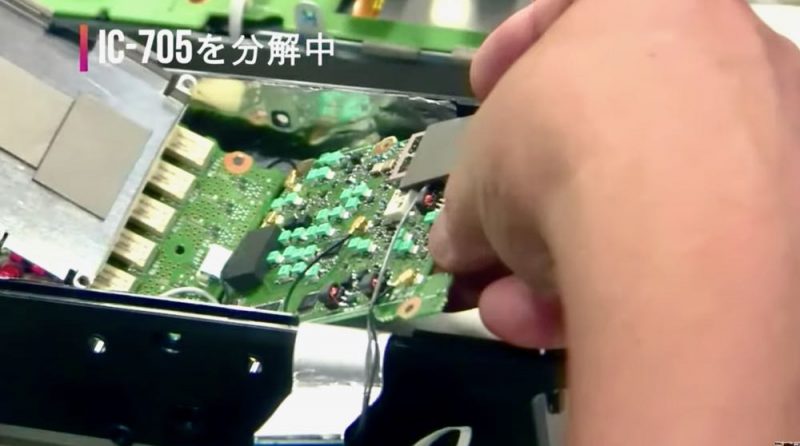
Many thanks to SWLing Post contributor, Dave Zantow, who shares the following video (in Japanese) where a technician performs an IC-705 cabinet breakdown and examines the internal PC board layers:
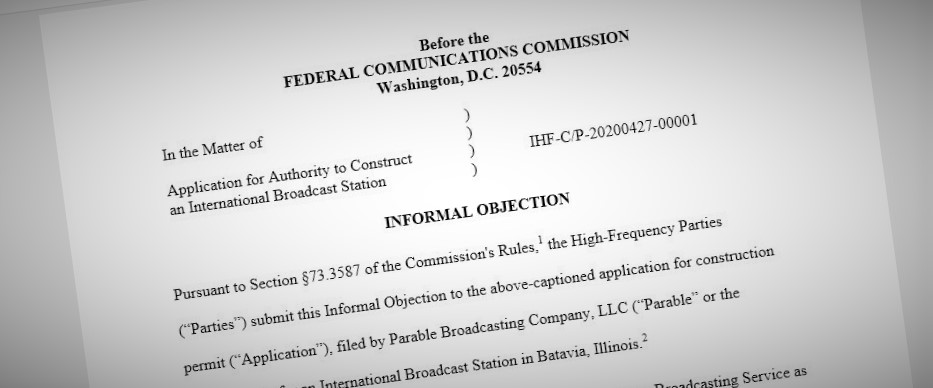
Many thanks to SWLing Post contributor, Bennett Kobb, who shares an FCC Informal Objection he drafted and filed together with Kim Elliott and Christopher Rumbaugh.
There’s a plan in the works to build a new international shortwave radio station in Illinois, one that would use the Digital Radio Mondiale modulation system. But now several prominent members of the U.S. shortwave community are asking the Federal Communications Commission to take a closer look first.
Parable Broadcasting Co. in April asked the FCC to allow it to build the station in Batavia, Ill., west of Chicago, using the call sign WPBC. It wants to offer “broadcasting and data services.”
Specifically, Parable wrote that the station would “serve the areas of Europe that may be authorized by the commission. The planned broadcast content includes religious and educational programming, as well as data content provided by third parties.” It added that it wants to “take advantage of the recent push by the National Association of Shortwave Broadcasters to develop and provide content for the growing DRM market.”
Now three individuals, collectively called the High-Frequency Parties, filed an informal objection. It’s that wording about data content that concerns them.
Bennett Z. Kobb, Kim Andrew Elliott and Christopher D. Rumbaugh said international broadcast stations in the U.S. are intended “to be received directly by the general public in foreign countries.”
Now they told the FCC that it is impossible to tell from the Parable application whether all of the data services and data provided by third parties will qualify. [Continue reading at Radio World…]
Bennett clarified with me:
The [FCC] rules require these [broadcasters] to be 100% broadcast stations, not a cover for some other kind of service.
Because there is no established radio service for international shortwave trading, some have used the workaround of calling them “experiments”. Quite a few such “experimental” stations have been licensed, some at rather high power levels.
But legally, the Experimental Radio Service is supposed to be for temporary scientific purposes, not ongoing for-profit operations. We don’t know what those stations are really up to because the FCC has kept the details secret. All we know is some technical data such as callsigns, frequencies, QTH.
Instead of experimental stations, others wanting to get into the data business — including the Turms Tech station in New Jersey, and this Parable station in Batavia IL — seem to be using the work-around of the International Broadcast service. That is, proposing an audio programming station that uses the DRM data channel for trading messages.
We are not in the 1970s or 80s. There’s not enough money today in broadcasting audio to other countries, to justify the millions spent on real estate, engineering, antennas and transmitter plant. Most SW broadcasting around the world is not commercial. So it is very peculiar for new entrants to drop major bucks in this field.
The new guys are probably not getting in to spread the gospel. That is a surface paint. There are already several U.S. HF stations with religious content, as you know, including WTWW, WWCR, WRMI, WRNO, WINB, WWRB, WHRI, WBCQ, WJHR etc. and most would welcome new customers for airtime.
No need to construct new stations.
So what is this new station really? Get it out in the open and ask them how they intend to comply with the existing rules. If they are in the business of carrying secure messages for traders, that does not qualify and will need some special FCC action to allow it. Let the public see the reasoning.
The rules that exist are very old. We think FCC needs to do a top-to-bottom review of the HF broadcast rules and scrap a lot of it. FCC should permit stations to be built for U.S. domestic audiences, and they should reduce the minimum AM power (50 kW) to lower this barrier to
entry.
And they should perhaps consider how data communications could be formally authorized. Maybe it wouldn’t be just a broadcast service any more, it could be a HF Communications Service with the old restrictions on languages and advertising discarded and more opportunities for people to try out creative ideas.
So we’re pressing the issue that this needs to be examined. Thanks for reading.
Thank you for sharing this, Bennett! We hope your filing gets its due attention. I also agree on one of your final points, that the FCC lower its 50 kw AM power requirement of a shortwave station as it places a huge barrier in front of would-be shortwave broadcasters.
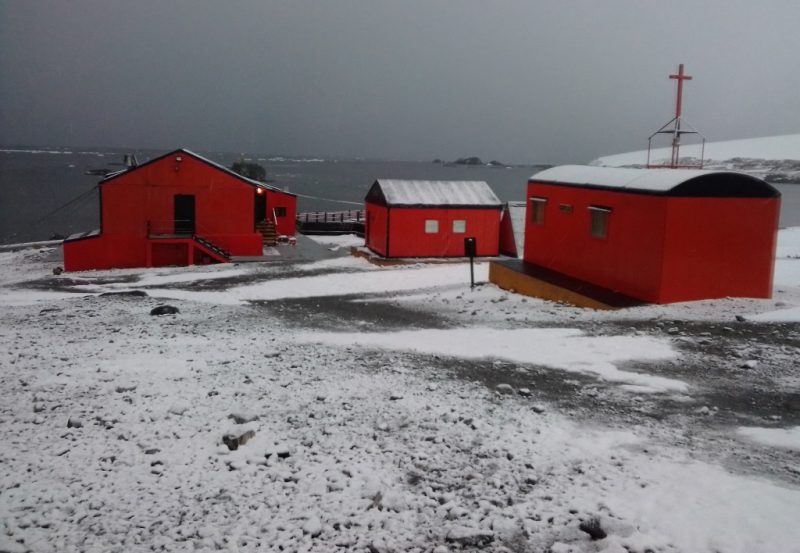
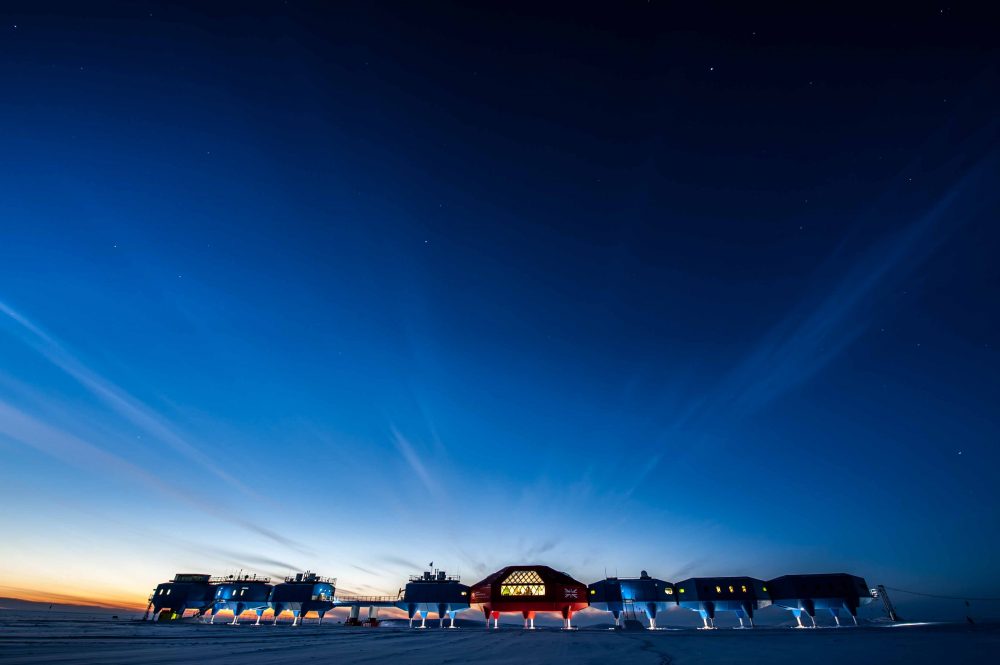
Halley VI Research Station on the Brunt Ice Shelf in Antarctica (Source: British Antarctic Survey)
On Sunday, 21 June 2020, the BBC World Service officially transmitted the 2020 BBC Antarctic Midwinter Broadcast–an international radio broadcast intended for a small group of scientists, technicians, and support staff who work for the British Antarctic Survey.
This is one of my favorite annual broadcasts, and I endeavor to listen every year. Once again, the SWLing Post called upon readers to make a short recording of the broadcast from their locale.
Below are the entries, roughly organized by continent and country/region.
Did I miss your recording?
Putting this post together takes almost a full dedicated day sorting recordings, uploading, and formatting them for the Post. Many readers posted a link to their recording on Facebook, Twitter, or even in the comments section on previous posts. I tried to hunt down these links, but if I’ve somehow missed including your entry, please send me an email with details and a link to your recording; I’ll amend this post.
So, without further ado please enjoy the following recordings:
The 2020 BBC Antarctic Midwinter Broadcast Recordings
Here are a couple of samples from the 2020 BBC Antarctic Midwinter Broadcast, both on 5790 kHz, the first one at 21:53 UTC, the second one at 21:59 UTC.
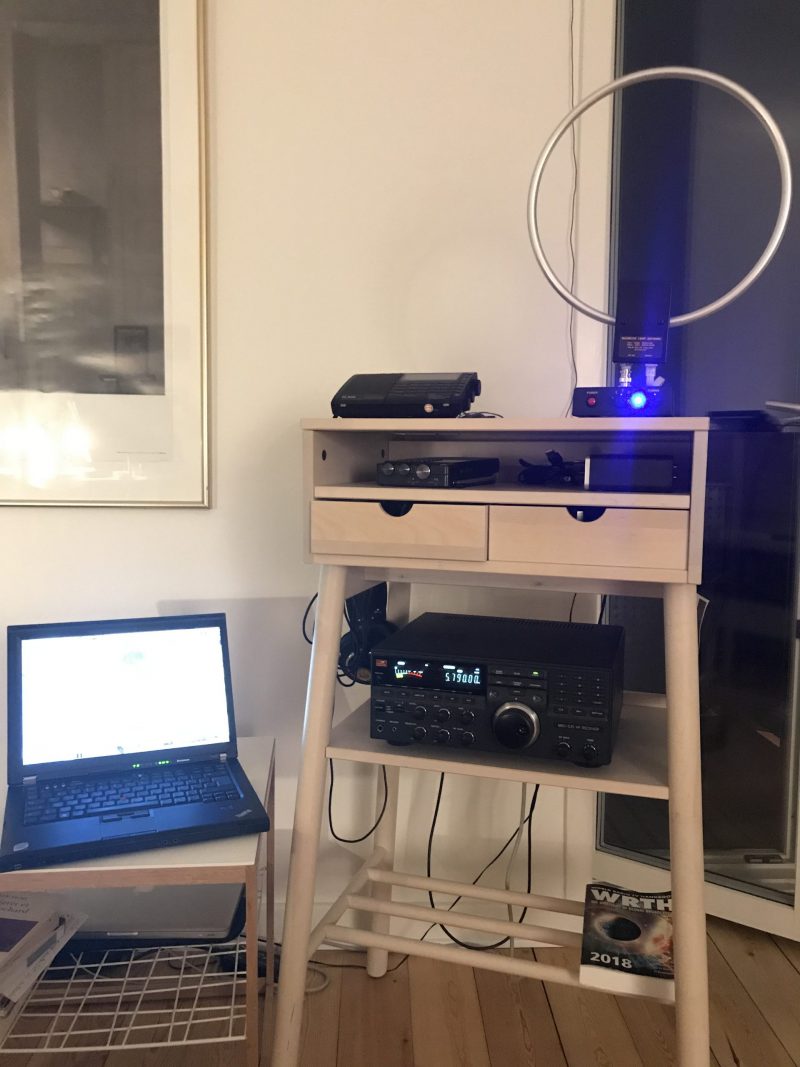
My receiver is a JRC-NRD 535 with an AOR LA400 loop antenna and I used a Roland Edirol R-09 recorder.
My location is Aarhus, Denmark. Best reception from here was on 5790 kHz followed by 7360 kHz (weaker signal and a bit background noise) while 9580 kHz was barely audible.
I really enjoy reading your articles, reviews, etc. in both your website and blog. thank you very much!
England
SWL: Paul Lethbridge Location: Worthing, England Notes: 9580 as received in Worthing with some talkback from G0JXX on 2mtr to me G3SXE
SWL: David (G4EDR) Location: North Yorkshire Notes:
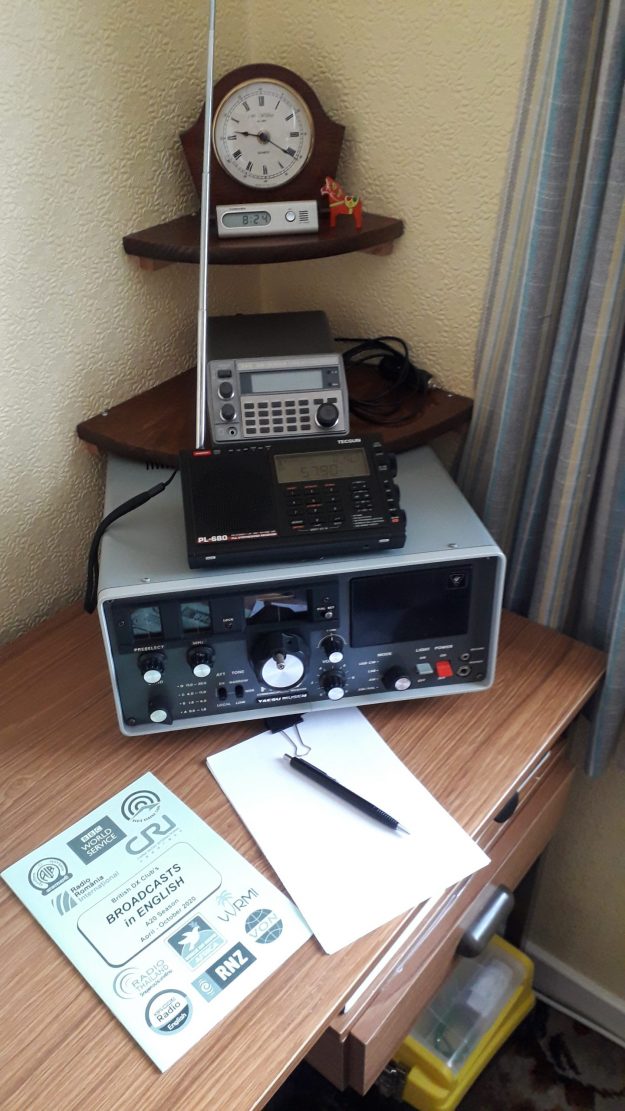
I used my Tecsun PL-680 and its telescopic whip antenna to receive the annual mid winter broadcast. 5790 kHz was very strong here on the North Yorkshire coast in the UK. My audio recording was taken from the loud speaker using my mobile phone. Hope the quality is acceptable for posting on your website.
73, David – G4EDR
SWL: Mark Hillman Location: Littlehampton, West Sussex Notes: 132ft longwire at my QTH in IO90RT (M0TVV)
SWL: Mark Hirst Location: North Hampshire, UK Notes:
I hedge my bets this year and monitored both 5790kHz and 7360kHz using my RSPDuo and FRG-7700 respectively.
Below is the beginning of the broadcast on 7360kHz, recorded in North Hampshire, UK:
7360 kHz deteriorated towards the end, so the RSPDuo recording will be the keeper.
SWL: Nick B. Location: England Notes:
Some recordings I made this evening on 5790kHz. I’m around 90 miles NE of Woofferton TX so it’s a big signal here!
Using Airspy HF+ Discovery, SDR Console in SAM mode.
Unfortunately, the BBC caused a lot of confusion due to their incorrect broadcast time (and incorrect pluralising Ascension Island!). I hope they managed good reception down in Antarctica.
SWL: Roseanna Notes:
I’ve got the BBC Midwinder 2020 broadcast recorded in pretty amazing quality for your archive post!
France
SWL: Philippe Location: Brest. France Notes:
Good morning Thomas,
i’ve recorded the last BBC Antarctic Midwinter broadcast.
I’m located near BREST, in west France.
Germany
SWL: Martin Location: Hannover, Germany Notes: Here is a recording of the 2020 BBC midwinter broadcast, received in Hannover Germany on my XHDATA D-808 and its telescopic whip antenna, with the strongest signal on 5790 kHz via Woofferton.
Thanks for bringing this broadcast to my attention!
SWL: Andreas Bremm Location: Western Germany Notes:
Hello Thomas i can send you my record from the BBC Midwinter Show sounds really good. It’s recorded with Tecsun ICR 100 Revived with Tecsun Pl880 and a MLA30+ Loop in Western Germany
Ireland
SWL: Alan Location: Ireland Notes:
5790 kHz Woofferton UK
BBC Antarctic Midwinter broadcast 21-06-2020 21:30UTC
Recorded from County Kildare, Ireland (GRID IO63ri)
Icom-718 and 20m Random wire
Olympus vn-741pc
Best regards,
Alan
Italy
SWL: Marco Origlia Location: Cuneo, Italy Notes:
My name is Marco and I am an Italian student in Telecommunications
Engineering. Thanks to one of our Professors, I’ve become enthusiast for
radio communications and day by day I’m becoming a shortwave listener. I
must thank you for your blog. I’ve added it to my RSS feed aggregator so
that I don’t miss any of your posts, which I always find very interesting.
Upon your invitation I would like to share a short recording of the BBC
Antarctic Midwinter Broadcast I made. The data of the recording are the
following:
Location: Cuneo, Italy (44.384413N, 7.542607E), from an indoor location
of a urban area
Frequency: 7360 kHz
Receiver: TECSUN PL-660 with wire antenna leaning out of the window
Time: UTC 2020-06-21 21.41
Although at times the signal faded, the broadcast was pretty clear.
I haven’t bought a jack to jack cable to pipe the output of the radio to
the computer, yet. So I plugged my headphones into the computer, I put
the headphone microphone on the radio speaker, I recorded the broadcast
with OBS and converted it using VLC.
Thank you again for your service to the shortwave listeners community,
Marco Origlia
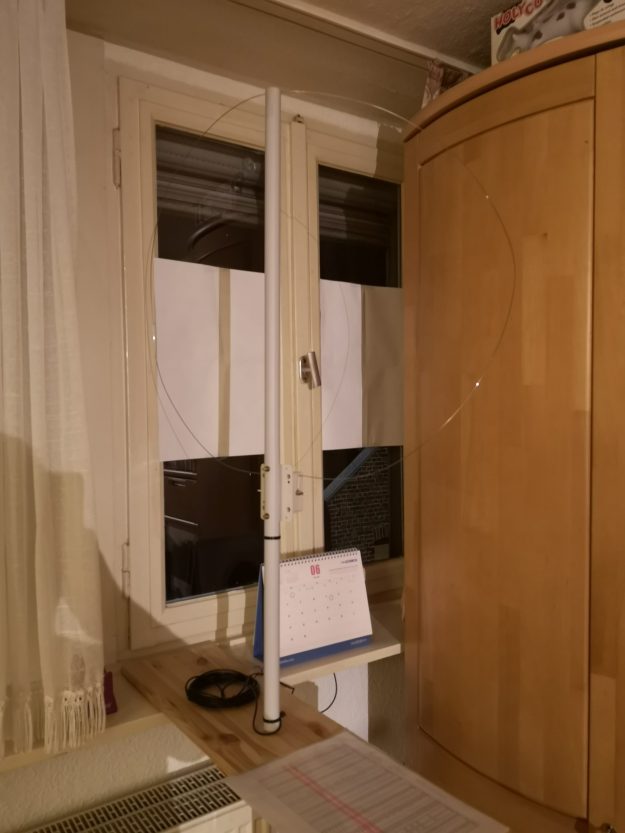
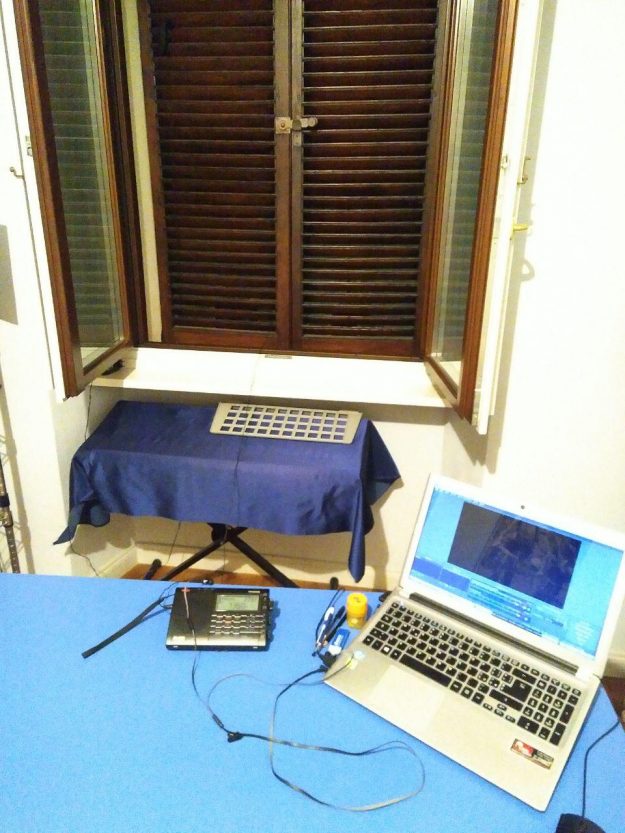
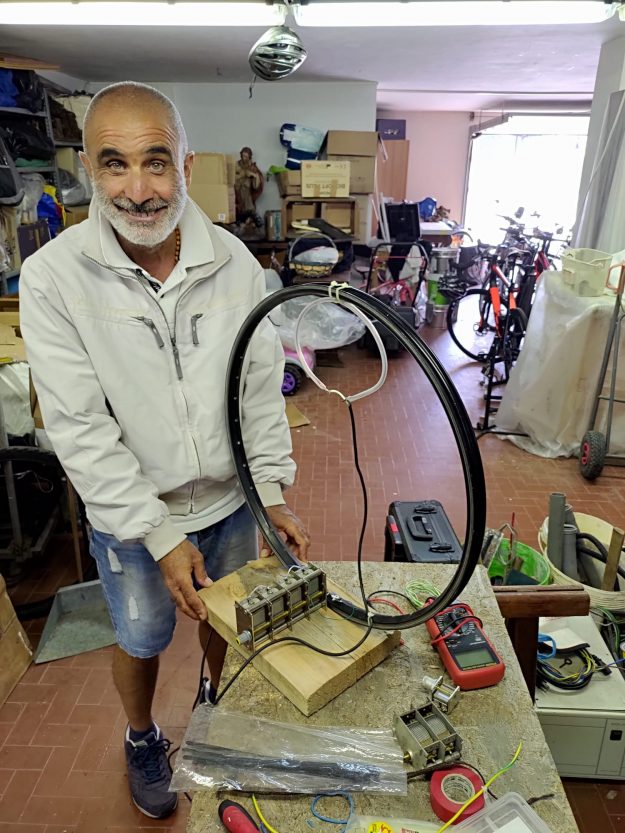
SWL: Giovanni Lorenzi Location: Messina, Sicily Island Notes:
I’m Giovanni Lorenzi, and I’m a amateur radio too. I live in Messina, Sicily Island. My working condition are: receiver Yaesu FRG-7000 and dipole antenna.
I’ve tuned the program above and I’m sending 3 audio clip about.
Giovanni Lorenzi
SWL: Giuseppe Morlè (IZ0GZW) Location: Formia, Central Italy Notes:
I’m Giuseppe Morlè, iz0gzw, from Formia, Central Italy, on the Tyrrhenian Sea …
Also this year I send you the link where you can see My Antartic Midwinter 2020 video.
I hope you will publish it on SWLing Post for the swl community of the world …
I thank you and always wish you good listening.
Ciao from Italy.
Poland
SWL: Przemys?aw Ryszka Location: Jaslo, Poland Notes: Recorded in Jaslo, south-eastern Poland using Tecsun PL-360 and some lenght of a wire.
Russia
SWL: Anton Kolesnichenko, R9LAU Location: Tyumen, Russia Notes:
SWL: Dmitry Elagin Location: Saratov, Russia Notes:
Good afternoon!
Hello from Saratov, Russia!
UTC time: 21:30 – 22:00
Frequency khz: 9580
Weak signal. Local impulse interference. Sometimes fading a weak signal and noise at frequency.
Signals 7360 and 5790 are much stronger.
Receiver: SDRplay RSP1
Antenna: Long wire antenna 7 meters + counterpoise 20 m. (10 – 14 m. above ground level)
MFJ-959C Antenna Tuner SWL and Preamp / MFJ-931 Artificial RF Ground
Receiver location: Saratov, Russia
North America
Canada
SWL: Richard Lacroix Location: Toronto, Ontario Notes:
I managed to receive on all 3 frequencies from Toronto, Ontario Canada. Best
of them was 9580 kHz. I first started to listen on 7360 kHz as this was the
only working frequency. Reception was poor, hence the poor audio recording.
Conditions rapidly got much better which allowed me to switch to 9580 during
the broadcast period with much better reception.
SWL: Richard Langley Location: Hanwell, New Brunswick Notes:
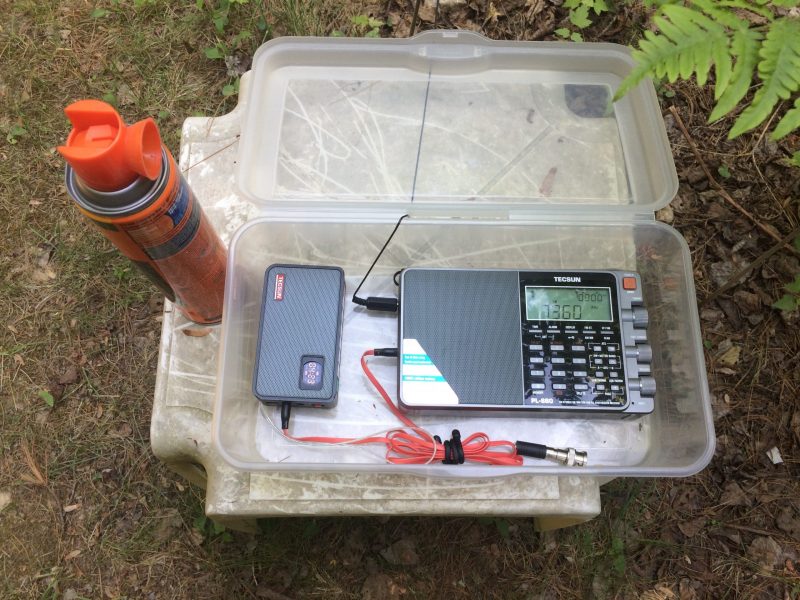
I obtained a good recording of the BAS broadcast here in New Brunswick, Canada, on 7360 kHz using a Tecsun PL-880 receiver outdoors at my house with a Tecsun AN-03L 7-metre wire antenna strung to a nearby tree. Attached is a photo of the “listening post” at the back of my mosquito-infested backyard. Note the bug spray!
Received in Ottawa, Canada using an XHDATA D-808 with ~15 feet of wire clipped to the telescopic antenna. Location was on a balcony, east facing about 20 feet above the ground. Nothing heard on 5790, faint signal on 9580 and readable with variable fading on 7360 (maybe S3R3-4). Recording here:
Oceana
Australia
SWL: Cameron Campion Location: Melbourne Notes:
Hello Thomas, Here is my reception of the BBC Midwinter broadcast from here in Melbourne, Australia with my XHDATA Receiver. I received first on 7360khz and then switched to 5790khz where the reception improved substantially.
New Zealand
SWL: Chris Mackerell Location: Marahau, New Zealand Notes:
Here are a couple of clips from the BBC Midwinter broadcast
for Antarctica received here in Marahau, New Zealand.
This is 7360 kHz – the best of the signals. 5790 was weaker,
and 9580 was just a spike on the SDR display.
The clips are the first & last minute or so.
Receiver was an Elad DUOr with a Wellbrook loop antenna.
73 Chris
South America
Argentina
SWL: Ulises Chialva Location: Rio Primero, Argentina Notes:
My name is Ulises Chialva, Im 46 years old and I live in a small rural town called Rio Primero, in the Cordoba province, central region of Argentina. Im a DXer since the late 80´s and been a member of several clubs here in Argentina, also a monitor for Radio Netherlands in the 2000´s.
Today is a cold Fathers day here in Argentina, and at the moment of listening I was also enjoying a really beautiful sunset.
I’ve listen to this years BBC midwinter broadcast with my Sony ICF-2010 and a 45 meters long random wire antenna with a 9:1 balun.
Conditions were pretty good with the UK so I’ve listened to Woofferton station transmissions very clear on 5790 and specially 7360 KHz; 6170 and 9580 from Ascension Island were barely audible here.
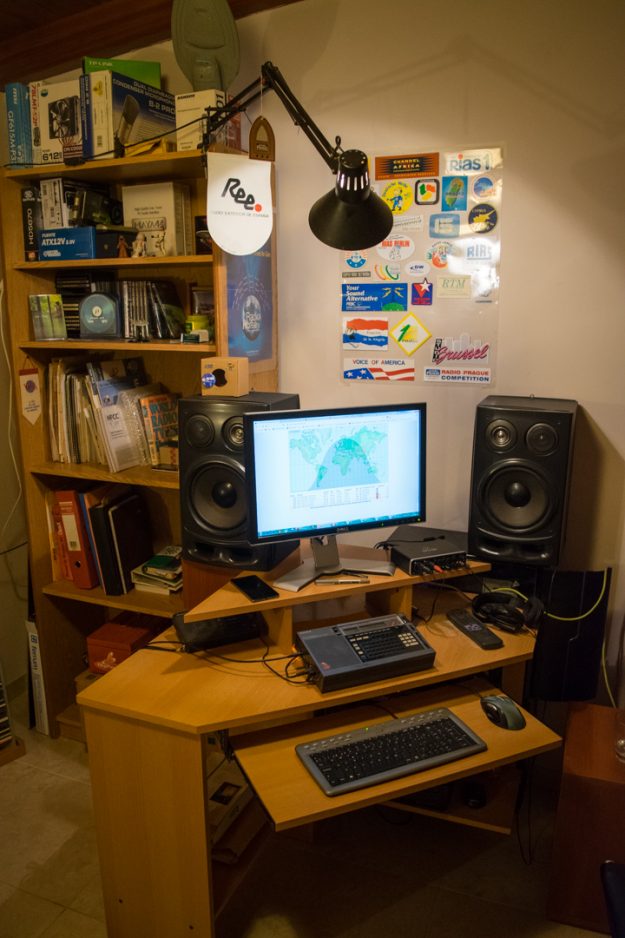
I send to you a little more than 1 minute recording of 7360 KHz from Woofferton, UK; and a photo of my little shack here at home.
Brazil
SWL: Carlos Latuff Location: Porto Alegre, Brazil Notes:
It was a risky listening to the Midwinter Broadcast during the Covid-19 pandemic, because I had to leave my home since inside my apartment it is practically impossible to listen to shortwave radio due strong interference.
I took my Tecsun PL-606 (telescopic whip only) to the Guaiba waterfront near my home here in Porto Alegre. It was a calm night with calm weather and the place was CROWDED; people with and without masks, ignoring the social distancing. I stayed only for a short time there, trying to keep myself away from people.
Chile
SWL: Francisco Miranda Fuentes Location: Santiago, Chile Notes:
I send you my participation to reception of the activity “2020 BBC Antarctic Midwinter Broadcast on June 21”. I also attach a recording in mp3 format corresponding to 44 seconds of the event.
Name: Francisco Miranda Fuentes
Receiving frequency: 7360 khz at Woofferton
Receiver: Kenwood R-1000.
Antenna: T2FD
Location of the box: Santiago, capital city of the Republic of Chile.
Recording: 128 bps mp3 format
Costa Rica
SWL: Julio Campos Location: Costa Rica Notes:
Hi. This is my brief reception. It was still daylight here, and there was a heavy storm. The reception was poor.
Wow!
Once again, many thanks to all of you who submitted your recordings of the BBC Midwinter Broadcast!
We’ll be sharing this post with both the British Antarctic Survey and the BBC World Service. And to all of you, from the SWLing Post: Happy (Belated) Midwinter! Happy Summer/Winter Solstice!
Many thanks to SWLing Post contributor, Mike, who writes:
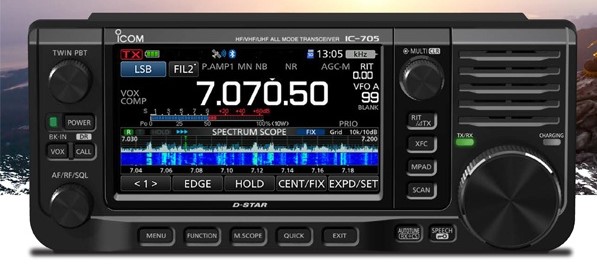
Hi, Tom: Icom Japan have just published a couple videos in Japanese where and enthusiastic JH1CBX takes us on a tour of the new IC-705. Although many of us don’t speak Japanese, it’s easy to understand what she’s talking about as she tours the radio features, functions, and ports. I’ve had an IC-705 on “pre-order” for months now, so I appreciate the preview. Perhaps Icom UK or America will follow-up with some videos as well. Thanks for all you do for the shortwave and ham radio community, Tom. 73, Mike
Videos
Thank you Mike! I plan to review the IC-705 and look forward to seeing how well it works in the field.

 Last week, I took delivery of an IQ32 SDR Transciever on loan from HobbyPCB. The IQ32 has been on the market for a few years now and is a fusion of the HobbyPCB RS-HFIQ and the STM32-SDR.