Category Archives: Shortwave Radio

Talking shortwave and spectrum on the Radio Survivor podcast

Last week, I had the honor of speaking with Eric Klein and Jennifer Waits on the excellent Radio Survivor podcast. It’s rare that in one show I get to spread so much shortwave radio love–thanks for making that happen Radio Survivor:

Perhaps you are like me and you have wished that you could go back in time and spin a radio dial and just listen to and browse the full radio spectrum from another time and place. Our guest on the show, Radio Anthropologist Thomas Witherspoon, is building a website for just such a thing. It’s called the Radio Spectrum Archive and it is not magic, it uses a piece of technology called a software defined radio that makes recording a full spectrum of Shortwave, AM and even FM radio (if you have the computing power to handle the load) a very real possibility. Thomas Witherspoon is also the primary contributor to The Shortwave Listening Post (www.swling.com) so we are going to learn a few things about the wonder that is shortwave radio on planet earth.

Click here to download the podcast audio.

Click here to listen via Radio Survivor.

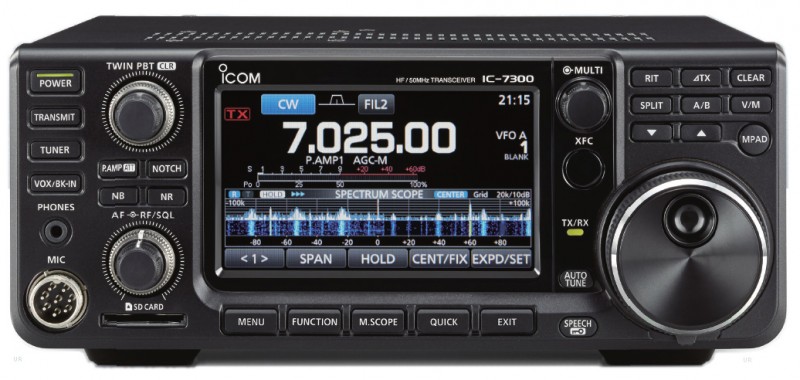
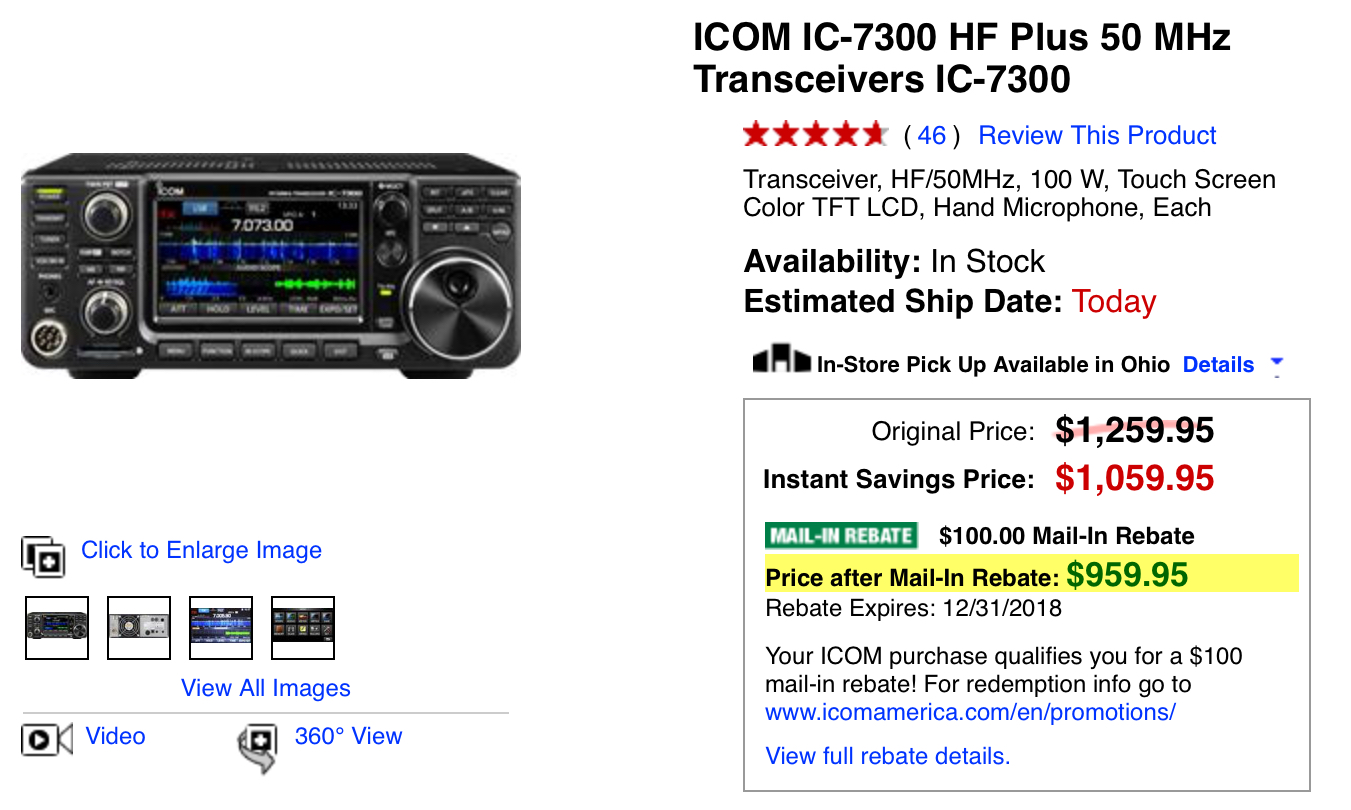
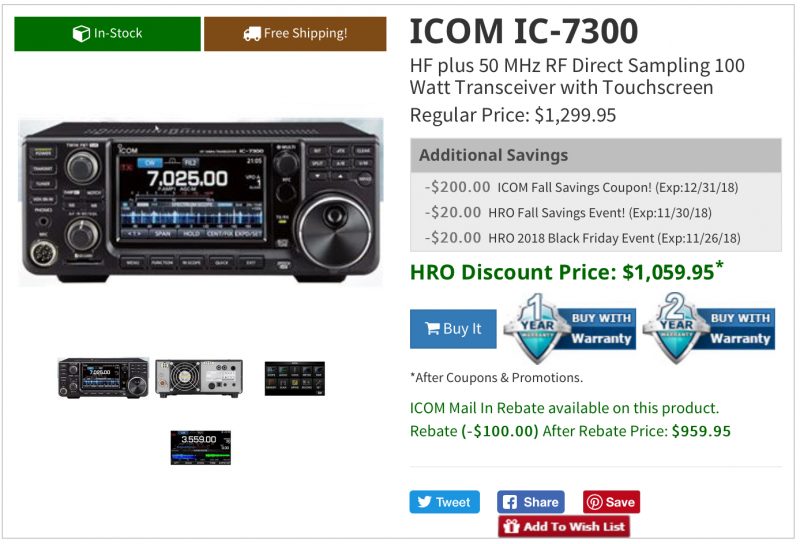
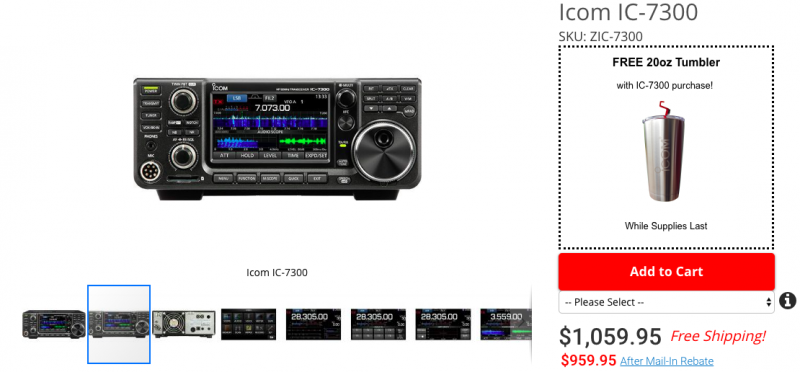
Black Friday Radio Deals: Icom IC-7300 $959.95 after rebate

Many thanks to SWLing Post contributor, James (W4AMP), who notes that the excellent Icom IC-7300 general coverage transceiver (click here to read our review) is currently $959.95 after coupons and rebates at GigaParts, DX Engineering and Ham Radio Outlet. 

DX Engineering

Click here to view at DX Engineering.

Ham Radio Outlet

Click here to view at Ham Radio Outlet.

GigaParts

Click here to view at GigaParts.

Editorial: Need for ABC HF service to remote Australian communities

Many thanks to SWLing Post contributor, Nigel Holmes––formerly of Radio Australia––for the following op ed.
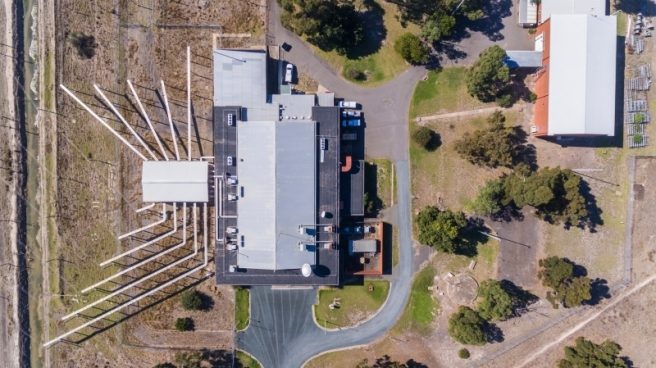

The Shepparton transmitter site of ABC/Radio Australia

Developments in the Australian domestic HF broadcasting scene

by Nigel Holmes

Radio broadcast on HF (high frequency or shortwave) has a solid role to play in the pantheon of media in the Australian and pan-Pacific context. It might be off the radar for the urban masses, but HF radio is the proven, economical alternative to satellite and cable for communication over continental or oceanic distances. Our commercial airlines use HF radio every day. So do our mining companies and emergency services. People holidaying in our remote areas buy or rent HF transceivers for their cars. Australia has the largest number of civilian users of HF radio in the world.

For thirty years a simple system of three HF transmitters quietly provided Australian Broadcasting Corporation (ABC) radio to remote populations across inland Australia, the Northern Territory (NT). Centered on Alice Springs, Tennant Creek and Katherine each transmitter reached out nominally 450 km, covering an area of nearly 2 million square kilometres. In practice the area serviced was larger, extending into Queensland and Western Australia. Such is the utility of this versatile medium. The audience was small, only a couple of hundred thousand, living or moving through the most remote places in Australia, but this was their lifeline.

During the cyclone season, storm alerts and flood warnings would reach people in the inland beyond the call of AM and FM networks. Yes, such people do exist in Australia and elsewhere in the Pacific.

Like many marginalised communities the HF radio listeners of the outback struggled to make urban elites understand their very real world. So in 2016 when the ABC announced the closure of the domestic HF transmitters in order to fund its DAB+ radio rollout in Canberra and Hobart, the backlash from the remote communities was shrugged off and the closures proceeded in 2017. ABC pointed at its satellite as an alternative, but had no answer when asked how to equip a jillaroo’s horse, a dusty 4WD or an offshore tinnie with a fragile satellite dish, an expensive receiver and the power point to run it all.

People who are used to an effective service tend to take its loss badly. So it has been in the NT. Politicians were pursued by the inland listeners wanting a better deal. The matter has culminated with the main opposition Australian Labor Party pledging to restore the HF distribution of ABC within Australia if it wins the forthcoming the federal election.

Let’s hope political expediency at the federal government level and within ABC doesn’t foul this up. We don’t want a half-baked resurrection as a sop to fend off critics of the ABC or to let politicians grandstand.

The three domestic HF sites in the NT cost a lot more than AUD$1.9 million p.a. to run. That was a figure bandied about by ABC after criticism of its DAB+ expansion costs. But for a sum in the order of half that, plus re-establishment costs, a service can be implemented which would have greater coverage, better reliability and lower outgoings. What’s not to like? The key is the former Radio Australia HF station at Shepparton, Victoria.

The cost of electricity at the NT sites was horrendous. Apart from feeding three thirsty 50 kW tx, huge air conditioning plant was required at each site to pull out waste heat and combat 50°C summer temperatures. Maintenance costs were savage. On-air availability was lousy (worst in the ABC network) because of environmental challenges and long maintenance travel times.

So here’s a plan: re-locate a near-new Continental 418G HF 100 kW transmitter from Tennant Creek to Shepparton. Electricity is much cheaper and more reliable at Shepparton. It’s a cooler site and has permanent, trained staff. The consolidation of spares and expertise with the other Continental transmitters at Shepparton makes engineering and economic sense. Re-locate the two small 6-12 MHz HR2/2/0.4 and HR2/2/0.6 aerials from the former RA station at Brandon. Erect them both as AHR2/2/0.4, align one on a boresight of 000°T and the other one on a boresight of 320°T. Feed both aerials from the transmitter via a splitter, run the transmitter at 80 kW so each array receives 40 kW. Run a 5.9 MHz channel at night and a 9 or 11 MHz channel during daylight. Bingo. You now have a two-frequency network covering the sector between 020° & 300° at a range of 1500 km -> 3000+ km. What a great conduit for cyclone/flood alerts, quality news and entertainment and if the ABC can manage that then it might just get back to meeting its charter obligations to all Australians.

Nigel Holmes
November 2018

Updated Raspberry Pi image for SDRplay software defined radios

(Source: SDRplay via Jon Hudson)

SDRplay is pleased to announce the availability of an updated Raspberry Pi3 image: This release (V0.4) is a complete image for the Raspberry Pi 3 with a range of pre-built applications for SDRplay devices.

Please note the following:

1. This software is made available purely for the convenience of users to save them from having to build the software themselves from source code.
2. All software apart from ADS-B is provided by third party developers and SDRplay can take no responsibility for any faults or bugs and is unable to provide support. For any support for these applications, we recommend that users contact the original authors.
3. Where the RSPduo is supported by applications, it can only be used in single tuner mode.
4. Whilst this should work with all RPi3s, we have only tested with RPi3 B+ and that will provide the best performance.

List of known issues:

SoapyRemote

Will only work over LAN connections and locally. It will not work over Wide Area Networks

CubicSDR
Will only support the RSPduo in single tuner mode

Gnu Radio
No known issues

GQRX
Some limitations with tuner hardware control
Audio only via USB and HDMI audio
CPU load is quite high and may cause audio stuttering

ADS-B
RSPduo not currently supported
Port B is the default port for the RSP2

Qt-DAB
Will only support the RSPduo in single tuner mode

TCP Server – This is a fork of the RTL-SDR (TCP) server developed by F4HH. This software should work with any client that supports the RTL-SDR (TCP) server software with some limitations. This software should be viewed as being for experimental purposes.
RSP2 works only on port A
RSPduo not supported
Maximum sample rate limited to 3.2 MHz
Some limitations with RSP1A RF gain control

Download links:

https://www.dropbox.com/s/kvaatu0ndet5pns/SDRplay_RPi3_V0.4.img.xz?dl=0

or

https://www.sdrplay.com/software/SDRplay_RPi3_V0.4.img.xz

Size: 2249196664 bytes (2145 MiB)

Checksums:
CRC32: 204AE0BE
CRC64: 76FAA00F83A96F1D
SHA256: 2BDB44BFCA95241AA9FE26F02EFB78FD0370869AC2775F76832AC68F7E9DA153

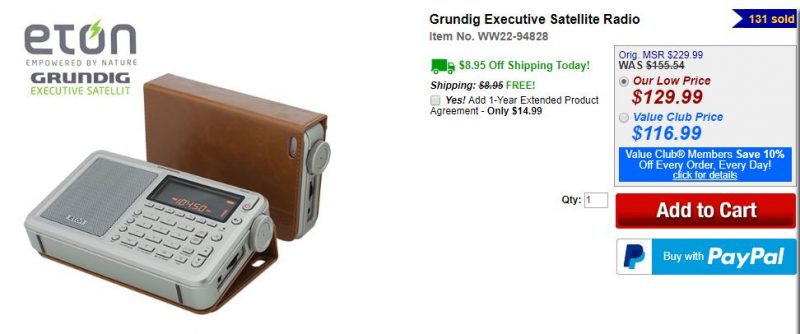
Heartland America’s Grundig Executive Satellit deals

Many thanks to SWLing Post contributor, John Figliozzi, who writes:

I figure you’re the best source to get word of this out. Heartland America (1-800-229-2901) (www.heartlandamerica.com) is selling refurbished Grundig Executive Satellit receivers for $129.99 (MSRP $229.99).

The ad states “Factory serviced to meet original quality standards – may have slight cosmetic blemishes”.

It is Item No. 1Z-94828.

I have one of these I bought earlier this year on a similar deal from Heartland America. It works and plays perfectly and if there is a blemish, I’ve yet to find it. This is an excellent portable at a bargain price.

Excellent, John!  Thanks for the tip!

Click here to view this deal at Heartland America.

If elected, Labor commits to provide $2 million to restore ABC shortwave radio

Many thanks to SWLing Post contributor, Ian P, who shares the following story and interview via ABC News Northern Territory Country Hour. I strongly suggest listening to the full seven plus minute interview via the embedded audio player below:

Click here to download audio.

If elected next year, Federal Labor says it will provide the ABC with $2 million in funding to help re-establish shortwave radio services across the Northern Territory.

The ABC controversially switched off its shortwave service in January 2017, and defended the decision by saying it would “only affect a very, very small amount of people” and save taxpayers up to $1.9 million.

The decision was heavily criticised by industry groups such as the NT Cattlemen’s Association (NTCA) and the NT Seafood Council.

NTCA president Chris Nott welcomed today’s announcement by Labor and said the ABC’s decision was short-sighted.

“What people take for granted in the cities is a luxury for those of us in the bush,” Mr Nott said.

“We rely on the HF shortwave radio transmitters because we don’t have mobile and data coverage for AM and FM radio stations.

“The ABC can expand its modern day platforms all it likes but the truth is we don’t all have access to it and the ABC did not care at all about the impact of its decision.”

Federal Member for Solomon Luke Gosling, said the axing of shortwave had angered a lot of people and community groups.

“Many thousands will benefit from this [bringing back shortwave],” he told the Country Hour.

“I was lobbied by a really large cross-section of the community that spends time in remote areas and when shortwave was cut there was a lot of angst, so it will be a good thing to bring it back to keep people on the land and waters connected.”

Click here to read via ABC News.

Many thanks, Ian!

SWLing Post Contest Question #2: A chance to win a piece of broadcasting history!

RCA Window from MI-7330

Last week, we announced a new contest to celebrate the SWLing Post‘s 10th Anniversary.

The prize is an amazing piece of broadcast history: a 75 year old round plate glass window that was fitted in the central main door of the RCA senders at the Woofferton, UK, transmitting site in 1943. This prize was generously donated by SWLing contributor and friend, Dave Porter (G4OYX).

Please read our original contest post (click here) which describes how you can enter to win.

The original post also contains the first of five contest questions which count as individual entries in the contest.

And now for our second question and second possible contest entry…

Please note: If you read the SWLing Post email digest, you will need to view our prize questions on the web to see the embedded form.

If the form below does not display, click here to open it in a new window.

Our second question:

We will post question #3 next week!

Click here to answer question #1.