Category Archives: Shortwave Radio

Why shortwave radio makes an idea “a powerful weapon”

Many thanks to SWLing Post contributors Rich Cuff and Mike Hansgen who share the following Op Ed piece from the Sydney Morning Herald:

Warning: put down any power tools and ensure you’re not operating heavy machinery before you read the next sentence. We’ve been outflanked!

Of course, unless you’re completely benighted or under some sort of strange, personal news blackout that prevents you even glancing at the front pages of newspapers, you’ll probably have already realised that China is extending and developing its relations with our close Pacific neighbours. This was, after all, only to be expected. Beijing and Taipei have long recognised the value of these countries’ votes in the United Nations; it’s not much of a step from there to glance at the map and recognise the islands’ have other significance as well. As China began expanding its international reach it was only natural it would similarly strengthen other relationships, including defence links.

[…]Nature abhors a vacuum and so, as we’ve been demonstrating less and less interest in this region, others have occupied the space.

The clearest example of this has been the strategically idiotic, fiscally-driven and wilfully blind destruction of Canberra’s lone voice in the region, the (once vital) ABC shortwave service, Radio Australia.

Sure, the internet’s better than a crackly radio signal. But simply to access the net requires computers and bandwidth, neither of which are readily available to the audiences in the South Pacific. And even if someone can manage to obtain a connection, the next problem is finding services, particularly news and information ones, that are relevant to your situation.

Someone in Apia (Samoa) is unlikely to be transfixed by events in Adelaide (South Australia) unless, of course, it’s their Seven’s team playing at the oval. Similarly a person in Buka (Bougainville) is likely to be bored by reports from Belgrade or Bulgaria, although not information about BHP Billiton. RA provided an independent, reliable news service specifically dedicated to the needs of its audience. Critically, it offered a vital, secure and trusted way of connecting islanders to their capitals and, through that, to the world.

The big advantage of shortwave services was that they could be heard; were relevant; and formed a starting point for a community. But as far as the ABC was concerned the broadcasts were nothing more than a big bag of money to raid in order to boost its domestic budget.[…]
Read this full article at The Sydney Morning Herald.

Channel292 broadcast tests this weekend on 7440 kHz

(Source: Southgate ARC via Eric McFadden)

Channel292 tests

The Amateur owned and run AM Short-wave broadcast station CHANNEL292 will be starting testing on their new 41 metre broadcast band frequency of 7440 kHz from this weekend onwards.

Rainer Ebeling DB8QC who owns and operates the station from near Ingolstadt in the state of Bavaria in southern Germany would appreciate all signal reports which can be sent simply via the form on the channel292.de website at http://www.channel292.de/deutsch/kontakt/
or
http://tinyurl.com/y78etubo in Google translated English.

Don’t forget the existing frequency of 6070 kHz in the 49m broadcast band will still carry Channel292’s existing programs. The planned programs for both frequencies are available on the Channel292.de website.

73  Ed  DD5LP

Radio Exterior de España: Shortwave expansion to include English language service

Many thanks to SWLing Post contributor, Tracy Wood (K7UO), who

I just listened to REE’s 30-minute English broadcast for this Friday with Alison Hughes and Justin Coe…! (REE is relayed on Hispasat so audio quality is superb.)

Big news! Engliish is coming back to shortwave starting 29 October along with the other foreign languages..

The podcast of Friday’s show with the formal announcement (and frequencies) has yet to be posted but it will be here: http://www.rtve.es/alacarta/audios/emision-en-ingles/

Tonight’s show was very celebratory with lots of old shortwave audio clips, well worth a listen in its own right.

Many thanks for the tip, Tracy!  These are exciting times for REE shortwave listeners. Click here to read our previous post about the REE shortwave expansion.

Listen to this show via the embedded player below:


Do you enjoy the SWLing Post?

Please consider supporting us via Patreon or our Coffee Fund!

Your support is greatly appreciated. Thank you!

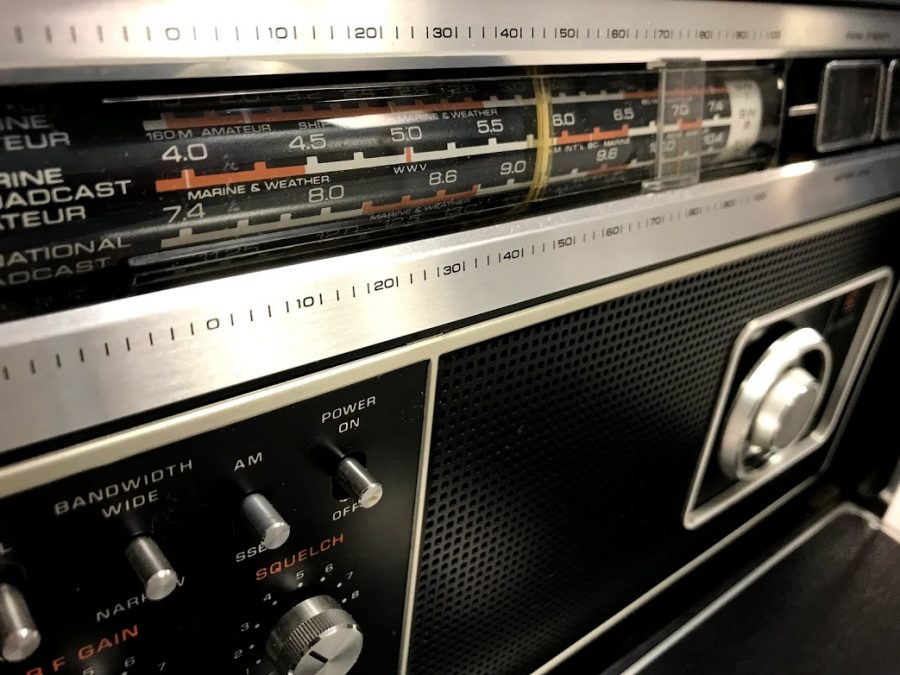
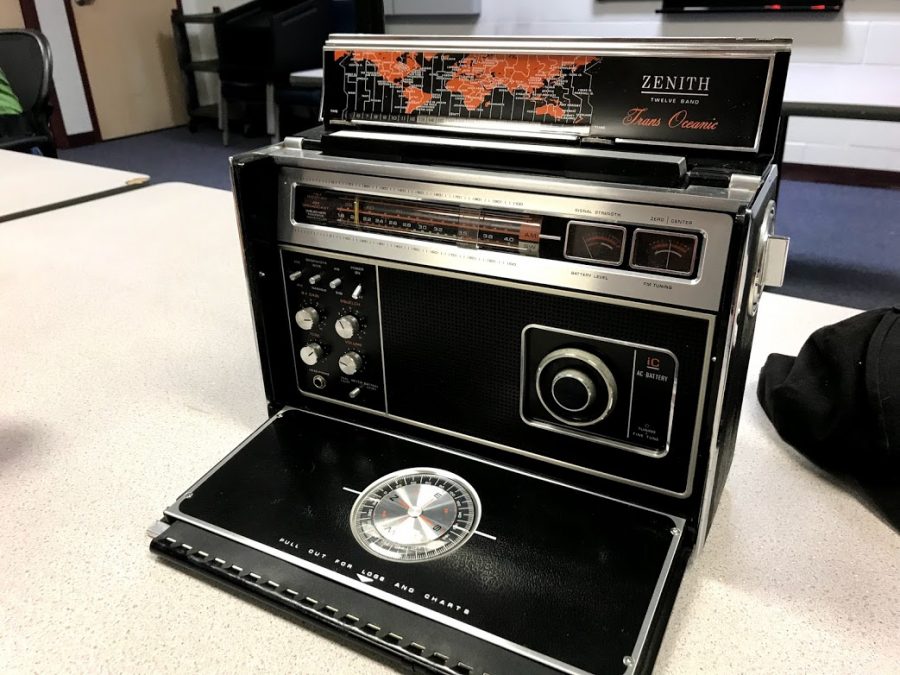
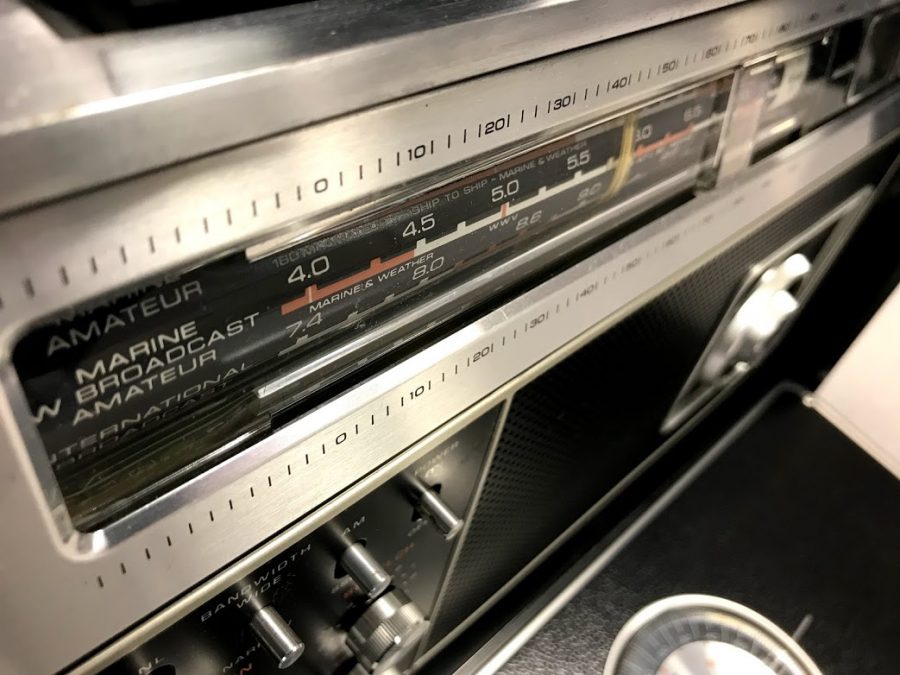
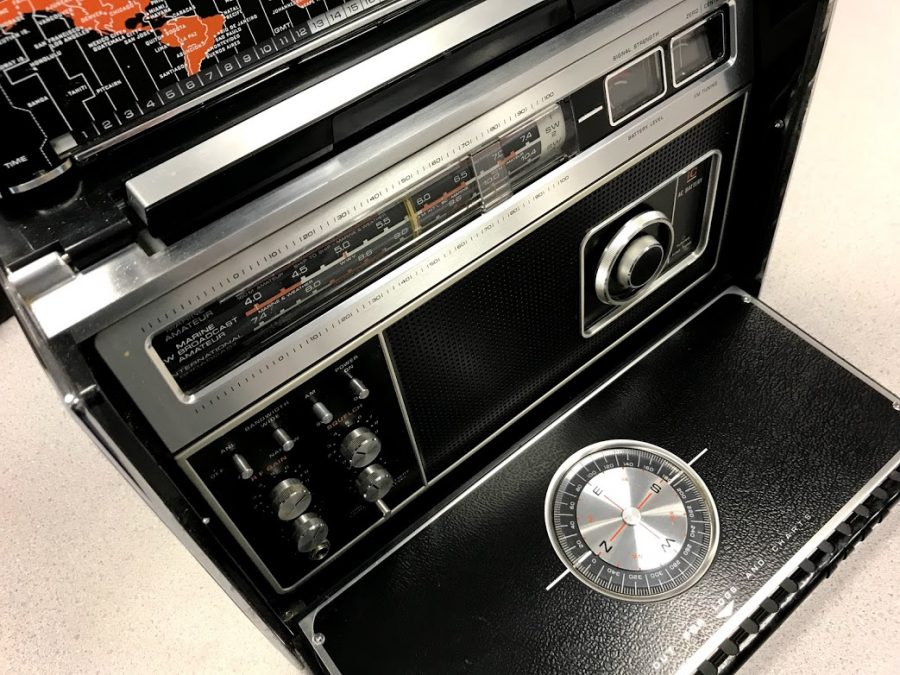
The gorgeous Zenith Model R-7000-2 Trans-Oceanic

Tuesday night, I attended a local radio club meeting with buddy Vlado (N3CZ).

Neither of us had ever attended this particular club, although we both knew a number of the members.

What was the first thing I spotted when I entered the meeting room? A pristine Zenith Model R-7000-2 Trans-Oceanic! Talk about a good omen!

Turns out there are no less than two Trans-Oceanic collectors in this group of about two dozen ham radio operators. The owner of this Model R-7000-2 told me that he has every Trans-Oceanic including the coveted Clipper and Bomber models.

I’m not sure I had ever seen the Model R-7000-2 in person. It’s a striking radio and the last in the line of the Trans-Oceanic sets–this model was produced in 1981.

Of course, I had to snap a few photos of this beauty.

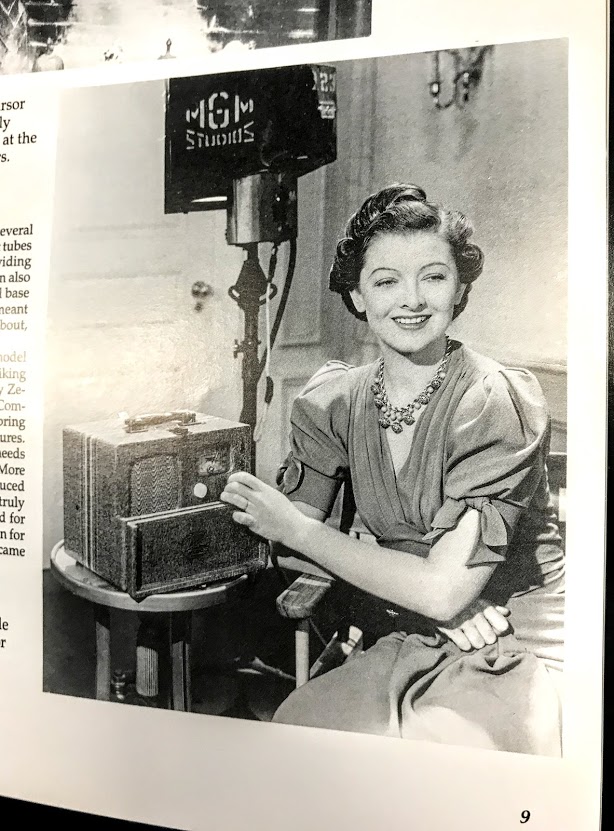
Speaking of beauties, this Zenith enthusiast also brought his copy of the John H. Bryant and Harold N. Cones seminal volume: The Zenith Trans-Oceanic, the Royalty of Radios. (A book I highly recommend.) On one of the pages I rediscovered an image of my favorite 1930s/40s actress, Myrna Loy:

I first fell in love with Myrna Loy watching the classic film series: The Thin Man. I’m a massive fan of Loy/Powell films. Here’s the trailer from the first of the Thin Man series:

Any Post readers own the Trans-Oceanic Model R-7000-2?  Any one else in love with Myrna Loy? Please comment!

Vatican Radio notes shortwave frequency changes

Vintage Vatican Radio QSL

(Source: Vatican Radio via Mike Hansgen)

Shortwave Frequency Changes for the English Africa Service starting on 28 October 2018 to March/April 2019

Daylight saving time in Rome
We wish to inform listeners that with the end of Daylight Saving Time in Rome on Sunday 28th October, there will be changes in the time and broadcast frequencies of the English Africa Service.

The programme will be going on air one hour earlier at 16.30 UTC (GMT) on the following shortwave frequencies: 11625 kHz (25mb) and 13830 kHz (21mb)

It will be repeated at 20.00 hours UTC on 6010 kHz (49mb) and the 7365 kHz (40 mb).

Listeners in Rome
For listeners in Rome and the Vatican who have a digital radio receiver, the ‘English Africa Programme’ can be heard on Vatican News’ World Channel on digital radio DAB+ at 17.30 Rome time and the repeat broadcast at 21.00 hours Rome time.

Listen to and download our daily Podcast from anywhere in the world
To listen to the Podcast of our programme throughout the day, just log on to our websitewww.vaticannews.va, click on English and then from right hand side of the page; click on “listen to our podcasts” and choose ‘English for Africa’.

Catholic Radio Stations in Africa retransmit our daily programme
On the continent, the main outlet for our daily English Africa programmes will continue to be through the re-transmission of our daily broadcasts by several Catholic radio stations.

Most of these radio stations are owned by various African Catholic dioceses, parishes, religious congregations and some by the Radio Maria network.

We thank you all for this important collaboration.

For further information kindly contact the English Africa Service through email: [email protected] or by phone: (+39) 06 69883892.

Radio Exterior de España expands shortwave broadcasts

Many thanks to SWLing Post contributor, Ed (K4CWM), who notes that Radio Exterior de España have announced they’re expanding their shortwave broadcast schedule. Ed has kindly translated the press release into English (click here to read the original in Spanish):

Radio Exterior de España to increase its short wave broadcast schedule

Radio Exterior de España, the international channel of RNE will broadcast eight hours a day from Monday to Sunday on short wave starting on October 28th . It is an increase of four hours in the transmission that was previously made from Monday to Friday.

With this increase, Radio Exterior of Spain sets a new stage that reinforces its programming with new features of its own production. This will augment public service and promote and disseminate Spanish culture and language. In short, it strives to place Spain on the global horizon of the time in which we live.

En clave turismo“, “A golpe de bit“, “Without a doubt“, “Said with music” and “Tiempo flamenco” are incorporated into a consolidated program along with features such as “Españoles en la mar“, “Marca España” , “Punto de enlace“, “Mundo solidario“, “Artesfera“, “Open Europe“, “America today“, “Africa today” and “Asia today“. Programs to which is added the emblematic “A language without borders”, in-keeping with its mission to take Spanish culture to all corners of the world.

From a technical point of view, Radio Exterior de España will broadcast its programming from Monday to Friday, for West Africa and the South Atlantic, the Middle East, the Indian Ocean and Gran Sol, from 16:00 to 24:00 UTC.

The emission frequencies:

  • West Africa and South Atlantic, 11,685 KHz, 25 meter band.
  • Middle East, Indian Ocean and Gran Sol, 12,030 KHz, 25 meter band .

For North and South America, Radio Exterior de España will broadcast short-wave, from Monday to Friday, from 19:00 to 03:00 UTC.

The emission frequencies:

  • South America, 11,940 KHz, 25 meter band.
  • North America and Greenland, 9,690 KHz, 31 meter band .

On Saturdays and Sundays, the RNE International Channel will transmit its signal from 15:00 to 23:00 UTC. The emission frequencies and the coverage areas are the following:

  • West Africa and South Atlantic, 11,685 KHz, 25 meter band .
  • South America, 11,940 KHz, 25 meter band .
  • North America and Greenland, 9,690 KHz, 31-meter band.
  • Middle East, Indian Ocean and Gran Sol, 12,030 KHz, 25 meter band.

In addition to eight hours per day of shortwave transmission, Radio Exterior de España broadcasts its 24 hour uninterrupted programming through the Internet, DTT, mobile applications and satellite:

  • Ses Astras 1M: frequency 11.626.5 MHz. Vertical polarization.
  • Hispasat 1E: frequency 12,052 MHz. Vertical polarization.
  • Asiasat 5: frequency 3,700 MHz. Vertical polarization.
  • Eutelsat 5 West A: frequency 3,727 MHz. Right circular polarization.
  • Intelsat Galaxy-23: frequency 4,191.35 MHz. Vertical polarization.

The changes in programming and frequencies are effective from October 28, 2018 to March 31, 2019.

Many thanks for the tip, Ed!

The HobbyPCB IQ-32: A general coverage portable QRP transceiver with color touch screen now shipping

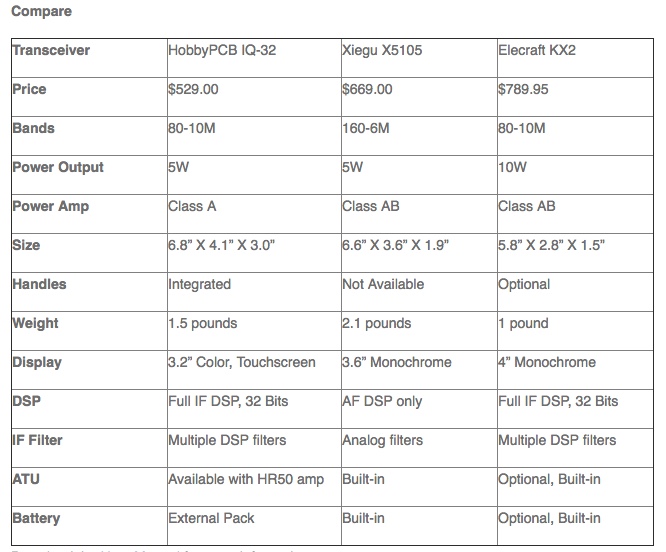
Many thanks to SWLing Post contributor, Pete (WB9FLW), who shares the following information regarding HobbyPCB’s much-anticipated portable transceiver which is now shipping.  The price is a competitive $529.00.

The following information comes from the HobbyPCB website:

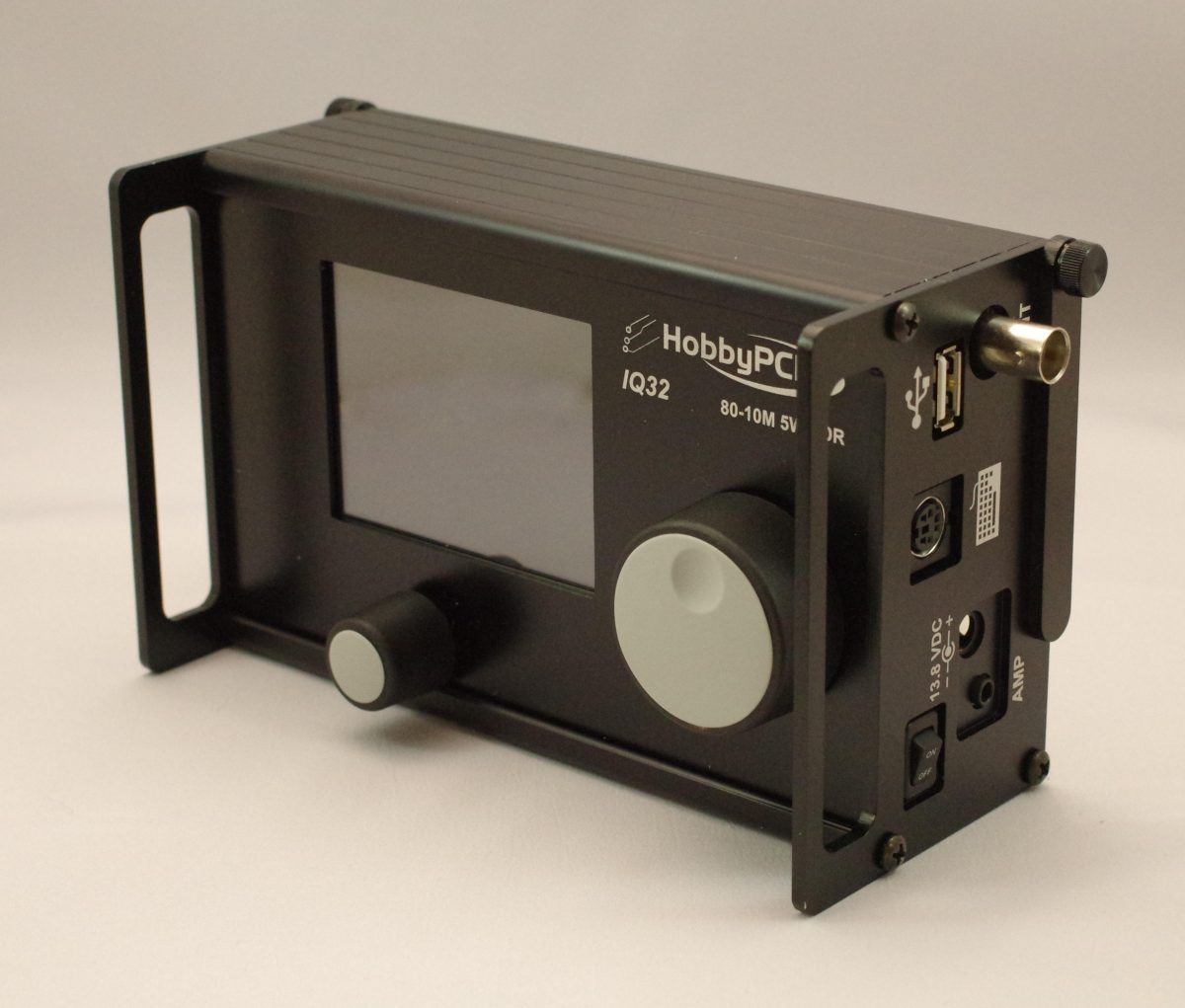
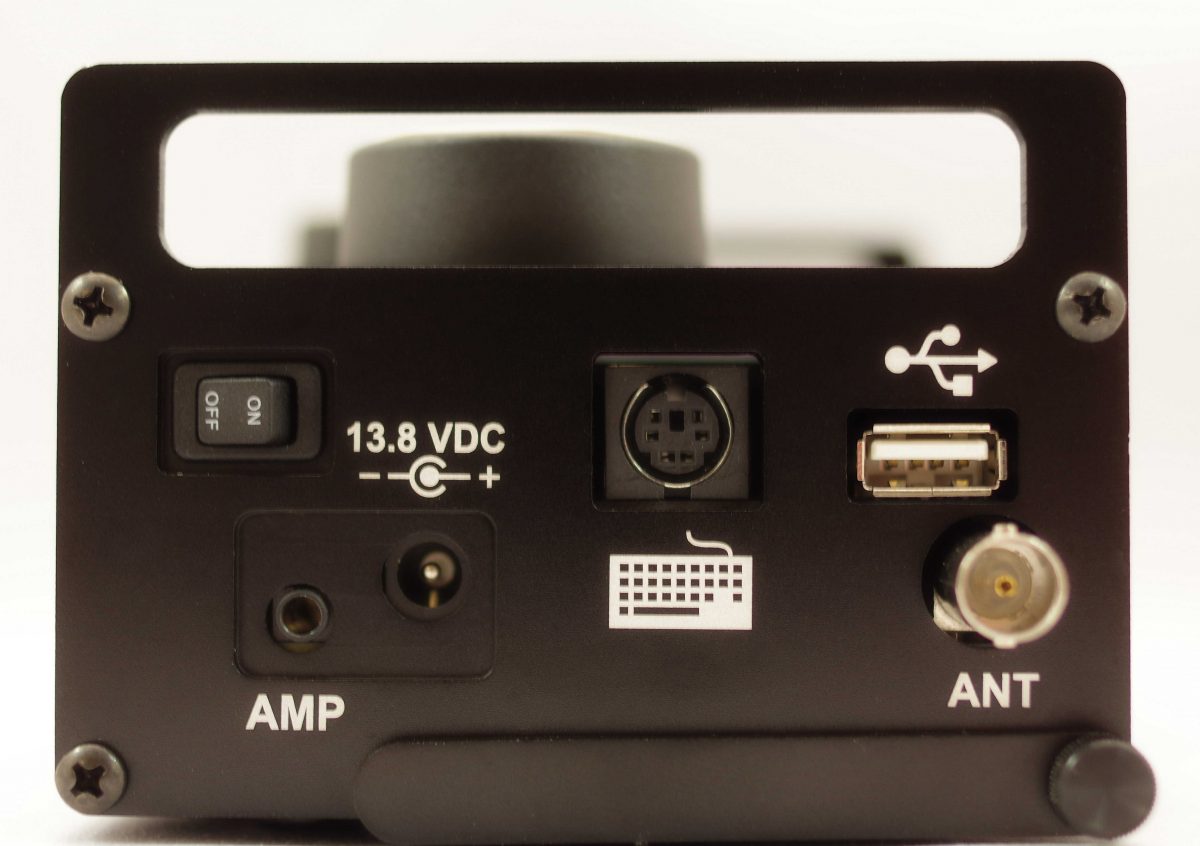
The IQ32 is 5W output, 80-10M Amateur Radio transceiver with powerful 32 bit processing providing high-end features at an entry level price. The IQ32’s 3.2″ color LCD touch-screen display and dual control knobs provide an enjoyable operating experience in a robust package.

Available for immediate delivery!

Introducing the HobbyPCB IQ32 HF transceiver, based on the high performance RS-HFIQ RF system, the receiver in the IQ32 consists of 5 band-pass filters to reject out-of-band signals, an LNA with frequency dependent gain and a conventional quadrature down-converter. The transmitter features a Class A, 5W power amplifier with individual low-pass filters for each band to exceed FCC requirements for spectral purity.

The IQ32 features a large, color, touch-screen display providing an enhanced user interface and informative spectrum and waterfall displays found on radios costing much more. With a powerful STM-32 DSP processor, the IQ32 transceiver has variable filtering, multi-mode AGC, memory functions, built-in PSK encode/decode with keyboard support.

5W not enough power? Add a HARDROCK-50 to your station to boost up to 50W. The IQ32 and HARDROCK-50 seamlessly integrate together for a powerful mobile/base station!

Simple upgradeable firmware, no connection to a computer required, no drivers, no cables. Simply insert a thumb-drive with the appropriate file and the IQ32 updates its own firmware.

Specifications

  • Frequency Range: 3-30MHz (performance guaranteed on 80/60/40/30/20/17/15/12/10M ham bands)
  • Sensitivity: MDS < -128 dBm on 80M dropping to < -135 on 10M
  • Noise Figure: < 8 dB
  • TX Power: 5W typical, 4W minimum
  • LO Feed-thru: < -50 dBc @ 5W output
  • Spurious and Harmonics: < -50 dBc typical
  • DC Power: 13.8VDC, 2 amp max
  • Size: 172mm x 105mm X 75mm
  • Weight: < 700 grams
  • Display: 3.2″ Color LCD Touchscreen
  • Modes: USB, LSB, CW, PSK 31
  • DSP Processor: STM-32, 32 Bit

Click here to download the manual.

Pete also notes:

If one already has the RS-HFIQ board fear not an upgrade kit is available:

https://hobbypcb.com/products/hf-radio/iq32-upgrade

Thank you for sharing this, Pete!

I may see about grabbing an IQ-32 to evaluate. I’m very curious how its receiver might stack up to the Elecraft KX2, the CommRadio CTX-10 and the LnR Precision LD-11. (Please note that these links lead to my other radio site, the SWLing Post.)

It doesn’t appear that the IQ-32 has an AM mode, but I would still like to see how it might handle broadcast listening on the shortwave meter bands using ECSS.

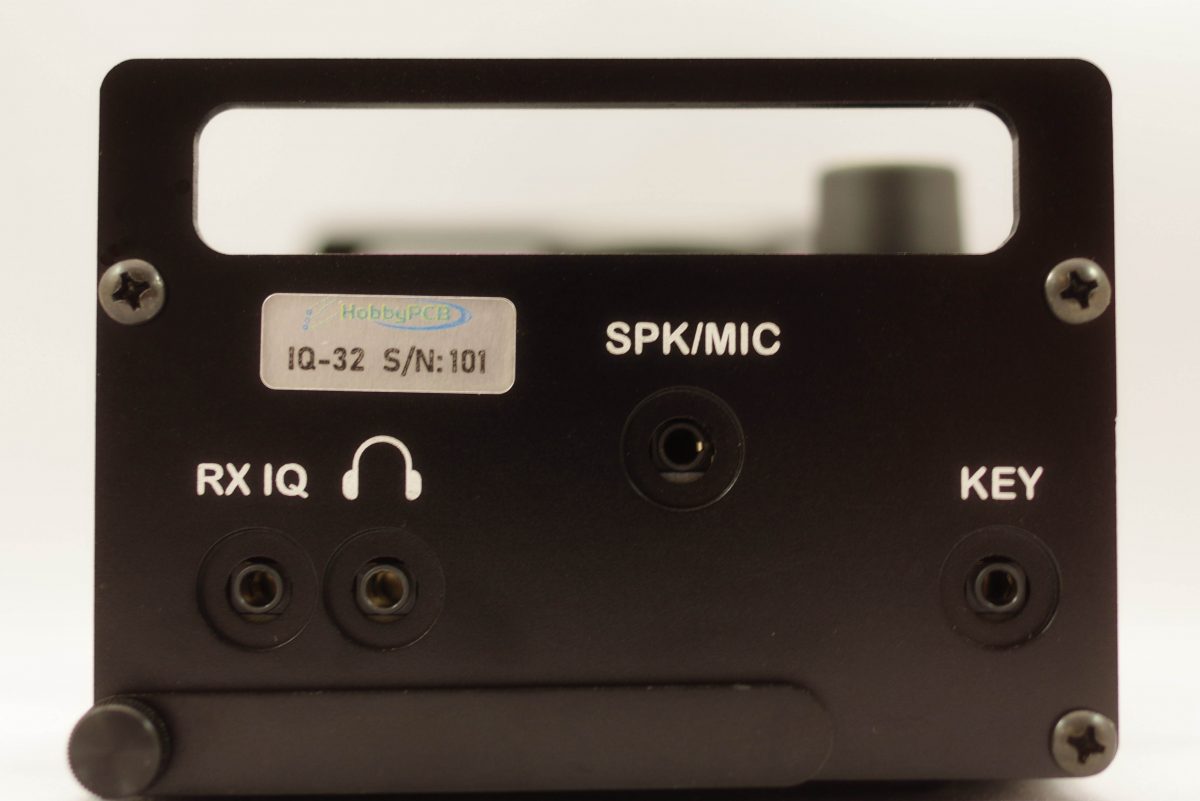
I love the portable form factor and the fact that it ships with stand-off handles to protect the front face of the radio.

Video:

Check out WA2EUJ’s IQ-32 presentation from the 2018 Hamvention on YouTube:

Click here to check out the IQ-32 product page at HobbyPCB.

Have any Post readers purchased the IQ-32?  Please comment!

Do you enjoy the SWLing Post?

Please consider supporting us via Patreon or our Coffee Fund!

Your support is greatly appreciated. Thank you!