Category Archives: Shortwave Radio

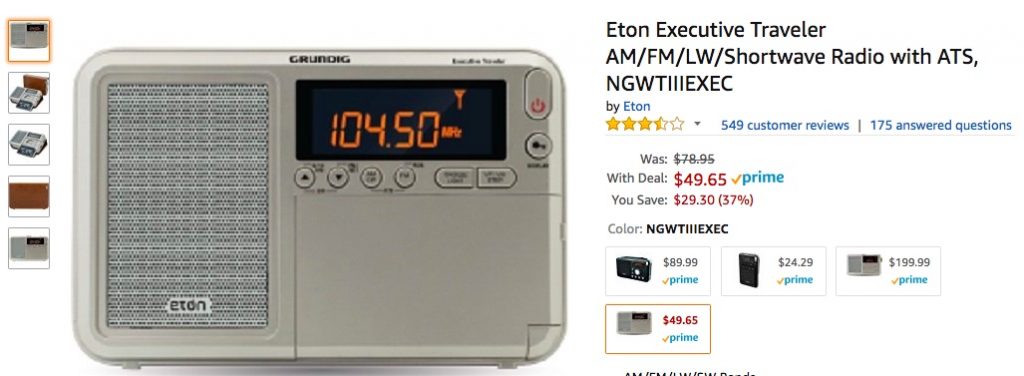
Radio Deal: Eton Executive Traveler $49.65 shipped

Many thanks to SWLing Post contributor, Christian, who writes:

Another Grundig/Eton deal on Amazon. This time the Eton Exectutive Traveler for $46.65 shipped. One of the lowest prices I’ve seen on this one. I already have a Traveler so no plans to purchase, but thought your readers might be interested. Good little radio if you ask me. Esp. the executive version as I like the case. Again we’re talking Amazon here so the price can change based on demand.

Thanks for the tip, Christian!

Click here to view on Amazon (affiliate link).

Can’t escape the noise? Take an impromptu DXpedition via the KiwiSDR network!

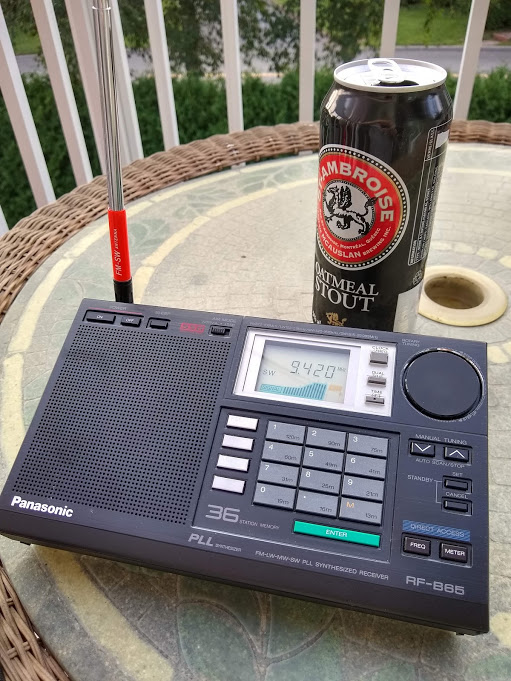
While I love the Panasonic RF-B65, the Voice of Greece and a St. Ambroise Oatmeal Stout: this combo can’t fight the persistent radio interference here at the condo.

Some of you might recall that I’m spending the months of August and September in a condo near Québec City, Canada. We love it here, though it does present some radio challenges. Unlike our rural/remote mountain home in the States, I’ve always had to cope with QRM (manmade radio interference) here at the condo. Not surprising.
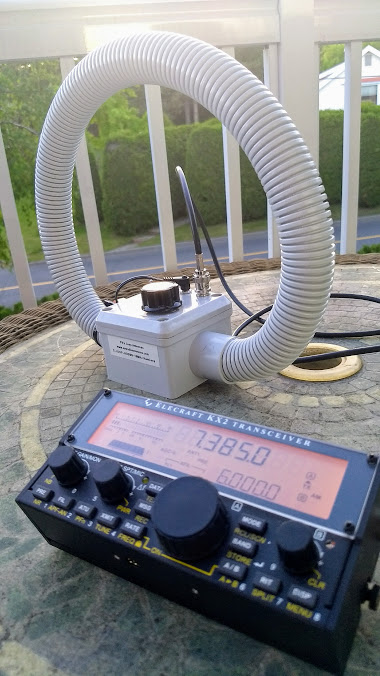
I typically bring my PK Loop antenna–it helps lower the noise a tad and is easy to take out on our balcony for optimal reception. Lately, though, the QRM has been even worse on the balcony than inside the condo (more on that in a future post).

Some North American and European stations punch through the noise when propagation is favorable (especially the Voice of Greece and Radio Romania International) but there have been evenings where nothing could penetrate the wall of noise.
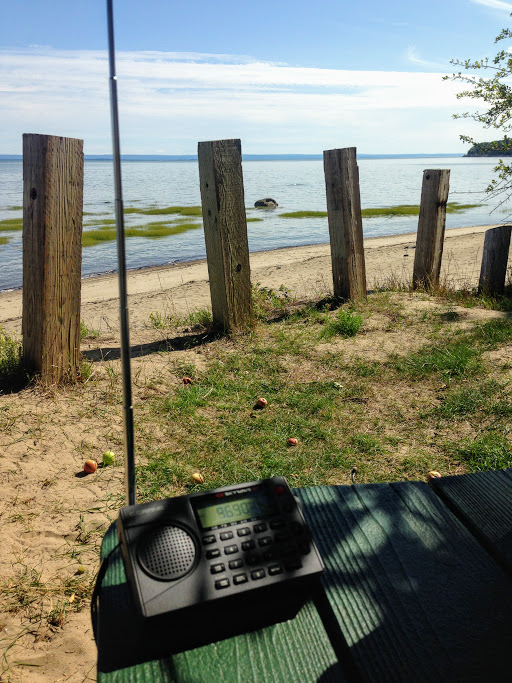
One way I escape the noise, of course, is to take my radio to a picturesque remote location for the afternoon or evening. It’s amazing the number of signals you can pull out of the ether when the noise floor is so low.

Back at the condo, though, there’s no easy way to escape the noise.

Or is there?

Impromptu DXpeditions
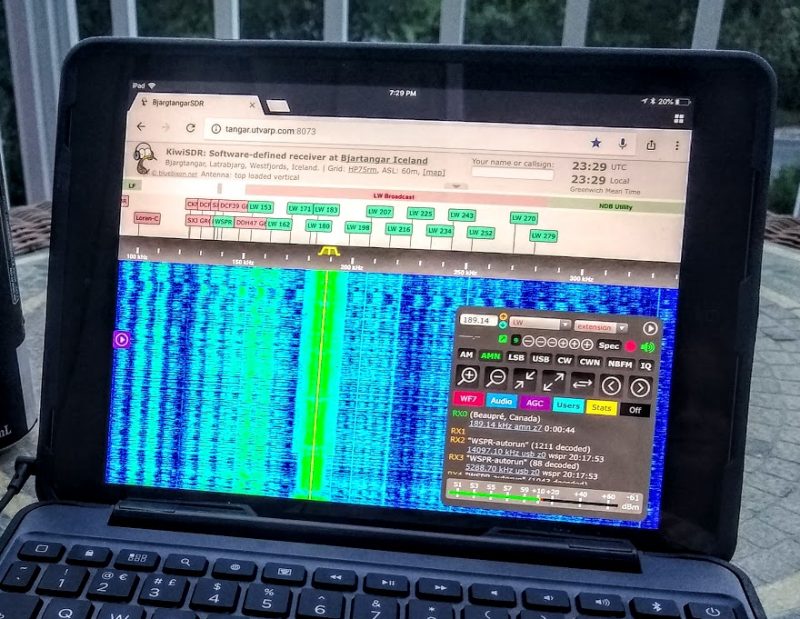
Perhaps 21st century problems require 21st century solutions.

This year–especially here at the condo–I’ve spent a great deal of time exploring the KiwiSDR network.

For those of you not familiar, the KiwiSDR is a self-hosted WebSDR which operates much like a mini U Twente WebSDR. KiwiSDR owners install their SDRs at home–or in other favorable locations–then share control of their SDR with the world via the the Internet.

Like the U Twente WebSDR, KiwiSDRs allow multiple simultaneous users to control the SDR independently of each other. Each KiwiSDR can allow up to four simultaneous guests (the U Twente WebSDR can allow hundreds of simultaneous users, but it’s also a university-supported bespoke SDR with fantastic bandwidth!).

Over the past few years, the KiwiSDR network has grown almost exponentially. There are Kiwi SDRs on every continent save Antarctica (someone remedy that, please!).
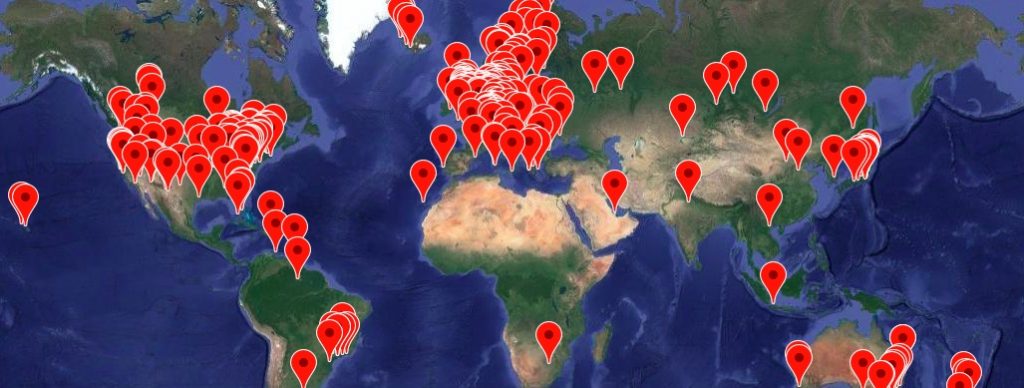
Each red pin represents a KiwiSDR installation.

Other than the fact that the SDR audio is piped through the Internet–and you can’t walk outside and adjust the antenna–there is no difference between using a KiwiSDR remotely or locally.

In fact, the KiwiSDR only has a web browser-based application, there is no downloadable application for local use. So quite literally, the experience of controlling and using a KiwiSDR locally or globally is identical.

And it’s so much fun! I browse the KiwiSDR network via the map above, select an interesting location, and virtually travel there for an impromptu DXpedition. I can travel to India, Italy, Japan, New Zealand, or Hawaii via the network and be back in time for dinner here in Canada without breaking a sweat or even using frequent flyer miles!
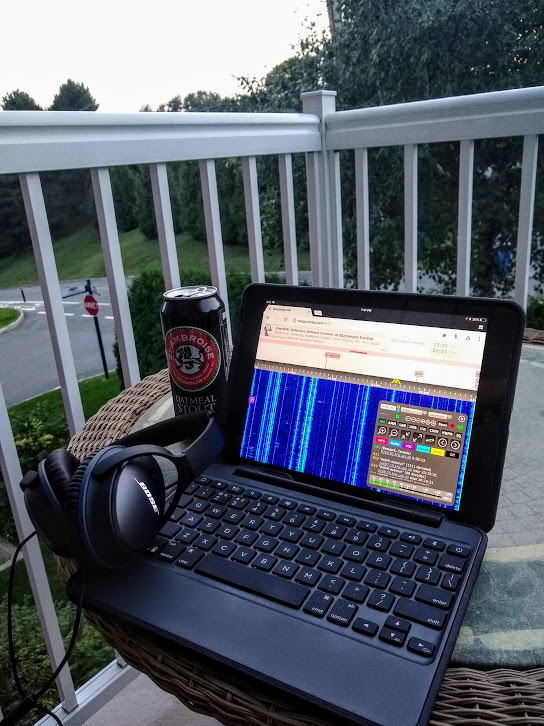
I’ve found that the combo above makes for an immersive experience. I use Bose Quiet Comfort noise-cancelling headphones paired with my iPad Air (which I have enclosed in a Zagg Rugged Book). With a reasonable Internet connection, it truly feels like I’m there.

Of course, you don’t need an iPad, or any special equipment. The KiwiSDR application works with pretty much any computer, tablet or smart phone that has a web browser. For the best experience, however, I would suggest connecting a good external speaker, bluetooth speaker or headphones.

I know many of you are thinking, “But Thomas! This isn’t real radio!”

But I would argue that it is real radio! It’s a real radio, connected to a real antenna that you’re simply controlling via the Internet with a web-based SDR application. Instead of the audio going through a sound card into your headphones, it’s going into a soundcard, piped through the Internet, then into your headphones.

Give it a try! You might find an impromptu DXpedition is the perfect remedy to your QRM and RFI blues!

Post readers: Any heavy KiwiSDR users out there?  Or do you oppose using WebSDRs? What are your thoughts? Please comment!

Do you enjoy the SWLing Post?

Please consider supporting us via Patreon or our Coffee Fund!

Your support makes articles like this one possible. Thank you!

Justin Moore on Making Music with Radios

Many thanks to SWLing Post contributor, Justin Patrick Moore (KE8COY), who is a radio host, radio enthusiast and musician. At my request, Justin has shared the following article excerpts from his blog that discuss the convergence of music and radio:


Imaginary Landscapes

The development of telecommunications technology and electronic circuits had a major impact on the creation of new musical instruments from the very beginning, but it was only in 1951 that a composer first got the idea that the radio itself could be used as a musical instrument.  Since then the use of radio as a source for live, unpredictable sound, music, and voice has become commonplace across the genres of contemporary classical music, and various styles of electronic, rock and pop music. Using the radio as an instrument has become part of what composer Alvin Curran has called a “new common practice” and is just one of many methods being used to create the sonic backdrop of the landscape we now inhabit in this age of electronic multimedia.

“It’s not a physical landscape. It’s a term reserved for the new technologies. It’s a landscape in the future. It’s as though you used technology to take you off the ground and go like Alice through the looking glass.” John Cage wrote this about his series of Imaginary Landscape compositions. Imaginary Landscape No. 4 was first performed in 1951 and is scored for 12 radios played by 24 musicians, two on each radio, one to control the tuning, the other to control the volume. It is a great example of indeterminate music. The only guarantee about the piece is that no performance of it will never be heard the same way. This is guaranteed because John incorporates chance operations to determine how much the dials of each radio are to be turned by each performer. The novelty of each performance is also guaranteed by the nature of radio itself. Depending on the place and time of a performance, the things coming out of the radio speakers are going to be different. During its premier concert at Columbia University’s McMillin Theater those in the audience heard the word “Korea” over and over again, as well as snippets of a Mozart violin concerto, news about baseball, static, and silence. The performance took place around midnight and many of the stations in New York had already gone off the air for the night.  Of course the silence never bothered Cage, who considered  in an integral part of the experience. He had said that “silence, to my mind is as much a part of music as sound.”

Read the full article at Sothis Medias.

The Radiophonic Laboratory

Radio is the perfect medium for the diffusion of electronic music. The unpredictable sounds coming from radios are also a perfect source material. In many cases the production studios available at broadcast facilities made them the first laboratories for the scientific investigation of sound, for the sole purpose of making music, to be used by electronic music pioneers. Likewise these stations became the first to introduce electronic and other avant-garde music to the public. Such was the case with Westdeutscher Rundfunk, or WDR, the German public broadcasting institution located in Cologne. Their Studio for Electronic Music was the first of its kind in the world and became an epicenter for musicians working in the new medium. On the broadcasting side the WDR promoted new music through unique programming that included radio lectures, the playing of live and recorded music, and commissioning new works from composers working in the field.

Read the full article at Sothis Medias.

Telemusik

As the world caught wind of the work being done at the WDR’s Electronic Music Studio, other radio stations and broadcasting corporations followed suit. NHK (Nippon HosoKyokai) in Japan built their electronic music studio in 1955, directly modeling it on the one at WDR. In 1958 the BBC created their famous Radiophonic Workshop. (I blame starting to watch Doctor Who as a ten year old, with its strange soundtrack and incidental music, for what became my lifelong fascination with electronic music.) The studio at NHK was just over ten years old when they invited Karlheinz Stockhausen over to work there and create two pieces for their airwaves.

When he arrived in Japan Karlheinz was severely jet lagged and disoriented. For several days he couldn’t sleep. That’s when the strange hallucinatory visions set in. Laying awake in bed one night his mind was flooded with ideas of  “technical processes, formal relationships, pictures of the notation, of human relationships, etc.—all at once and in a network too tangled up to be unraveled into one process.” These musings of the night took on a life of their own and from them he created Telemusik.

Read the full article at Sothis Medias.

Kurzwellen

Starting in the early 1960s Karlheinz Stockhausen composed several instrumental works which he called “process compositions”. These did away with traditional stave notation and instead used symbols including plus, minus, and equal signs that indicated the successive transformations of sounds that were otherwise unspecified or unforeseeable by the composer. In this way he brings elements of improvisation into the fold of Western classical music where the strict adherence to a fixed score left little room for interpretation by musicians. The scores in his process pieces don’t dictate specific notes or ways of playing but rather specify the way a sound is to be changed or imitated. Taking a cue from his studies of information theory Stockhausen created a way of writing music that is similar to computer programming. The program “determines the way information is processed while leaving the choice of information to be processed to the individual user.” (Maconie 1990, 156-157)

Stockhausen’s process pieces include Plus-Minus (1963), Prozession (1967), Kurzwellen, and Spiral (both 1968). Eventually they led to the text based processes of his intuitive music compositions in the cycles Aus den sieben Tagen (1968) and Für kommende Zeiten (1968–70).

Kurzwellen (Short waves), the third of the process pieces also marks the beginning of Stockhausen’s magnificent voyage using shortwave receivers as a medium for musical transportation. The formal procedures in Kurzwellen (and the others) are fixed. Stockhausen thinks of these not as fixed in the way Beethoven’s Fifth symphony is a fixed piece that will sound the same to a greater or larger degree from recording to recording or performance to performance. Only the processes themselves are fixed. These are indicated primarily by plus, minus, and equal signs and constitute the composition.

Yet the sound materials themselves, like the knobs on the tuners, are variable. The process scores can be followed and bring about very different results each time they are played and yet somehow still sound similar. The sound material coming in from the shortwave radios is unpredictable. Yet the prescribed processes themselves can be heard from one performance to another as being “the same”. These developments in musical theory and practice make live performances and new recordings exciting events.

Read the full article at Sothis Medias.

How to listen to Hurricane Watch Net frequencies

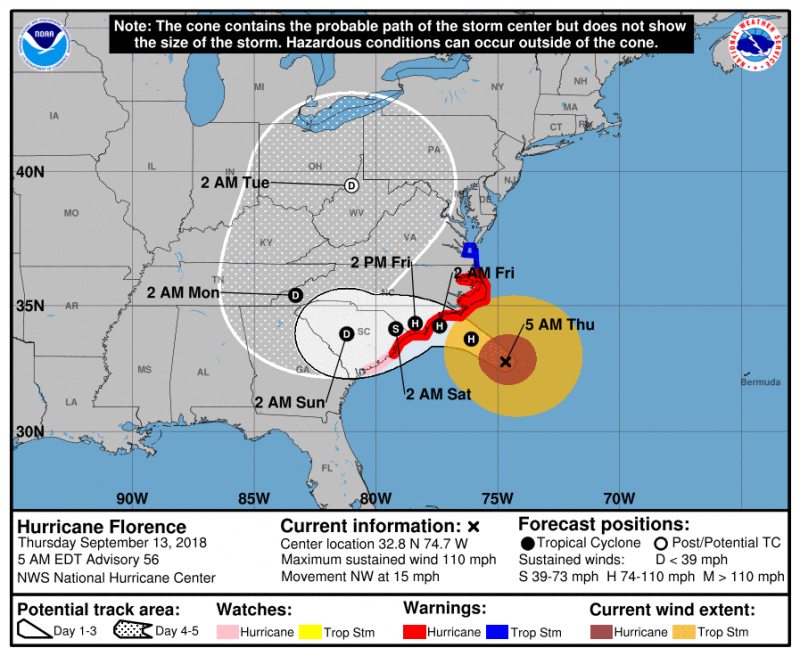
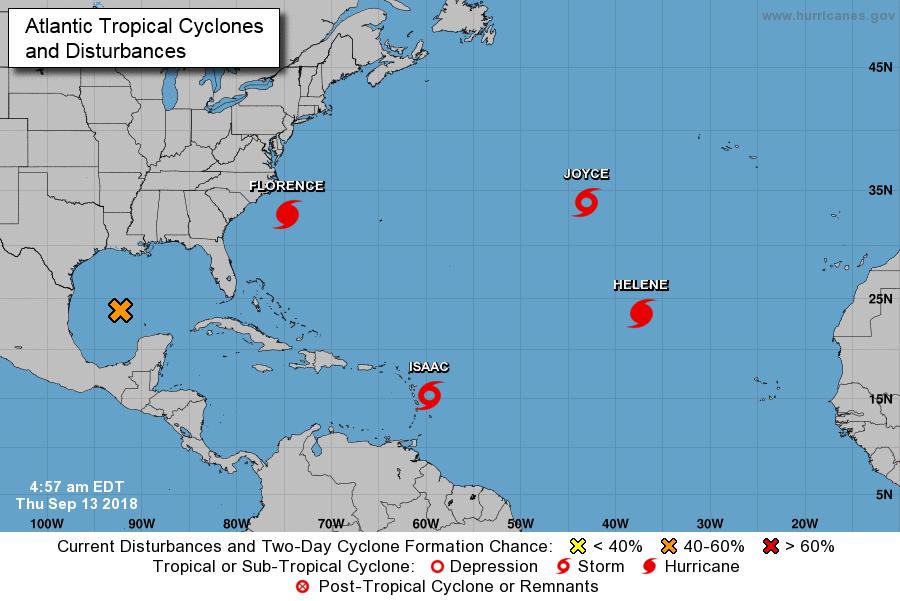
As Hurricane Florence starts to make landfall today, it is expected to have a serious impact on coastal South Carolina and North Carolina. Florence is currently a category 2 hurricane, but they expect wind speeds to diminish quickly upon landfall. No doubt, we’ll remember Florence for the tremendous amount of rainfall she packs–there will be significant flooding in her path.

A few readers have asked about frequencies to monitor as the storm approaches.

Hurricane Watch Net (HWN)

hwn-hurricane-watch-netThe Hurricane Watch Net is a group of amateur radio operators who are trained and organized “to provide essential communications support to the National Hurricane Center during times of Hurricane emergencies.” The HWN focuses on “ground truth” observations (much like SkyWarn nets).

The Hurricane Watch Net is activated when a hurricane is within 300 statute miles of expected land-fall. The HWN covers the Caribbean, Central America, Eastern Mexico, Eastern Canada, and all US Coastal States.

The HWN operates in both English and Spanish, and is active on 14.325 MHz (upper sideband) during the day and 7.268 MHz (lower sideband) at night. The HWN is known to operate on both frequencies if propagation allows.

Please keep HWN frequencies clear

If you’re an amateur radio operator, please avoid using 14.325 MHz and 7.268 MHz anytime the HWN has been activated.

Monitoring hurricane frequencies

If you have a shortwave radio with a BFO/SSB mode–and you live within the propagation footprint–you can monitor the Hurricane Watch Net.

Note that you’ll need to use upper sideband on 14.325 MHz and lower sideband on 7.268 MHz.

You can also monitor the Hurricane Watch Net via a number of WebSDRs on the KiwiSDR network and even potentially via the U Twente WebSDR in the Netherlands (although a WebSDR in North America would be preferable).

Click here to view the Hurricane Watch Net website.

At time of posting, there are a number of tropical storms in the Atlantic. If you live in an area prone to hurricanes, tropical storms and other natural disasters, please keep an emergency kit fully-stocked and at the ready. Click here for some ideas about building your own simple kit.

Marketplace: “Time may be up for timekeeping radio stations”

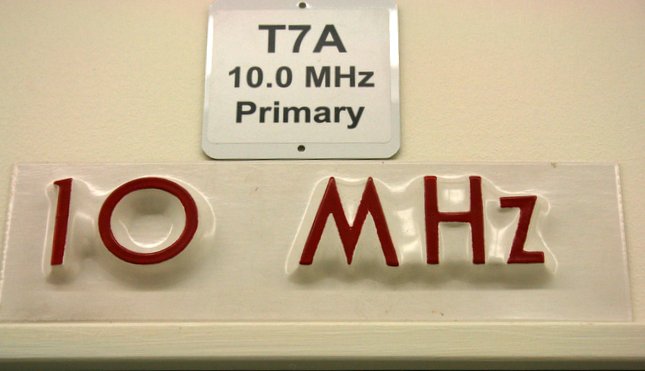
Photo taken in 2014 of the sign above WWV’s primary 10 MHz transmitter.

(Source: Marketplace via Richard Cuff)

The Trump administration wants to shut down two shortwave radio stations that broadcast time signals from the nation’s master clock.

The administration’s budget proposal would eliminate nearly $27 million in funding from the National Institute of Standards and Technology for the two stations. WWV, based in Fort Collins, Colorado, has been transmitting one rock-steady pulse per second for more than 80 years. Its sister station, Hawaii’s WWVH, has been extending the time signal across the Pacific for nearly 70 years. WWV is also the world’s longest continuously-broadcasting radio station. (NIST doesn’t stream the stations online because signals are often delayed as they stream over the internet. But you can hear the stations by calling (303) 499-7111 for WWV or (808) 335-4363 for WWVH . There are also online recordings of the stations’ gentle announcements.)[…]

Click here to read the full story and listen to the program audio.

If you feel strongly about keeping the atomic clock signals on the air, I urge you to contact your local representatives,and sign this White House petition.

Radio Deal: Eton Field BT on Amazon

Many thanks to SWLing Post reader, Christian, who writes:

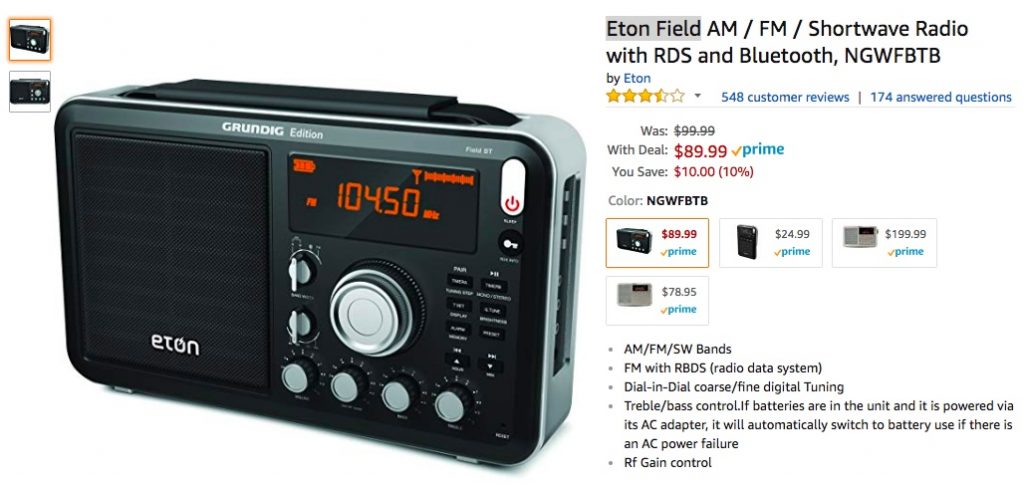
Hi Thomas. Just thought you should know that Amazon has lowered the price of the Eton Field BT to $89.99 shipped. For how long this will be the price I don’t know. This is only $5 more than the lowest price I’ve ever seen for the Field on Amazon. I just bought one and thought I’d share.

Thanks for the tip, Christian!

Click here to view on Amazon.com (affiliate link).

SDRplay Video: More Panadapter Tips & Tricks

Many thanks to Jon Hudson with SDRplay who shares the following on the SDRplay Facebook page:

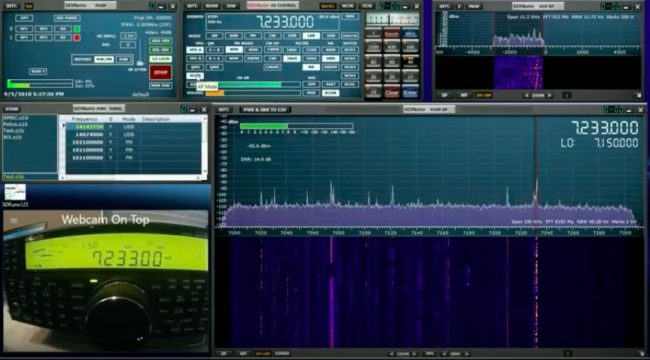
We have released a new YouTube video which covers some items that have been asked about by our users. First up we talk about synchronizing VFO A and VFO B between SDRuno and the rig. This leads into a discussion of using the band switches in SDRuno and use of the LO LOCK button.

Then we cover how to use an RSPduo as a panadapter and a couple of configurations that can be used to expand ease of use and flexibility.

See the video here:

Click here to view on YouTube.