Category Archives: Shortwave Radio

Guest Post: A WRNO Worldwide Transmitter Site Visit

Many thanks to SWLing Post contributor, Dan Brown (W1DAN) for the following guest post:


A WRNO Worldwide Transmitter Site Visit

by Dan Brown W1DAN

WRNO-logo

The opportunity to visit a shortwave transmitter site does not come to me often. It did during the summer of 2009, so I jumped at the chance. Along with friend Bob K5IQ, we visited the WRNO Worldwide transmitter in New Orleans and were guests of Chief Engineer Larry Thom. He kindly showed us the transmitter site, talked of the interesting technical story of the rebirth of the WRNO Worldwide transmitter site and displayed some of his ingenious technical adaptations to create a smooth running plant.

Fullscreen capture 8222016 40935 PM

Larry smiles as Bob Is amazed at the innards of the WRNO HF transmitter!

Originally put on the air as the first commercial shortwave station by local New Orleans radio owner Joe Costello in 1982, and purchased by Dr. Robert Mawire of Good News Outreach in 2001, the now non-profit religious station is fed from Fort Worth Texas studios. The transmitter, still in the New Orleans suburb of Marrero, primarily operates at 7505KHz and can be heard evenings from 1200 to 1400UTC (8PM to 10PM EST).

The plant’s main feature is an Electronic Corporation (Elcor) SW50/3S fifty kilowatt transmitter (see Figure 1). Built in Costa Rica, this transmitter feeds a TCI 516-3 log periodic antenna that was a mainstay of the Joe Costello rock and roll days of WRNO Worldwide. The transmitter is plate modulated and uses time-tested circuitry such as vacuum tubes, relay control and crystal oscillators as compared to solid-state modulators and microprocessor control. The system sends effectively a 3 megawatt signal around the world.

Figure 1. Larry describes the Elcor transmitter. In the foreground is the control cabinet with the control relays out front for easy access.

Figure 1. Larry describes the Elcor transmitter. In the foreground is the control cabinet with the control relays out front for easy access.

Interestingly, Larry incorporates baking thermometers to measure the exhaust air temperature. Cheap and efficient! In order to get the transmitter to work properly two interesting adaptations were required. The first was the transformation of the output impedance from 50 ohms to 75 ohms.  This was done using a custom Elcor transformer as shown in Figure 2.


Figure 2. Elcor custom RF transformer

Figure 2. Elcor custom RF transformer

This impedance transformer feeds a TCI high power BALUN (BALanced to UNbalanced transformer, but here run in reverse), as the TCI antenna requires a balanced feed. The BALUN is a commercial TCI unit and is shown in Figure 3.

Figure 3. TCI BALUN takes unbalanced RF from transmitter and feeds the 300 ohm balanced TCI Antenna. How big is your BALUN?

Figure 3. TCI BALUN takes unbalanced RF from transmitter and feeds the 300 ohm balanced TCI Antenna. How big is your BALUN?

Another interesting adaptation became necessary, as the transmitter would often trip the main breaker when it was placed on the air. This problem was due to the high inrush current that would occur when the high voltage power supply was energized. Larry went to Grainger supply and bought high power heating elements and time delay relay. He inserted this in the primary three-phase feed to the power supply. Now, when the supply is switched on, the heating element provides a series resistance (and heats up for a moment) to absorb the inrush. After a short time, the relay would jump the element out to allow full current to feed to power supply (see figure 4).

Figure 4. Heating elements on the upper right inside wall of the power supply limit inrush current.

Figure 4. Heating elements on the upper right inside wall of the power supply limit inrush current.

Another small problem with the transmitter was the drift of the master oscillator. Larry had Elcor build a synthesized oscillator for the transmitter to reduce the drift (figure 5).

Figure 5. Larry with new synthesized reference oscillator module

Figure 5. Larry with new synthesized reference oscillator module

WWL-AM has their 50Kw transmitter on 870KHz near the WRNO Worldwide transmitter. Due to this proximity they send a hefty signal into the WRNO antenna and thus into the transmitter. Here these two signals can mix together to form a soup of audio in the WRNO transmitter tank circuit. A notch filter was constructed to reduce WWL-870’s AM signal (Figure 6).

Figure 6. WWL 870KHz notch filter

Figure 6. WWL 870KHz notch filter

During the visit, Bob and I listened to Larry’s stories and snooped around the building. We spotted a Vintage Radio Labs “Globe King” 500A that is slated as an emergency backup transmitter (Figure 7). It is rumored that this classic redesign of an older transmitter marketed in the 1990’s was a poor copy of the original 1950’s era World Radio Labs Globe King transmitter. Larry states that this transmitter is serial number 1. Only a few were built.

Figure 7. A Vintage Radio Labs “Globe King 500A” backup transmitter (SN1?). The crystal is for the old frequency of 7355 kHz

Figure 7. A Vintage Radio Labs “Globe King 500A” backup transmitter (SN1?). The crystal is for the old frequency of 7355 kHz

Figure 8. Bob K5IQ dreams of calling “CQ DX!” on a 50Kw rig and a 14db antenna

Figure 8. Bob K5IQ dreams of calling “CQ DX!” on a 50Kw rig and a 14db antenna

Figure 9. The Official FCC-approved Reader’s Digest reference modulation monitor!

Figure 9. The Official FCC-approved Reader’s Digest reference modulation monitor!

Figure 10. The audio and control rack. Audio is fed via a T1 line from Texas to the Telos ISDN decoder, then to the Optimod 9000A audio processor (an original from the Joe Costello days). The remote control is a Burk unit that allows the studio folks in Texas to control the transmitter.

Figure 10. The audio and control rack. Audio is fed via a T1 line from Texas to the Telos ISDN decoder, then to the Optimod 9000A audio processor (an original from the Joe Costello days). The remote control is a Burk unit that allows the studio folks in Texas to control the transmitter.

Figure 11. The Marrero, LA transmitter shack heard ‘round the world!

Figure 11. The Marrero, LA transmitter shack heard ‘round the world!

An article I wrote on the re-birth of WRNO Worldwide for the August 2007 Monitoring Times magazine, and the fact that I was on vacation in New Orleans prompted this visit. It is always fun to visit a transmitter site to see how things are done. Thanks to Bob K5IQ for driving!

WRNO-Feedline WRNO-Feedline-B

Figure 12. View from the balanced feed point of the TCI 516-3 log periodic antenna 1ith 14db gain aimed at 20 degrees

Figure 12. View from the balanced feed point of the TCI 516-3 log periodic antenna 1ith 14db gain aimed at 20 degrees

Here are a few web-links of interest:

Copyright
Dan Brown, W1DAN
Created 09/2009
Updated 07/2016


Wow–many thanks for sharing your tour of WRNO with us, Dan! My-oh-my how I’d love to have that 14db gain log periodic at my disposal! Great facility!

Creating a global network of inexpensive remote SDRs

U_Twente_SDR

Many thanks to SWLing Post contributor, Mark Fahey, who replies to Ivan’s preliminary review of the V3 RTL-SDR dongle:

With Shortwave SDRs (the receiver dongle) now costing less than $20, the time has come for us to set up a global group of receivers that we can all log into at will!

RTL-SDR-RTL2832U-e1471375714199Have a look at SDR.hu – here you can put your SDR dongle on line and share it with anyone and they have full control of the receiver just as if it was in their own shack.

Imagine receivers scatted around the world – South America, Tropical Asia, Africa! The cost is now virtually nothing, all that is needed is the dongle, antenna (doesn’t have to be anything special – even a long wire or whip) and a small low cost CPU (Raspberry Pi for example).

Anyone else interested in this dream? Lets get together, get some receivers setup and then talk about our experience in a kick-ass presentation at the 2017 SWL WinterFest in PA!

Also… I am very soon to receive my KiwiSDR matched to a BeagleBone CPU. It will be online at SDR.hu and four remote listeners will be able to tune the full shortwave bands independently, its like my own Twente setup! Heaps of others are getting receivers online in the next few months with KiwiSDRs, this is going to be totally amazing!

I agree, Mark! While there is already quite a network of remote SDRs and receivers in the world, the barrier of entry keeps getting lower and lower. It’s hard to imagine that $25 can buy an SDR that natively covers the shortwave and mediumwave bands!

There’s only one other requirement for an online SDR that Mark didn’t mention: a decent Internet connection. Sadly, this is the only thing keeping me from hosting a remote SDR here at my home. I considered purchasing a KiwiSDR like Mark, but my upload speed (0.2-0.3 mbps) is so terrible and so unreliable that I could only host one listener at a time at best. You can bet that as soon as my ISP upgrades our service, I’ll launch a web SDR as well.

Of course, I’m willing to bet that most SWLing Post readers have more than enough bandwidth to host a $25 remote receiver! Let’s make Mark’s vision a reality!

Shortwave Radio Recordings: Radio Baghdad, August 8, 1990

radio baghdad qsl

Many thanks to SWLing Post contributor, Al Quaglieri, who shares the following recording, QSL (above) and notes:

Here’s a nice recording I made of the first 13 minutes of Radio Baghdad’s English broadcast one day around August 8, 1990. It begins with some music and then there’s a newscast. For a couple of months, I sent such recordings down the phone line to CBS News in New York, who were eager to hear them. This, alas, is the only one I kept. Hard to believe it was nearly 26 years ago.

My how that does bring back memories! Thank you for sharing this excellent recording, Al!

200 metre longwire: Radio Verdad 4054.9 kHz, Guatemala, unprecedented reception in Oxford, UK

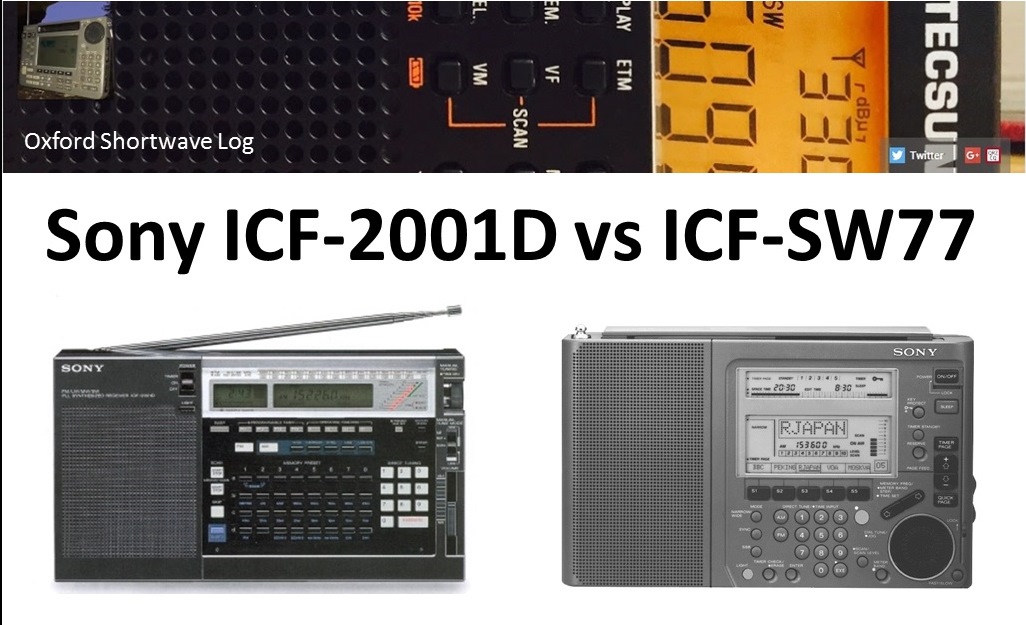
verdadRadio Verdad, Chiquimula, Guatemala is quite a regular catch at home, however, their modulation is nearly always weak as the carrier struggles to lift above the ubiquitous blanket of local QRM. Another issue with hearing this station is the digital utility signal just above 4055 kHz, thus requiring LSB reception to reject the adjacent noise.

This particular recording of Radio Verdad was taken during a DX’pedition using the 200 metre longwire and is unprecedented in signal strength and clarity – in my personal experience. With fully discernible audio both the Elad FDM DUO and Sony ICF-2001D receivers perform very well with my experimental 200 metre antenna. I should point out that the audio from the Sony is significantly louder because the speaker on the Elad is puny, to say the least. However, the reception on the Elad sounds to me at least, superior to the Sony in terms of SNR, which is everything in Tropical Band DXing. As usual, I welcome your comments. Recorded in Oxford UK on 31/07/18 at 03:31 hrs UTC. Thanks for watching.

Direct link to the Oxford Shortwave Log reception video of Radio Verdad, Guatemala

Clint Gouveia is the author of this post and a regular contributor to the SWLing Post. Clint actively publishes videos of his shortwave radio excursions on his YouTube channel: Oxford Shortwave Log. Clint is based in Oxfordshire, England.
Francis loves the Sony ICF-SW11

Sony_ICF-SW11_4

Many thanks to SWLing Post reader, Francis, who left the following reply on our Battery Endurance Contest Results post:

Dear Thomas,

I have been using a Sony ICF-11 for 5-6 years now, still sold new at 50-70 euro. It’s analog and rather well featured: FM (stereo on earbuds), LW, AM, and 9 SW bands. It runs on 2 cheap AA batteries I get in low-cost supermarket, for sure not the best ones.

Sony_ICF-SW11_3

Using it at least one hour a day on the speaker, I have to change the batteries after 9-12 months. I am convinced a set of good Duracell or Energizer batteries would last some more months.

Sony_ICF-SW11
I am not a radio expert, but I am quite pleased with its audio performances, specially on LW (used most of the time ) and AM, where it is vastly superior to my Tecsun PL-660. SW looks OK for what I can say from listening quite occasionally these bands. I would be curious to see a serious review of this Sony to know how it compares with others, but I didn’t find any on the web so far (hint?). [Yes, Francis, hint taken!]

Sony_ICF-SW11_2
I am so pleased with this small radio that I recently bought a second one as a spare.
Thanks for your very interesting blog and reviews.
Francis

Thank you, Francis, for sharing your thoughts on the Sony ICF-SW11 and your photos as well!

It appears Amazon.com (US) has a few options for ordering a Sony ICF-SW11–click here to show search results. Prices vary between $50-$55; Amazon even has replacement telescopic whips available.

Of course, an eBay search will also uncover a number of SW11’s.

I searched the web, but couldn’t find many other retailers selling new ICF-SW11’s. It appears many of the ones on Amazon are imports from Japan.

At $50 shipped, it seems like a bargain to me, so I just pulled the trigger on one.

Radio South Atlantic: recording of a short-lived clandestine radio station

Crosley-Dial-BlackAndWhite

In reply to our recent post about Radio Atlantico del Sur, SWLing Post contributor, Jonathan Marks, adds:

Radio South Atlantic was a short-lived clandestine radio station started by the UK Ministry of Defence with programmes aimed at Argentine troops on the Falkland islands. This programme was broadcast from a transmitter on Ascension Island which was temporarily taken away from BBC World Service.

The Falklands War (Spanish: Guerra de las Malvinas), also known as the Falklands Conflict, Falklands Crisis and the Guerra del Atlántico Sur (Spanish for “South Atlantic War”), was a ten-week war between Argentina and the United Kingdom over two British overseas territories in the South Atlantic: the Falkland Islands and South Georgia and the South Sandwich Islands. It began on Friday 2 April 1982 when Argentina invaded and occupied the Falkland Islands (and, the following day, South Georgia and the South Sandwich Islands) in an attempt to establish the sovereignty it had long claimed over them.

On 5 April, the British government dispatched a naval task force to engage the Argentine Navy and Air Force before making an amphibious assault on the islands. The conflict lasted 74 days and ended with the Argentine surrender on 14 June 1982, returning the islands to British control. In total, 649 Argentine military personnel, 255 British military personnel and three Falkland Islanders died during the hostilities.

This is a studio copy of Radio South Atlantic. In May 1982, the British government decided to set up a Spanish language radio station targeting Argentine troops. This was probably in response to an Argentine radio station (nicknamed Argentine Annie by the UK press) which appeared on shortwave some weeks earlier using the Beatles theme “Yesterday” as a signature tune.

I was editing the Media Network programme at the time. We could hear Radio South Atlantic in Hilversum – but the signal was very weak. So I rang the British embassy in the Hague and asked if it would be possible to get a studio copy of the programme to use in a documentary feature we were making. A few days later, a courier riding a large motorbike arrived at RN’s reception and asked for me. I went down to the front-desk to sign for the tape. “But you can’t keep this tape. You can only listen to it” was the message from guy in the helmet. “I have to take it back to the Hague in about half an hour”. I said I’d look for an empty studio, gave the guy a large coffee and wandered casually round the corner. Then I made a mad dash to the fast copy-room used to make tape copies of RNW transcription programmes for other radio stations. It had a machine that could copy tapes at around 8 times faster than normal. Luckily, Jos, the guy in charge, saw my challenge, set up the machine immediately and 15 minutes later I was back in reception to return the tape to the messanger. And I had a copy.

It seems the British dropped leaflets over the Falklands to try and spread the word that this shortwave radio station existed. And we later analysed the programme. It was classic Sefton Delmer (Black Propaganda), although rather poorly presented. Bit like calling up Vera Lynne if the British had a dispute with France.

But this is one of the few surviving recordings of Radio South Atlantic. You be the judge of how effective it all was. http://jonathanmarks.libsyn.com/radio-south-atlantic-may-1992

Click here to read Jonathan’s full post about Radio South Atlantic and listen to the recording on his website.

This is an amazing recording, Jonathan.  I’ll admit that I had never heard of Radio South Atlantic before and never knew a UK-supported clandestine station was on the air during The Falklands War/Guerra de las Malvinas.

Thanks for the excellent history lesson and your own (clandestine) recording!

Icom’s announcement includes two new receivers: the IC-R8600 and IC-R30

The IC-R8600 (Photo source: QRZ Now)

The IC-R8600 (Photo source: QRZ Now)

Many thanks to SWLing Post contributor, Dave Zantow (N9EWO), who shares the following info about Icom’s announcements at the Tokyo Ham Fair:

Well the cat is now really out of the bag now !! Icom announced 2 new RECEIVERS at the Tokyo 2016 JARL Ham Fair.

We can almost say for certain that the new IC-R8600 is a SDR based design.

[…]The new IC-R30 handheld probably is SDR too, but not sure yet. Pretty large bugger (no real good picture as of of me typing this). Will it be able to do at least P25 Phase one?

I’ll admit it: I was a little surprised to hear that Icom had announced new receivers. I’m happy to see that it’s an IC-R8500 replacement/update. I love the touch screen color display.

I also very much like the idea of a handheld wideband–possible SDR–receiver.  I did a little extra digging and found the most concrete details about the new models on Icom UK’s website:

After an online teaser campaign featuring silhouettes of mystery radio models, the secret is out and Icom Inc. has shown the very first samples of the IC-7610, IC-R8600, IC-R30 and ID-51 PLUS2 to the public at the Tokyo Ham Fair 2016 (August 20-21, 2016). Details are relatively scarce but here are the basic details we have so far on these models.

The new IC-7610 (Photo: Icom UK)

The new IC-7610 (Photo: Icom UK)

IC-7610 HF/50MHz Transceiver (Base Station)
The IC-7610 is the successor to the IC-7600 and will be a dual-watch capable HF+50MHz 100W base station with built-in antenna tuner. The LCD will be touch screen and you will be able to connect an external display.

IC-R8600 Wideband Receiver (Base Station)
The IC-R8600 replaces the IC-R8500 wideband receiver and will feature the technology incorporated into Icom’s best selling IC-7300. The IC-R8600 will be able to receive a wide frequency range from 0.01-3000MHz frequency in analogue and various digital modes (D-STAR, P25, NXDN and dPMR). The IC-R8600 will feature a larger 4.3 inch touch screen display which will feature fast moving spectrum scope and waterfall display.

IC-R30 Communications Receiver (Handheld)
The IC-R30 is the successor to the popular IC-R20 compact handheld receiver. The IC-R30 can listen to two signals under certain conditions (analogue + analogue or analogue + digital). The IC-R30 will be able to decode D-STAR, P25, NXDN and dPMR digital (conventional) modes.

ID-51 PLUS2 Dual Band D-STAR Digital Transceiver (Handheld)
The ID-51 PLUS2 handportable is a special edition model which will come in several colours/patterns. The new ‘Terminal Mode’ and ‘Access Point Modes’ enable you to make D-STAR calls through the Internet, even from areas where no D-STAR repeater is accessible.

More details will be available nearer to each product’s launch. There are currently no details about pricing and availability.

Stay tuned to this website and our social media pages for further announcements.

I can’t wait to learn what the price point will be for the IC-R8600. I hope it’s at least in-line with the IC-7300 or (its predecessor) the IC-R8500. I also hope that, perhaps, the new IC-R30 will have full-mode HF capabilities.

We’ll post news about these new rigs as it becomes available–so will Dave Zantow. Stay tuned!