Shortwave listening and everything radio including reviews, broadcasting, ham radio, field operation, DXing, maker kits, travel, emergency gear, events, and more
Many thanks to SWLing Post contributor Jeff McMahon for sharing a recent Herculodge post, where he battles radio frequency interference (RFI) while trying to enjoy his Tecsun PL-990—only to find his PL-880 unaffected. This led to a deeper reflection on FM listening habits and the temptation of tabletop radios like the Sangean HDR-18 and HDR-19. But with RFI always a threat, is a new radio the solution or just another problem in disguise?
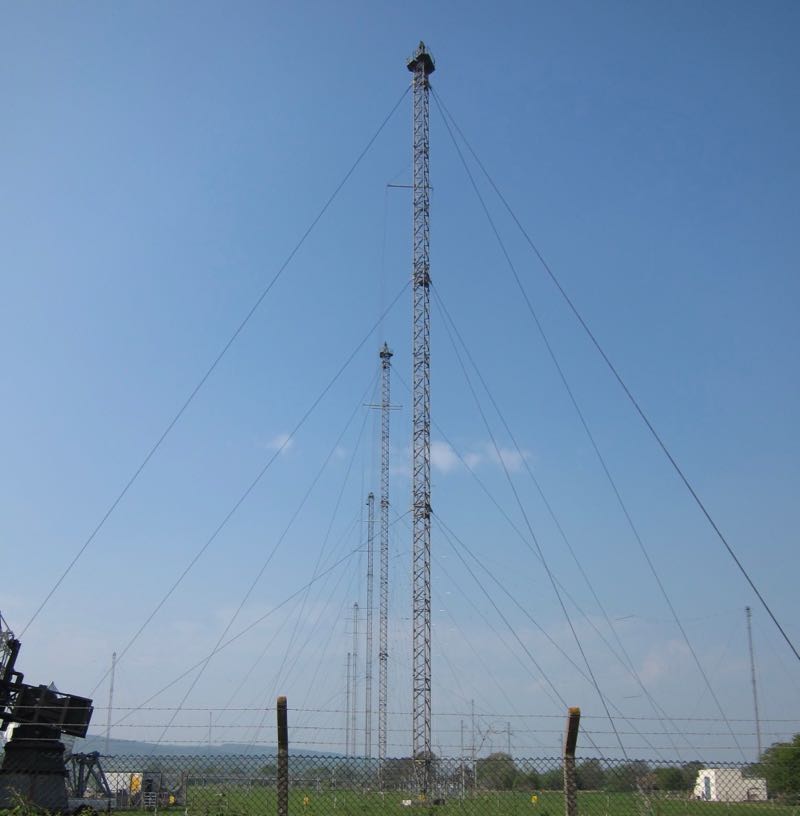
Woofferton Transmitting Station (Photo by Shirokazan via Wikimedia Commons.)
Many thanks to SWLing Post contributor David Iurescia for sharing this fascinating piece from The Spectator. In a world increasingly reliant on fragile digital communication networks, what happens when cyber warfare, physical attacks, or global conflict disrupt the systems we depend on? Clifford Beal explores how shortwave radio—once the backbone of wartime communications—could again play a vital role in ensuring information access when all else fails. “True, it’s retro-analogue, but shortwave gets through to people where more sophisticated digital communications fail,” Beal writes, making the case for renewed investment in resilient radio infrastructure.
Voice of America (VOA) and Radio Free Europe/Radio Liberty (RFE/RL) are in the sights of Elon Musk, the billionaire entrepreneur appointed by President Donald Trump to oversee the House Subcommittee on Delivering on Government Efficiency (DOGE).
Musk commented on a social media post by Richard Grenell, the U.S. Special Envoy for Special Missions, who said the radio networks are “state-owned media” and “are a relic of the past.”
“Yes, shut them down,” Musk wrote in his reply to the post. “Europe is free now (not counting stifling bureaucracy). Nobody listens to them anymore. It’s just radical left crazy people talking to themselves while torching $1B/year of US taxpayer money.” [Continue reading…]
Update: SWLing Post contributor, Jock Elliott notes that he wrote the following message and sent it via the Whitehouse contact page:
Mr. President;
First, I am not, and never have been, employed by Voice of America or Radio Free Europe.
But you might want to think twice before you shut them down.
If the electronic networks such as internet and mobile phones are ever shut down, you might want a means of communicating with the populations overseas; you might want to factor that into your decision-making process.
Good day all SWLing Post community! FastRadioBurst 23 here with this week’s Imaginary Stations transmissions.
On Saturday 15th February 2025 at 1200 hrs UTC on 6160 kHz and also on Sunday 16th February 2025 at 1000/1400 hrs UTC on 6160 kHz and at 2100 UTC on 3975 kHz via Shortwave Gold we’ll be bringing you another Beatles to Bigfoot. It’s a mixture of Lennon & McCartney, songs about Sasquatch and aliens if you remember the show from last week. We bring you more of the same!
Then on Wednesday 19th February 2025 at 0300 UTC via WRMIwe bring you KMRT, your official shortwave supermarket station. Expect short-term discounts that are indicated by a flashing blue light, a book at bedtime (if it is bedtime when you’re tuning in) from the thriller called “A chance meeting in the Middle Aisle”, tips from an ex-shelf stacker and much much more. Tune in and bag yourself a bargain!
Also we need your help again to cover our production and transmission costs. Even if you can only spare a couple of dollars it still helps to bring our shows to the shortwaves. So please donate to paypal.me/DJFrederick. A heartfelt thanks from all at Imaginary Stations goes out to all the folks who have sent us generous donations in the past!
For more information on all our shows, please write to [email protected] and check out our old shows at our Mixcloud page here.
Many thanks to SWLing Post contributor, Carlos Latuff, who shares the following guest post:
SONY ICR-N20 Quick Review
by Carlos Latuff
In the last century, several Japanese electronics manufacturers such as Sony, National-Panasonic, Hitachi, and Sanyo produced radio receivers aimed at the Japanese public and which had a peculiar characteristic: they came with crystal lock, preset frequencies from Radio Nikkei, which in the past was known by the acronym NSB (Nihon Shortwave Broadcasting) or “Radio Tampa”. For more information about this station, check out this post.
One of these models is the Sony ICR-N20, which, based on the date of the instruction manual I found on the Internet, must have been produced in the late 1990s. The device measures 150 mm × 75 mm × 36 mm and weighs 400 grams (with batteries). It has a 6.6 cm speaker (8 ohms) and a headphone output.
This device is analog and operates on the following frequencies:
Shortwave:
NSB1 3.925 MHz, 6.055 MHz, 9.595 MHz
NSB2 3.945 MHz, 6.115 MHz, 9.760 MHz
MW: 530 kHz ? 1.605 kHz
Currently, Radio Nikkei only broadcasts on two frequencies: 6.055 and 6.115 MHz.
It has a 7-segment telescopic antenna. No input for an external antenna.
It works on electrical power (DC 4.5 V) or 3 AA batteries.
As it’s primarily intended for the Japanese market, the buttons and dial panel are written in Japanese.
I have no complaints about the selectivity and sensitivity of the Sony ICR-N20 when it comes to medium waves. At night, in Porto Alegre (in the extreme south of Brazil), it was possible to receive (indoor) stations from Uruguay, Paraguay and Argentina, but due to its proximity to these countries, this is not such a difficult task. It’s not a receiver for the most ardent DX fan, but it does a good job of being a radio for regular, everyday listening.
In the case of shortwave, I was able to receive the signal from Radio Nikkei 1 and 2 close to the Guaiba waterfront. The signal from active frequencies is weak, but audible. With favorable propagation, the reception is sometimes surprising. Following the instructions in the instruction manual, I used a long wire antenna for better reception.
In my region, the most favorable propagation window is between 08:45 and 09:15 (UTC), and yesterday, for example, February 7, 2025, the signal reached well until 10:00 (UTC). On other frequencies, it is even possible to hear other stations, such as China Radio International, and even amateur radio interference. Remember that this is not a radio receiver with all shortwave frequency bands, but only those in which Nikkei Radio 1 and 2 operate.
Here are some of the listenings made with this receiver.
Radio Nikkei 1: February 7, 2025
Radio Nikkei 1: February 7, 2025
Radio Nikkei 1: February 4, 2025
Listening Session Video
Please support this website by adding us to your whitelist in your ad blocker. Ads are what helps us bring you premium content! Thank you!

 Many thanks to SWLing Post contributor Jeff McMahon for sharing a recent Herculodge post, where he battles radio frequency interference (RFI) while trying to enjoy his Tecsun PL-990—only to find his PL-880 unaffected. This led to a deeper reflection on FM listening habits and the temptation of tabletop radios like the Sangean HDR-18 and HDR-19. But with RFI always a threat, is a new radio the solution or just another problem in disguise?