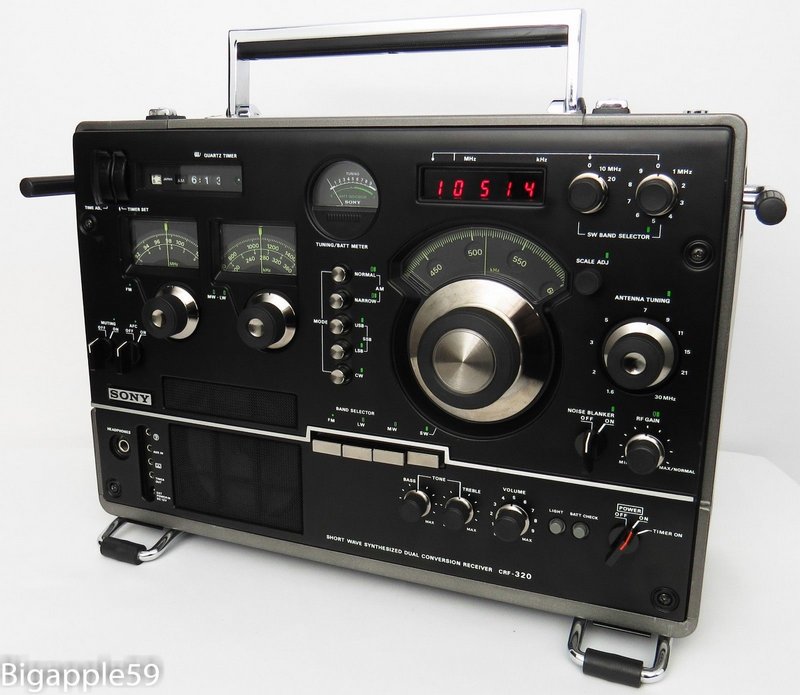
 Many thanks to SWLing Post contributor, Robert Gully, who points out this Sony CRF-320 on eBay:
Click here to view on eBay.
The BuyItNow price is $1900 plus shipping(!)–not for the casual radio collector. A serious collector will probably purchase this rig. This particular listing comes from the eBay seller bigapple59, who is well known for restored vintage radios and a 100% customer satisfaction rating.
While the price of this CRF-320 is well beyond my limits, I do admire the amount of detail bigapple59 includes in his listings. Since this radio will eventually sell, I’ve copied and pasted the description of this listing below:
This radio is the famed CRF-320 manufactured by Sony from the years 1976-1980. As is the case with many Sony products, especially at that time, this was a high end “portable” radio that represented the best that Sony could put together in one unit. This Cadillac Sony unit was analog with a digital readout on shortwave and thus was one of the first radios to offer the user such frequency accuracy generally unavailable in a portables prior to this time. Most American consumer grade radios did not offer any where near the accuracy of tuning available on this radio. This Sony was a double conversion super heterodyne fully solid state radio that is built like a tank and weighs like one too…at a full 27 lbs without any batteries installed.
These CRF-320’s are coveted by collectors that enjoy the classic good looks, the outstanding capabilities, and the Sony brand that was stellar in the late 70s and early 80s. However, 30 years later, these 320’s typically have several issues that need attention and it requires some resourcefulness to deal with these issues. You many find these 320’s available for less money…even considerably less money….but they will likely require attention and unless you are qualified to do the restoration, you may spend a lot of money to bring the 320 back to full capabilities.
The selling price on this CRF-320 takes into consideration relative scarcity, condition, the cost to acquire, and the effort and expense in restoration. We have sold a number of these restored 320’s and this particular one is in good cosmetic condition overall, but not perfect. Operational and cosmetic details are given below.
Over time, these CRF-320s can develop problems due to use, abuse, and even neglect. Any of the 320’s that come into our hands go through a series of checks, and if necessary, things are repaired or replaced. Let us now list some of the common issues and what has been attended to with this CRF-320 radio:
1. The nylon tuning gears shrink over time and crack, exacerbated by time and heat. There are 3 tuning gears in this 320. The shortwave, FM, and LW/MW gears were inspected and tested and it was determined that the FM and LW/MW gears would need to be replaced. The FM gear was cracked and the dial was slipping. During replacement of that gear, inspection was done of the other two gears and the LW/MW gear was cracked, but still working. It was also replaced.
2. The antennas are often broken, or if complete, the spring that extends the top of the antenna allowing it to be grasped for extension is non-functional. The two antennas on this radio are in excellent condition. They extend fully and the spring works properly in each radio.
3. The s-meter is often non-functional with the needle pointer frozen in position. This s-meter had this problem, but was repaired and now functions perfectly.
4. The audio is sometimes weak or non-functional as Sony used some poor audio caps that were discovered only years later. The audio in this 320 worked fine on all bands.
5. Sensitivity of the bands can be weak. This 320 had reduced sensitivity on the AM (MW) band, but the other bands had good sensitivity. The sensitivity on the AM band was quite weak so that it was difficult for me to actually receive a local AM station. The service tech tweaked all the bands and now the MW sensitivity is wonderful and the other bands are also operating at optimum performance.
6. Some of the control pots can be noisy due to oxidation. The pots and controls were noisy and have been cleaned on this 320.
7. Dial lamps can be burned out. This 320 did not have an issue with any burned out lamps. Please note that some of the panel lamps do not illuminate until the specific band (FM, mediumwave, or shortwave) is selected so you may see some lamps out, but that is only due to the chosen mode operation of the radio. The lamps are not as easy to see in a well lit room and only illuminate the dial to see it’s markings in the dark.
8. Digital frequency counter may not work properly or at all. Many of the digital readouts on these receivers can have issues that can be seen with 3 dots instead of a frequency being registered and this can be a serious repair. The frequency counter on this radio worked perfectly fine.
9. Battery and storage covers are sometimes missing and the clips that secure them to the back can be weak or broken. Both covers were present on this radio and the clips were strong.
10. The quartz clock is sometimes non-functional, but on this 320, the clock works just fine keeping accurate time. You can see the clock D cell battery in the rear compartment when viewing our pictures.
11. The front protective cover is often missing, but is present on this 320. When operating the radio, the cover is typically removed and set aside. This act causes the cover to sometimes be separated from some of these 320’s that have survived and are being sold. If missing, the opportunity to locate and secure one of these front covers is nearly impossible.
There are no known operational issues / problems with this CRF-320. Anything that needed attention was cared for and this Sony looks and performs like a champ. All the dials turn completely across the bands and all the bands receive with good sensitivity. On shortwave, the operator needs to rotate the knob to select the proper Mhz band and then dial in the frequency using the tuning knob. Once the band is selected, then the antenna trimmer is adjusted for best sensitivity and then tweaked again once you arrive at a station.
This CRF-320 operates off of a Sony AC power cord that is included or the operator may use 8 D cells for “portable” use (not included). The quartz clock requires it’s own D battery for operation and you can see this small holder inside the larger upper compartment on the back. We placed a battery in the clock and it held accurate time for several days prior to our listing this radio. There is a connection on the front of the receiver to allow the user to attach to a 12 volt external source…like a car, RV or boat.
Cosmetically, the 320 is in very nice condition for these radios. We have sold about 35 of these CRF-320s and this one has a small area of scratching on the front left side to the left of the FM dial. In addition, there are some minor markings on the sides and top, but is in better than average overall condition. The 320 has been fully detail cleaned by Pamela, my wife, who is meticulous in her work. We try to detail everything we sell and we encourage you to look closely at my pictures for specific cosmetic detail and email if you have any questions. Please note that after the pictures were taken, we decided to change the foam in the battery compartment so this is new foam and not the original Sony foam as seen in the pictures.
This CRF-320 comes with a full array of support documents and it’s AC power cord. In fact, this is the most complete set of user and service documents that we believe has ever been made available for this consumer shortwave radio. Along with the radio, you will receive:
1. A color copy of the CRF-320 Operating Manual. While much of the operation of the radio is intuitive, this manual includes information on properly using this radio, setting the clock and timer, and how to maximize your knowledge of the capabilities of this radio.
2. A copy of the CRF-320 Service Manual in color with 63 pages that has schematics, dis-assembly instructions, parts lists, dial cord stringing, etc.
3. A copy of the CRF-320 Circuit Description of 23 pages. This manual is the same as the 330K Circuit Description manual since both radios were identical with the exception of the tape deck.
4. A copy of the CRF-320 Troubleshooting Guidebook of 36 pages. Again, this is virtually identical to the 330 Guidebook since both units use the same radio circuitry.
5. A copy of the CRF-320/330K Troubleshooting Guide Supplement of 22 pages.
6. Several service updates that are 1 or 2 pages of corrections or of supplemental information.
7. A copy of the Sony sale brochure for the CRF-320 that identifies the features and gives operational specs.
8. A copy of the Sony advertisement for the CRF-320 radio from the 1970’s.
9. A CD that contains the above documents in PDF format.
What makes this receiver so special beyond the accuracy of the frequency readout ….well, the construction for one. Sony made comprehensive use of die-cast aluminum and chrome at a time when manufacturers regularly used plastic, cardboard, and vinyl to cheapen their products. There were no short cuts taken on construction as even the metal knobs have a rubber gripping surface and the speaker grill is metal to protect the speaker beneath. There are rack handles on the sides that extend to the front in order to give the unit a semi-military appearance, to offer additional grab surfaces, and to protect the array of front dials and knobs from damage should the unit tip over or during replacement of batteries. As with the knobs, Sony spared no expense in making these rack handles out of chrome and covering them with rubber trim for design sharpness and for gripping.
Fred Osterman in his book “Shortwave Receivers Past & Present” lists this radio as extremely scarce. The suggested retail price was $1500 at the time of sale in 1976…..yes, for a portable radio in the 1970’s! Using the consumer price index, the cost for this same radio in 2016 dollars would be $6,245 if purchased today….over 4 times the original cost!
http://www.bls.gov/data/inflation_calculator.htm
The CRF-320 is a general coverage receiver and covers the Longwave, AM, Shortwave, and FM bands. Basically, the unit begins at 150 KHz and runs up to 30 MHz plus FM. There are two separate telescopic antennas…one for FM and the other for Shortwave and then a separate internal ferrite antenna for AM and Longwave. The telescopic antennas are unique in that they completely retract flat into the cabinet. Then with a slight push, the top of the whip antennas spring up about an inch for you to grab and extend. The right shortwave antenna extends vertical and the left FM antenna extends to allow a swivel from upright so that it can catch the FM signal more readily.
This Sony radio is a gadget person’s delight having lots of buttons and knobs to add visual and operational interest. Other features on this CRF-320 include:
- digital quartz clock timer (cutting edge for the mid 70’s)
- dial lamps for each band
- narrow / wide bandwidth filter
- scale calibration
- headphone jack
- input jack, output jack
- antenna jack for external connections
- recording jack
- antenna trimmer
- local / dx switch
- noise blanker
- FM muting
- AFC
- RF gain
- battery check button
- jack to connect a separate 12 volt power supply
- separate bass / treble controls to tailor sound to suit the listener preference.
- timer – so that the owner can record a program when absent or turn the unit on as if using for an alarm clock. On the back, you will spot 2 compartments…one for batteries and one for the AC power cord and other accessories like an earphone.
The separate tuning dials on this unit allow for the user to move from AM to FM to Shortwave and back again and not have to re-tune the dials for each band…a very convenient feature. If you look at the frequency readout and the analog scale in the pictures, you will see that they are close. There is a knob to calibrate the analog scale to the digital readout to get the dial scale “spot on” for shortwave tuning. There is a choice of narrow or wide IF filters for maximizing fidelity and minimizing side-channel interference and the choice of upper and lower sideband to hear marine, aircraft, or amateur radio traffic.
Here is some concise info on Rigpix:
http://www.rigpix.com/sony/sony_crf320.htm
There is not much info online about this radio and thus this indirectly helps to establish the scarcity of the CRF-320!
We are happy to answer any questions about this radio that you may have.
The cost to purchase packing materials for the CRF-320 for safe shipping will cost $20 regardless of where the radio is shipped. This charge will not cover all our packing material costs, but should allow us to pack this 320 properly for transport to your location. The shipping cost includes the cost for packing materials, shipping charge, and full insurance.
Overseas buyers are warned that shipping overseas will be expensive. We have shipped several of these CRF-320’s overseas and the cost was not cheap any time this was done due to the weight and size. The Ebay calculator is set for UPS delivery, but it is very likely that USPS Express Guaranteed mail will be less expensive. Unfortunately, this is not an option to select for the Ebay calculator. If you would like us to verify and see if shipping can be lower using Express Guaranteed, please email your city and postal code. Also, please keep in mind that the shipping cost does not include any customs, duty, import or VAT fees. If you are unsure whether you will be responsible for additional costs to receive this radio, please check with your local post office and custom’s office prior to purchase. Thank you!
In shipping this radio overseas, it may be determined that the post office will not allow me to purchase full insurance to cover the value of the radio. There are a couple of destinations in which the insurance value is limited to $650. This cannot be easily determined prior to purchase as there is no clearing house to see which destinations may be affected. If you should purchase from such a location, I will offer an alternative shipping that will likely be more expensive. If this is not acceptable to you, we can reverse the sale so that neither one of us is held accountable. Thank you for your understanding.
The buyer is to pay via Paypal within 3 days of purchase. Ebay does not permit us to list other accepted forms of payment so we will refrain from doing so to prevent them from removing my listing as is the Ebay policy. Please email if you have any questions.
Penna residents are reminded that they are responsible for the 6% state sales tax.
Thank you for taking the time out of your busy day to look at our Ebay items!
Info About Sony
Sony is a postwar (WW2) success story. The Sony Corp. was first established in May of 1946 in Japan and given the name from combining “Sonus”, the original Latin word for “Sonic”, meaning sound, and Sonny denoting small size. Over the years, Sony has been an industry and worldwide leader in high end and in minature consumer electronics. It has become one of the larger electronics firms worldwide and the Sony name if often attributed to high quality products. The company history is long and very extensive, detailing many of the company’s innovations and achievements. I sometimes include coporate history in my Ebay sales, but will not do that in this sale as that would require someone to read an enormous amount of information. Instead, if interested, you may read about the fascinating history of Sony here:
http://www.sony.net/Fun/SH/
Thanks again, Robert, for sharing this listing! Sadly, I’ll just keep dreaming that a CRF-320 will show up at the local thrift store.