Category Archives: Videos

Tony’s homebrew mag loop antenna and amplifier

Fullscreen capture 10312015 115110 AM

Yesterday, Tony (K3DY), shared a video (via Twitter) demonstrating his new home brew loop antenna and amplifier.

This is actually a great demonstration of how even a relatively simple, inexpensive loop antenna can improve reception in locations with heavy radio interference. Tony includes the following notes with his video:

“Testing a new receiving loop antenna that I built today. It uses a pre amplifier based on deferential setup of two 2N5109 transistors. Loop is made out of coaxial cable, only the shield is connected to the circuit.

Quick demo on 31 meters, lots of stations at sunset time. No time for further testing but I observed a pronounced directivity below 7 MHz. 75 meters is so quiet that it makes me forget I live in a townhouse. As a comparison, my noise level on 75 meters is at S8 on an end fed [antenna].

I will use this loop primarily for SWLing purposes but I may use it as a separate receiving antenna with my amateur radio equipment.

A lot of fun, loops are fascinating and efficient!

Indeed, Tony! And perhaps the icing on the cake is that loop antennas are so portable, low-profile and easy to deploy. They’re ideal for those living in restricted areas and with picky home owners’ associations.

Inspired by my buddy Vlado (N3CZ), I’ve actually been collecting the pieces to build my own mag loop antenna this winter. I doubt the parts for my loop will exceed ten dollars as I plan to use the shield of some heavy coax for the primary loop and a little PVC for support (much like Tony’s loop).

Tony’s video is inspiring me to go a step further and also build a simple amplifier. Any suggestions or schematics for doing so are most welcome!
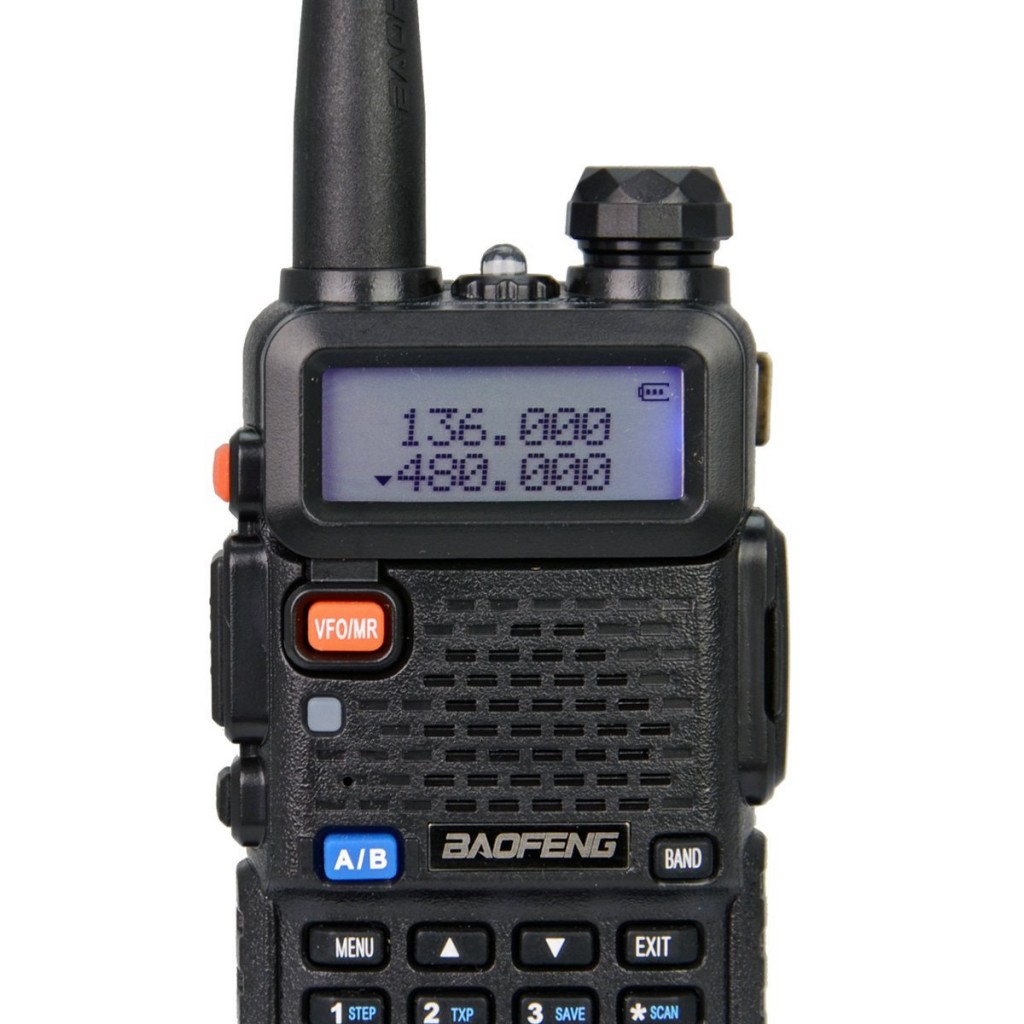
The BaoFeng UV-5R is tougher than the $25 price tag implies

UV-5R

I’ll admit it: I’m a bit of a handheld radio snob.

I don’t own many HT transceivers, but the ones I do own are manufactured by the “big three”–namely, Yaesu, Kenwood and Icom. For ages, these three companies dominated the handheld radio market.

A few years ago, several Chinese radio manufactures (BaofengWouxun, TDXone and TYT to name a few) started flooding the market with inexpensive handheld transceivers–radios that literally cost a fraction of those produced by the “big three.” Where a Yaesu dual band handheld might cost between $150-250 US, a Baefeng model might cost $25-50 US.

As one might imagine, these inexpensive transceivers gained quite a following in the ham radio community and with preparedness/communications enthusiasts.

I’ve read that many of these ultra-cheap transceivers are difficult to program and I’m sure that’s one of the factors that has kept me from purchasing one.

I also assumed that a $25 radio must be very poorly constructed. Seems I’m incorrect at least on this point.

Many thanks to Dave (K4SV) for sharing the following video from Chris (K5CLC), who put the popular Baofeng UV-5R through an “extreme” field test:

The Baofeng UV-5R is available at Amazon.com for a mere $25.80 US shipping included.

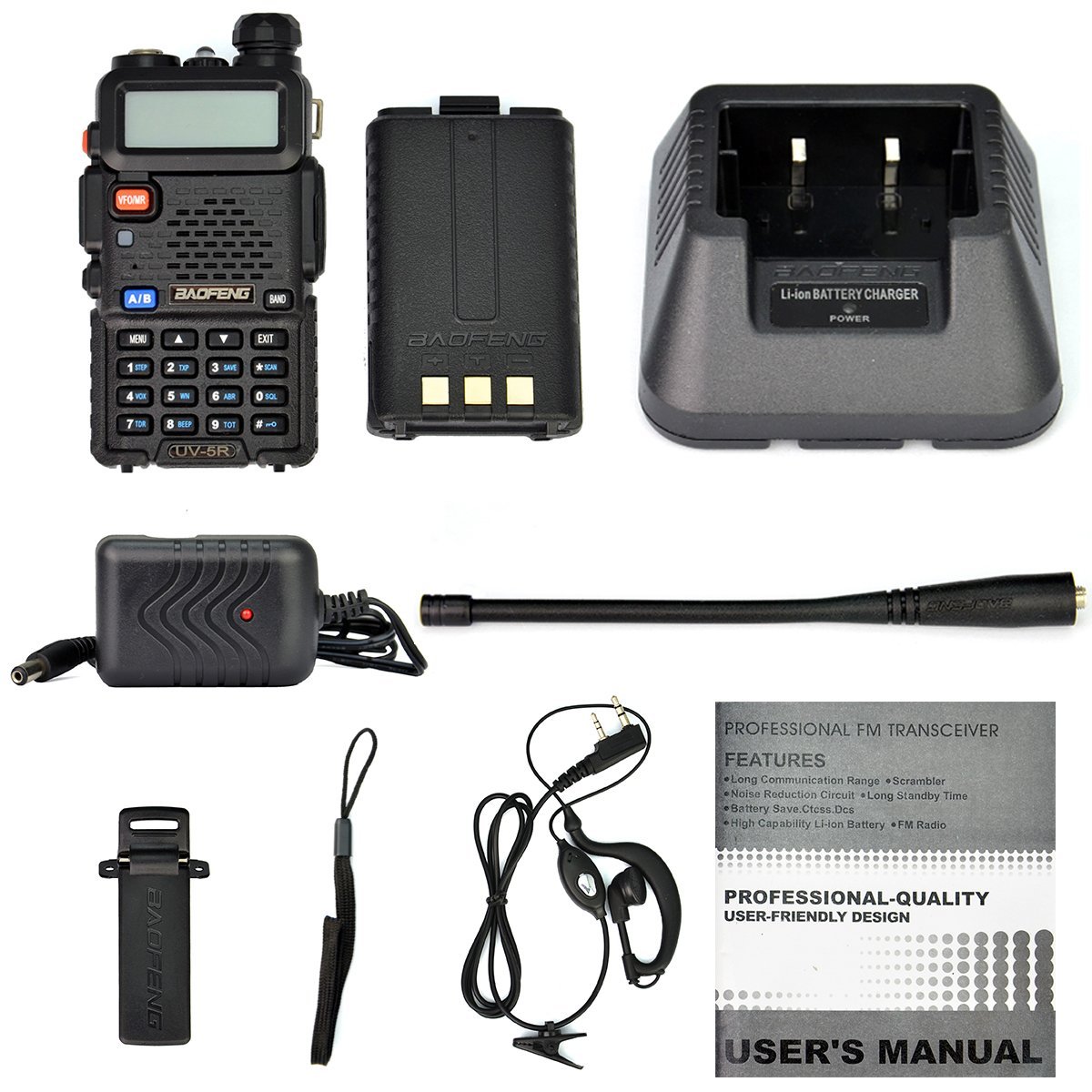
UV-5R accessories. Click to enlarge.

UV-5R accessories. Click to enlarge.

The UV-5R even comes with a number of accessories:

  • a ANT5 SMA-J flexible antenna,
  • BL-5 Li-ion battery (7.4V 1800 mAh),
  • belt clip,
  • wrist strap,
  • AC adapter (8.4V 600ma)
  • and drop-in charger.

Frankly, it’s hard to believe you get so much radio for the price.

Curiosity is getting the best of me and I believe I very well may purchase a UV-5R in the coming days. I’ll probably purchase the USB programming cable as well [UPDATE: several readers suggested this proper FTDI cable as a much better option].

Click here to view the Baofeng UV-5R on Amazon: I encourage you to read the numerous reviews–many of which sing its praises, others do not.

Readers: if you have the UV-5R, please post your comments about this little radio. I’m curious if you find it easy to use and if the battery life has held up over time.  Any tricks for programming it?

Mini DXpedition: Oxford Shortwave Log and the Sony ICF-SW55

Sony-ICF-SW55

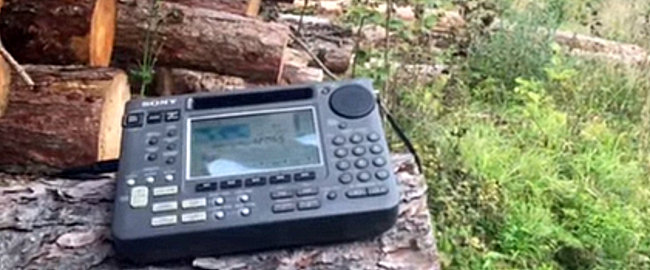
SWLing Post reader, “Oxford Shortwave Log” recently noted the following on our Facebook page:

“Hi there, I received some very nice feedback regarding almost perfect reception of Radio Australia during a mini DX-pedition into the Oxfordshire countryside and thought I would share it.”

“I use a (now vintage I guess!) Sony ICF-SW55 and a 25 metre long-wire. There are lots more videos at on YouTube channel: Oxford Shortwave Log

Great proof that Mini DXpeditions can pay off!

Sounds like that Sony ICF-SW55 performs admirably–it is certainly a classic portable.

I remember when the ICF-SW55 was introduced in 1993-1994; back when I was doing my undergraduate studies and had no funds for it. In the 1990s, Sony’s portables almost seemed to be sent to us from the future–large informative displays, advanced memories, and incredible portable performance were the hallmarks.

On eBay, you’ll find that the ICF-SW55 still fetches a high price.

OSL: thanks for sharing the videos!

TASS: An Arduino-based antenna switch

TASS

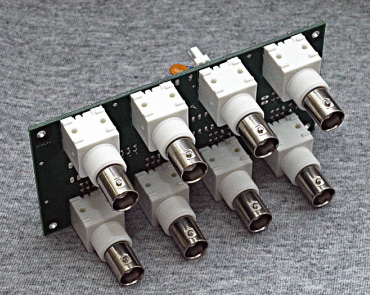
Many thanks to SWLing Post reader, Stan (WA1LOU), who writes:

“Enjoy your blog. I have been reading it for years. [H]ere is something your readers might be interested in that I mentioned in my blog today:

http://www.horzepa.com/2015/09/computer-controlled-switch-system.html

Very cool! Goes to show that there are a countless number of applications for the Arduino system to be used with amateur and shortwave radio.

Click here to read Stan’s informative post, and here to order the TASS system from TAPR.

John Ackermann also produced this informative presentation/video about the system:

Video: “The very particular world of amateur radio”

BBC-Yaesu

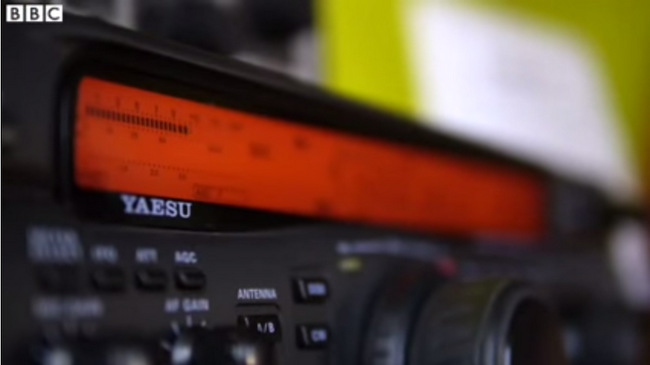
Many thanks to SWLing Post reader, Nick, for sharing this 2013 video produced by the BBC. Here is the description from YouTube:

“In the face of the internet, mobiles and instant messaging you might expect the hobby of amateur radio – or HAM radio as it’s also known – to be on the decline.

But in the last three years, the number of amateur radio licences has risen by over 8,000 – with 80,000 currently issued in the UK.

Using designated frequencies, amateur radio enthusiasts communicate with people over the world. Many prefer the relaxed approach of ‘rag chewing’ or chatting at length with people, who often become friends – while at the opposite end of the spectrum ‘contesters’ compete to make as many contacts as possible in a given period.

The hobby is also a public service, with Raynet (in the UK) stepping in during emergencies when regular communication networks fail. Amateur radio enthusiasts are currently contributing to relief efforts following Typhoon Haiyan in the Philippines.”

TX Factor Episode 9

TXfactorAnother episode of the superb UK ham radio program, TX Factor has been published. TX Factor Episode 9 features ham radio “Essex-style!” Here’s a brief description:

“We visit the south east to report on the work of Chelmsford ARS, Essex Repeater Group and Essex Ham. And we’re giving away a CG-PK4 Pocket Memory Keyer in our free-to-enter draw.”

Fans might also take note that TX Factor now has a collection of audio interviews and features called TX Talk.