Shortwave listening and everything radio including reviews, broadcasting, ham radio, field operation, DXing, maker kits, travel, emergency gear, events, and more
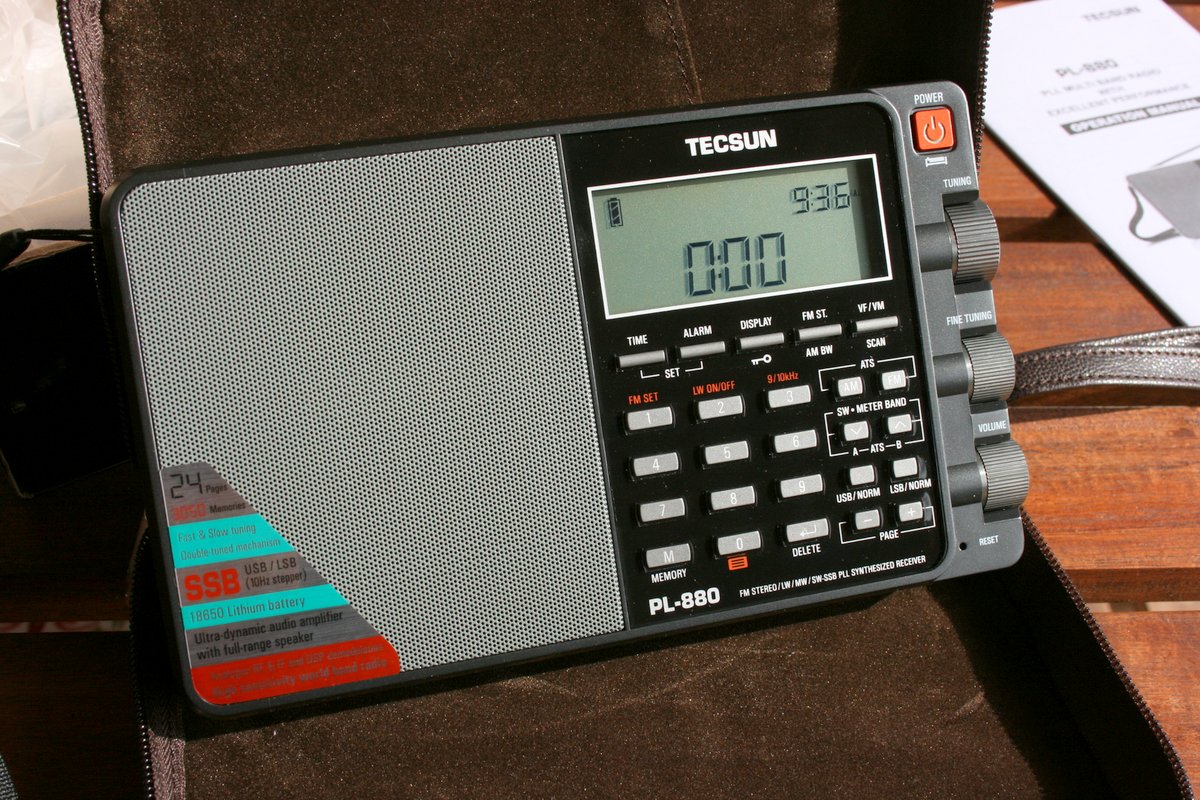
Once again, I ventured out to my truck tailgate to make a few videos of the Tecsun PL-880. In this video, I’ve tuned the PL-880 and PL-660 to Deutsche Welle’s English language service on 9,800 kHz (transmitted from Kigali, Rwanda, some 7,600 miles away).
I made this video with my iPhone, so apologies for the low quality:
Note that when I first turn on the PL-660 it is in sync mode by accident. After changing the bandwidth on the PL-660, I then turn off sync.
I’ve noted that the PL-660’s sync detector locks better than that of the PL-880. However, using the PL-880’s SSB mode to zero-beat the AM carrier (see article on ECR), produces great (and stable) results.
Sensitivity-wise, these radios are quite similar. While I personally prefer the audio of the PL-880, the PL-660 makes vocals pop out of the noise a bit better.
I normally like to do in-line recordings for audio comparisons of radios, but my digital recorder is non-functional at the moment. This fact–coupled with a bit of reader peer pressure–prompted me to take a short video with my iPhone of the PL880 and PL660 in action. While this will not be a true representation of the PL-880’s audio, of course, it should serve as some point of comparison in terms of function.
In this (very basic) video, you can hear the difference between the PL-880 and PL-660 when both radios are coping with adjacent signal interference. In this case, I tuned to Radio Australia on 9580 kHz–typically a blow-torch signal here in eastern North America. I wanted to gauge how each radio coped with adjacent signal from China Radio International broadcasting out of Cuba on 9570 kHz, which can cause major adjacent signal problems, even though it’s a full 10 kHz below Radio Australia.
In this video, I tried to use both radios’ bandwidth controls and (upper side-band) sync lock to cope with the interference. Forgive the lack of tripod. Here you go:
Check out this brilliant video tour of the BBC Woofferton Transmitting Station, presented by Senior Transmitter Engineer Dave Porter (G40YX). The video is divided in seven parts, thus I’ve created a playlist that will automatically load each video in order.
The following is a no-spoiler review, as I assume many of you may be waiting for the film to hit the big screen, and I wouldn’t want to reveal any cinematic surprises.
We first mentioned The Numbers Station back in late 2011 –and admittedly, I was eager to see public attention drawn to this public-yet-covert shortwave communications medium that’s still in existence today. Indeed, it’s no wonder that a numbers station became the subject of a film; the subject is truly mysterious. Only a few days ago, while describing numbers stations to a visiting friend who had never heard of them, I played a recording of a numbers station that I made last year–her initial response upon hearing the recording was, in her words, that she experienced “chills” running up her spine.
But what is a numbers station?
Numbers stations, for those of you not familiar with them, are shortwave radio broadcasts that contain only strings of what seem to be random numbers. In truth, these numbers are encrypted messages for operatives in the field (otherwise known as secret agents). The operatives tune in the station with a simple shortwave radio, then decode the message with a one-time decryption key. Once the message has been deciphered, the message pads are immediately burnt or destroyed (or, at least, they’re meant to be…). Oddly, even though this is a very public communication which anyone with a shortwave radio can hear, only one or two individuals will likely ever decode the message. Such messages have been known to exist in a variety of languages at least since the time of the Cold War, but strangely did not conclude with the Cold War’s supposed end–they are ongoing even today. (Click here to check out our other numbers station posts.)
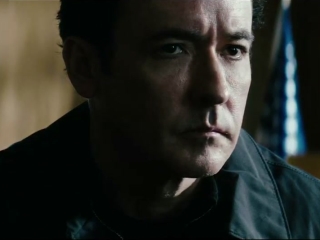
John Cusack as Emerson (Photo: Image Entertainment)
The Movie
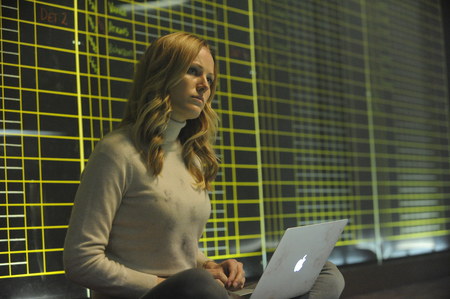
In the movie The Numbers Station, John Cusack’s character, Emerson, is a seasoned field operative–a “black-ops” agent–who faces a life-changing dilemma in the field which places his career in jeopardy. In an attempt to give Emerson some time to reconcile his emotions, his leader (Liam Cunningham) assigns him to what should be a simple, routine assignment: to protect Catherine (Malin Akerman), a cryptologist who broadcasts at a rural remote numbers station in the UK.
Things go terribly wrong when the station is compromised and Cusack finds himself again facing the same dilemma that sent him to this assignment in the first place: whether to “retire” his asset (namely, Catherine) in order to fulfill his duty, by cutting off loose ends? Or will his conscience–and tenuous friendship with Catherine–take him in another direction? It’s a difficult ethical dilemma, one Emerson has been attempting to avoid.
Malin Akerman as Catherine (Photo: Image Entertainment)
I’ve seen a number of John Cusack films over the years, and while he’s an extraordinary talent, The Numbers Stationunfortunately doesn’t quite allow us to see his full range as an actor simply because his character, Emerson, is stoic and quite introspective. But the chemistry between Emerson and Catherine is complex and tense, and one can’t help but believe he cares deeply for her.
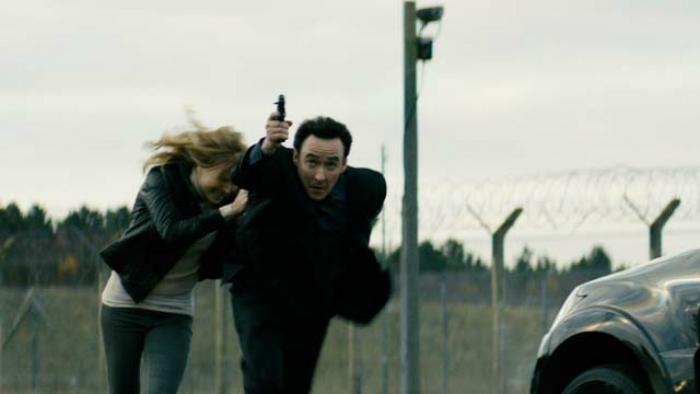
On the action front, The Numbers Station is a much greater success: pacing is good, with a few moments to collect your breath; still, there’s always looming conflict. The bulk of the film is set in a dimly lit, underground bunker-come-numbers station, and there are actually very few shoot-’em-out scenes, yet the tension and suspense are constant.
I won’t comment on how the plot resolves, but I can say that if you like dark films with tension, moral decisions, action, and intrigue, this is well worth watching. I enjoyed it.
Moreover, if you love shortwave radio, and are intrigued by numbers stations, you will be pleased to discover that this film treats the concept with due respect and more accuracy than I would have anticipated.
(Photo: Image Entertainment)
How accurate is The Numbers Station?
While those who write about numbers stations have presumably never worked for one, there’s an existing body of knowledge out there built on thousands of hours of listening, cataloging stations and even court documents from cases involving spies. This gives us a fairly accurate idea of the true nature of numbers stations.
Likely inaccuracies
Though it is possible, I have never heard of a numbers station which has a live voice behind the microphone, reading numbers; these would most likely be advance-recorded or computer generated.
In the film, Malin Akerman’s character, Catherine, only seems to read a string of numbers for a matter of seconds, not minutes; in reality, this would take much more time.
I heard no preamble of numbers to ID the correct decipher key.
And yet…likely accuracies
In the film, under standard operating conditions, no one at the station knows the nature of the messages being broadcast–this reflects a probable fact about such stations.
The numbers station is located in a rural and remote part of the UK, a convincing setting for a numbers station (though some may broadcast from major broadcasting sites).
Once the station has been compromised, Cusack’s character explains in some detail how numbers stations work on the operative’s end; this description is very true to what is known or believed of actual numbers stations.
So, should you see it?
I anticipate that most any shortwave radio enthusiast will enjoy The Numbers Station. As a non-movie-reviewer–in other words, as a regular joe public movie-goer–I give it 8 stars out of 10. Go ahead!
Clandestine station, Radio Free Sarawak, offers an alternative voice in Malaysia ahead of elections next week. For those living in remote jungle communities–places where the Internet is not readily available–Radio Free Sarawak can be heard on shortwave radio.
Al Jazeera’s Florence Looi reports from a village in Sarawak: