The bands are open! Make time to listen.

Sony-ICF-SW100-Outside-Fall

Though I’ve spent the entire day sawing and splitting firewood, I’ve been actively recording spectrum on the 31, 25, 19 and 16 meter bands with the WinRadio Excalibur, Elad FDM-S2 and the SDRplay RSP. Why? Propagation–especially on the higher bands–has been the best it’s been in several weeks.

As I discovered at the recent SWLing Post DXpedition, my shack PC can handle making multiple spectrum recordings simultaneously as long as I limit each recording to the width of a broadcast band. (I’ve never tried pushing the limit very hard.) Someday in the future–perhaps when we’re having terrible propagation–I’ll play those spectrum recordings back and tune through them as if they were live.

Radio time travel at its best.
Sony-ICF-SW100-Outside-2

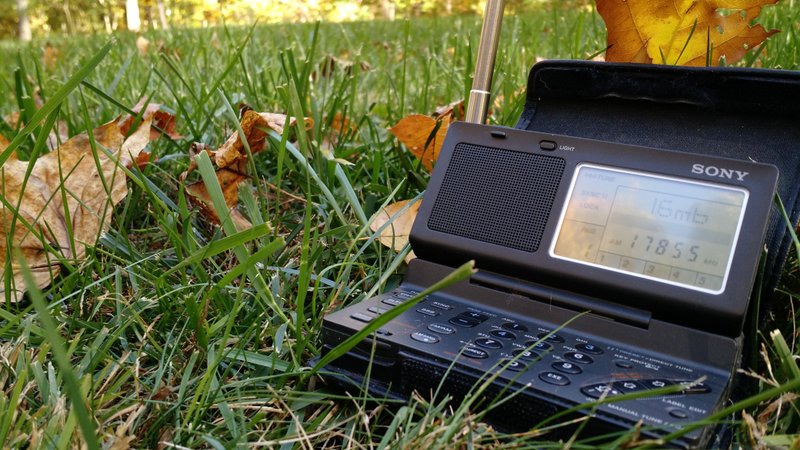
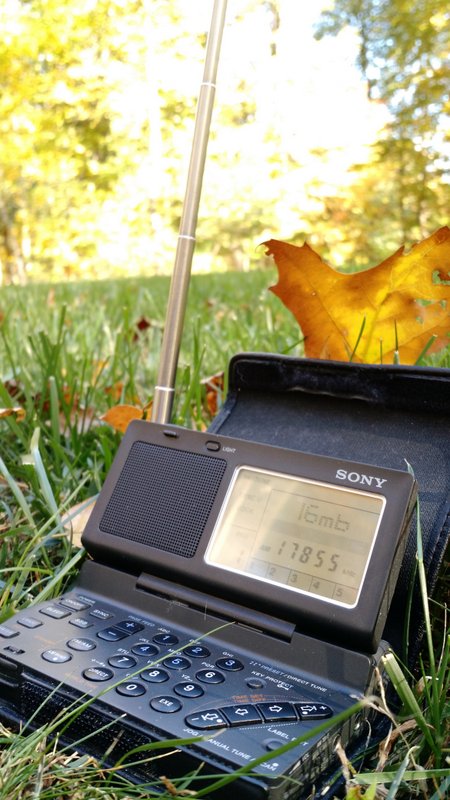
When I decided to throw in the towel with all of the firewood processing, I fired up the Sony ICF-SW100 (above) and tuned in a game on 17,855 kHz: Radio Exterior de España.

The REE signal was simply booming into eastern North America!

Hard to break away from the radio on days like this.

My advice? Take advantage of these conditions and make time to listen!

For me, SWLing a great excuse to relax and let me back heal after a long day of splitting wood. For some, perhaps it’s a good excuse to take the radio outdoors and away from urban interference. Whatever the excuse, don’t hesitate to fire up your radio!

There are some interesting stations on the bands this evening. Feel free to comment with some you’ve logged.
In Korogocho, Koch FM focuses on water sanitation

KenyaMap

(Source: BBC Media Action)

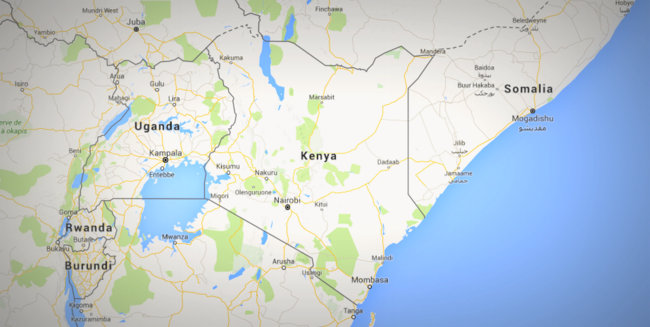
On Global Handwashing Day, Diana Njeru looks at how a radio station constructed from a shipping container is helping people improve their health in one of Kenya’s largest slums.

On the banks of a slimy grey river, a man is using a handcart to dump a barrel of human waste into the water. Sliding down the slope, the cart slips from his grasp and it tumbles in, forcing him to wade through the sludge to retrieve it.

This was the scene before me as I visited Korogocho slum last week, one of Nairobi’s largest informal settlements and home to over 150,000 residents.

A shipping container turned studio

Just up the road from the river is Koch FM, a popular community radio station BBC Media Action is helping to support through tailored mentoring to improve the technical skills of its staff. The station’s studio – constructed from an old shipping container and sound proofed with egg boxes – has been run by a team of passionate volunteers since 2006.

[…]Clean water is very hard to come by. In slums like Korogocho, people must either rely on rainwater or water vending points run by cartels. This toxic environment paired with limited awareness of good hygiene means life-threatening but preventable illnesses like diarrhoea are all too common.

To help tackle this, BBC Media Action mentor Davie Njuguna is currently working with staff at Koch FM to help them produce programmes that address water, sanitation and hygiene (WASH) issues.

Continue reading on the BBC Media Action blog…

A.V.Club reviews “The Russian Woodpecker”

Duga-3-Woodpecker

Many thanks to SWLing Post reader, Charles, who writes:

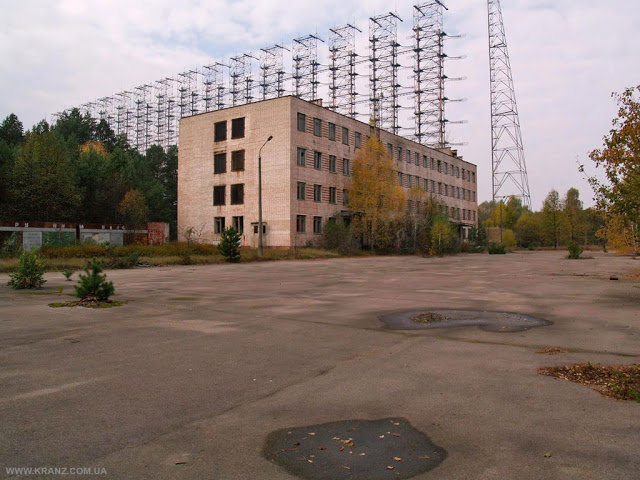
Thomas, you might find this movie review of “The Russian Woodpecker” interesting. Looks like the film is more conspiracy than investigative reporting. Too bad. Having dealt with Woodpecker noise during my ham radio career, it would have been fun to know more about the motivation behind building that enormous OTH radar:

http://www.avclub.com/review/russian-woodpecker-offers-plenty-conspiracy-little-226743

SDRplay RSP review in CQ Ham Radio Japan

CQhamradioMag-Front

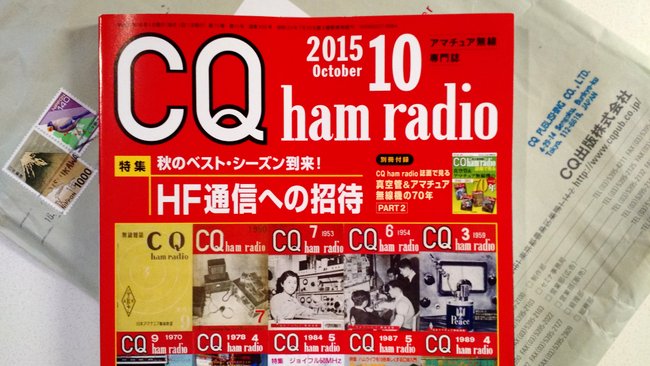
Two weeks ago, I received a mystery package in the mail: a copy of the October 2015 issue of CQ Ham Radio magazine, sent directly from the publisher in Tokyo, Japan.

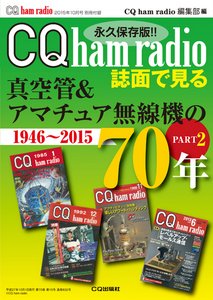
Supplement magazine shipped with the October issue.

Supplement magazine shipped with the October issue.

Since I can’t speak or read Japanese, I was very confused why I would receive a copy.

Out of curiosity, last week, I opened the magazine to see what sort of articles it contained.

In short: I was very impressed. While I couldn’t read the content, of course, I was able to get an idea of the scope of this magazine–it contained numerous articles, news items, reviews and photos.

I was pleased to note a section that focused on good etiquette for amateur radio exchanges in English. After all, if you are a Japanese DXer, you will need to know enough English to log DX stations around the world as English is the staple DX language. Japanese hams are well known for their excellent on-air etiquette–ask anyone who has been on a DXpedition.

The magazine is thick, too; most of the pages are black and white news print, but there are several color/glossy sections as well. This particular issue was even mailed with a separate supplement magazine containing a history of ham radio ads throughout the years. I thoroughly enjoyed the trip down memory lane.

CQhamradioMag-Article

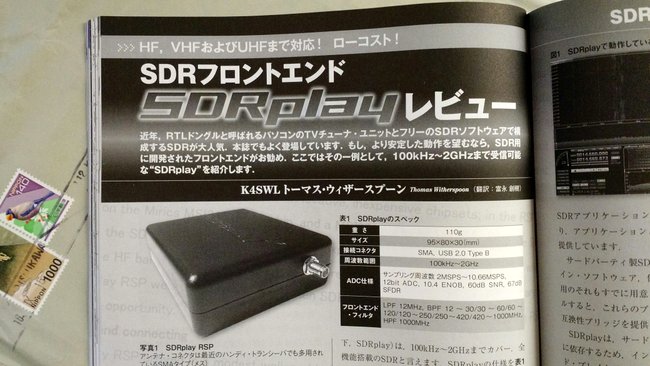
Once I landed on the page above, I quickly realized why I had been sent a courtesy copy of the magazine: my SDRplay RSP review had been translated and published. It was then I remembered granting permission to have the article translated into Japanese for a ham radio magazine. I had completely forgotten!

I’m honored my review was printed in CQ ham radio, but most of all, it has been fascinating to browse through what appears to be an excellent radio publication. I offer my gratitude to the translator who took the time to edit my article.

Help identifying longwave transmitters

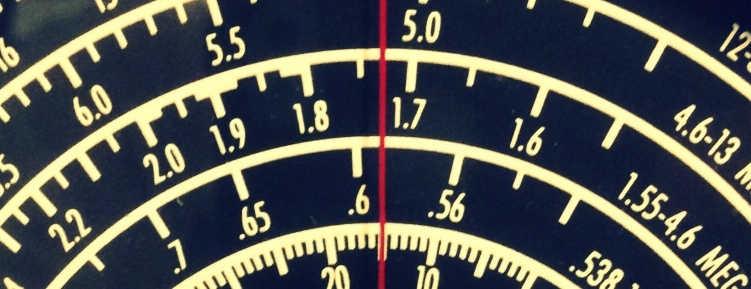
SX-99-Dial-Nar

As many of you know, I’ve been catching up on correspondence recently as the past few weeks have been quite hectic. 

SWLing Post reader, Andy (G0FTD), sent the following message several weeks ago, but is still seeking help:

I came across your website recently, so good to read something dealing with proper SWLing!

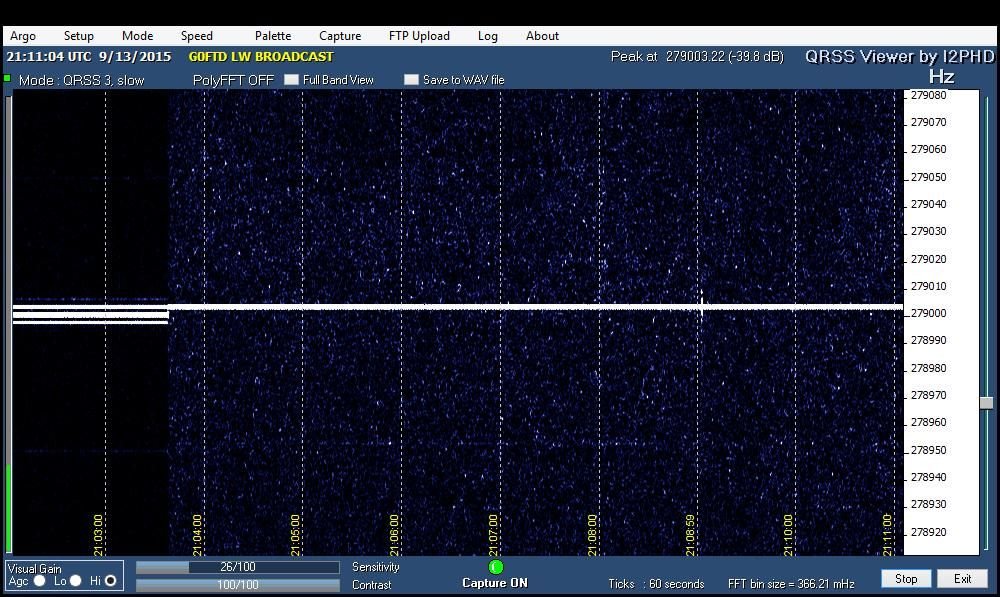
Last night I set up an experiment on 279Khz.

This is because of my interest in something called QRSS beacons in  amateur radio. I use the HF bands, but recently became interested in the LF  bands, 136 / 475Khz amateur bands and propagation.

I thought it would be interesting to test for the times that the day / nightime occurs at LF.

To do this I decided to use 279Khz, which by rights only has 2 transmitters on them, and at a convenient distance.

The only list I have says that Belarus and Turkey operate transmitters, so in theory I should only see 2 traces on my Argo software.

UNID 279KHZ

But I was surprised to see 3 traces.

Two of them have about a 1Hz offset to the main one, exactly on 279Khz.

I wonder if your readers can confirm the transmitters ?

Maybe Belarus is operating two TX sites with the offset, and the other is Turkey ?

You can see that the two offset ones go QRT at the same time.

If you can help Andy, please comment. Again, Andy, apologies for the delay in posting your inquiry!

RCI on Saving Canada’s Public Broadcaster

CBCbuilding

Many thanks to SWLing Post reader, David LW4DAF, who shares this link from RCI news:


After seven days of walking, a group of supporters of Canada’s public broadcaster, has reached its goal on Parliament Hill in the national capital, Ottawa.

The group calling itself “Tous Amis de Radio-Canada” is protesting the severe budgte cutbacks to the institution. They, and the English equivalent “Friends of the CBC” say the funding reductions from the federal government have resulted in severe staff reductions in the past couple of years, along with an inability to properly fulfill its role.

The group of marchers and supporters stood on Parliament Hill today after walking about 200 km to arrive in the capital on this National thanksgiving holiday to deliver a message to politicians now in the final stretch of a close federal election campaign.

The group says that Radio-Canada/CBC has always been a vital national cultural institution, and critical source of Canadian viewpoints on world affairs. It notes however, that role is increasingly more important in the light of a globalized digital world, where the voice of Canada as a producer, distributor, and aggregator of domestic and world news from a Canadian perspective, current affairs, and Canadian entertainment, is often swamped by the vastly bigger content from foreign sources.

Continue reading on Radio Canada International’s news page…

ITU Monitoring Programme: 2.85 to 28 MHz

Fullscreen capture 10142015 42958 PM

I’m having difficulty remembering who sent me a link to the ITU Monitoring Programme, but I am most grateful.

What is the monitoring programme? Here’s the description from the ITU website:

“The objective of this monitoring programme is to identify stations whose emissions in bands between 2 850 kHz and 28 000 kHz are not in conformity with the RR and to provide administrations that do not have monitoring facilities with information for frequency management purposes.

?The Bureau prepares a publication containing spectrum monitoring information in the frequency bands between 2 850 kHz and 28 000 kHz submitted by administrations in accordance with BR Circular-letter CR/159 of 9 May 2001.”

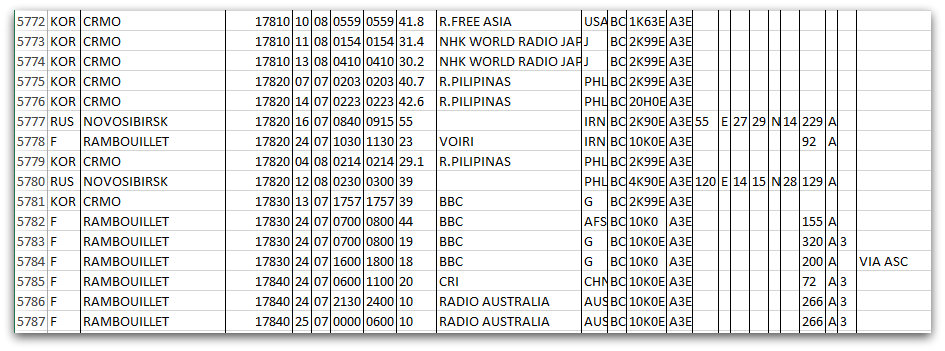
The data can be downloaded in spreadsheet format, organized by monitoring date. It’s an amazing amount of information–a decent survey of what can be found on the bands.

Click here to view the list of spreadsheets.