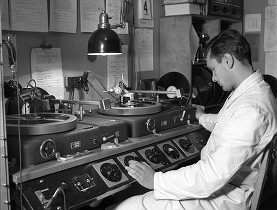
(Photo: SwissInfo.ch)
Many thanks to my buddy, Rob Wagner, for passing along yet another great article with archived sound clips from Swiss Radio International.
Click here to read Switzerland’s international voice in a changing world.

(Photo: SwissInfo.ch)
Many thanks to my buddy, Rob Wagner, for passing along yet another great article with archived sound clips from Swiss Radio International.
Click here to read Switzerland’s international voice in a changing world.
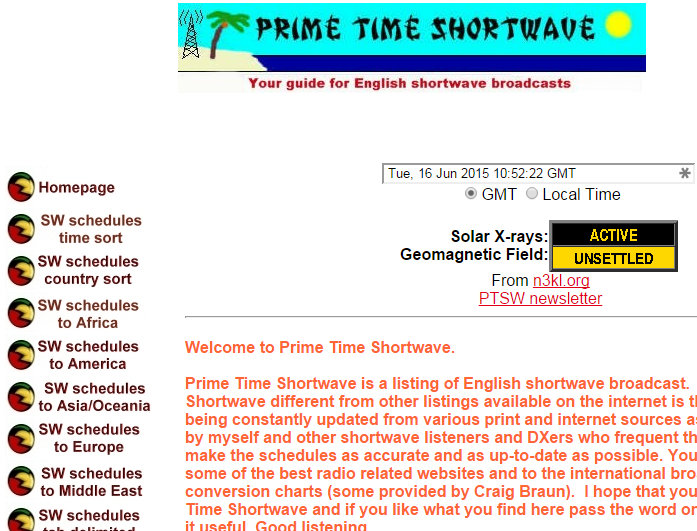 Many thanks to SWLing Post reader, Chris Crosby, for passing along this information from Daniel Sampson of Prime Time Shortwave:
Prime Time Shortwave shutting down June 26, 2015
~.~.~
It is disappointing to have to do this but it looks like I may be discontinuing the Prime Time Shortwave website June 24. Where I have the Prime Time Shortwave hosted, Front Page extensions will no longer be supported, and the costs for using their website builder is too high added to the server space. I expected this day would eventually come since the Front Page product was discontinued in 2006.
I have been doing the Prime Time Shortwave website for 17 years and it is getting difficult to find the time to work on it.
Regards,
Daniel Sampson
__._,_.___
Prime Time Shortwave
http://www.primetimeshortwave.com
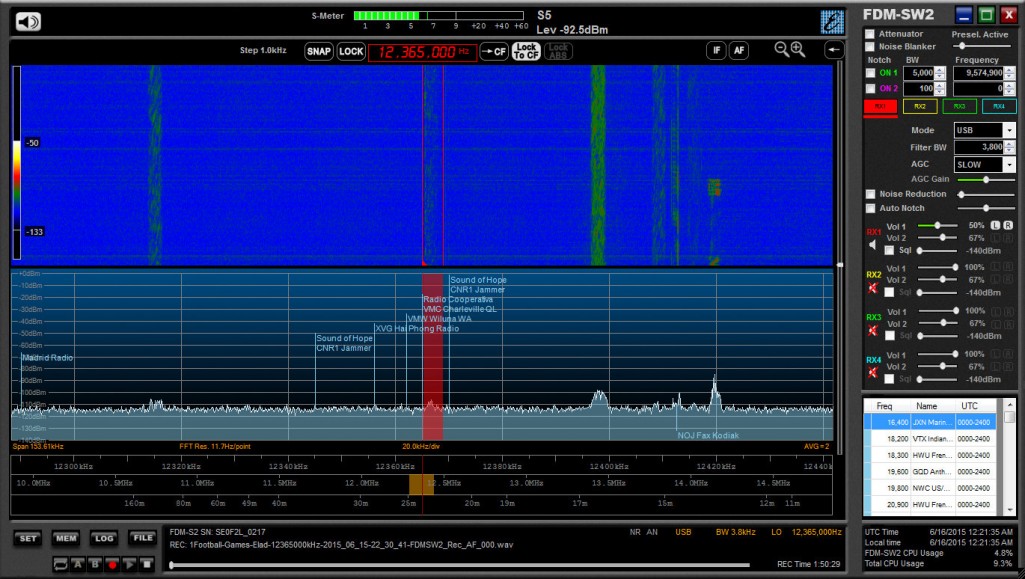 Many thanks to David Goren, who has apprised me of a (utility?) broadcaster who relaying Spanish language football matches on 12,365 kHz in the upper sideband. According to a message on the DXLD Yahoo group, someone has been relaying games on this frequency with some consistency.
As I type this, I’m listening to Chile v Mexico, though it’s a very faint signal here in eastern North America. The Elad FDM-S2 is doing a good job of pulling the signal out of the static, though. I have no clue where this broadcast originates.
Please comment if you’re able to log this station where you live, or you have further details about the relay.
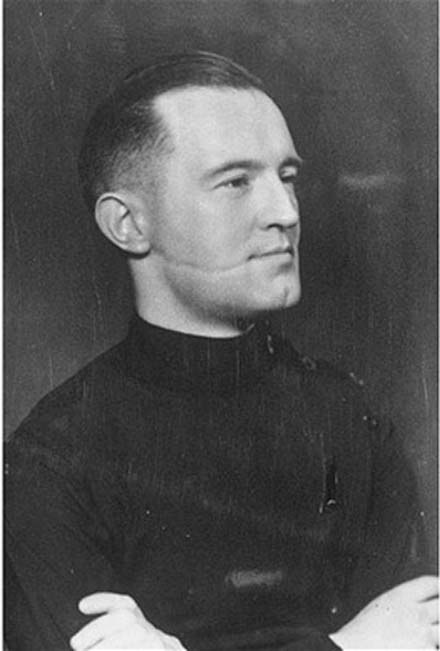
William Joyce (a.k.a. “Lord Haw Haw”)
Many thanks to SWLing Post contributor, Jonathan Marks, who shares this brilliant radio documentary from BBC Radio 4 about the trial of the infamous Lord Haw Haw.
(Source: Radio 4)
Clive Anderson looks at a variety of famous or infamous cases and retells the story that the case brought into the public eye.
In this programme he explores the 1945 trial of William Joyce – Lord Haw-Haw – for High Treason.
Featuring Professor Colin Holmes, Geoffrey Robertson QC and Professor Jean Seaton.
Click here to listen to the full episode via Radio 4.
As a side note, if you’re interested in WWII propaganda, I would highly recommend the book, Hitler’s Radio War by Roger Tidy.
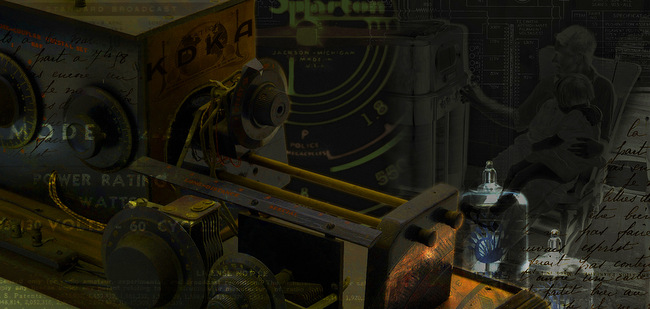 SWLing Post contributor, Guy Atkins, writes:
I’m writing to let you know of a “nostalgia radio” Windows wallpaper graphic I’ve made available to radio hobbyists. This design is called Hertzian Vision, and I created it three years ago for a few SDR enthusiasts/software authors in Finland. I’d like to offer it to your readers too.
My design was inspired by the SPARK Museum of Electrical Invention in Bellingham, Washington, which opened initially as a showcase for antique radios.
Here is a link to a folder with two sizes of the wallpaper:
https://app.box.com/s/33qzg7ouo3sztzzbnd36ylytt1cp7u3y\
The two high resolution wallpaper files are 1920 x 1200 and 2560 x 1440 pixels.
This is a fantastic graphic you’ve created, Guy–many thanks for sharing it with us!
 On a side note, Guy also informed me that the SPARK Museum of Electrical Invention also operates a low power FM station, (KMRE) that features old time and classic radio shows. You can listen to KMRE online via TuneIn Radio or several other sources.
All morning, I’ve been listening to KMRE via my SStran AM transmitter though my BC-348-Q. Great fun!
[Update: if you have difficulty downloading the wallpaper via the link above, you can download them directly from the SWLing Post server by clicking here and here.]
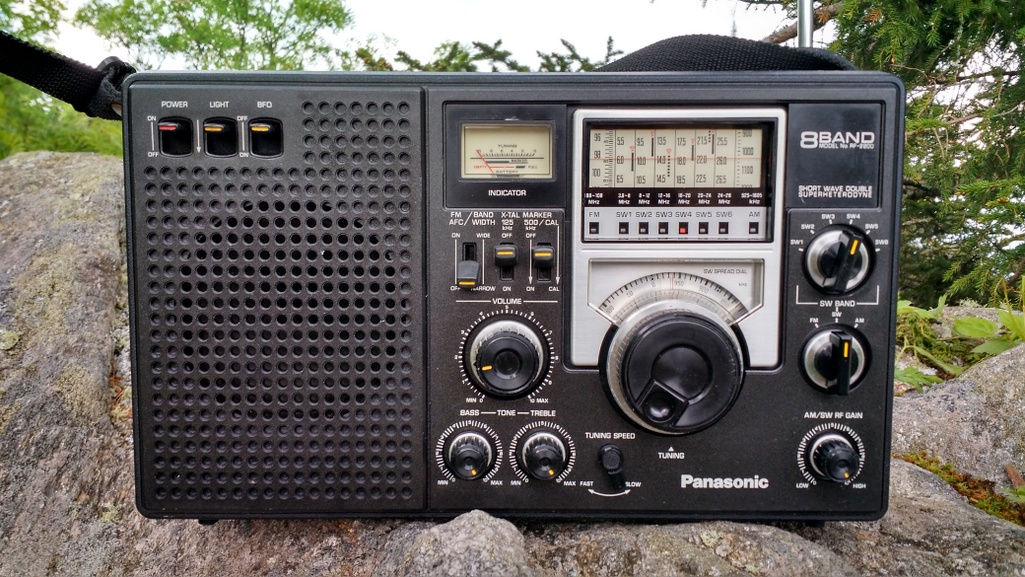
I’ve had the Panasonic RF-2200 for just one week, but I’ve thoroughly enjoyed getting to know this classic solid-state portable. Without a doubt I’ve been very pleased with the RF-2200, and I only have good things to say about the eBay seller, volodymyry123 from whom I bought it. Eventually I’ll take the time to calibrate the analog dial, which is about 100 kHz off-frequency. (I’m obviously in no rush, but if readers with these rigs have suggestions for doing so, feel free to comment.)
The RF-2200 is surely one of the largest, heaviest portables in my collection…still, it begs to be taken outdoors!
Last week, I drove with some friends to the highest point in eastern North America, Mount Mitchell State Park. As I left for our drive, picnic supplies and backpacks in tow, I took a glance at the RF-2200 in my office–and couldn’t resist taking it along.
During our mountain picnic, I turned the RF-2200 on; immediately I heard Radio Exterior de España‘s interval signal on 17,715 kHz. It was loud and clear, at times pegging S9 on the signal meter.
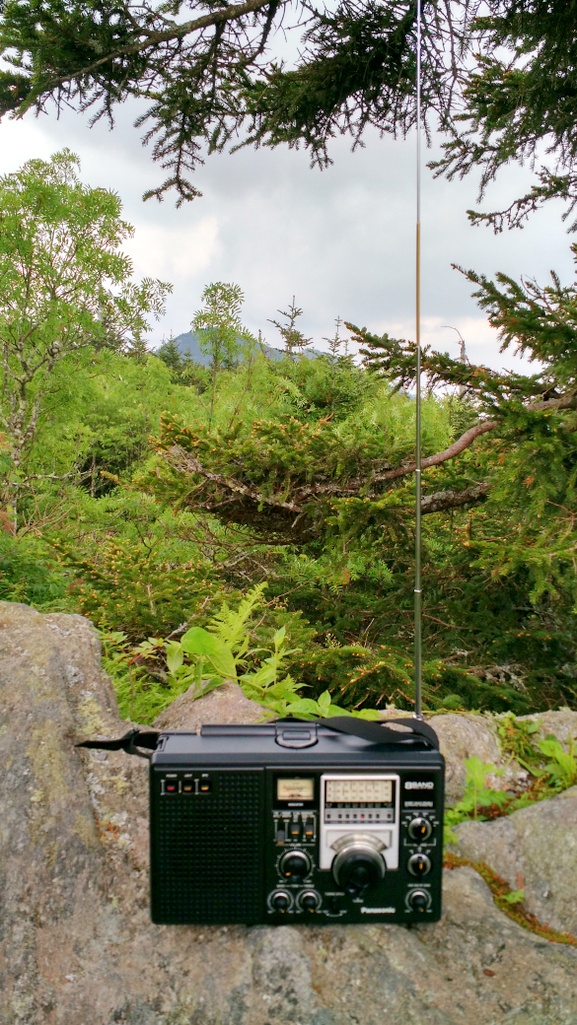
I also tuned to the medium wave band and was instantly amazed by all of the signals it drew in. I was able to hear one of my favorites, WAIZ, on 630 kHz–the signal was very stable and sounded local, although the transmitter was easily 60 miles away.
In general, medium wave performance on the RF-2200 has been nothing short of incredible. But this shouldn’t come as much of a surprise. Indeed, just prior to purchasing the RF-2200, I consulted my buddy, Jeff McMahon (the fellow behind The Herculodge); here’s what he says about the ‘2200:
“I borrowed my friends’ RF-2200 for a month in 2008 and I loved it. It picked up stations effortlessly and had a magisterial quality about it, especially the AM sound. It reminded me of why I fell in love with radios.”
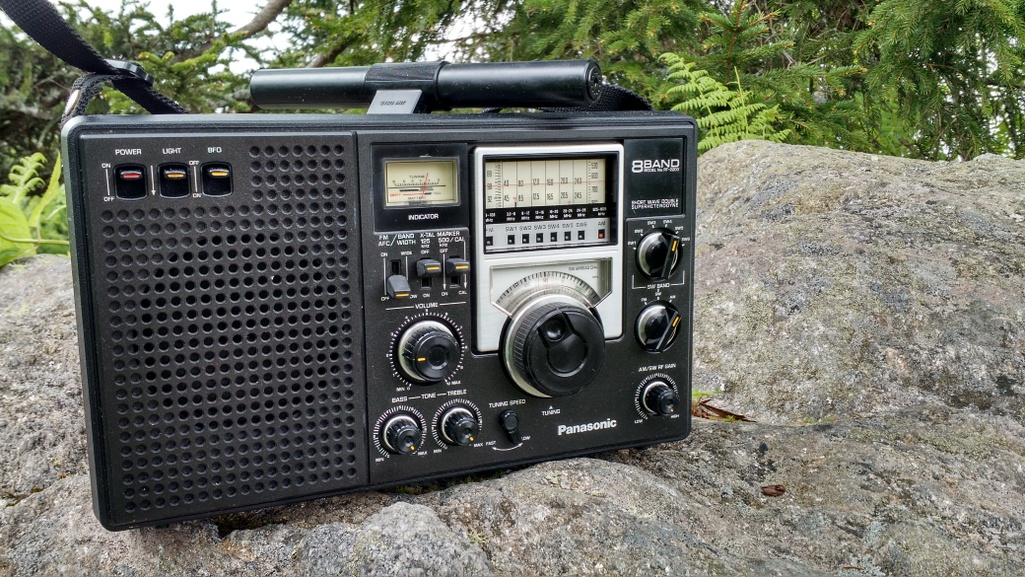 But why is it that when I look at the RF-2200, I feel like I should be taking it to the field? Perhaps it’s the staunch, beefy look of the chassis, or the controls that could easily be worked even with winter gloves? Or perhaps it’s that woven carry strap?
Or perhaps the RF-2200 offers something I miss in the age of compact portables with digital displays: a radio with presence, one that lends itself to pure listening discovery. The RF-2200 demands your attention, and does so with a clear, deep voice…
Yep, the RF-2200 is a true field companion. But don’t take my word for it: find one, take it along, and see–or rather, hear–for yourself.
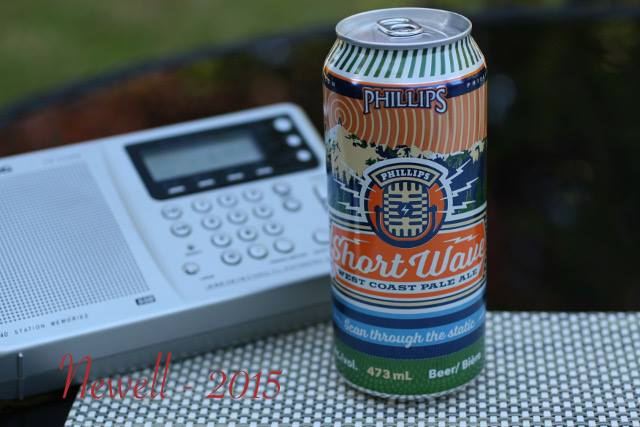
Many thanks to Colin Newell over at DXer.ca for apprising me of a new (retro) craft brew called “Short Wave.” Colin took the above photo last week featuring the venerable Grundig YB400PE and a can of Short Wave pale ale. What a combo!
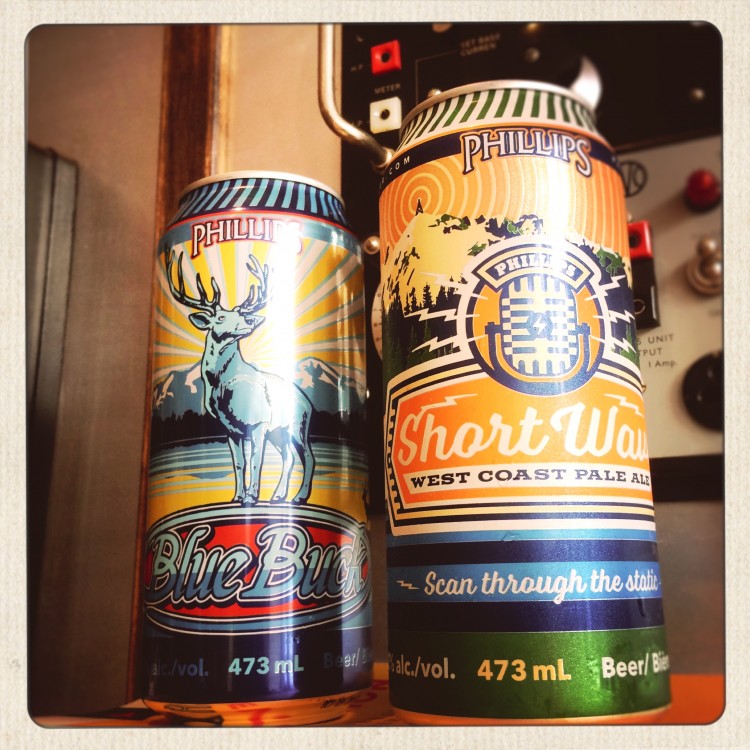 Phillips Brewing Company describes Short Wave Ale on their website:
“Short Wave is a brand new pale ale where a medium malt body is electrified with a healthy dose of bright American hops until sweetness and bitterness are dialed to balance. Both of these pocket-sized cans are packing a full-flavoured punch, making them the perfect partner for wherever your next adventure may take you!”
Perhaps the perfect “tuning oil” for your next Canadian DXpedition?
Shortly after Colin posted this message, I received a note from SWLing Post reader, Bill (KD5XN) who passed along this news item about the new brew.
Those of you who live in British Columbia, Canada, are in luck: Short Wave pale ale is brewed in Victoria, BC. If you live in northwest Washington state, I think it may be worth making the pilgrimage across the border for this brew! Short Wave ale aside, BC is a remarkably beautiful province.
But wherever you live or travel, cheers, SWLers~!