BBC: Curators discover first recordings of Christmas Day

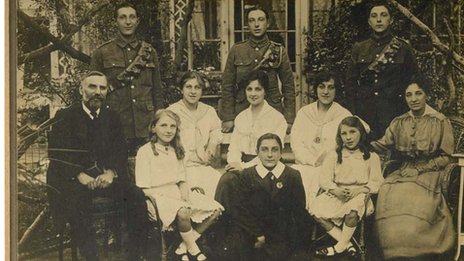
The Wall family (Photo: BBC News

The Wall family (Photo: BBC News

An amazing piece of recorded history:

(Source: BBC News)

Curators at the Museum of London have discovered what they believe to be the first ever recordings of a family Christmas.

They were made 110 years ago by the Wall family who lived in New Southgate in North London.

There are 24 clear recordings on wax cylinders which were made using a phonograph machine between 1902 and 1917.

Music curators say the sound quality of the music recorded is outstanding. [Continue reading and listen to original recordings…]

Saturday Night Country takes you ‘down under’ for the holidays

Felicity Urquhart, host of ABC's Saturday Night Country. (photo: ABC)

Felicity Urquhart, host of ABC’s Saturday Night Country. (photo: ABC)

If you’ve been reading the SWLing Post for long, you’ll know how much I love ABC’s Saturday Night Country, which I tune to every Saturday morning starting on 9,580 kHz.

Yesterday, host Felicity Urquhart produced another great mix of interviews and music, including some uniquely Australian Country Christmas songs.

You can download the recordings of the show as MP3s by clicking here for the first hour of Saturday Night Country on 9,580 kHz and here for the rest of the show on 11,945 kHz, or by simply listening via the embedded player below:

Scandinavian Weekend Radio Christmas specials & frequencies

SWR(Source: Scandinavian Weekend Radio via Alokesh Gupta)

Scandinavian Weekend Radio is broadcasting a series of Christmas Specials on 5980, 6170, 11690, 11720 kHz the 24th & 25th of Dec 2012.

The full broadcast schedule can be found here: http://www.swradio.net/schedule.htm

Severance pay of Radio Netherlands CEO under scrutiny

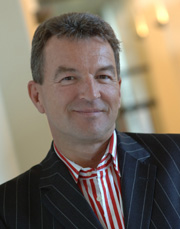
Outgoing Radio Netherlands CEO, Jan Hoek (Photo: RNW)

Outgoing Radio Netherlands CEO, Jan Hoek (Photo: RNW)

(Source: de Volkskrant, translated by Andy Sennitt)

The severance payment for the outgoing CEO of Radio Netherlands Worldwide is excessive. This is what Sander Dekker, deputy minister responsible for the media, wrote on Thursday in a letter to the Lower House of the Dutch parliament.

RNW Director-General Jan Hoek was originally set to receive a fee of 1.1 million euros. Following an urgent request by Mr Dekker and his predecessor, the RNW Supervisory Board agreed with the Director-General to reduce the severance pay to 800,000 euros. Despite the reduction in the amount, according to Mr Dekker it is still “too high and therefore inappropriate and undesirable.”

The Deputy Minister willl investigate the legal issues, but sees no possibility of preventing payment of the severance premium. Mr Dekker says that taking the matter to court offers no solution, because according to the agreement signed in 2001 Mr Hoek is formally entitled to receive his full severance payment.

A new law regulating the salaries of public officials goes into effect on 1 January. This will prevent excessive payments in the future. Under the new rules, a severance payment will be restricted to a maximum of 75,000 euros. But agreements already signed are not covered by the new law.

Radio documentary on history of the Australian Broadcasting Corporation

ABC reporter, and later RN documentary maker, Tim Bowden on patrol with a US Marine squad near Da Nang in Vietnam. (1966) [Photo: ABC ]

ABC reporter, and later RN documentary maker, Tim Bowden on patrol with a US Marine squad near Da Nang in Vietnam. (1966) [Photo: ABC]

(Source: John Figliozzi via InternetRadio Digest)

ABC Radio National will broadcast a weeklong series highlighting the history, development, key moments and future of the Australian Broadcasting Corporation on the occasion of its 80th Anniversary, from December 24-28.  Details from:

http://www.abc.net.au/radionational/programs/specialbroadcasts/abc-80th-anniversary/4373618

There is a 16 hour difference between New York and Melbourne during our standard time winters; 19 hours between Los Angeles and Melbourne.  “Live” broadcast, therefore, will be at 2 am, Dec. 23-27; repeated at 9 am, Dec. 24-28.  No word yet on whether or for how long a podcast of this series will be made available.

John Figliozzi

The Mighty KBC’s holiday broadcasts include DRM

MightyKBCIn this series of special holiday broadcasts, The Mighty KBC is targeting different regions of the world.  See how many you can hear:

The following broadcast times and frequencies are valid for December 22, 23, 25 and 26

Targeting Europe
9835 kHz, 1500 – 1600 UTC, Non Directional, 125 kW

Targeting USA
21600 kHz, 1500 – 1600 UTC, 300°, 250 kW

Targeting Asia/Australia
15470 kHz, 1500 – 1600 UTC, 75°, 250 kW

The KBC will also broadcast in DRM on December 22, 23, 25 and 26
9755 khz 16.00 – 17.00 UTC from Bulgaria with 100 kW and we are using a curtain antenna.

International Broadcasters support freedom of information

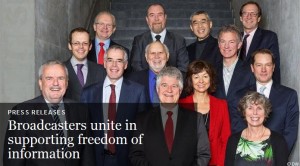
JointStatementThe international broadcasting arms of France, Australia, the US, the United Kingdom, Germany, Japan and the Netherlands issued a joint statement in support of press freedoms across the globe. With the exception of the Netherlands (RNW), all of these countries still broadcast over the shortwaves.

(Source: BBC Media Center via Kim Elliott)

We, the representatives of Audiovisuel Extérieur de la France (AEF), Australian Broadcasting Corporation (ABC) [Australia], British Broadcasting Corporation (BBC) [United Kingdom], Broadcasting Board of Governors (BBG) [US], Deutsche Welle (DW) [Germany], Nippon Hoso Kyokai (NHK) [Japan] and Radio Netherlands Worldwide (RNW), have met in Berlin to discuss common concerns.

We find international journalism is facing unprecedented challenges from countries that seek to deny their own citizens access to information from outside their borders in violation of Article 19 of the Universal Declaration of Human Rights, which states:

“Everyone has the right to freedom of opinion and expression; this right includes freedom to hold opinions without interference and to seek, receive and impart information and ideas through any media and regardless of frontiers.”

We call upon the world’s nations to strengthen their commitment to Article 19 and to support expanded opportunities to share information across borders through digital and mobile technologies.

Yet we note with dismay that certain governments continue to control the flow of information. For example, China routinely blocks the Web and social media sites of our broadcasters and jams our shortwave signals, or Iran and Syria interfere with the satellite signals that carry our programs. Governments in Eurasia, Africa, the Middle East and Latin America also seek to control what their own citizens can see, hear and read.

Many of these actions, including intentional jamming of satellites, violate international regulations. We condemn them without reservation.

We also call attention to troubling new challenges to free expression. Some governments are seeking to enact far-reaching telecommunications regulations to stymie free speech.

At the World Conference on International Telecommunication (WICT) in Dubai, representatives of the world’s nations have considered telecommunications rules that might explicitly apply to the Internet for the first time.

We cast a wary eye on such efforts to control the Internet, and we denounce efforts to identify and track Internet users in order to stifle free expression, inquiry and political activity.

We have agreed to increase, whenever possible, our support for efforts to circumvent Web censorship through the use of new and innovative hardware and software tools. We also agreed to increase our advocacy for Internet freedom.