RCI’s “radio silence”

This well-written, comprehensive take on RCI’s closures does an excellent job of addressing radio’s continued relevance in our current socio-political climate. It even includes a brief quote from yours truly.  Thanks, Rich, for bringing this to my attention.

(Source: rabble.ca by Garth Mullis)

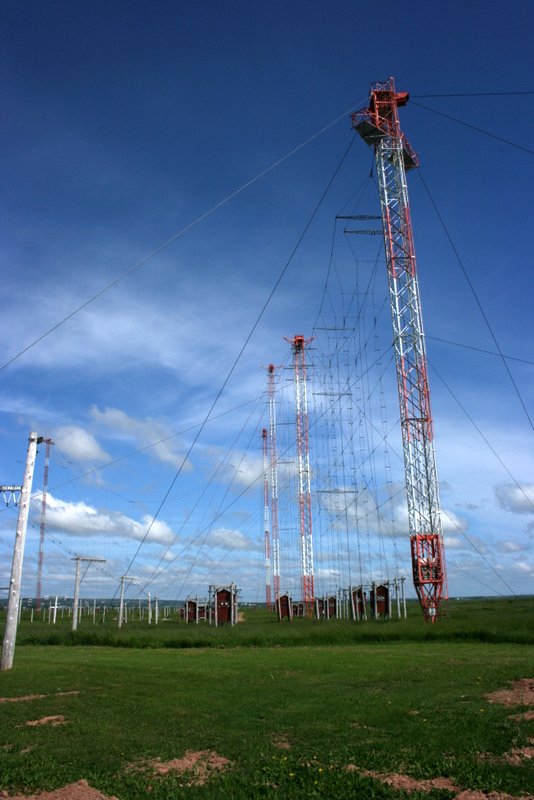
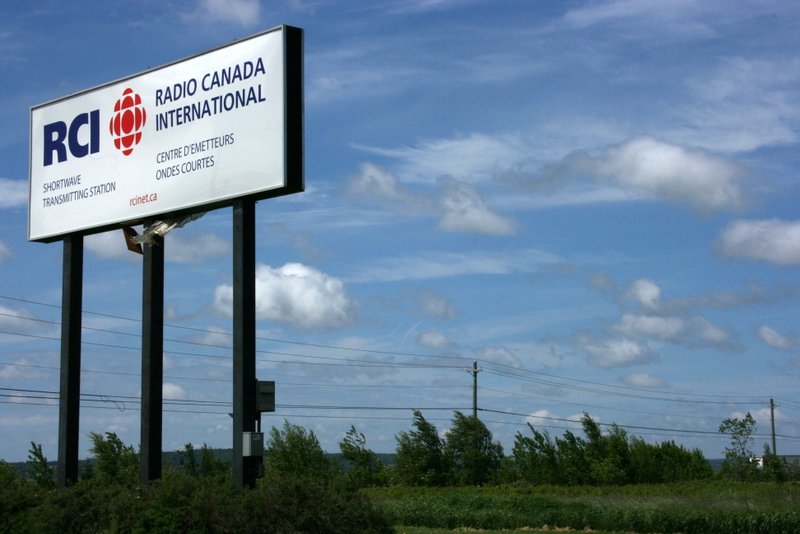
Across the Indian sub-continent and Asia, shortwave radio sets scan up and down familiar frequencies, seeking a signal from Canada that had come to be known as “an old friend.” Internet-blocked Chinese activists search the dial for Canadian news of a Hong Kong demonstration. But an ocean of low static is all that emanates from the Sackville, New Brunswick transmitter. Canada’s once robust international radio voice has fallen silent, victim of the latest round of budget cuts.

Recently, choked with emotion, Mark Montgomery closed out the final transmission of Radio Canada International (RCI) after 67 years of shortwave radio programming to the world. Then, dead air. Radio station shuttered and budget slashed by 80 per cent, RCI is now reduced to an anemic web presence and a skeleton staff.

Like vinyl records, newspapers and incandescent light, the death of shortwave radio has long been heralded. But the global millions who listened regularity to RCI may disagree. So do I.

As a nearly blind child, my world was pretty small. But once I found shortwave radio, the world bloomed out of my orange foam headset. My dad slung a long wire up over a high branch in a neighbour’s tree. That antenna connected me to something bigger; fracturing the lonely alienation of the 1980s.

[…]Unlike the Internet, which is easily disrupted by dictators, hackers, wars or natural disasters, shortwave cannot really be jammed and does not require the massive infrastructure of fiber optic networks, servers and miles of phone or cable lines. Unlike reading this story on-line, listening to radio does not leave an electronic record. A profile of one’s interests cannot be generated by authorities. Though, Canadians surely would never have cause to worry about this.

I am not a cyber-luddite. Podcasting has given birth to a radio renaissance and an explosion of voices. Just listen to Memory Palace, 99% invisible or Transom to see how the format is being innovated. Yet, I would never want to see Vancouver’s Co-op Radio or CBC Radio One reduced to an on-line only presence. I want to live in a broad community, not a pod of one.

Radio waves easily cross the digital divide. About a third of the world has no access to phones or electricity, never mind Internet. But battery-powered and hand-cranked shortwave radios are ubiquitous over the developing world, and they won’t be hearing from Canada any more.

Shortwave is also a good backup when other forms of communication go down. It can be used to communicate internally in case of natural disasters (this was done during Hurricane Katrina) and can even transmit Internet content.

[…]Of 18 western countries, Canada is 16th in terms of expenditure per capita on public broadcasting, narrowly beating out New Zealand and the U.S., but RCI punched above its weight.

“Please, Canada, find a way to avoid severing your own tongue. The world is listening to you,” pleads U.S. citizen and founding director of U.S. NGO Ears to Our World, Thomas Witherspoon.

In the ’80s, 20 million Chinese listeners learned English from a series of RCI broadcasts running for months in advance of regular programming to the Middle Kingdom. But China is now more a market for Canadian petro-exports than radio.

Last weekend, Hong Kong erupted in pro-democracy protests. But on the Chinese mainland, the state was able to censor most reportage by blocking Internet content, through deep packet analysis, or simply by a flood of propaganda from government bloggers and tweeters. Previously, millions tuned into RCI’s “Voice of Canada” and would have heard such news. But RCI’s web-site is blocked in China.

International shortwave radio is old school for sure. At fractions of a cent per listener, it’s also cheap and accessible. It allows activists overseas to hear what their own governments are up to. Radio is part of the global conversation. The RCI Action Committee is an employee effort with union support campaigning to save the service.

Radio silence is a ham-fisted decision.

End of transmission.
Garth Mullins is a writer, long time social justice activist and three-chord propagandist living in East Vancouver. You can follow him @garthmullins on Twitter.

Read the full article here.

The Economist: taking a look at shortwave radio

Though concise, this is one of the best summaries of shortwave radio that I’ve seen in major press. The full article, remarkably, addresses the recent RCI cuts, DRM, the expansion of China Radio International and other innovations that could happen via the shortwaves:

(Source: The Economist)

TWIDDLE the dial of a short-wave radio and you never know what you will get. Through the hiss of static you may hear Cuban propaganda, football from Brazil or Chinese opera. Unlike other radio broadcasts, short-wave transmissions, bouncing off the ionosphere, can connect any two points on earth. One hazard is physics: signals wane and wax during the day. Another is governments. In the cold war communist regimes jammed Western stations. Now the threat is budget cuts.

…[S]hort-wave remains a good way of reaching remote areas and poor people (a basic receiver costs as little as $10). Graham Mytton, who used to run the BBC’s audience research, says it is cheap, easy to use and the only medium that gets through everywhere. A natural disaster, he notes, can take local transmitters off air and bring down the internet, but a battery-powered radio will still work.

China is expanding its short-wave broadcasts—both to reach listeners abroad and (some say) to disrupt transmissions from unwelcome foreigners, such as the Voice of America (VOA). The largest remaining short-wave broadcaster, VOA says it has no plans to junk its transmitters: its short-wave audience has actually grown over the past decade in countries like Myanmar (where it claims a quarter of the adult population listens, and three-quarters in rural areas).

Digital short-wave broadcasts would be clearer and could carry bits of text too.[…]

[…]Globe Wireless, an American firm, has long used short-wave for maritime e-mail service to thousands of ships. Although the data speeds (at only 2,400 bps) are not as zippy as a satellite link, the service is cheaper—and keeps going if solar flares or space debris hit satellites, says the firm’s boss, David Kagan. The short-wave voice may be old and hoarse. But it still dependably carries a message.

Thanks to Alokesh Gupta for the tip.

Radio Northern Star: test transmission

(Via Cumbre DX and Svenn Martinsen on Facebook)

Test transmission from Radio Northern Star on Shortwave.

Starting on Friday July 6th 0330 UTC/GMT (0530 Norwegian Time/CET) Radio Nord Revival in Sweden will be relaying the programmes of Radio Northern Star in a long test transmission on Shortwave 5895 kHz in the 49 meter band with a power of 10 kW. The test will last until Saturday morning July 7th. We welcome written reception reports to Radio Northern Star, Box 100, N5331 RONG, NORWAY. Email may also be used:[email protected].

For listeners outside Scandinavia we would also like recordings of the transmission, but please do not send large files as attachments to emails. If you want to send large files, send them on a CD to the address above. Be sure to include return postage if you’d like regular mail replies. Correct reports will be answered by QSL letter.

Radio Northern Star is an independent commercial radio station broadcasting on the web and available broadcasting platforms. Our website may be found here:
http://www.northernstar.no/

Smith-Mundt is a tough Act to follow

May, June and July have been very busy months for me (hence the lack of daily updates).
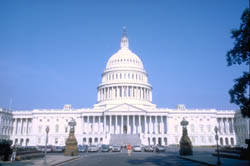
In May, I attended and presented at the North American Shortwave Broadcasters annual meeting in Washington DC, then spent nearly a week in Ohio at the Dayton Hamvention–June and July have been filled with sporadic travel.

During my travels in May, controversy swirled around the Smith-Mundt Modernization Act and its impact upon radio broadcasting since it passed mark-up as an amendment to the House version of the National Defense Authorization Act on May 18. The bill is now before the US Senate.

What is the Smith-Mundt act? Per Wikipedia:

The US Information and Educational Exchange Act of 1948 (Public Law 80-402), popularly referred to as the Smith–Mundt Act, specifies the terms in which the United States government can engage global audiences, also known as public diplomacy.

The act was first introduced as the Bloom Bill in December 1945 in the 79th Congress and subsequently passed by the 80th Congress and signed into law by President Harry S. Truman on January 27, 1948.[…]

There are three key restrictions on the U.S. State Department in the Smith–Mundt Act.

The first and most well-known restriction was originally a prohibition on domestic dissemination of materials intended for foreign audiences by the State Department. The original intent was the Congress, the media and academia would be the filter to bring inside what the State Department said overseas […]

The second and third provisions were of greater interest to the Congress as they answered critical concerns about a deep-pocket government engaging domestic audiences. Added to the Bloom Bill, the predecessor to the Smith-Mundt Bill in June 1946 by Representative John M. Vorys (R-OH) “to remove the stigma of propaganda” and address the principle objections to the information activities the Congress intended to authorize.

The Smith-Mundt Act is the very reason why so few US Citizens have ever heard of the international radio broadcaster Voice of America (VOA):  the law forbids them from “targeting” an American audience. In their current state, the VOA and many other BBG international broadcasting entities are not likely to be a source of the type of propaganda many fear could be unleashed with the lifting of the Smith-Mundt Act.  Speaking as one familiar with the VOA’s broadcasts–I know many who work at the VOA, I’ve listened to their broadcasts for decades and I actively read their online content–I can comfortably state that VOA produces quality journalism and certainly provides another credible voice in the cloud of international broadcasters on the air or online. Their journalists have a mandate to report the truth, even when they find it necessary to be critical of the US government.

Don’t be mislead, however; VOA is a diplomatic arm of the United States, and as such would fit the broadest definition of what might be considered propaganda. In other words, VOA represents an American viewpoint on the news. Indeed, I consider (and it’s only fair to acknowledge) that every radio or television broadcaster’s voice exhibits some bias, even if the broadcaster makes claims of “fair and balanced reporting” or says they are “reporting the truth.”  There is always a leaning, however modest.  Even at the tender age of eight, listening to my Zenith Transoceanic in my bedroom, I recognized this.

So why all of the fuss about the Smith-Mundt Act?  Even as a child, I remember finding it quite easy to tune in the Voice of America. The magic of shortwave radio almost by default means that there are no borders that can control how shortwave distributes content. It’s even more absurd to think of enforcing these restrictions now in the internet age–indeed, by clicking this link, you can freely go to the VOA website to read, watch or listen to thousands upon thousands of hours of content.

So, in reality, VOA has never been prevented from delivering its content to the US.  It’s just not well-known in our country.

But this is the state of things today:  If the Smith-Mundt Act were lifted, the US State Department could, if they choose, funnel resources into effectively targeting US audiences. In the US, you could see VOA ads on Facebook, hear ads on the radio, a VOA TV channel could be launched–FM relay stations could be established in, say, Nebraska.

Does that sound strange? Keep in mind that in the UK (and in many other countries) there has never been this division between government-funded international and domestic broadcasting. The BBC broadcasts to both a domestic audience and an international audience via the BBC World Service. They routinely recycle content between the two.

The Smith-Mundt Act has both critics and supporters on both the left and right of the aisle. The think tank, The Heritage Foundation, recently held a panel discussion with a slant towards lifting the Smith-Mundt Act. They stated:

Critics […] have charged that modernizing the Smith-Mundt Act will lift the floodgates for U.S. government propaganda aimed at U.S. citizens. Not so. Rather, the amended act will force greater government transparency and accountability and it will allow Americans insights into what Washington is communicating to audiences around the world.

Yet, many of my friends who work within the VOA see the lifting of Smith-Mundt as a means to target various diasporas within the US. Perhaps, for example, via local FM relay, VOA could broadcast in Swahili to communities the US with large populations of recent immigrants who could benefit from this news source.

The watchdog organization BBG Watch, on the other hand, describes their concerns about lifting Smith-Mundt:

While BBG Watch supports placing all Broadcasting Board of Governors (BBG) international broadcasts and other programs in the public domain for anyone to use free of charge, some of us are concerned that the proposed Smith-Mundt Modernization Act of 2012 is so broadly written that it gives BBG and other US government officials unrestricted power to target American citizens with government information marketing. We would support the modification of the Smith-Mundt Act if it included clear and strict rules and a prohibition on active direct marketing of BBG programs to US citizens and US broadcasters. There is a real fear that BBG officials would take advantage of the new law, if it passes, to move resources from international to domestic information activities.

Herein lies my fear regarding this restructuring–that the State Department could tap into the already limited resources allotted for international broadcasting via shortwave radio, in order to shift attention to a domestic audience (who already, in truth, has full access to all of the US international broadcasting entities via the world wide web).   Yet the international broadcasting need is much greater than our own–many who receive these broadcasts–in rural Africa, for example–have little else to rely upon for their understanding of the United States and their perspective on the world.  It could harm starve the United States’ relationship with people in these regions, in essence lopping off one of our valuable diplomatic arms.

A balanced approach

The best way to be informed about the progress of the act is to follow Kim Andrew Elliott’s blog on international broadcasting and diplomacy.  He does an amazing job of picking out news items relevant to the act and posting them along with his comments.  Indeed, when I last asked him about the Smith-Mundt act several weeks ago, he suggested checking out this post: http://kimelli.nfshost.com/index.php?id=13356

Within that post, there is a link to a previous post, in which he state why the domestic dissemination ban is now enforceable rather than outmoded by the internet. Dr. Elliott also commented:

Sen. Gillibrand removed the Thornberry-Smith language from the Senate version of the DAA.  Thornberry-Smith could possible return in the conference process, or perhaps even from the floor, but I wouldn’t bet on it.

In future attempts to relax the domestic dissemination ban, the BBG should not be involved. It should remain neutral. The stakeholders in the US should initiate any such legislation. Such stakeholders would include….

1) US ethnic media, who could use news about the countries of interest, in the languages of their audiences.  At no extra cost to the taxpayers, USIB could provide a valuable public service.

2) Americans who are interested in what in contained in US international broadcasting and public diplomacy

3) US domestic media who could barter their content on US domestic affairs for USIB content on world affairs.  This win-win would bring USIB content to US audiences, hence a need to relax the ban.

Note that the UK never had any qualms about domestic distribution of BBCWS.  It was available only in the overnight hours, on BBC R4, because it was assumed the content was not of sufficient interest to sustain a domestic service.  Now it’s available 24/7 via digital BBC radio bouquets in the UK and, of course, via internet.  BBC even proudly proclaims the domestic RAJAR ratings for BBCWS.

A tough act to follow…

So, is lifting or modifying the Smith-Mundt Act wise?  Only time can tell.  One thing is certain: careful consideration of all eventualities must be taken into account before action is taken, and envisioning all potential outcomes could truly prove tough.

For more on the Smith-Mundt act and hundreds of other news items that have an impact on international broadcasting and diplomacy, subscribe to Kim Andrew Elliott’s news feed.


John’s letter to RNW

John Figliozzi, noted author of the Worldwide Listening Guide, wrote the following letter to Radio Netherlands Worldwide regarding their farewell broadcast. I thought it was worth sharing with SWLing Post readers:

(Source: John Figliozzi)

RNW Farewell

It was a classy, inspired, quintessentially RNW move to open a shortwave frequency for North America for one last evening. I shut off the internet radio, set up the Eton E1 in the veranda (it’s summer here) and luxuriated in a strong, clear RNW signal from Bonaire on 6165 kHz., just like the “old days”. I enjoyed the experience so much, that I listened to the very same program three times as your target shifted hours from east to central to western North America. I recall when, after the “Save BBC World Service” effort failed to alter the BBC’s decision to shut down shortwave to North America, RNW stepped in immediately using the abandoned BBC frequencues to provide us solace and sustenance. That, too, was quintessentially RNW. There have been many such “losses” for we listeners to absorb over the last decade, but for me this one hurts the most. Thank you to all, past and present, at RNW for all you have done to make radio that truly mattered for so many years. Rest assured,!

I will be a frequent and consistent visitor to your archive so I might relive often the “golden age of radio” that RNW created and maintained for decades. Thank you and godspeed to all of you.

John Figliozzi
Halfmoon, NY

Radio Netherlands says farewell in style

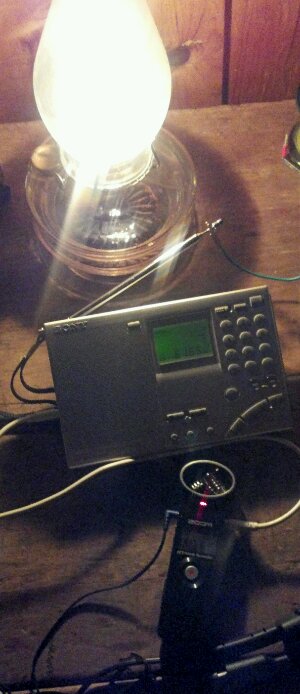
Thursday night, by the light of an oil lamp, I tuned my trusty Sony portable shortwave to 6,165 kHz. At 2:00 UTC, I was rewarded with a rich, full signal from Radio Netherlands Worldwide’s transmission site in Bonaire. Here in this off-grid cabin, on sixty rural acres, I bask in the freedom from electrical noise that might otherwise interfere with my shortwave radio listening—at least in this respect, this is the perfect DXpedition cabin.

The signal coming out of Bonaire, however, would have overcome any interference: Radio Netherlands, my dear friend of some 32 years, had opened a special frequency for those of us in eastern North America…in order to say their good-byes to the airwaves.

I can only describe the experience of listening as radio bliss…pure radio bliss…marred only by the bittersweet realization that these were RNW’s final days on the air. The experience harkened back to the day when the big broadcasters had booming signals directed toward us.

But, alas. All too brief.

The broadcast was simply entitled Farewell and Thank You. You can hear it just as I heard it—through my recording–here (actual broadcast starts at 1:15):

Then, all day Friday, for nearly 24 hours straight, RNW bid good-bye and farewell to various parts of the world via shortwave, satellite and the internet. I was lucky enough to catch two more broadcasts.

This time of day (19:00 UTC), however, I needed bigger ears than the Sony could provide. I was listening to broadcasts targeting west and east Africa, not North America. Having already charged my laptop battery, I plugged in the Bonito Radiojet (an SDR that I’m currently reviewing) and, just before 1900 UTC, directed her towards 17,605 kHz. Though my Sony found the signal barely audible, the RadioJet produced beautiful fidelity.

This RNW broadcast, entitled The First 50 Years, took listeners through the highlights and history of the Dutch radio service. Here’s the recording I made with the RadioJet:

A final sign-off

RNW headquarters in Hilversum, Netherlands (photo coutesty: RNW)

At 20:00 UTC, RNW broadcast their very final show—a repeat of Farewell and Thank You (above) appropriately targeting Africa once more. I tuned the dial to 11615 kHz and listened again to the full broadcast. This time, however, as the program drew to its close, the broadcast crew added a personal message.

Jonathan Groubert, the talented host of The State We’re In, broadcasted live from Hilversum’s Studio 4 for a deeply touching adieu. Tears were shed, and I’m not ashamed to confess that I, too, listened through a haze of them as these capable and dedicated journalists, whom I’ve grown to trust, signed off the RNW airwaves for the last time.

But listen for yourself:

Jonathan Marks, RNW’s host of MediaNetwork, also featured in the farewell broadcast, recorded the final sign-off from within Studio 4. You can listen to this and read the description on his excellent website.

Dank je wel, Radio Nederland

RNW–my dear radio friends—I’m going to miss you. Your personalities–and the collective personality of RNW itself–your award-winning content, news, reporting, and your integrity stood out amongst all those Cold War broadcasters I listened to growing up—who, as you so well put it, were merely mouthpieces for their respective governments.

Radio Nederland, I loved your broadcasting because you were fearless: you marched to the beat of your own drummer, were not afraid to turn a critical eye even upon yourself, and as a result–in a world of sham journalism, of compromise and hypocrisy—you earned my trust. You had nothing to hide, and you had so many stories to tell.

RNW: I listened.

I wish you (and your intrepid creators) the very best in all that you do. I trust your new incarnation(s), whatever form they take, will do much good in this world which so sorely needs it, and sincerely believe that your integrity will live on.

Toronto Sun: Killing RCI was shortsighted

(Source: Toronto Sun)

BY  ,QMI AGENCY

The chipping away at Canada continues apace.

Radio Canada International’s shortwave service was, quite literally, Canada’s voice to the world for nearly 70 years — through wars, through triumphs and disasters, through it all. It has been part of our history. And, now, it’s gone.

…[T]he service became a means by which we could subtly promote democracy, and the Canadian way of life, in far-flung corners of the world. In places like China, Russia and North Korea — where the Internet can be censored, but shortwave can’t be — RCI was heard by many. In post-Communist Eastern Europe, shortwave radio receivers are still the way in which many receive news from the outside world.

I know this from experience. When I was an election observer in Bosnia in 1996, billeted with a Serbian family, I was glued to my tiny shortwave radio at night. I’d listen to the Stanley Cup playoffs, and the news from back home, and I was always pretty grateful that RCI existed.

Our allies — the U.S., Britain, Germany, France and Australia — have all expanded their national shortwave service.

In Canada, meanwhile, we’ve killed it.

The Harper regime, which has taken a chainsaw to the CBC in recent months, is ultimately to blame for this short-sighted decision. They will say that government needs to tighten its belt, and they’re mostly right about that.

But getting rid of RCI’s shortwave service is pennywise and pound foolish. In all, keeping RCI on-air would have cost about 35 cents a year, per Canadian. In comparative terms, it’s as much as it cost taxpayers to rent a couple of panda bears from China for zoos in Toronto and Calgary. Or, it’s a fifth of the cost of building gazebos in Tony Clement’s riding and fake lakes for the G8/G20 summit.

Meanwhile, KPMG did a study on RCI, and found it was the most efficient — that is, cost-effective — broadcaster of its type in the world.

Why should you care? Does it matter? It matters. Billion-dollar fighter jets and super jails, before a pittance for a radio station that promoted democracy and decency around the world? The idiots who came up with this outrageous decision should all be fired.

Perhaps you didn’t notice the death of RCI because you have access to lots of media here in Canada, or because you don’t ever need to tune in to shortwave radio. But to people around the world — to our men and women in uniform — the death of RCI won’t go unnoticed.[…]

Read the full Op Ed piece in the Toronto Sun