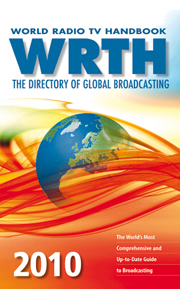
 The World Radio TV Handbook (WRTH)–a printed guide to broadcasts on shortwave, mediumwave, longwave, and FM, as well as on TV–is now available for purchase in its 64th edition. This guide is known as the key reference book for hard core DXers, shortwave radio listeners, broadcasters and radio enthusiasts of all stripes.
This year, WRTH‘s publisher sent me a copy of their latest reference directly from the UK; as has often been the case, I found myself immersed in its pages within moments of opening the mail package.
This year in particular, it is my belief that WRTH will become even more important to radio listeners. The main reason for this is the fact that in 2009, International Broadcasting Services, Inc., decided to halt production of its fine broadcast guide, Passport to World Band Radio. [To learn more about this, check out previous posts here and here].
On SWLing.com, I had always suggested newcomers to the hobby check out Passport (PWBR) over WRTH simply because the main body of its guide was laid out in a “TV Guide”-like fashion, easy for a beginner to understand. In other words, it sorted broadcasts by Universal Time and listed all of the broadcasts available (primarily in English) with information about program content, where you could find it on the radio dial, and even included mini-reviews–often humorous–of the shows. This format was very accessible for those who may not yet have a full grasp of the nuances of shortwave radio listening.
Although not intentionally formatted for newcomers, WRTH is also reasonably easy to use, and a much, much more comprehensive guide to broadcasts than Passport to World Band Radio. Indeed, I find that I when I hear a unknown broadcast in a language that I also don’t know, I reach for WRTH to solve the mystery.
What’s inside WRTH?
The bulk of WRTH is a tried-and-true radio reference book with major sections delineated by convenient side bars which make navigating through this substantial book much easier.
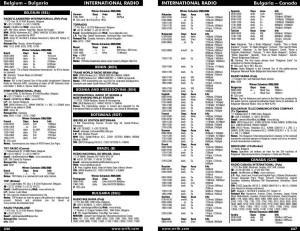
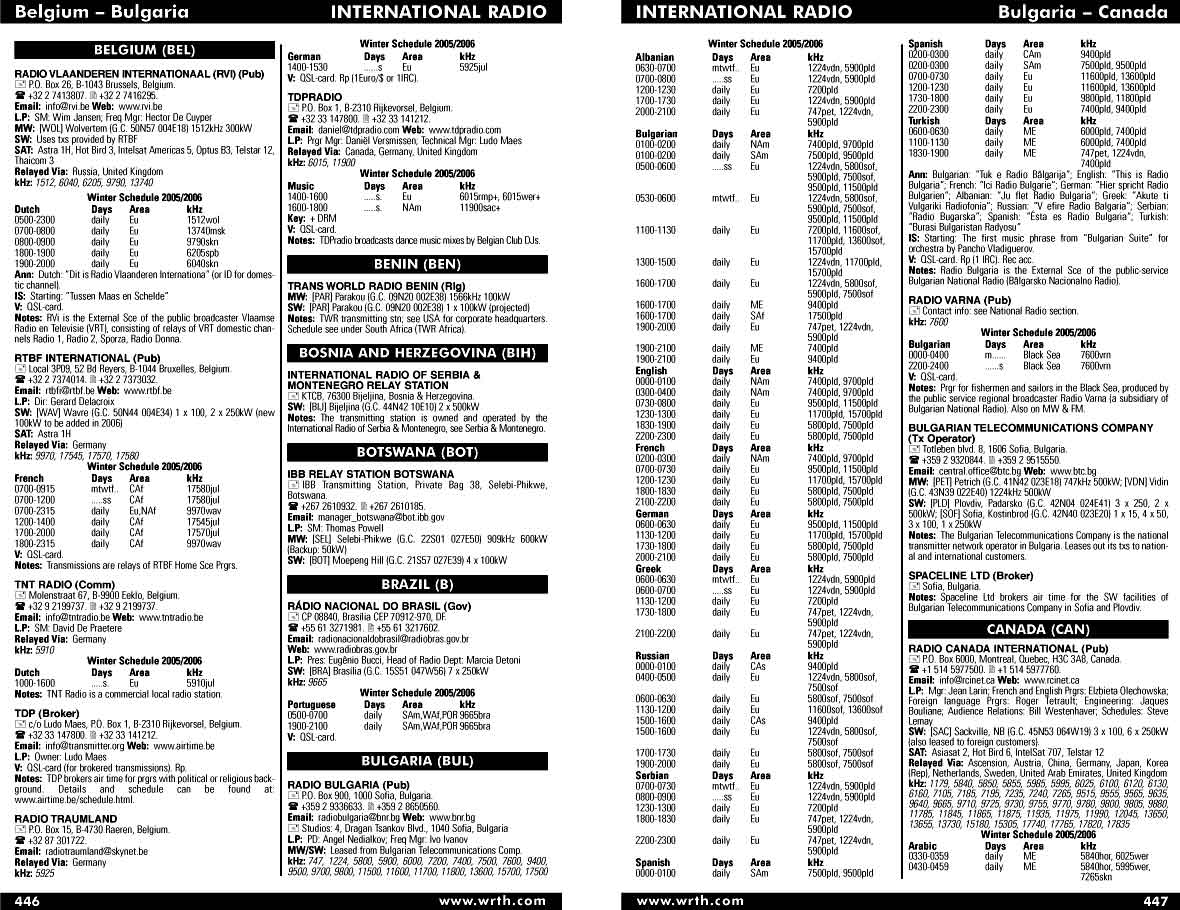
Click to see sample of WRTH's International Radio section.
WRTH offers the following:
- Features and Reviews
- National Radio
- International Radio
- Frequency Lists
- Terrestrial Television
- Reference
The “Features and Reviews” section is always the first thing I read when I receive my new copy of WRTH. This year, for example, WRTH features receiver reviews of the Icom IC-7600, IC-7000 (ham transceiver), Eton Satellite 750, and a selection of very low-cost portables. They also feature mini-reviews of some “Cold War Classics,” as they are known, like the Collins R390, Racal RA17, Harris RF-590 and the Rohde & Schwarz EK 070. [By the time I finished reading about these fine classic rigs, I’ll admit, my mouth was watering…] They also feature the BBC World Service, Samoan Radio, a Digital Update, and more.
As a shortwave and medium wave (AM broadcast) listener, I find that I use WRTH based on the way I’m listening to radio. Either I listen for a particular station or country by looking it up in the national or international sections of WRTH, then listening on known frequencies at the appropriate time. Or, I simply tune through the bands, and when I locate something of interest on my radio dial, I turn to WRTH‘s frequency list to see what station I’m hearing. WRTH will also give you useful information for QSLing and identifying the coordinates of the transmission site any given broadcaster is using. Indeed, WRTH gives you more info about a broadcast than any other radio reference book with which I’m familiar. This is one of the reasons it has become a staple reference for serious radio listeners.
An Interview With Nicholas Hardyman, Publisher of WRTH
This year, in particular, I had a few questions that only WRTH could answer–so I asked Nicholas Hardyman, WRTH‘s publisher, if he would agree to a brief interview. He accepted with enthusiasm.
Thomas (SWLing.com): WRTH is now in its 64th edition; how has your content changed over the years?
Nicholas (WRTH): The biggest changes have been in the large increase in stations following deregulation across the globe. This is most evident is the explosion in the number of FM stations, although this is also happening in some countries that are still fairly heavily regulated. We have also seen a large increase in TV stations which we cannot, unfortunately, fully reflect in WRTH. The change that is coming is obviously the switch to digital transmissions both for TV and radio. It will be very interesting to see how that plays out.
Thomas: How do you gather all of your detailed broadcast information and update it each year?
Nicholas: Through the hard work and dedication of the finest set of contributors and editors any publisher could hope for. We have a very extensive and deep contributor network and consequently get a lot of information.
Thomas: Passport to World Band Radio has decide not to publish a 2010 edition; do you feel your customer base is broad enough to support your future publications?
Nicholas: Yes, I think it is. We serve several markets and different specialties within those markets so I hope our readers will continue to support our unique offering.
Thomas: Who are some of your typical readers?
Nicholas: DXers and listeners are our largest market, and of those, our typical reader is a man aged 50+ with a strong interest in technology and a loyal commitment to WRTH. We also have a lot of readers who have a professional interest in radio and others who are most interested in global transmissions.
Nicholas, thank you for the interview; I believe I speak on behalf of Shortwave radio listeners around the globe when I say that DXing wouldn’t be the same without a copy of WRTH at hand. Keep up the good work, and happy DX!
If you would like a copy of WRTH, simply click on one of the following to order your copy:

 For those of you readers who often feel you’re alone in your enthusiasm for radio, I highly encourage you to attend the NASWA-sponsored SWL Fest in Kulpsville, Pennsylvania this year. This will be my second year attending, and I have eagerly awaited the arrival of the ‘Fest. It is jam-packed with radio-related information and attended by many radio kindred spirits. From their website :
 Broadcast Frequencies
 Nash Holos is a bilingual Ukrainian-themed radio program which focuses on Ukrainian culture with an international perspective. The program is produced and hosted by Paulette (“Pawlina”) Demchuk MacQuarrie.