Shortwave listening and everything radio including reviews, broadcasting, ham radio, field operation, DXing, maker kits, travel, emergency gear, events, and more
HELSINKI (AP) — For nearly three decades, Finland’s YLE radio has broadcast a weekly news program in Latin to a small group of committed listeners around the globe.
With the audience numbering just 10,000 and people increasingly turning to the internet for content, Friday was meant to be the end of the road for “Nuntii Latini,” which means “news in Latin.” But don’t underestimate the passion of Latin aficionados — more than 3,000 of them wrote in from around the globe, some in fluent Latin, encouraging the station to save the program.
YLE leadership listened, agreeing to extend it until at least its 30th anniversary in 2019.
“Ne umquam desperaveris,” (loosely translated: “never give up,”) said co-announcer Reijo Pitkaranta, a docent and lecturer in Latin at the University of Helsinki.[…]
Recently, I started posting Colin’s recordings on a schedule so that each recording is being published exactly 40 years from the original broadcast date. Check out the Shortwave Radio Audio Archive each day (or subscribe via iTunes) to listen to the recordings.
Below, I’ve embedded the recording from New Year’s Day 1978 where we learned that Yuri Romanenko and Georgi Grechko toasted the New Year with fruit juice (for obvious reasons, champagne was not allowed on the station!).
Many thanks to SWLing Post contributor, Eric McFadden (WD8RIF), who notes that the excellent website, Atlas Obscura, recently featured The Shipping Forecast:
Why a Maritime Forecast Is So Beloved in the United Kingdom
For the penultimate song on their 1994 album Parklife, Blur chose the swirling, meditative epic, “This Is a Low.” The song envisions a five-minute trip around the British Isles as an area of low pressure hits.
“Up the Tyne, Forth, and Cromarty,” sings the lead singer Damon Albarn, “there’s a low in the high Forties.” The song’s litany of playful-sounding place names, including the improbable “Biscay” and “Dogger,” may seem obscure to listeners abroad, but to a British audience, they resonate.
The song’s lyrics were inspired by the Shipping Forecast, a weather report that is broadcast on BBC Radio 4 on behalf of the Maritime and Coastguard Agency. Sailors working around the coasts of Britain and Ireland, recipients of the wrath of the North Atlantic and North Sea, are the ostensible beneficiaries of the forecast.
But, for listeners who tune in while tucked in bed rather than sailing the high seas, the reassuring sound—a simple, steady listing of conditions in the seas around the British Isles, broken down into 31 “sea areas,” most of which are named after nearby geographical features—is something more akin to the beating pulse of the United Kingdom, as familiar as the national anthem or the solemn chimes of Big Ben.[…]
When I lived in the UK, I would often fall asleep and/or wake up to the Shipping Forecast. Here in the States, I can listen to the forecast live via the U Twente WebSDR, but I rarely remember to do so.
And, of course, I can navigate to the Radio 4 website and stream current and past forecasts on demand, but I find the audio a little too clean and full fidelity. I prefer listening to my maritime poetry via Amplitude Modulation (AM)!
The AirSpy HF+ is the new SDR on the block, but how does it compare to the Elad FDM-S2 which is more than 2-1/2 times its $199 price? My main interest is finding out how they compare in a very RF-quiet DXpedition setting, but today I compared the two briefly from my home in Puyallup, Washington (near Seattle).
The receivers were connected via a two-way antenna splitter to the output of aWellbrook ALA1530S+ loop antenna. I monitored during mid-afternoon local time to ensure that all my MW locals in my suburban location would be at full power, for the best test of the radios’ overload performance. The Wellbrook active antenna is rather “hot” and sometimes overloads receivers during the daytime unless attenuation is added to the signal chain.
I noted there were no truly weak medium wave signals available during the session so comparing sensitivity wasn’t appropriate. However, the band was full of strong daytime MW signals.
It became apparent quickly that the upstart HF+ provides strong competition to the Elad SDR. Clearly, the AirSpy’s trade-off is bandwidth for raw performance at lower cost–approx. 660 kHz alias-free coverage versus about 6 MHz maximum for the Elad.
Using the same center L.O. (local oscillator) frequency, short recordings were made with both receivers on the same receive frequency, same bandwidth, AGC setting, etc. To approximate the 660 kHz coverage of the HF+, I set the FDM-S2 to its 768 kHz sampling rate, the closest available setting to 660 kHz wide coverage.
Here are the results on 1540 kHz, just 10 kHz away from a strong signal on 1550:
AirSpy HF+ – 1540 kHz
Elad FDM-S2 – 1540 kHz
What’s wrong with the above audio picture? The FDM-S2 is clearly overwhelmed by the strong RF on the upper end of the MW band. Visually, the spectrum looked like this with the Elad:
Elad FDM-S2 waterfall/spectrum (1540 kHz)
The noise floor rose by approximately 20 dB due to the overloading. The HF+ showed a normal waterfall and spectrum display while tuning 1540 kHz:
AirSpy HF+ waterfall/spectrum (1540 kHz)
Let’s listen to two more audio clips, this time from 720 kHz which is adjacent to very strong 710 KIRO, the ESPN affiliate in Seattle:
AirSpy HF+ – 720 kHz
Elad FDM-S2 – 720 kHz
This time the difference is subtle, but I think you’ll agree there is a greater amount of “crunchy” background distortion noise on the FDM-S2 recording. I found this to be the case in each instance where I compared receivers on frequencies adjacent to strong locals.
I no longer own a Perseus SDR, but that receiver handles the entire MW band at this location without overload using the same Wellbrook ALA1530S+ loop.
I’d like to emphasize that these were brief, somewhat casual AirSpy HF+ vs. Elad FDM-S2 tests. I expect that in a more forgiving RF environment, both receivers will be equally adept and digging out weak weak and challenging DX signals. I plan to investigate this very scenario in a few weeks at a quiet location on the Oregon coast.
Side note: I have two HF+ units and they can operate concurrently without problems for full medium wave band coverage with HSDSR software, even when both are recording IQ WAV files.
Guy Atkins is a Sr. Graphic Designer for T-Mobile and lives near Seattle, Washington. He’s a regular contributor to the SWLing Post.
Many thanks to SWLing Post contributor, Michael (N9YZM), who writes:
Hi Thomas,
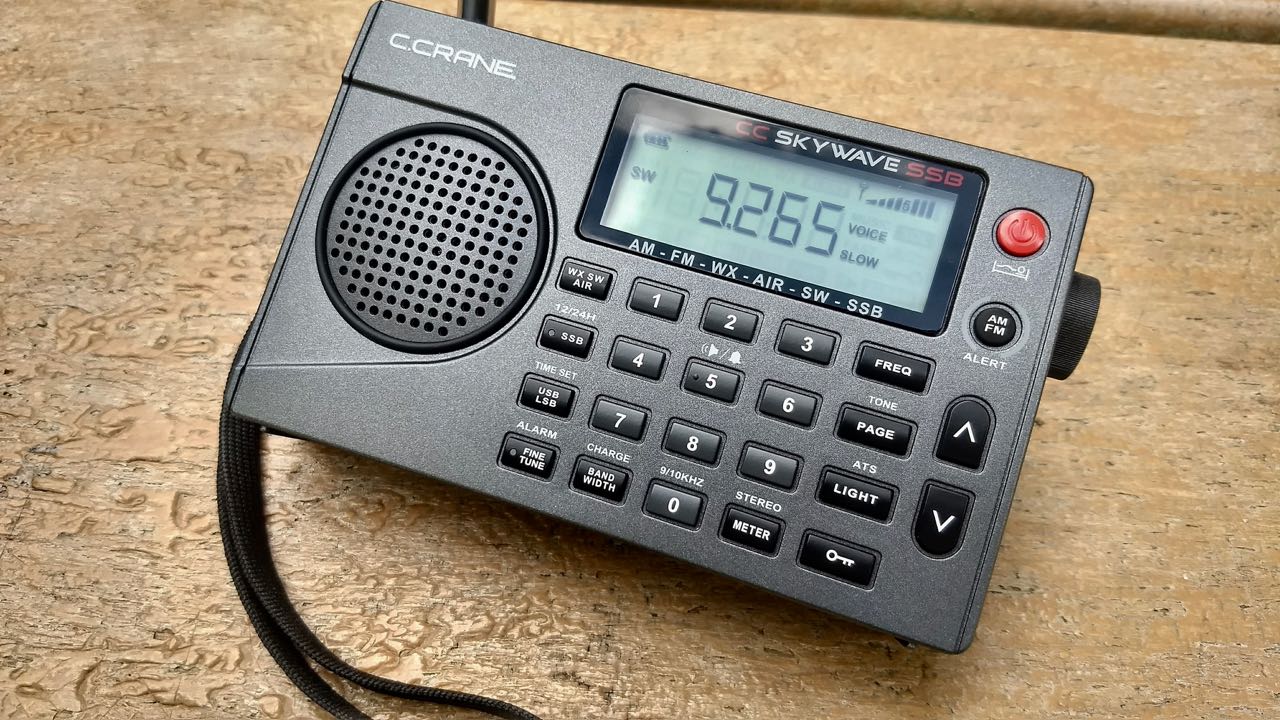
I took the plunge and purchased the Skywave SSB. It was under the tree on Christmas morning.
It was with some trepidation that I unwrapped it and installed a pair of AA batteries. I had read all the reviews regarding whistles and whines and had decided to give it a go anyway, particularly with the knowledge of the manufacturer’s excellent reputation for product support.
I am pleased to report no whistles or whines so far!
This morning I was listening to the breakfast club net on 3973 kHz. Reception, with just the whip, was not quite as good as my Commradio CR1-a with the W6LVP loop, but still very readable, and good enough to put a smile on my face and remove any thoughts of returning the radio to the manufacturer.
Air band, Weather Channel, FM, AM all seem to work great. I bought the radio primarily to throw in the bag when travelling, and can’t wait for the next business trip! I will still take the PL-880, and do some comparisons.
If I could change anything on the Skywave SSB, It would be to soften up (or remove) the detent on the tuning knob.
Holy Grail definitely comes to mind !!
Excellent, Michael! It sounds like your Skywave SSB is one that received a proper calibration and quality control run! I think you’ll find it makes for a superb compact travel radio.
Thanks for sharing your review!
As a side note, my full (4,300 word–!) review of the Skywave SSB has been published in the January 2018 issue of The Spectrum Monitor magazine. You can purchase and download the issue for $3, or (better) purchase a one year subscription for only $24. As I’ve said before, TSM is one of the best values in our radio hobby!
A number of private broadcasters had already pulled his programming after his arrest last Monday. Now that Overcomer has announced the halt of all radio broadcasting–and the voice of Overcomer, Brother Stair, is in jail–their satellite and online feeds will likely replay old content.
While I’ll certainly not miss Overcomer programming on shortwave, the numerous private broadcasters who had Overcomer as a primary client will feel the loss of revenue in no insignificant way. Indeed, I believe this could even lead to the closure of some private broadcasters this year.
Please support this website by adding us to your whitelist in your ad blocker. Ads are what helps us bring you premium content! Thank you!