Tag Archives: Deutsche Welle

Radio Waves: Russia Shuts Down DW, History of WGY, W2AN/1BCG On The Air, and Summits On The Air

Radio Waves:  Stories Making Waves in the World of Radio

Because I keep my ear to the waves, as well as receive many tips from others who do the same, I find myself privy to radio-related stories that might interest SWLing Post readers.  To that end: Welcome to the SWLing Post’s Radio Waves, a collection of links to interesting stories making waves in the world of radio. Enjoy!


German anger as Russia shuts international broadcaster Deutsche Welle (BBC News)

Germany and the EU have condemned Russia’s decision to shut down the Moscow bureau of international public broadcaster Deutsche Welle (DW).

All DW’s staff have lost their press accreditations and the channel is barred from broadcasting in Russia.

Germany’s culture minister said the move was “not acceptable in any way”.

Russia argued it was retaliating after German regulators decided a new Russian state-run TV channel, RT DE, did not have a suitable licence to operate.

Russian Foreign Ministry spokeswoman Maria Zakharova appeared to offer an olive branch to the German government on Friday, saying that if Germany moved to “normalise the situation”, then Russia would too.

RT has channels in English, French and Spanish and launched its German-language satellite channel in December 2021, using a licence from Serbia, outside the European Union. [Continue reading…]

Exhibit showcases history of radio station WGY (WAMC)

The City of Schenectady, home of General Electric, was once a nursery for broadcasting. One of the nation’s first commercial radio stations began broadcasting 100 years ago. A new exhibit at the Museum of Innovation and Science is celebrating the history of WGY.

WGY was created by GE in 1922 and still operates today under different ownership as a news/talk station. The station’s history is currently on display at miSci in a photo exhibit called WGY: Radio’s Laboratory Celebrates Its Centennial.

Chris Hunter, the museum’s Vice President of Collections and Exhibitions, took me on a tour of the exhibit located in a new gallery inside the museum.

“So, it was about 10th commercial station licensed in 1922. And because it was formed by GE’s publicity department, and not so much the engineers that formed a lot of the other early radio stations, they really placed a premium on entertainment and, kind of, the development of broadcasting.” [Continue reading…]

W2AN/1BCG On-The-Air Again for two-Way QSO’s (AWA)

After a successful AWA on-air sending of the historic 1921 Trans-Atlantic message in December of last year, using the AWA replica of the 1921 transmitter, plans are now in place to do it again only this time to offer two-way QSO’s with all stations wishing to participate.

The QSO party begins on Saturday evening, February 26, at 6:00 p.m. EST, or 23:00 GMT. AWA operators at the museum site in Bloomfield, NY will begin calling CQ on 1.821 MHz, CW, and will listen on or about that frequency for callers. We will work as many folks as we hear in order received and continue to do so until all amateur stations on the planet are in the log or propagation goes away, which ever happens first!

No QSL’s are required for you to receive a nice full sized color certificate confirming your QSO with W2AN/1BCG. Simply send your QSO information via email to [email protected] and the personalized certificate will be sent to the sending email address.

Inside the Summit-Obsessed World of Ham Radio (Outside Magazine)

n a gray Friday afternoon last spring, Steve Galchutt sat high atop Chief Mountain, an 11,700-foot peak along Colorado’s Front Range. An epic panorama of pristine alpine landscape stretched in almost every direction, with Pikes Peak standing off to the south and Mount Evan towering just to the west.

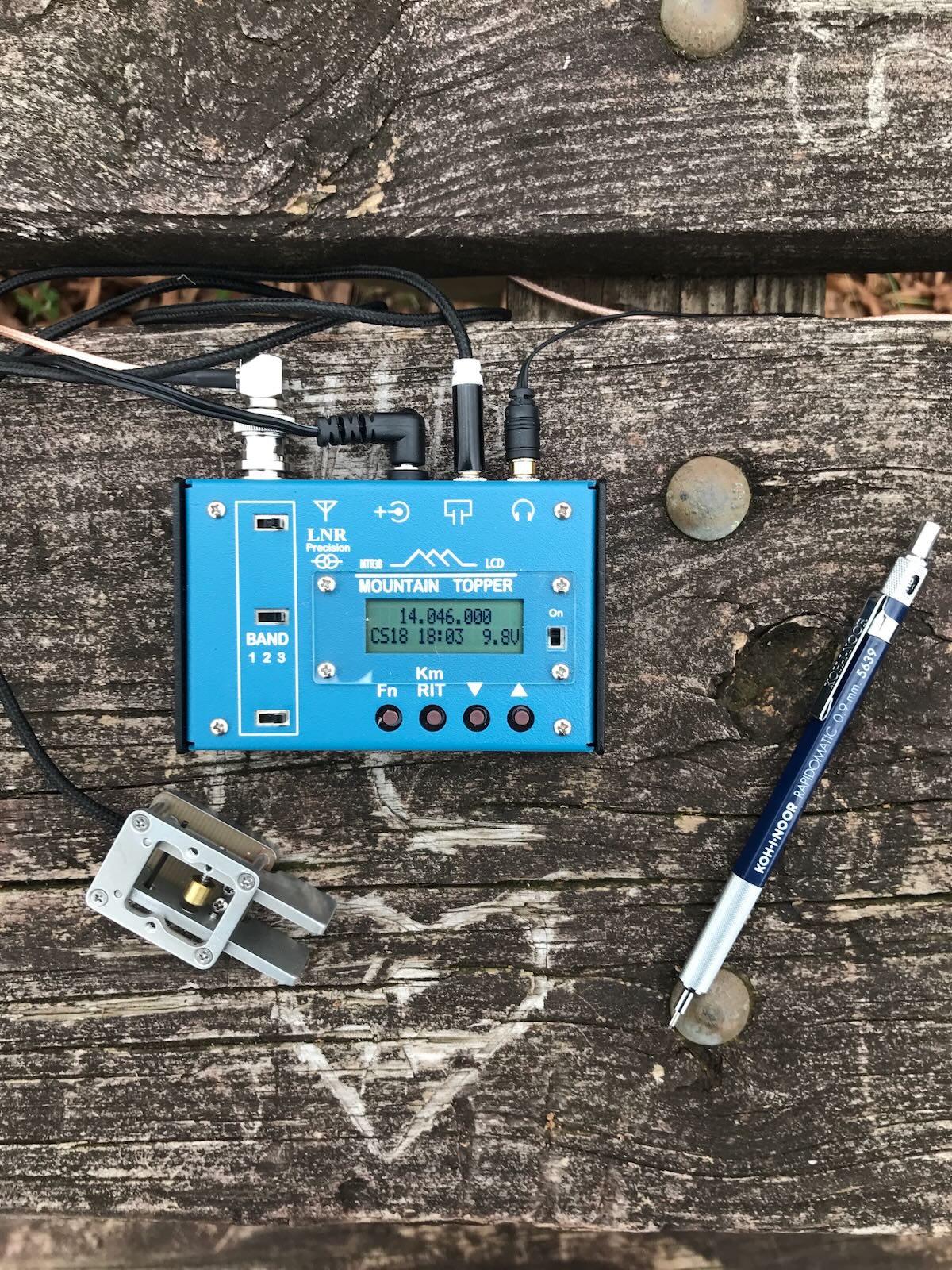
It was an arresting view, and the perfect backdrop for a summit selfie. But instead of reaching for his smartphone, Galchutt was absorbed by another device: a portable transceiver. Sitting on a small patch of rock and snow, his head bent down and cocked to one side, he listened as it sent out a steady stream of staticky beeps: dah-dah-di-dah dah di-di-di-dit. “This is Scotty in Philadelphia,” Galchutt said, translating the Morse code. Then, tapping at two silver paddles attached to the side of the radio, he sent his own message, first with some details about his location, then his call sign, WG0AT.

At this point, a prying hiker could have been forgiven for wondering what, exactly, Galchutt was doing. But his answer—an enthusiastic “amateur radio, of course!”—would likely only have further compounded their confusion. After all, the popular image of an amateur-radio enthusiast is an aging, armchair-bound recluse, not some crampon-clad adventurer. And their natural habitat is usually a basement, or “ham shack,” not a windswept peak in the middle of the Rockies. [Continue reading…]


Do you enjoy the SWLing Post?

Please consider supporting us via Patreon or our Coffee Fund!

Your support makes articles like this one possible. Thank you!

Radio Waves: First Transatlantic Signal 120 Years Today, 100 Years of German Radio, NASA Laser Communications, and Ham Transmitter on the Moon

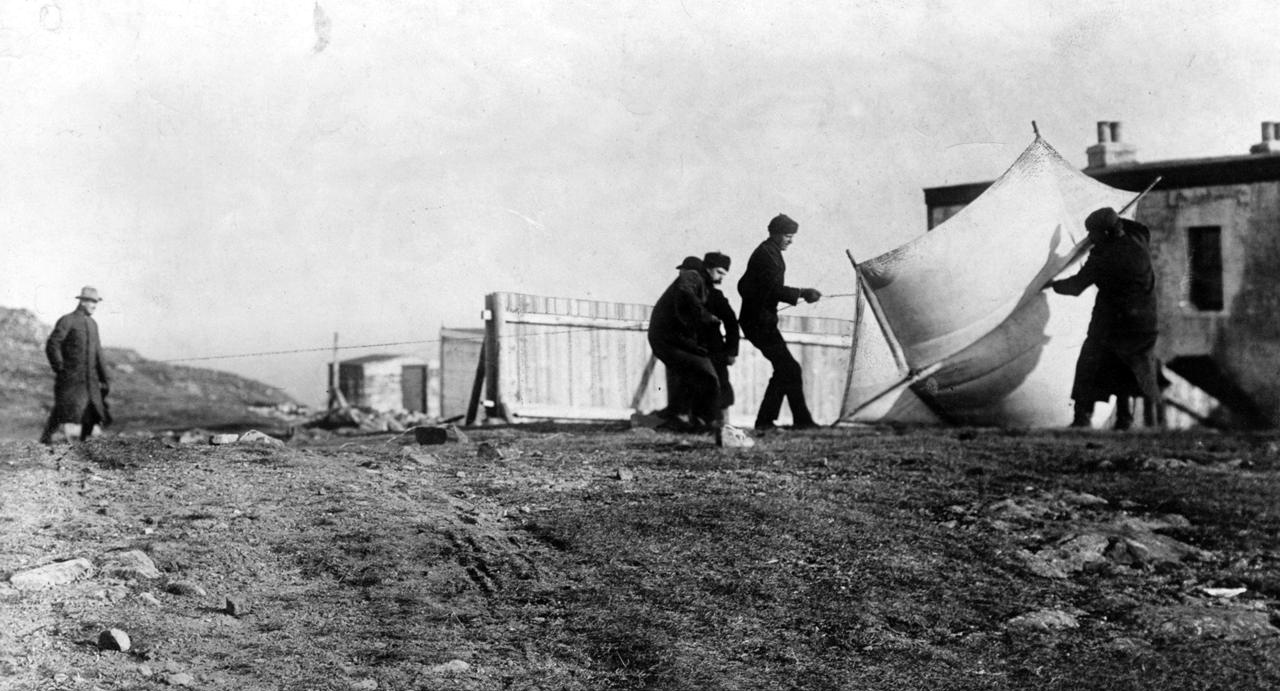
Marconi watching associates raising the kite (a “Levitor” by B.F.S. Baden-Powell[47]) used to lift the antenna at St. John’s, Newfoundland, December 1901 (via Wikipedia)

Radio Waves:  Stories Making Waves in the World of Radio

Because I keep my ear to the waves, as well as receive many tips from others who do the same, I find myself privy to radio-related stories that might interest SWLing Post readers.  To that end: Welcome to the SWLing Post’s Radio Waves, a collection of links to interesting stories making waves in the world of radio. Enjoy!

Many thanks to SWLing Post contributors Trevor R, Andrea Bornino, Wilbur Forcier, and the Southgate ARC for the following tips:


First radio transmission sent across the Atlantic Ocean (History.com)

Italian physicist and radio pioneer Guglielmo Marconi succeeds in sending the first radio transmission across the Atlantic Ocean, disproving detractors who told him that the curvature of the earth would limit transmission to 200 miles or less. The message–simply the Morse-code signal for the letter “s”–traveled more than 2,000 miles from Poldhu in Cornwall, England, to Newfoundland, Canada.

Born in Bologna, Italy, in 1874 to an Italian father and an Irish mother, Marconi studied physics and became interested in the transmission of radio waves after learning of the experiments of the German physicist Heinrich Hertz. He began his own experiments in Bologna beginning in 1894 and soon succeeded in sending a radio signal over a distance of 1.5 miles. Receiving little encouragement for his experiments in Italy, he went to England in 1896. He formed a wireless telegraph company and soon was sending transmissions from distances farther than 10 miles. In 1899, he succeeded in sending a transmission across the English Channel. That year, he also equipped two U.S. ships to report to New York newspapers on the progress of the America’s Cup yacht race. That successful endeavor aroused widespread interest in Marconi and his wireless company. Continue reading

Radio Waves: DW launches SW Service to Afghanistan, Foreign Sponsorship ID, Tokyo Ham Fair 2021 Cancelled, and the Bond of Gibraltar

Photo by Claudio Schwarz

Radio Waves:  Stories Making Waves in the World of Radio

Because I keep my ear to the waves, as well as receive many tips from others who do the same, I find myself privy to radio-related stories that might interest SWLing Post readers.  To that end: Welcome to the SWLing Post’s Radio Waves, a collection of links to interesting stories making waves in the world of radio. Enjoy!

Many thanks to SWLing Post contributors Dan Robinson, Kanwar Sandhu, Robert Carleton, Mark C. and the Southgate ARC for the following tips:


DW launches shortwave radio service for Afghanistan (DW)

Starting September 13, DW will broadcast daily radio programs in Dari and Pashto via shortwave to provide credible information to listeners in Afghanistan.

Deutsche Welle is launching a shortwave radio service for listeners in Afghanistan. The daily programs will be in both regional languages Dari and Pashto.

“In Afghanistan, media diversity and free access to independent information are under acute threat,” said Director General of DW Peter Limbourg. “DW has an experienced and skilled editorial team for the region which will contribute to providing better information to the people of Afghanistan with a shortwave radio service in Dari and Pashto, in addition to our online and social media offerings.”

The programs will broadcast daily for 30 minutes over the 15230 kHZ and 15390 kHZ frequencies at 14:00 UTC in Dari and at 14:30 UTC in Pashto.

Director of Programs for Asia Debarati Guha said the focus of the programs will be on peace, civil society and gender and human rights issues.

Continue reading

Radio Waves: A Century of Radio in Germany, Magic of ARISS, and Second Lockdown Special Callsigns in Belgium

Radio Waves:  Stories Making Waves in the World of Radio

Because I keep my ear to the waves, as well as receive many tips from others who do the same, I find myself privy to radio-related stories that might interest SWLing Post readers.  To that end: Welcome to the SWLing Post’s Radio Waves, a collection of links to interesting stories making waves in the world of radio. Enjoy!

Many thanks to SWLing Post contributors Paul, Dennis Dura, Wilbur Forcier, and the Southgate ARC for the following tips:


How radio became a cult in its early years in Germany (DW)

A century ago, the age of radio began in Germany. Cultural broadcasts made radio popular before the Nazis appropriated it for their propaganda.

On December 22, 1920, the first radio broadcast in Germany hit the airwaves. “Attention, attention — this is Königs Wusterhausen on radio wave 2700.” This was how a Christmas concert by the employees of the German Reichspost was announced. Featuring a clarinet, reed organ, string instruments and piano, they played in the broadcasting building of the city of Königs Wusterhausen.

Modest sound quality

Transmission quality was poor: static and crackling accompanied the musical performance. Only official agents of the German Reichspost could listen to this transmission since in accordance with the Treaty of Versailles, private citizens in Germany were forbidden from listening to radio signals.

Society on the move

Nonetheless, radio in Germany was born. Society at the time of the Weimar Republic was in transition. Painters were no longer merely depicting the natural worlds — Cubism, Dadaism and abstract art were unearthing new dimensions of the imagination that had no direct reference to reality. Musicians and composers were creating hitherto unheard-of sounds with jazz and twelve-tone techniques joining familiar rhythms and keys. Writers and poets were creating parallel plots and stories. Consumer products were being mass-produced. Aviation was connecting people over thousands of kilometers — and radio was booming.

The first official radio entertainment program in Germany was broadcast on October 29, 1923. The Allies had by then lifted the ban on listening to radio waves. The fact that we even have an acoustic record of it today is due to a coincidence: a few months after it was broadcast, the program was re-enacted and preserved on disc.

Broadcasting with a mission

Meanwhile, inflation was soaring in Germany. Poverty and misery were rampant, especially in the big cities. “Radio was welcomed in Germany like a liberating miracle, especially at a time of intense emotional and economic hardship,” Hans Bredow, considered the “father” of German radio, said at the time.

Like many radio pioneers of the Weimar years, Bredow had lofty ambitions to widen national perspectives in his position as Radio Commissioner to the German Reich’s Postal Minister. This new technology was to signal an end to the age of ignorance and prejudice.

In December 1923, there were a total of 467 listeners. One year later, there were already one million listeners within the Reich’s entire territory. And in 1932, there were more than four million paying radio subscribers — and at least as many non-paying listeners. The daily broadcasting time also increased steadily. In 1923, it was 60 minutes; by 1932, there were already 15 hours of radio programs every day.

Entertainment for the masses

It was the new possibilities of simultaneous acoustic reporting that captivated the “Radioten, ” a derogatory term that was used for radio lovers at the time. An extraordinary media event at that time, the radio achieved its exciting effect through its immediacy and “live” character. And it gave birth to a genre unknown until then: the radio play.

Meanwhile, heated debates abounded about the negative effects of radio on listeners, culture and politics. Many intellectuals and artists distanced themselves from the new medium. Among them was the Austrian composer Arnold Schönberg. “Broadcast media caters to the majority. At any time of the day or night, people are served a feast for the ears without which they apparently can no longer live today. I assert the right of the minority against this delirium for entertainment: one must also be able to broadcast what is necessary, and not only the trivial.”[Continue reading full story at DW…]

Earthlings and astronauts chat away, via ham radio (Phys.org)

The International Space Station cost more than $100 billion. A ham radio set can be had for a few hundred bucks.

Perhaps that explains, in part, the appeal of having one of humankind’s greatest scientific inventions communicate with Earth via technology that’s more than 100 years old. But perhaps there’s a simpler explanation for why astronauts and ham radio operators have been talking, and talking, for years.

NASA astronaut Doug Wheelock was just a few weeks into his six-month mission at the space station when feelings of isolation began to set in.

Wheelock would be separated from loved ones, save for communication via an internet phone, email or social media. At times, the stress and tension of serving as the station’s commander could be intense.

One night, as he looked out a window at the Earth below, he remembered the space station’s ham radio. He figured he’d turn it on—see if anyone was listening.

“Any station, any station, this is the International Space Station,” Wheelock said.

A flood of voices jumbled out of the airwaves.

Astronauts aboard the space station often speak to students via ham radio, which can also be used in emergencies, but those are scheduled appearances. Some, like Wheelock, spend their limited free time making contact with amateur radio operators around the world.

“It allowed me to … just reach out to humanity down there,” said Wheelock, who interacted with many operators, known as “hams,” during that stay at the space station in 2010. “It became my emotional, and a really visceral, connection to the planet.”

The first amateur radio transmission from space dates to 1983, when astronaut Owen Garriott took to the airwaves from the Space Shuttle Columbia. Garriott was a licensed ham who, back on Earth, had used his home equipment in Houston to chat with his father in Oklahoma.

Garriott and fellow astronaut Tony England pushed NASA to allow amateur radio equipment aboard shuttle flights.

“We thought it would be a good encouragement for young people to get interested in science and engineering if they could experience this,” said England, who was the second astronaut to use ham radio in space.[]

Living in space can get lonely. What helps? Talking to random people over ham radio (LA Times)

The International Space Station cost more than $100 billion. A ham radio set can be had for a few hundred bucks.

Perhaps that explains, in part, the appeal of having one of humankind’s greatest scientific inventions communicate with Earth via technology that’s more than 100 years old. But perhaps there’s a simpler explanation for why astronauts and ham radio operators have been talking, and talking, for years.

NASA astronaut Doug Wheelock was just a few weeks into his six-month mission at the space station when feelings of isolation began to set in.

Wheelock would be separated from loved ones, save for communication via an internet phone, email or social media. At times, the stress and tension of serving as the station’s commander could be intense.

One night, as he looked out a window at the Earth below, he remembered the space station’s ham radio. He figured he’d turn it on — see if anyone was listening.

“Any station, any station, this is the International Space Station,” Wheelock said.

A flood of voices jumbled out of the airwaves.

Astronauts aboard the space station often speak to students via ham radio, which can also be used in emergencies, but those are scheduled appearances. Some, like Wheelock, spend their limited free time making contact with amateur radio operators around the world.[]

Special call signs in Belgium during the second lockdown period (Southgate ARC)

Belgian amateurs activate the following special event callsigns to remind everyone of Covid-19 restrictions and express gratefulness to medical personnel:
OS2HOPE, OT5ALIVE, OT4CARE, OR20STAYHOME, OT6SAFE, OP19MSF, OQ5BECLEVER, OR6LIFE, OO4UZLEUVEN and OT2CARE.

Due to the recent stricter COVID-19 measures, many radio amateurs will be forced to spend most of the following weeks at home again. Many are obliged to telework. Teleworking is definitely becoming the new standard for several employees. COVID-19 has accelerated teleworking for almost all companies.

At the request of the Royal Union of Belgian Radio Amateurs (UBA), the BIPT has decided to once again grant permission to apply for customised special call signs. The exceptional conditions apply to special call signs with an encouraging meaning.

These appropriate special call signs may be used at the home address of radio amateurs. The conditions are the same as during the first lockdown in spring.
Radio amateurs are allowed to re-request the special call sign obtained during the first lockdown.

Operation until January 31, 2021.

For QSL information see QRZ.com


Do you enjoy the SWLing Post?

Please consider supporting us via Patreon or our Coffee Fund!

Your support makes articles like this one possible. Thank you!
Short film about RIAS (Rundfunk im amerikanischen Sektor)

Many thanks to SWLing Post contributor, Gerhart, who shares links to this short 1994 film, produced by Deutsche Welle TV, about the West Berlin radio station, RIAS:

Part 1:

Part 2:

I’m curious if any SWLing Post readers ever listened to or logged RIAS while living or travelling in West/East Berlin during the Cold War years. Please comment!

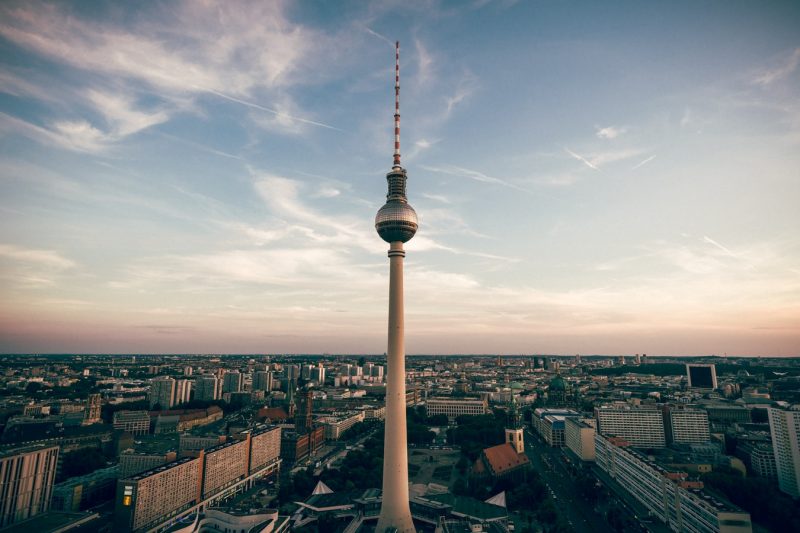
Iconic Berlin TV Tower turns 50

Photo by ?? Claudio Schwarz | @purzlbaum on Unsplash

(Source: Deutsche Welle via David Iurescia)

It served as a symbol of communist power and remains a remarkable landmark of the now reunited city: the Fernsehturm on Alexanderplatz was inaugurated on October 3, 1969.

With its iconic glittering sphere, the TV Tower looks over the once divided city that has been reunited since 1990. The 365-meter-high (1,198-foot-high) Fernsehturm on Alexander Platz in East Berlin was almost 220 meters taller than West Berlin’s broadcasting tower, the Funkturm at the Berlin Exhibition Center.

When the Fernsehturm was completed in October 1969, it was the second-highest television tower in the world, right after the Ostankino in Moscow (537 meters). TV towers built afterwards, such as in Tokyo, Guangzhou, Toronto, Shanghai, Tehran or Kuala Lumpur, have since broken the records of the time.

The head of the East German state, Walter Ulbricht, inaugurated the building to mark the 20th anniversary of the foundation of the GDR, on October 3, 1969. The structure served as a demonstration of the power of the communist state. The tower was indeed a masterpiece of engineering — even West German experts were ready to admit that.[…]

Click here to read the full story.

Note: Corrected title from Radio to TV Tower. 🙂

Deutsche Welle’s 65th anniversary

(Source: Deutsche Welle)

Deutsche Welle marks 65th anniversary

For six-and-a-half decades, Germany’s international public broadcaster has been providing the world with news and information. Deutsche Welle’s offerings are more diverse and widely used than ever before.

“Dear listeners in faraway countries” — with these words from German President Theodor Heuss, Deutsche Welle (DW) began broadcasting on May 3, 1953. Germany’s foreign public radio station was charged with providing audiences abroad with a political, economic, and cultural picture of the country.

DW broadcast via shortwave and initially only in German. The first foreign languages were added in 1954. In 1992, DW expanded into television and, shortly thereafter, the internet.

“Of course the days of just shortwave were easier,” says Deutsche Welle Director General Peter Limbourg. “But thanks to the internet, social media, and our network of partners, we now have the chance to reach significantly more people than we used to. We offer a mix of news, background, and think pieces, presented in a modern fashion and oriented around the interests of our diverse and often very young target audiences.”

Limbourg has been DW’s director general for the past four and a half years.[…]

Click here to read the full article at Deutsche Welle.