Tag Archives: Recordings

Pulling Radio Santa Cruz out of the interference

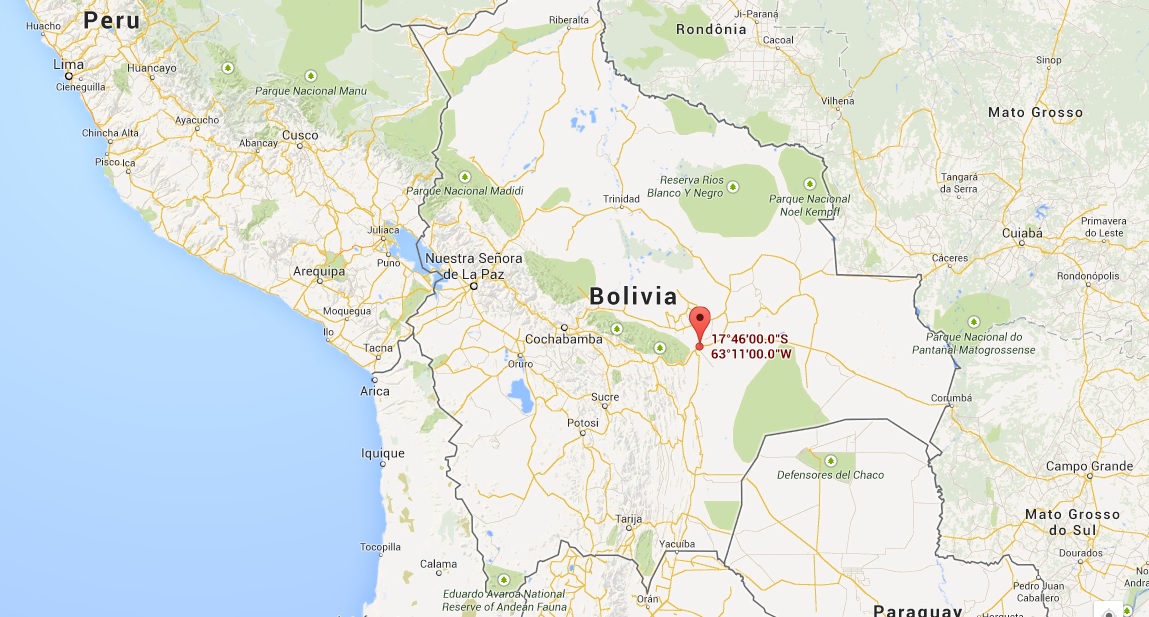
BoliviaI recorded Radio Santa Cruz early this morning around 05:00 UTC on 6,135 kHz using the TitanSDR I currently have under review.

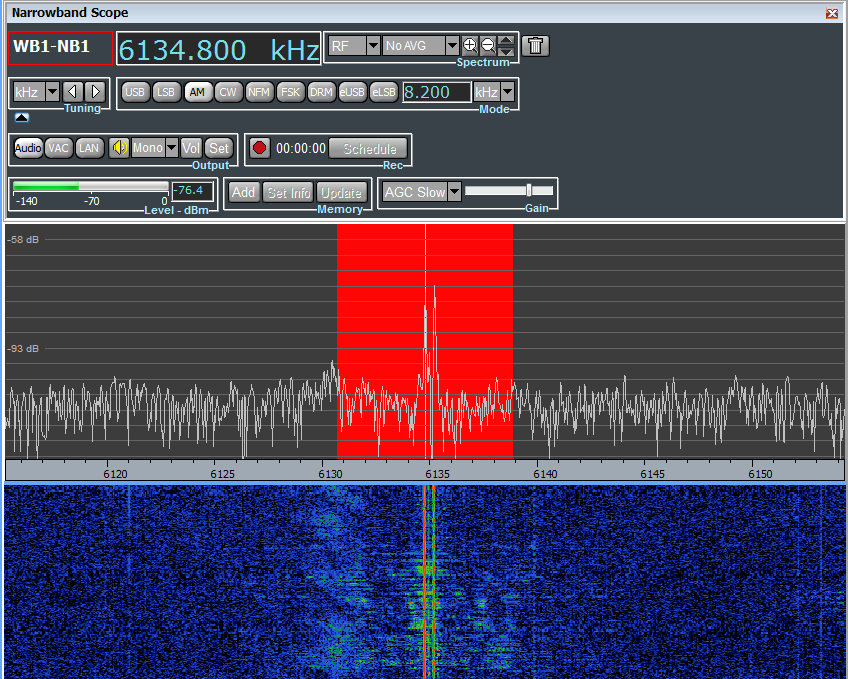
Radio Santa Cruz‘s 10 kW signal from Santa Cruz, Bolivia, was very much audible here in North America, though RSC was competing with another station on-frequency at the time. Actually, Radio Santa Cruz was broadcasting slightly off-frequency–6134.8 kHz instead of 6,135 kHz. In this case, the fact that RSC was slightly below frequency helped me delineate the station’s audio from that of a competing station.
Fullscreen capture 272015 54241 PM

In the screen-grab of the narrowband channel from the Titan SDR (above–click to enlarge) you can see two distinct carriers spaced only .2 kHz apart (represented by the two peaks in the spectrum display and two parallel vertical lines in the waterfall display).

Here is what the audio sounds like in normal AM mode when we center on the Radio Santa Cruz frequency of 6,134.8 kHz:

You hear a hetrodyne and garbled noise from a competing station. Not pleasant audio.

If we change from the AM mode to eLSB mode (essentially, the TitanSDR’s version of synchronous detection on the lower sideband) we are ignoring all of the noise in the upper sideband, allowing the desired signal of RSC to pop out.
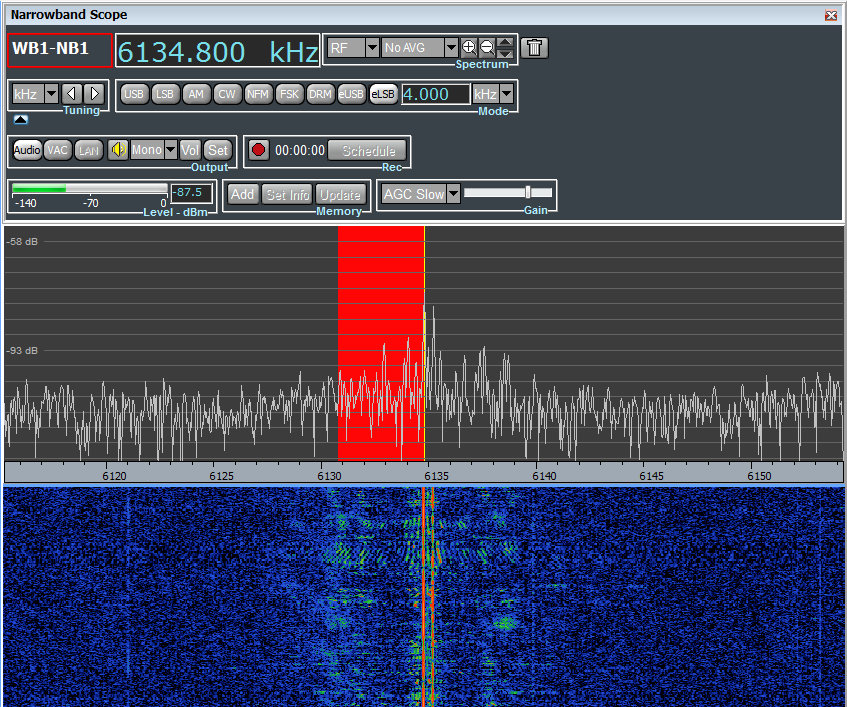
Fullscreen capture 272015 54317 PM

You can see in the screen-grab above that now only the lower sideband of the RSC signal is highlighted. Here’s a 21 minute recording:

Makes quite a difference!

It’s easy to see competing signals and interference on an SDR’s spectrum display, but if you hear something similar on your portable, try the techniques above to see if it clears up the signal.

If your receiver lacks a selectable synchronous detector, much of the same results can be gained by zero-beating (tuning in) the desired signal in lower sideband mode. Of course, if you have a receiver that lacks SSB mode, the best you can do is tune slightly below frequency in AM, in which case the results will not be as dramatic.

Conclusion? Listening in single-sideband or with a selectable sync detector might be all you need to dig a signal out of the interference.


Shortwave Radio Recordings: Voice of Nigeria

VON-BH front yardFor your listening pleasure: the Voice of Nigeria–recorded on January 28, 2015, starting at 10:00 UTC on 9,690 kHz.

The past few days, the signal out of Ikorodu has been much stronger than normal, so I’ve spent several afternoons listening to the wonderful sounds and music from the Voice of Nigeria.

Click here to download the recording as an MP3, or simply listen via the embedded player below:

Shortwave Radio Recordings: Radio Slovakia

RadioSlavakia

For your listening pleasure: the English language service of Radio Slovakia–recorded on January 23, 2015 at 1230 UTC on 9,955 kHz.

This broadcast of Radio Slovakia comes by way of the World Radio Network and is relayed by Radio Miami International (WRMI).

Click here to download the recording as an MP3, or simply listen via the embedded player below:

Shortwave Radio Recordings: Radio Berlin International, Final episode of DX-tra

Radio_Berlin_International.svg

Many thanks to Shortwave Radio Audio Archive contributor, Richard Langley, who writes:

[The following is a] recording of the penultimate English broadcast from Radio Berlin International (RBI) and the last broadcast in the particular time slot. It was also the last broadcast of the popular DX program DX-tra.

RBI ceased broadcasting at the end of the day on 2 October 1990, the day before German reunification took place.

In addition to the final episode of DX-tra, the recording features the news (in progress as the recording starts a minute or two after 00:45), Commentary, RBI Press Review, and Spotlight on Sport. There are several “goodbye” songs including “The Final Countdown” by the Swedish hard rock band Europe, and “Goodbye Blue Sky” by Pink Floyd and some announcer goodbye comments like “the voice of the disappearing German Democratic Republic,” “that was it,” and “the last day of the good old GDR.”

The 45-minute recording ends with the familiar RBI interval signal and, at 01:30 UTC, the first part of the German-language transmission, also the last in its time slot.

This recording was made in Hanwell, NB, Canada, with a Sony ICF-7600D receiver and supplied wire antenna draped around Richard’s home office. This recording begins around 0045 UTC, October 2, 1990 on a frequency of 9,730 kHz.

Click here to download this recording as an MP3, or simply listen via the embedded player below:

Shortwave Radio Recordings: Helliniki Radiophonia

GreeceIt’s been a while now since 9,420 kHz–a former Voice of Greece frequency–should have gone off the air.  Fortunately, it has not.

The station is no longer referred to as the Voice of Greece; it’s now a relay of ERT Open, otherwise known as the Helliniki Radiophonia (you’ll hear this name in the station ID).

Friday evening, I recorded nearly four hours of Helliniki Radiophonia because I love the music programming they air during weekends, yet I rarely stay up late enough to listen live. With this recording, I’ll enjoy Greek music most of my working day today–and you can, too!

Simply click here to download an MP3 of the full recording, or simply listen via the embedded player below.

The music begins, in earnest, a little after 17:00–enjoy:

Shortwave Radio Recordings: Mikhail Gorbachev’s 1991 resignation speech via Radio Moscow

Gorbachev_and_Reagan_1987-012One of the advantages of hosting a contributor-driven shortwave radio audio archive, is receiving off-air recordings of defining moments in our world history. This is certainly one of them.

SRAA contributor, Richard Langley, writes:

“I’ve started to convert some of my old cassette shortwave recordings to mp3 files. I’ve uncovered a box of about 25 tapes with recordings mostly from 1990 and 1991. This was an interesting era for shortwave. There was the reunification of Germany, the breakups of the Soviet Union and Yugoslavia, and the invasion of Kuwait by Iraq and then the First Gulf War. I monitored some of these events using my venerable Sony ICF-7600D receiver with the supplied wire antenna draped around my home office. I bought this receiver during a trip to Hong Kong (and the P.R.C.) in 1985. It was my first decent shortwave radio and I still have it but it has since been joined by several other receivers.

[…]

[The following] is a recording of President Mikhail Gorbachev’s resignation speech as broadcast live by the World Service of Radio Moscow. As the announcer says, “a moment of history in the making.” It begins at about the three-minute mark of the recording (at 17:00 UTC). The speech is followed by a program of classical music (filler), the News in Brief at 17:30 UTC, followed by part of the program “Africa as We See It.”

Richard: many, many thanks for sharing this recording–I can’t wait to hear the other treasures you uncover in your collection.

 For your listening pleasure: Radio Moscow World Service from December 25, 1991 on 17,670 kHz, beginning at 1657 UTC. Click here to download this recording as an mp3, or simply listen via the embedded player below:

Shortwave Radio Recordings: A Tale of Two Cities via Global 24

Elad-FDM-S2-FrontPanelTuesday morning, I tuned my WWII era BC-348-Q to Global 24 on 9395 kHz. The signal, via WRMI’s transmitter, was quite strong.

The company rehearses Treasure Island, the second program in The Mercury Theatre on the Air series, presented July 18, 1938 (Source: Wikipedia)

The company rehearses Treasure Island, the second program in The Mercury Theatre on the Air series, presented July 18, 1938 (Source: Wikipedia)

At 2:00 UTC, I heard an announcement that The Mercury Theatre on the Air radio play of A Tale of Two Cities was about to begin.

Not wanting to miss an opportunity to record this timeless Dicken’s classic, I quickly switched over to the Elad FDM-S2 SDR to record the broadcast live. Fortunately, I captured the full broadcast and the fidelity is almost as good as a local station.

For your listening pleasure this New Year’s Day, please enjoy A Tale of Two Cities by The Mercury Theatre on the Air courtesy of Global 24:

Click here to download the recording as an MP3.

Happy New Year, everyone!