Tag Archives: Shortwave Radio

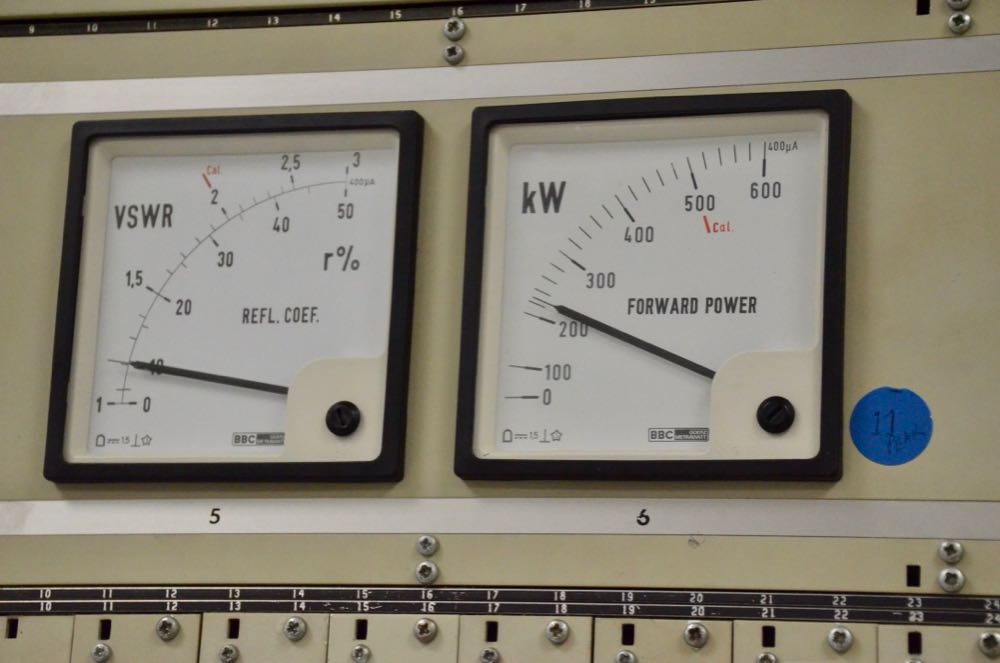
BBC Kranji shortwave relay station to close July 16, 2023

Many thanks to a number of SWLing Post contributors who have reached out about a report on AWR Wavescan regarding the closure of the BBC Kranji relay station in Singapore.

I contacted AWR Wavescan host, Jeff White at WRMI, and asked for any details he might have since I could not locate any press release from the BBC or Encompass.

Jeff shared the following notice from AWR Wavescan:

Another shortwave station is about to go off the air for good also. Encompass TV reports that the BBC relay station that Encompass operates in Kranji Singapore will cease operation as of July 16th, after many decades of service. This will result in a reduction of BBC English transmissions to South Asia. Some transmissions from Kranji will be moved to other shortwave transmitter sites.

Many thanks for the info, Jeff.

We’ll post more details about the closure as they become available.

Shortwave Modernization Coalition: Public comment period on new proposal

Many thanks to SWLing Post contributor, Benn Kobb, who shares the following announcement:

The FCC has opened for public comment the Petition for Rulemaking of the
Shortwave Modernization Coalition.

The proposal would bring new private, non-broadcast digital stations to
the high-frequency spectrum.

As covered in Experimental Radio News, the Coalition members have
performed HF experiments over the last several years. Favorable FCC
action on the proposal would open the field to regular commercial
operations.

The FCC has assigned the petition number RM-11953. Comments are due in
30 days.

FCC Public Notice:
https://docs.fcc.gov/public/attachments/DOC-394830A1.pdf

Petition:
https://www.fcc.gov/ecfs/document/1042840187330/1

Benn Kobb

Experimental Radio News
https://www.experimentalradio.news

Guest Post: Here Come the Lithiums

Many thanks to SWLing Post contributor, Bob Colegrove, who shares the following:


Power Play – Here Come the Lithiums

by Bob Colegrove

I have belonged to several radio-oriented user groups in recent years and can’t help noticing how often the subject of batteries comes up.  It’s almost a sub-hobby within the hobby.  There are a couple of reasons for this, first is the unending quest for the ultimate cost-effective, everlasting battery, and second, it’s a rare opportunity for most of us to tinker in an increasingly complex world of technology.

Lithium batteries offer a sustainable voltage output well into their discharge cycle and can deliver a higher rate of current than alkaline batteries.  They are somewhat lighter in weight than alkaline batteries – 2.5 oz. versus 5 oz. for D-cells.

Considering the fast pace of technology, lithium batteries have been with us for a comparatively long time, this in the form of cell phone and camera power, not to mention a host of electric appliances.  Most of these batteries have limited purpose, that is they have been developed and packaged for just a few applications, thus resulting in an incredible variety of sizes and shapes, and no doubt a host of frustrations due to obsolescence.  It’s somewhat reminiscent of the early days of transistor radios which ran on a wide array of zinc-carbon batteries.

Perhaps I have been asleep at the wheel, but it has only come to my attention recently that lithium chemistry has begun to backfill the standard battery sizes we have long been familiar with, namely AAA, AA, C, D, and even the PP3 standard 9 volt.

I have been running along quite successfully for more than 10 years on AA NiMH technology on several portable radios.  Although these run at a slightly lower cell voltage of 1.25 Vdc, the one-for-one substitution of these for alkaline chemistry has seldom been a problem in terms of performance.  In most cases, newer radios are provided with an alkaline/NiMH-NiCad setting to compensate for the difference in voltage.  Even the venerable Sony ICF SW7600GR, for which alkaline batteries are assumed, seems to operate equally well either way.

My problem has always been the larger power consumers running on D-cells – the Sony ICF 2010 and Grundig Satellit 800 to cite two examples.  A fresh set of NiMH batteries put the 2010 on the cusp of poor performance.  Lithium batteries having a sustainable single-cell voltage of 1.5 Vdc now provide a possible alternative to a steady diet of costly alkaline cells.  Even more attractive, some are equipped with a USB-C connector and can be recharged without a dedicated charger.
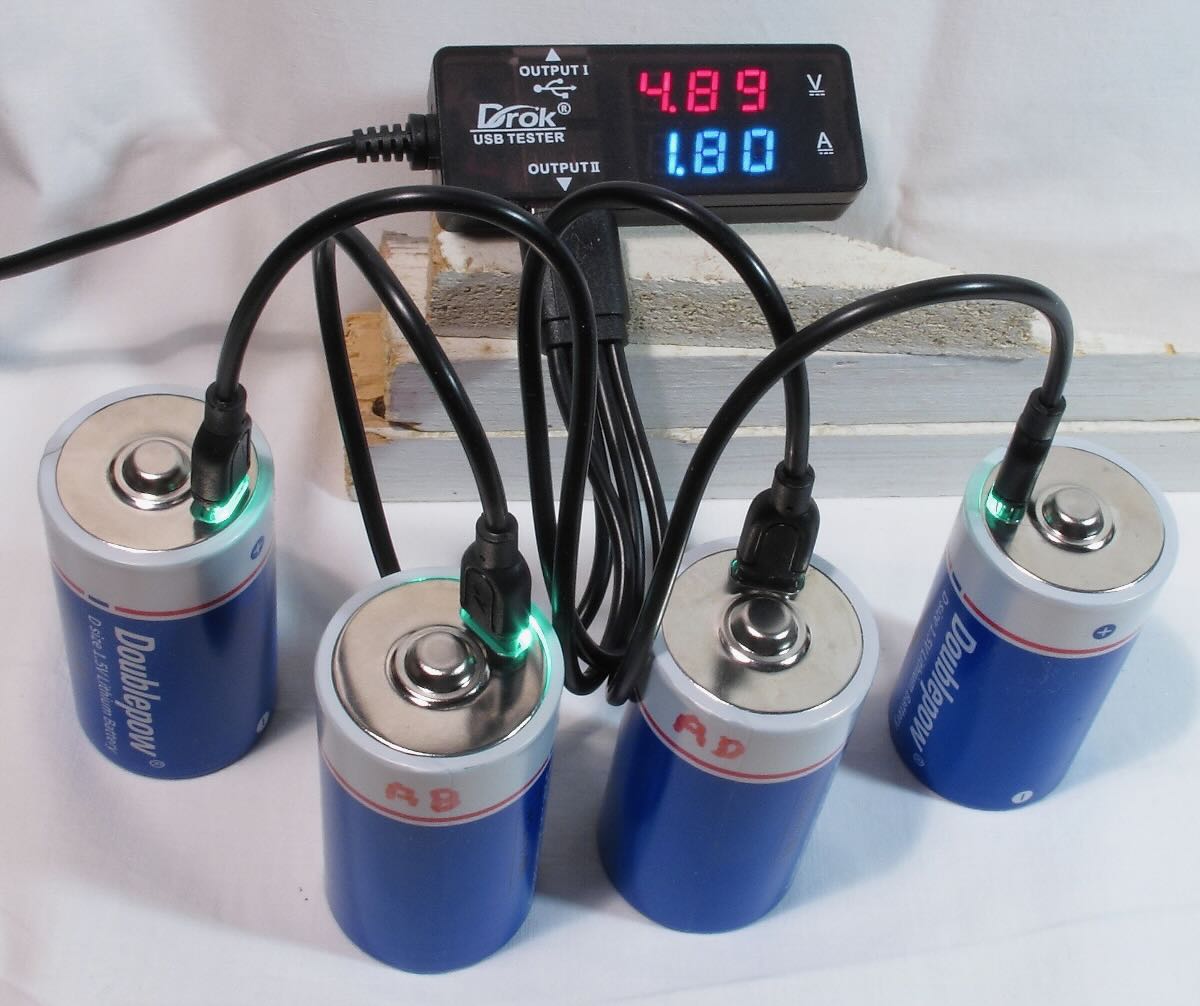
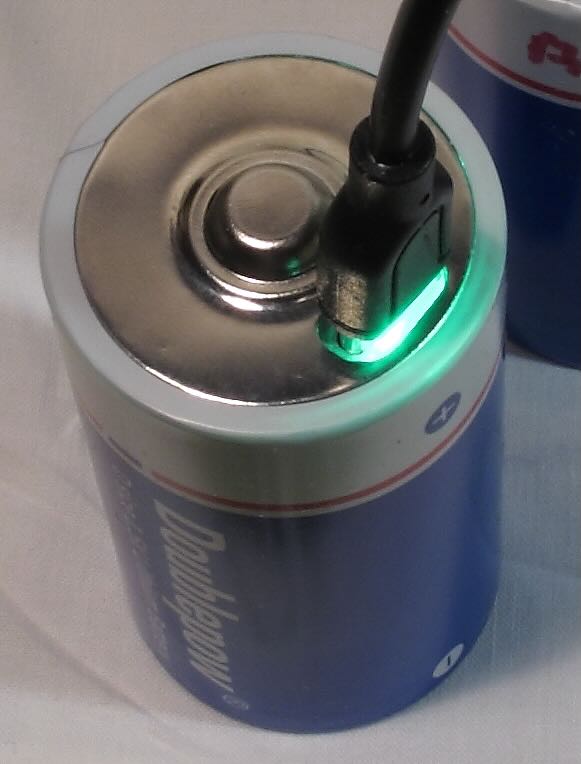
In the figure above, a set of four lithium D cells are connected simultaneously through a 4-lead USB-C harness and USB charger (not shown).  Many of the brands include the harness with a set of batteries.  I have added a USB multimeter, which I find very useful to monitor the progress of the charge, but this is not necessary.  This particular meter can also show accumulated capacity.  However, it should be noted that, unless batteries are charged one at a time, charging rate and capacity will show the total values for the number of batteries being charged.  I would also recommend that the USB charger be rated at least 3 amps.  In the figure below, one of the USB-C leads is connected at the top of the battery.  The built-in LED flashes during charge and remains on when the charge is complete.
Cost is an equally important consideration.  There is a lot of hype in the marketing department about how many times these batteries can be recharged.  The key compound preposition here is “up to,” and as long as they use those words, they can make the number anything they want to.  That said, it simply won’t take more than a few cycles for the cost-benefit cusp to be reached in favor of lithium batteries.

I am just getting started with this.  Although the batteries came highly recommended for the portable radio application, I can make no judgment at this time as to their ultimate quality or convenience.  It just seems like the next logical way to go.

There are some things to remember when choosing lithium batteries.  Not all lithium batteries are rechargeable, particularly smaller sizes.  Some do not come with the built-in USB-C charging jack, so a separate charger intended for lithium batteries will be required.  D size batteries are also available at 3.6 Vdc/cell.  There may be other options, so watch out.  Be sure to thoroughly check the features of any batteries you consider.

I would close by warning that lithium batteries come with safety caveats regarding their transport, handling, use, charging, and disposal.  These precautions are all well stated in the literature, which should be followed with an abundance of caution.  Of note is the fact that not all chargers support lithium batteries, and their capability should be checked as well.


Click here to check out these Lithium D Cells on Amazon.com (SWLing Post affiliate link), or explore other brands.


Radio Waves: Sri Lanka DRM, Czech Radio, Ham Radio Ops Ready for Disaster, Space Pirates, FM Not Far Behind AM, and AM Hearing Live Today

Radio Waves:  Stories Making Waves in the World of Radio

Welcome to the SWLing Post’s Radio Waves, a collection of links to interesting stories making waves in the world of radio. Enjoy!

Many thanks to SWLing Post contributors Dennis Dura, David Iurescia, John Palmer, Gareth Buxton, and Mangosman for the following tips:


Sri Lankan Broadcaster Goes DRM Following Listeners’ Request (DRM Consortium)

The international service of the Sri Lankan Sri Lanka Broadcasting Corporation (SLBC) recently doubled its Tamil Service airtime to two hours, on 873 kHz AM (medium wave) from Puttalam transmitter. The new schedule is 0130-0330 UTC (7.00 am to 9.00 am IST). This is partly in response to individual efforts of listeners, many in the southern part of India, in Bengaluru. Introducing this change, Colombo International Radio also announced that shortly they are going to use DRM on 1548 kHz! This will be done by is using the old transmitter of Deutsche Welle located in the north of Sri Lanka at Trincomalee. The Sri Lankan public broadcaster has started airing the DRM announcement:

The publicity for the new DRM service is in full swing. See video:

Czech Radio centenary: Listeners send congratulations (Czech Radio)

On the occasion of Czech Radio’s centenary, we asked our listeners to let us know where they heard our special programme on that day in order to map Radio Prague International’s broadcast reach today. Here are at least some of the many letters and photos which you have sent us. Thank you to all our loyal fans.

George Jolly, who was listening to our special programme over the internet, wrote from Houston, Texas:

“Thank you so much for the special program today celebrating your 100 years of radio. If I were not so far away, I would surely visit you on Saturday. It means a lot to me that you continue the tradition of the ‘radio magazine’. Hearing the opera excerpt and other recordings from the past was wonderful!

“I love old music and old technology like radio, and I love that you are keeping their spirit alive and new again for today’s world. I am so grateful to celebrate your centenary with you from afar.”

Another listener from the United States is Timothy Marecki, who wrote us from New Port Richey in Florida: Continue reading

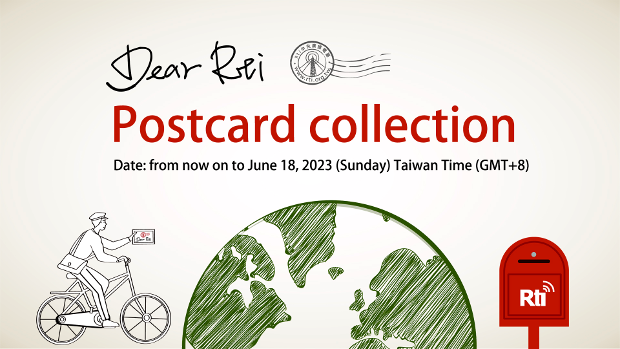
Dear RTI Postcard Collection

Many thanks to SWLing Post contributor, Paul Jamet, who writes:

Hi Thomas,

This message is to draw your attention to this announcement from Radio Taiwan International titled “Dear RTI”:

https://event.rti.org.tw/dearrti/en/

Listeners are invited to send postcards to the station before June 18, 2023:
https://event.rti.org.tw/dearrti/en/send-a-postcard/

I hope that readers of the SWLing Post site and RTI listeners will be very numerous to participate in the operation Dear RTI

Thanks. With my best regards.

Paul JAMET

Thank you so much for the tip, Paul!

European Parliament: Special Multilingual Europe Day Show from Brussels and Strasbourg, May 6-13, 2023

Many thanks to SWLing Post contributor, Robertas Pogorelis, who shares the following announcement:

Dear radio friends,

Europarl Radio will be on shortwave with its multilingual Europe Day Show from Brussels and Strasbourg, according to the following schedule:

  • Saturday 6 May 09:00-10:00 UTC
  • Tuesday 9 May 17:00-18:00 UTC
  • Saturday 13 May 09:00-10:00 UTC

on 6070 and 9670 kHz, via 10 kW transmitter of Channel 292 in Waal (Rohrbach), Germany.


The multilingual programmes are produced by the staff of the Directorate-General for Translation at the European Parliament.

The station will issue separate eQSLs for each programme. Qualifying reception reports should contain a description of at least 15 minutes of the programme, as well as of signal quality. Web SDRs are accepted. The reports should be sent to [email protected]

As this is a pilot project, listener feedback will facilitate its repetition in the future. So please tune in and send your reports, comments and suggestions to the above address!

Radio Waves: State of AM Radio, Quindar Tones Hack, AI DJs, BBC Pop-Up Station for Sudan, Artemis II & Ham Radio, and a Morse Revival

Source: NASA

Radio Waves:  Stories Making Waves in the World of Radio

Welcome to the SWLing Post’s Radio Waves, a collection of links to interesting stories making waves in the world of radio. Enjoy!

Many thanks to SWLing Post contributors Dennis Dura, David Shannon, and Eric McFadden for the following tips:


Bouvard Laments “Yawning Gap” in Marketer Perceptions About Radio (Radio World)

Cumulus publishes analysis to counter prevailing sentiments about AM and radio in general

“Ford owners are massive users of AM radio.”

So writes Pierre Bouvard, chief insights office of Cumulus Media, citing data from MRI Simmons.

That is but one of his observations as Cumulus Media/Westwood One released an analysis of listening data from sources that also include the Nielsen fall 2022 survey, Edison Research’s “Share of Ear” and research by Advertiser Perceptions.

Bouvard regularly posts about the power of radio and what he calls misperceptions about the medium among the broader marketing community.

He summarized takeaways from the new Cumulus analysis:

“The Nielsen Fall 2022 survey reveals that 82,346,800 Americans listen to AM radio monthly; 57% of the AM radio audience listens to news/talk stations, the very outlets that Americans turn to in times of crisis and breaking local news; and one out of three American AM/FM radio listeners are reached monthly by AM radio,” he wrote. [Continue reading…]

AM News Radio, your go-to in a crisis, could itself be in trouble (NorthJersey.com)

“Some clouds over the city right now. I’m Paul Murnane,” says a familiar voice.

“I’m Wayne Cabot,” says another.

Few would know their faces. But as names, they’re as recognizable as anyone in New York.

Fewer still could tell you their address — an 11th floor studio in a light-brick high-rise in lower Manhattan, between a Chase bank branch and patisserie named Maman.

But hundreds of thousands know where to find them on the AM dial — right between 820 WNYC (“public affairs”) and 930 WPAT (“multi-ethnic”). That, for 56 years, has been the location of WCBS Newsradio 880 — one of those rare unchanging institutions in a changeable city. [Continue reading…]

Apollo Comms Part 27: Quindar Tones Microphone Hack (CuriousMarc on YouTube)

The last DJ nears? Radio station uses artificial intelligence, cloned voices (WRAL)

GENEVA — The voices sound like well-known personalities, the music features trendy dance beats and hip-hop syncopations, and the jokes and laughter are contagious. But listeners of an offbeat Swiss public radio station repeatedly got the message on Thursday: Today’s programming is brought to you by Artificial Intelligence.

Three months in the making, the French-language station Couleur 3 (Color 3) is touting a one-day experiment using cloned voices of five real, human presenters — in what managers claim is a world first — and never-aired-before music composed almost entirely by computers, not people. From 6 a.m. to 7 p.m., the station said, AI controlled its airwaves. Every 20 minutes, listeners got a reminder. Continue reading