Shortwave listening and everything radio including reviews, broadcasting, ham radio, field operation, DXing, maker kits, travel, emergency gear, events, and more
Many thanks to SWLing Post contributor, Mangosman, for sharing the following press release from Radio Exterior de España. Please note that the original press release was in Spanish and can be viewed at RTVE Comunicación. What follows is a machine translation:
Radio Exterior de España transmits its programming on Short Wave from its broadcasting center in Noblejas (Toledo). Source: RTVE
Radio Exterior de España: The Short Wave service of REE reaches Ukraine and Russia
Radio Exterior de España, the international channel of Radio Nacional de España, offers an open window to truthful information in times of war through Short Wave. The Russian attack on the Kiev communications tower has silenced several television channels. The Internet and social networks are easily controllable, and the telecommunications infrastructure that provides Internet service is highly vulnerable to attack.
True to its commitment to public service, the Short Wave broadcasts of Radio Exterior de España, in Spanish and Russian, are the only Spanish ones that can publicize the reality of the invasion, its repercussions, the testimonies and the demonstrations of solidarity to the Ukrainian population directly. They can be easily received with affordable receivers and you cannot control who is listening to them, unlike online radio broadcasts.
Radio Exterior de España transmits its programming on Short Wave from its broadcasting center in Noblejas (Toledo) to Ukraine and Russia, thus preventing any type of control or censorship by the Russian army. Any citizen from the war zone can access a proven, serious, truthful and honest source of information.
With broadcasts in English, French, Arabic, Portuguese, Sephardic and Russian, Radio Exterior de España offers its listeners the transmission of all the national and international events that arouse the interest of world public opinion regarding the Russian invasion of Ukraine and its global consequences. A work that is enriched by the live testimony of the correspondents and special envoys of Radio Nacional de España to the conflict zone and its area of ??influence.
Radio Exterior de España’s short wave broadcasts for Ukraine and Russia are broadcast in Spanish from 5:00 p.m. to 1:00 a.m. Spanish time (4:00 p.m. to 12:00 a.m. UTC) and in Russian from 7:00 p.m. to 7:30 p.m., Spanish time (6:00 p.m. to 6:30 p.m. UTC time).
Radio Waves: Stories Making Waves in the World of Radio
Because I keep my ear to the waves, as well as receive many tips from others who do the same, I find myself privy to radio-related stories that might interest SWLing Post readers. To that end: Welcome to the SWLing Post’sRadio Waves, a collection of links to interesting stories making waves in the world of radio. Enjoy!
Feb. 26, 2022: Something big just happened on the sun. Solar physicists Scott McIntosh (NCAR) and Bob Leamon (U. Maryland-Baltimore County) call it “The Termination Event.”
“Old Solar Cycle 24 has finally died–it was terminated!” says McIntosh. “Now the new solar cycle, Solar Cycle 25, can really take off.”
The “Termination Event” is a new idea in solar physics, outlined by McIntosh and Leamon in a December 2020 paper in the journal Solar Physics. Not everyone accepts it–yet. If Solar Cycle 25 unfolds as McIntosh and Leamon predict, the Termination Event will have to be taken seriously.
The basic idea is this: Solar Cycle 25 (SC25) started in Dec. 2019. However, old Solar Cycle 24 (SC24) refused to go away. It hung on for two more years, producing occasional old-cycle sunspots and clogging the sun’s upper layers with its decaying magnetic field. During this time, the two cycles coexisted, SC25 struggling to break free while old SC24 held it back.
“Solar Cycle 24 was cramping Solar Cycle 25’s style,” says Leamon. [Continue reading…]
For a few seconds every hour, WZHF-AM interrupts its round-the-clock schedule of talk to air a curious disclaimer: “This radio programming is distributed by RM Broadcasting on behalf of the Federal State Unitary Enterprise Rossiya Segodnya International Information Agency, Moscow, Russia. Additional information is available at the Department of Justice, Washington, D.C.” Continue reading →
Many thanks to SWLing Post contributor, Richard Langley, who brought the “Shortwaves for Freedom” fundraising (crowdsource) campaign to my attention.
I’ve confirmed with WRMI that this campaign is legitimate and that they are purchasing time from WRMI to broadcast VOA and RFE/RL into Russia and Ukraine.
Here’s the description of the mission behind their campaign:
The people in Russia, as well as those in Ukraine and other countries where Russian, Ukrainian and English are spoken in the imperiled region, need to hear the truth about the carnage President Putin has unleashed.
With Moscow silencing foreign media in Russia, threatening to send reporters to jail and censoring all war information, objective outside information is critically needed not only for Russia, but also for Ukraine and surrounding countries.
Such content, produced by the U.S. government-funded Voice of America and Radio Free Europe/Radio Liberty is being disseminated on the internet and TV. But these Russian, Ukrainian and English language programs are not being distributed through the simplest technology that skirts censorship and internet shutdowns — shortwave (and medium wave) radio.
The parent agency of VOA and RFE/RL, the U.S. Agency for Global Media, apparently has decided not to air such transmissions (unlike the BBC). As these programs are in the public domain, we plan to air them live and on tape delay by purchasing air time on commercial shortwave stations in the United States and Europe. These powerful transmitters (with hundreds of thousands of watts and large antenna systems) can easily reach Russia, Ukraine and the rest of Eastern Europe where hundreds of millions of people still listen to radio. These potential listeners will be alerted through social media as to what frequencies and times to listen for these critical programs.
We need your help to pay for the transmission costs until there comes a time when USAGM (like BBC) can be persuaded to utilize its own facilities (which are paid for by U.S. taxpayers).
Even a small donation will make a difference as airtime can be obtained for as little as $50 for a 30-minute slice of airtime that can be potentially heard around the world. Of course, the more money we raise gives us access to more powerful transmitters and more airtime.
This group has been started by members of the general public, policy professionals, academics, radio enthusiasts and others who feel this is a critical mission at a critical time. Help us be a part of world history. After all, jazz music aired by the VOA and the allure of blue jeans is credited with bringing down the Iron Curtain as much as anything else!
You can play a crucial role in this exercise of soft power to counter the guns, rockets and missiles of the Russian army intent on exterminating the Ukrainian nation and possibly other freedom-loving sovereign states.
After confirming this campaign with Jeff, I contributed.
Although I’m fully aware that Russia’s younger citizens may have never even heard of shortwave, my guess is that some in the older generation have. According to a report I read recently, Russia’s older generation are the ones who tend to trust Russian state media and propaganda.
But as this CCN report points out, Russian state media is showing a consistent false narrative to all of its citizens and are also making it nearly impossible for any other independent news sources to broadcast within or into Russia. Many international broadcasters have been pulling out of Russia for fear of being arrested. The penalties if you’re labeled as “fake news” or if you protest what the Kremlin is doing in Ukraine are stiff–many carry 15 year jail sentences.
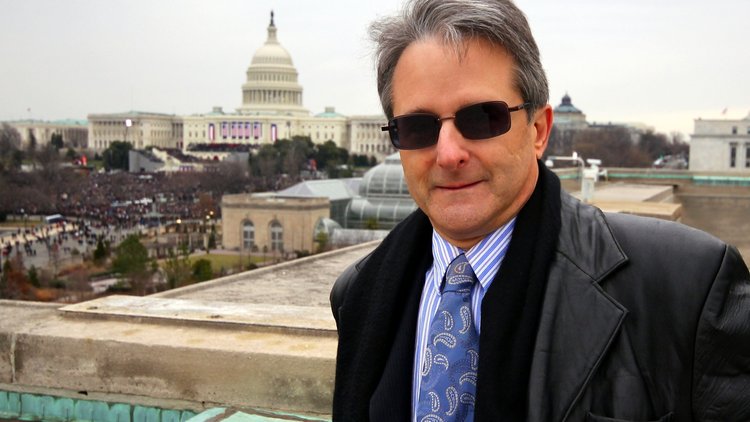
Many thanks to SWLing Post contributor, Dan Robinson, for the following guest post:
Dan Robinson
How VOA’s Communications World Started
by Dan Robinson
NOTE: This exclusive is being published simultaneously with the North American Shortwave Association (NASWA) journal in its March 2022 edition.
Voice of America recently observed its 80th birthday. Readers may recall that in the mid-1980’s into the 2000s, VOA broadcast a program about communications, but which was in fact designed specifically for shortwave listeners.
Communications World as it was known owed its existence to my efforts in the late 1970’s and into the early 1980’s to persuade VOA managers to put such a program on the air, The story is told in detail here for the first time.
In a SWL career that began in the late 1960’s, I was an enthusiastic consumer of DX programs broadcast by stations at the time, from Radio Netherlands to HCJB and others. I always wondered why VOA wasn’t among them, and I was determined to make some progress on this.
First steps came in 1975 as I was attending The American University and began making contacts at VOA in downtown Washington, DC. This would become a multi-year effort to induce VOA to re-start a DX’ing program. I say “re-start” because I would later learn that VOA once had such a program, but aimed at radio amateurs.
These early efforts included at one point a meeting with the head of a major think tank on K Street in Washington. I can only imagine their reaction when two college age kids (I was accompanied by ace DX’er Taylor “Pitt” McNeil) arrived seeking help in selling a federal agency on a hobbyist show.
I never learned whether anything came from that meeting. In my final two college years, I interned with ABC News, where I observed network operations, including the evening news with Frank Reynolds, and also interned with local station WASH-FM.
By 1979, my contacts at VOA had led me to part-time work in its English to Africa, Worldwide English, and central news divisions. In 1980, I was formally sworn in as a full-time VOA news writer. My objective was to become a VOA foreign correspondent, which I would achieve in 1983. But putting VOA back on the board, so to speak, with a SWL program remained high on my priority list.
A pilot for the show needed to be produced. It needed a name. What came to mind was something containing the word communications, to have wider appeal. So, there it was: the VOA Communications Magazine.
My time in VOA’s central news operation included work on all three shifts over 24 hours. On the side, I set about putting together a script for VOA Communications Magazine – conceptualizing what elements would go into it. By 1983 – just before I departed for Nairobi as VOA’s new East Africa correspondent – we were ready to record the pilot.
The show began by recognizing World Communications Year, and a message noting that we would cover SW hobby news, international broadcasting developments, satellites and computers, news about receivers and antennas, along with letters from listeners.
WRNO New Orleans had gone on the air on shortwave. I thought that would make an interesting segment. Shortwave broadcasting had not yet started its downward slide. Stations remained on the air in Africa, Latin America, and Asia. Transmitter manufacturers still had customers. New stations were coming on air.
I served as host of the Communications Magazine pilot. Bob Arnold, who was doing science reporting for VOA at the time, voiced a roundup of broadcasting news. Included were some of my personal recordings, including Voice of Kenya and Radio Mozambique.
In the news, Kenya was reported planning international broadcasting (we now know this never happened). Ghana was expanding domestic radio. The U.S. was helping Liberia expand rural radio. We noted ELBC and ELWA, and played a recording of ELWA.
Iran was installing what were expected to be the world’s most powerful transmitters. There was news from Singapore, and a recording of Radio Singapore. Malaysia planned two 500 kw transmitters. I noted existing domestic Malaysian stations, and included a recording of Radio Malaysia Sarawak.
Arnold reported on the explosion of the production, distribution and storage of information, including an interview with Wilson Dizard, then with Georgetown University.
Dipping into the mailbag I read letters and reception reports from VOA listeners in Denmark, Sweden (one of whom used a Grundig 3400 receiver), Australia (who used a Panasonic RF-2800), and Japan (who used a Kenwood R-1000).
My interview with Joseph Costello of WRNO concluded the pilot, and began with a recording I had made of a WRNO test transmission. Costello pointed to “a couple of thousand pieces of mail per month,” and surprising response from New Zealand and Australia, though WRNO’s signal was beamed northward.
Private shortwave stations were granted to reflect the culture and lifestyle of the United States, Costello said. By partially simulcasting WRNO-FM, listeners heard about life in New Orleans, with coverage of the Jazz and Heritage Festival, and progress reports on Mardi Gras. WRNO was considering a morning Spanish service beamed to central and south America
Doug Flodin of Drake-Chenault discussed the purpose of KYOI. And we reported on other shortwave broadcasters preparing to go to air, including Radio Miami International, and KNLS from Alaska.
Based on my pilot for VOA Communications Magazine, VOA green lighted what would become Communications World, hosted first by Gene Reich, who later would join Worldspace, the satellite radio pioneer that filed for bankruptcy in 2008, and later by Kim Elliott.
This is the first time I have told the in depth story of how Communications World came into being, which likely never would have existed had it not been for my efforts to bring this kind of program to Voice of America. The full 1983 pilot for Communications World is available on the Internet Archive and below:
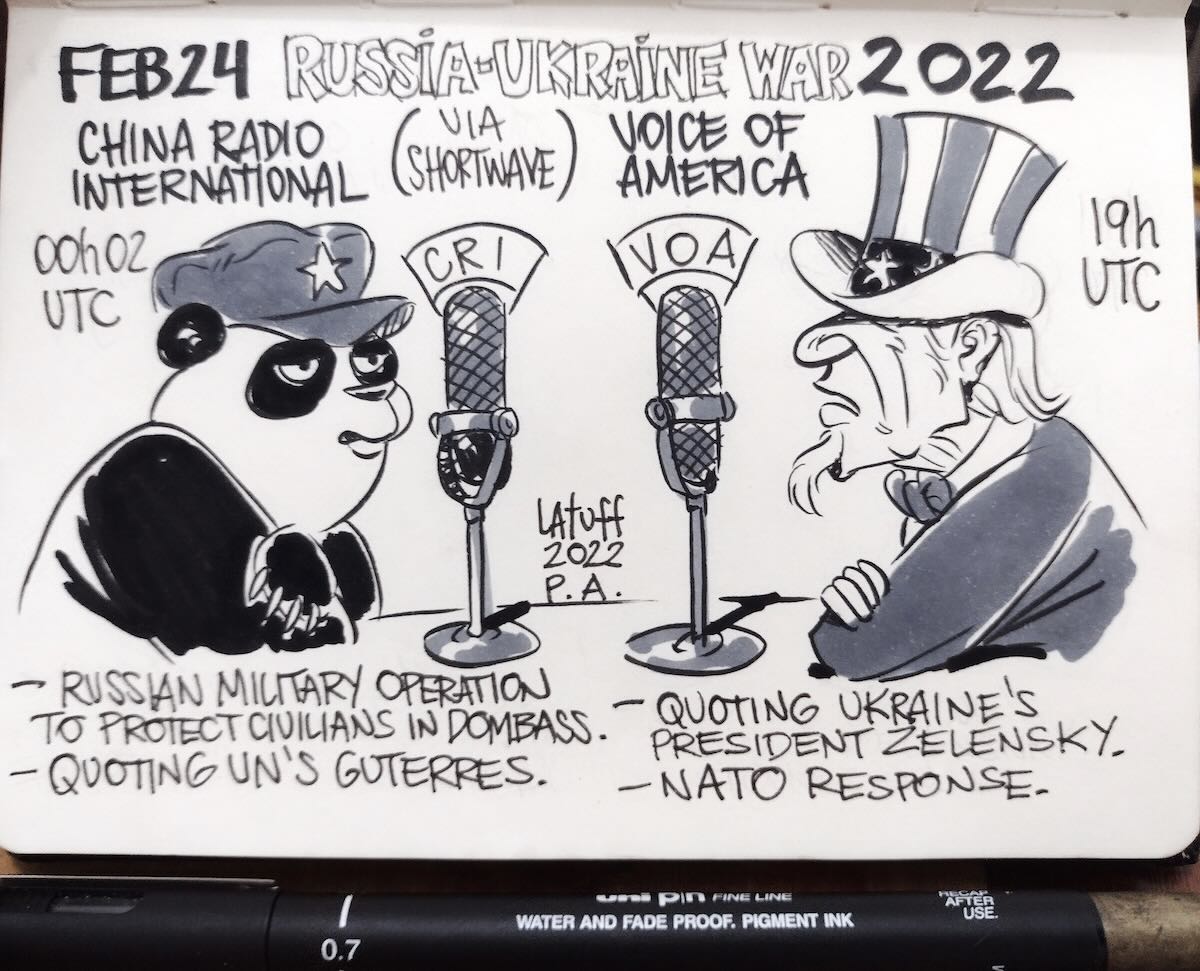
Many thanks to SWLing Post contributor and noted political cartoonist, Carlos Latuff, who shares his radio log art, this time along with shortwave recordings taking a look at the Russian invasion of Ukraine.
China Radio International and the Voice of America:
Carlos notes:
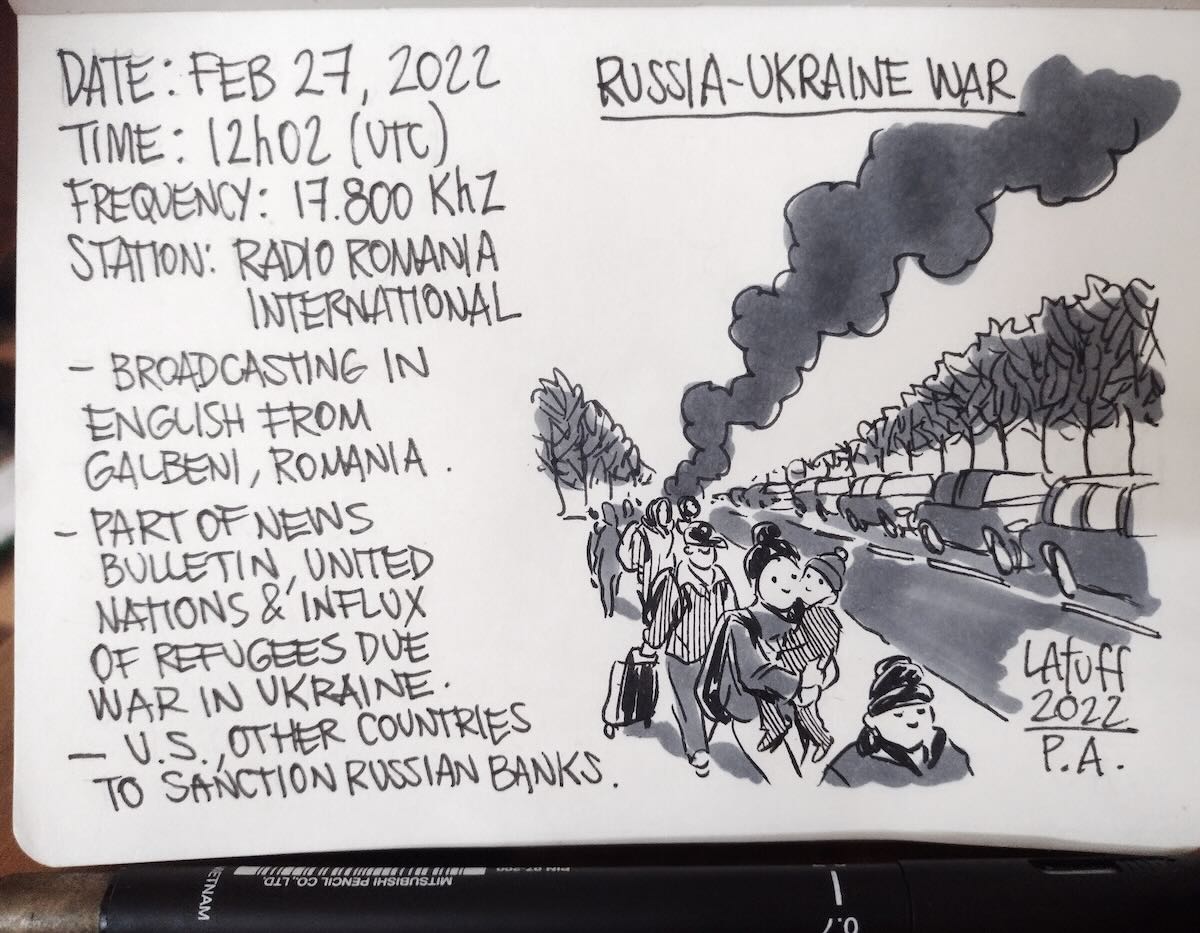
Excerpts from news bulletins of Voice of America (USA) and China Radio International about the beginning of the Russia-Ukraine war on February 24, 2022. Shortwave broadcasts listened in Porto Alegre, Brazil.
Part of Radio Romania International news bulletin, 17800 kHz, broadcasting in English. – United Nations and influx of refugees due to war in Ukraine. – US and other countries to sanction Russian banks. Broadcast listened in Porto Alegre, Brazil, February 27, 2022, 12h02 pm (UTC).
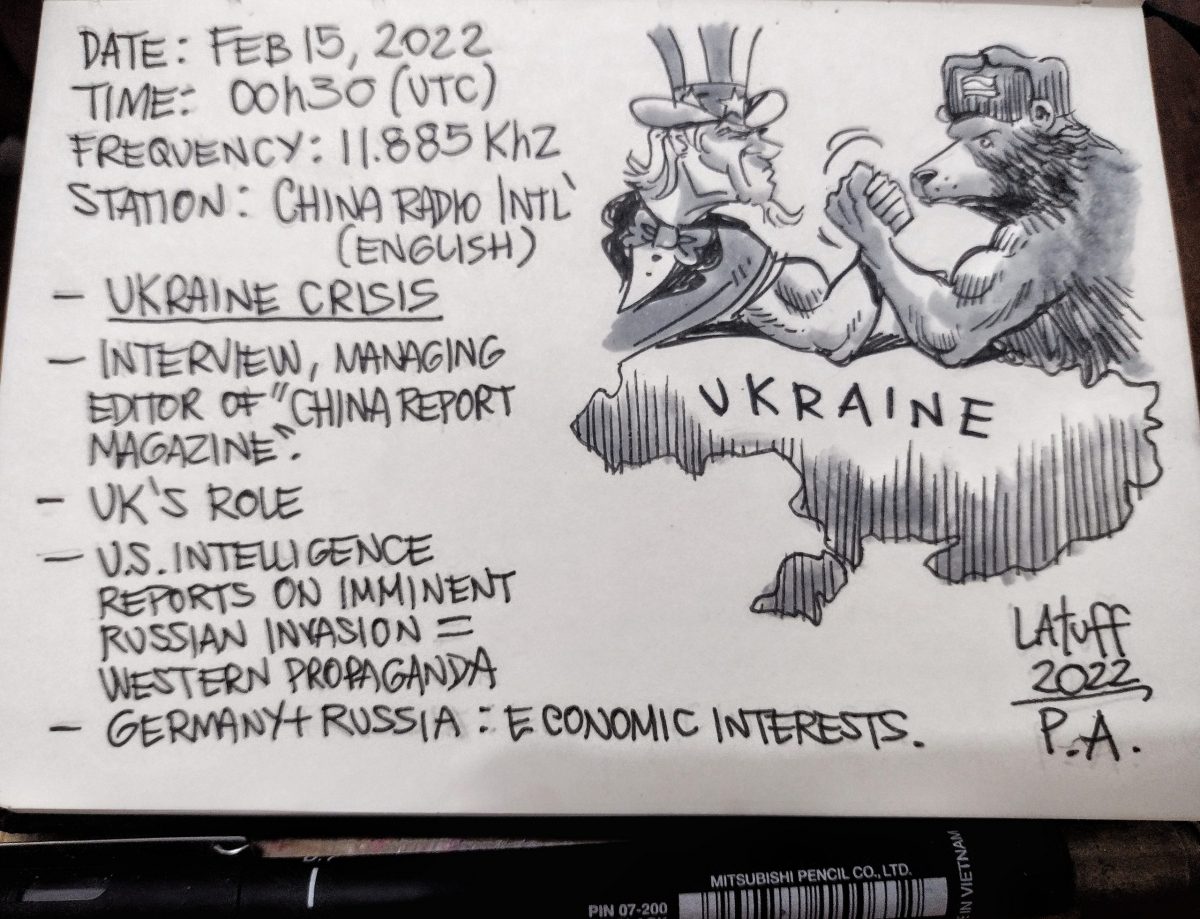
Many thanks to SWLing Post contributor and noted political cartoonist, Carlos Latuff, who shares yet another example of his radio log art, this time for China Radio International. Carlos notes:
China Radio International, 11885 kHz, Xianyang, China.
Ukraine crisis, interview with managing editor of “China Report Magazine”.
UK’s role, US intelligence reports, Germany interests, etc.
Listened in Porto Alegre, Brazil, February 15, 2022, 00h30 (UTC).
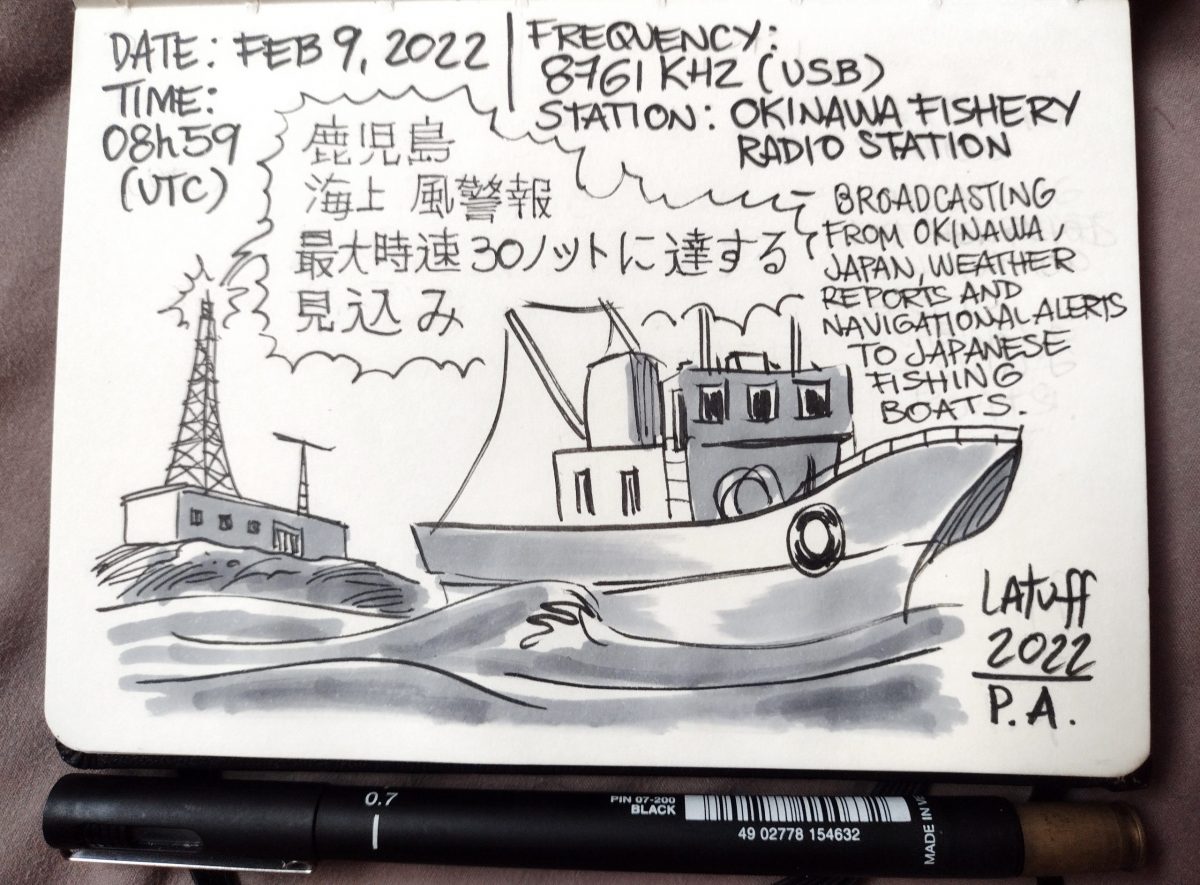
Many thanks to SWLing Post contributor and noted political cartoonist, Carlos Latuff, who shares yet another example of his radio log art, this time for Okinawa Fishery Radio. Carlos notes:
Okinawa Fishery Radio Station, Okinawa, #Japan, 8761 kHz (USB), broadcasting weather reports and navigation alerts to Japanese fishing boats.
Heard in Porto Alegre, Brazil, Feb 9, 2022, 08h59 (UTC).