Shortwave listening and everything radio including reviews, broadcasting, ham radio, field operation, DXing, maker kits, travel, emergency gear, events, and more
Monday, September 7, is Labor Day throughout most of North America; shortwave pirates love to operate on long holiday weekends (though you can hear them most any weekend for that matter).
So, if you’ve never heard a live pirate station on shortwave radio, this is a great opportunity to catch your first pirate!
Despite dismal propagation, I was quite happy to receive a relatively strong signal earlier this week (31 August 2015) from Channel Africa, starting around 16:40 UTC on 15,235 kHz.
This recording begins with the French language service (already in progress), followed by the English language service. Receiver used was a WinRadio Excalibur connected to a large horizontal delta loop antenna.
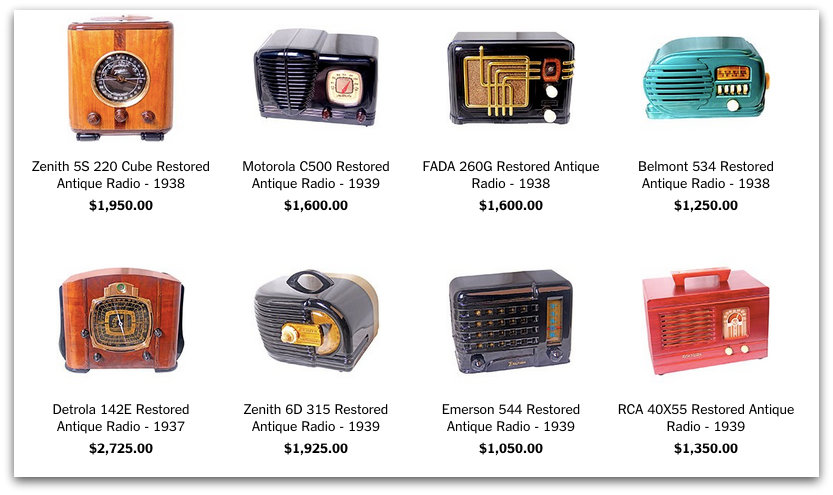
Pricing is not for the faint of heart–at time of posting, prices ranged from $395 to $23,000 US. Each radio is beautifully presented, with a full description, and carries a one year restoration warranty. For an additional $95, many models can be modified with an AUX in audio jack.
While these radios are well outside my meager vintage radio budget, I must say that I’ve thoroughly enjoyed looking at the photos and reading the descriptions.
The Mighty KBC will be making their seasonal move to 7,375 kHz on Sunday September 6, 00:00 – 03:00 UTC.
The Mighty KBC’s Giant Jukebox is an easy catch for listeners in much of North America and Europe–if you’ve never heard the show, you’re certainly in for a treat.
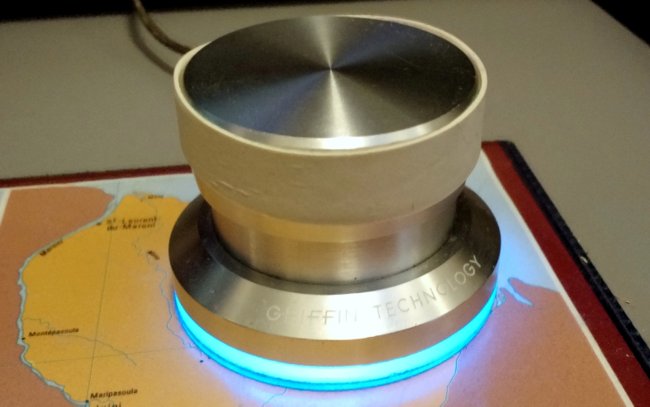
“Do what I did a couple of years ago and add a lobster claw rubber band to the [PowerMate] tuning wheel.”
In case you’re not familiar, Mike is referring to the thick, wide rubber bands that are placed on lobster claws to hold them shut. Mike included the following video; you can see that the rubber band fits perfectly around the top of the tuning knob, giving it a little extra grip.
This same type of rubber band can often be found in the produce department of grocery stores as it’s used to hold bunches of broccoli, asparagus and other produce together.
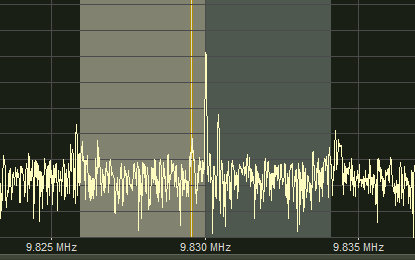
The lighter shaded side of the AM carrier indicates a lower sideband sync lock. (Click to enlarge)
A few days ago, I tuned to 9,420 kHz and found a relatively strong signal from the Avlis transmitter site of the Voice of Greece. The broadcast was quite clear until a heterodyne (het) tone popped up out of nowhere.
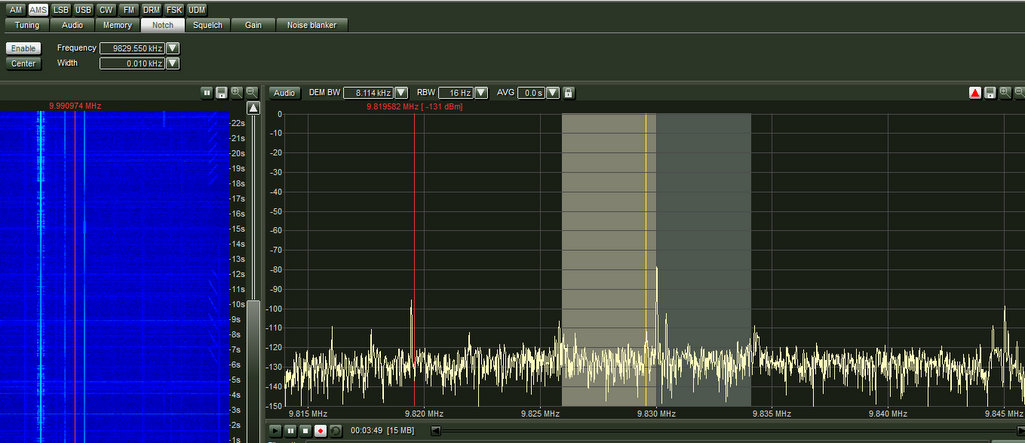
I checked the spectrum display of my Excalibur to find two steady carriers located about .5 kHz off each side of VOG’s AM carrier. I assume this may have been a faint digital signal centered on the same frequency as VOG.
The noise was annoying, but SDRs (and many tabletop radios) have tools to help mitigate this type of noise.
The het tone was originating from both sidebands of the VOG AM carrier (see spectrum display above). I had planned to use my notch filter to eliminate the noise, but I had two carriers to notch out and only one notch filter.
Synchronous detection to the rescue…
The simple solution was to eliminate one of the carriers using my SDR’s synchronous detector which can lock to either the upper or lower sideband. In this case, it didn’t make any difference which sideband I locked to because both had similar audio fidelity and were otherwise noise free. In the end, I locked to the lower sideband, thus eliminating the het in the upper sideband.
Next, I enabled my notch filter and moved its frequency to cover the annoying het carrier in the lower sideband; I kept the notch filter width as narrow as I could to preserve VOG’s audio fidelity. You can see the notch filter location and width in the spectrum display above (the notch filter is the thin yellow line).
I should note here that the great thing about using an SDR–or tabletop receiver with a spectrum display–is that you can see where the noise is. I was using my WinRadio Excalibur, but pretty much any SDR in my shack could have handled this task.
The results? No het tone and I was able to preserve the great audio fidelity from the Voice of Greece broadcast!
Here’s a 3.5 hour recording I made after cleaning up the signal. I believe at one point in the recording, I switched off the notch filter to demonstrate how loud the het tone was:

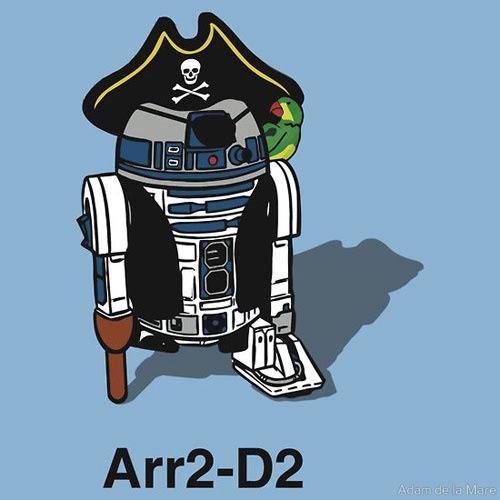 Monday, September 7, is Labor Day throughout most of North America; shortwave pirates love to operate on long holiday weekends (though you can hear them most any weekend for that matter).