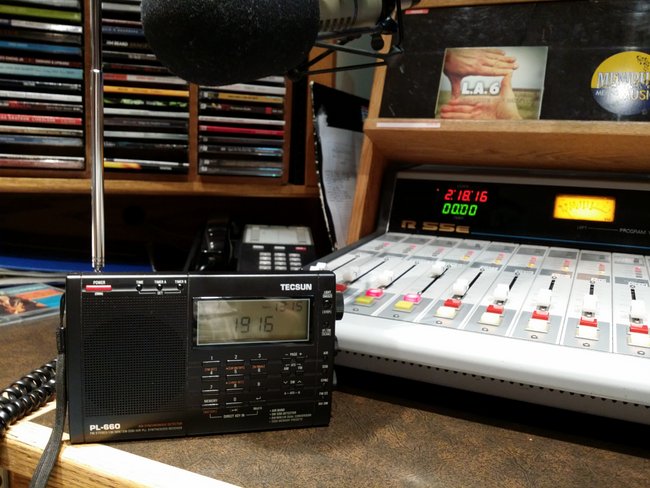
Chris’ Tecsun PL-660
Shortwave listener and radio producer, Chris Freitas, recently posted an article on his blog touting the Tecsun PL-660 as his shortwave portable of choice.

Chris’ Tecsun PL-660
Shortwave listener and radio producer, Chris Freitas, recently posted an article on his blog touting the Tecsun PL-660 as his shortwave portable of choice.
 I’ve now added a total of five recordings by David Firth, circa 1968, to the SW Radio Audio Archive. Click below for direct links:
Note that you can subscribe to the SW Radio Audio Archive as a podcast via iTunes or by using the following RSS feed: http://shortwavearchive.com/archive?format=rss
I stumbled upon this WWII era book published by the Foreign Policy Association on Archive.org. A fascinating look at the the power and fear of propaganda over the shortwaves.

(Image source: BBC)
I appears the BBC World Service is cutting shortwave broadcasts even further in an attempt to meet tighter budget numbers. Not many details, at the moment, in terms of what language programs will suffer the most.
Many thanks to Richard Cuff for the tip:
(Source: The Guardian)
The BBC World Service will further reduce its shortwave transmissions next year as part of a £15m savings drive which staff have been warned will be a “real stretch”.
The money will be used to invest in new TV and digital services, part of a programme called Invest to Innovate.
An extra £6.5m is being pumped into the World Service’s budget this year, alongside an extra £1.5m of savings, helping to create 130 jobs. New initiatives include a global version of Radio 1’s Newsbeat.
But the BBC’s director of global news, Peter Horrocks, said further savings would be required in the future.
[…]Horrocks said changes would include more multilingual reporting, with staff filing for their own language service and in English, as well as a further reduction in shortwave transmissions.
He said the World Service would also have to integrate further with the main BBC News operation.
Horrocks also announced that the BBC’s global news division, which includes its world news TV channel, would be renamed “World Service Group … a sort of World Service-plus” and the World Service board would be axed with the change in its funding.
[…]It closed five language services, stopped radio broadcasts in seven languages, cut back on shortwave and medium-wave transmissions and axed a number of World Service English programmes.[…]
Read the full article at The Guardian online.
 In December 2012, we posted a survey from the 2012 edition of The Best Places to Work in the Federal Government by The Partnership for Public Service and Deloitte. The survey indicated that the Broadcasting Board of Governers (BBG) had been ranked in the bottom five places to work in the federal government.
According to the Washington Post, the agency is now working on a plan to boost employee morale. Some of their initiatives include:
“Agency directors and senior staff hold[ing] face-time sessions in the cafeteria for informal talks with employees, a “Civility Campaign” addresses labor-management issues, and a Workplace Engagement Initiative takes a deeper dive into the agency’s low morale ratings.
Some of the morale-boosting events are meant to be fun, such as the raffle during the fitness-center open house, a chocolate bake-off in time for Valentine’s Day, and ?after-work gatherings — a bingo night, happy hour, checkers and chess.
It’s going to take all that and some sustained work to improve the agency’s failing report cards.”
Many thanks to Richard Cuff for the tip!
There’s a new project in the works, Outernet, that aspires to bring the international accessibility of shortwave radio along with the versatility of the Internet. Outernet’s goal is stated on their website:

“By leveraging datacasting technology over a low-cost satellite constellation, Outernet is able to bypass censorship, ensure privacy, and offer a universally-accessible information service at no cost to global citizens. It’s the modern version of shortwave radio, or BitTorrent from space.”
It’s a fascinating concept: deploy low-cost, CubeSat satellites which broadcast data in a way that it should be accessible to anyone with a wi-fi enabled device such as smart phone or computer. Specifically, Outernet states that they will be using, “globally-accepted, standards-based protocols, such as DVB, Digital Radio Mondiale, and UDP-based WiFi multicasting.”
(What? Did they say Digital Radio Mondiale? They did indeed.)
I’m all about freedom of and access to information, so I hope Outernet is successful. They’ve published an ambitious timeline with a goal of having CubeSats ready to deploy as soon as June of 2015. For more information, check out Outernet’s project page.

Lynley Marshal (Source: ADNews.com.au)
(Source: The Sydney Morning Herald)
“The chief for the ABC broadcasting into the Asia Pacific insists the taxpayer funded network has a growing audience with better programs on the way – despite reports the service is for the chop in the May budget.
ABC International boss Lynley Marshall stoutly defended overseas broadcasts as a way of promoting Australia, saying the spread of social media and mobile devices in Asia has vastly extended the potential audience.
She told a Melbourne audience on Monday evening the service had more than 1 million supporters on its Facebook page for learning theEnglish language.”
While this article doesn’t mention shortwave radio per se, it’s most interesting to see where Marshall must both defend Australian international broadcasting as a form of diplomacy while also defending the news agency when its reports are critical of the government.
There’s an inherent tension all international broadcasters face–at least, those that are tax-payer supported–as many try to transition from being purely a mouthpiece of the government to an example of free press and democracy.