Author Archives: Thomas

BBG Watch: Edward R. Murrow site appears safe in fiscal year 2014

The Edward R. Murrow Transmitting Station campus as seen by Google Earth (Click to enlarge)

The Edward R. Murrow Transmitting Station campus as seen by Google Earth (Click to enlarge)

This is good news for our friends at the Edward R. Murrow Transmitting Station (click to read tour):

(Source: BBG Watch)

Thanks to efforts by Broadcasting Board of Governors (BBG) member Victor Ashe, support of his board colleagues Susan McCue and Michael Meehan, and intervention from North Carolina congressmen G.K. Butterfield (D-NC) and Walter B. Jones (R-NC), the Edward R. Murrow Transmitting Station in Greenville, NC appears to be safe for now from budget cuts previously sought by officials of BBG’s International Broadcasting Bureau (IBB).

In a letter to both congressmen, IBB Director Richard Lobo assured them that the Office of Cuba Broadcasting (OCB), which utilizes more than 80 percent of the scheduled shortwave transmissions from the Murrow Station, will work with the State Department and the U.S. Agency for International Development (USAID) to utilize $50 million of existing democracy and human rights un-obligated funds to pay some of the costs of the station’s operations.

IBB Director Lobo assured both congressmen that under this proposal there will be no personnel changes at the Murrow Station and the employees would remain on the payroll of the International Broadcasting Bureau.

But with Victor Ashe expected to leave his post on the board soon. With new BBG members expected to be confirmed, long-term future of the Murrow Station is still not certain. Ashe and Congressmen G.K. Butterfield and Walter B. Jones worked hard to keep it open despite pressure and resistance from IBB executives who wanted to close it down. The station is the only BBG shortwave transmitting facility on American territory fully controlled by the U.S. government.

Let’s hope the new BBG board members understand the importance of keeping at least one BBG shortwave transmitting on US soil. In my opinion, every country should do this; not only for diplomatic and free press reasons, but for reasons of national security. In an emergency, if other communications systems were to fail, shortwave radio could still cover a vast broadcasting footprint–even the whole of the US.

Brian Hongwe reports on importance of shortwave radios in Zimbabwe

Zimbabwe-MapMany thanks to Dave for sharing this excellent radio documentary from the BBC World Service show, The Fifth Floor. In this brief report, reporter Brian Hongwe clearly explains why police are seizing shortwave radios and arresting those who own them in the run up to the Zimbabwe elections.

Hint: Information = power / Shortwave radio = information / Those in power fear shortwave radio

Click here (or use the embedded player below) to listen to this short segment or listen to the entire program–definitely worth it!– on The Fifth Floor’s web page.

This post has been tagged in our ever-growing collection labeled: Why Shortwave Radio?

On sale now: the CommRadio CR-1, a great little receiver

IMG_8048

[UPDATE: Check out our full review of the CR-1 by clicking here.]

A hot tip:  currently, CommRadio offers the CR-1 software-defined tabletop receiver for just $500 (US), until August 1, 2013. Check out the sale on CommRadio’s website and at Universal Radio.

I have been using the CommRadio CR-1 for almost two months now. I had planned to provide a brief review for The SWLing Post by early July, but my travel schedule has simply been too hectic.

MTcover0813coverlgFortunately, however, I offer a full in-depth review in the August 2013 issue of Monitoring Times magazine (incidentally, their turn-around time from submission to print is simply amazing). If you subscribe to MT–or can get your hands on a copy–you will have my full review.

Many of you have been asking me for my thoughts on the CR-1 so you will know whether or not to take advantage of promotional pricing.

In a nutshell, here is the answer your question:

Q: Is the CommRadio CR-1 a good deal?

A: Yes!

Though I was skeptical about this little receiver when I first saw the announcement in January, the CR-1 truly does hold its own. It’s a sturdy radio built with longevity and performance in mind. It’s the little touches I love: a near-perfect tuning knob (in my opinion), size & portability, multiple antenna jacks, an excellent internal battery and gold-plated circuit board pads…Performance-wise, the CR-1 has great sensitivity and selectivity on the HF bands…

Though there are a few negatives, in my book, the positives far outweigh them. If you really want to dig into the juicy details, I would encourage you to check out my full review in the August 2013 issue of Monitoring Times magazine (especially since MT, sadly, is slated to stop publishing at the end of the year).

If you’ve been on the fence about buying the CR-1, I would encourage you to give it consideration before August 1st, 2013, when the price increases to $599 US.

Here is the press release from CommRadio regarding the current $500 sale:

(Source: CommRadio)

CR-1 News for Friday, July 26th, 2013

Our Promotional Price of $500 will increase on August 1st.

All orders made after July 31st will be priced at $599 (battery included).

Order now before the price goes up.
www.commradio.com

Please note we are working hard to get all radios out as soon as possible, although the lead time could be up to 4 – 5 weeks starting this week (7/24/2013)

For any questions about ordering and shipping

or international orders please contact

Lizz Arias

[email protected]

Bonito introduces the AntennaJet AAS300 active antenna splitter

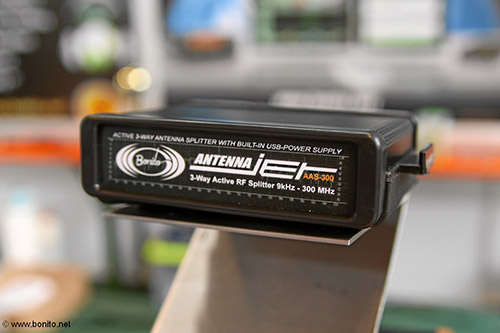
The Bonito AS300 AntennaJet

The Bonito AS300 AntennaJet

This year, at the Friedrichshafen Hamfest, Bonito introduced the AntennaJet AAS300–an active antenna splitter that will allow three receivers to use one antenna with very little loss. Dennis Walter, with Bonito, recently contacted me with info:

The AAS300 is a 3 way active antenna splitter with excellent specifications (like isolation of 70dB!) between the outputs.

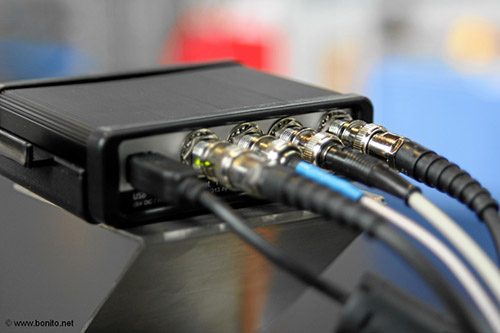
No extra power supply is necessary, because it’s USB powered– no switching, no buttons. The physical size is exactly like the Bonito RadioJet IF Receiver.

It was one of the most popular devices at the Friedrichshafen show and we already have many preorders.

The device is fully made here in Germany.

We are starting now to resell it.

The Price for end costumers is: 210,-€ / 278 US$ as an introductory offer and will be 230,-€ / 299,-US$ regular (next year)

antennajet_rear_hamradio2013Thanks, Dennis!

If you would like to read more about the new AntennaJet AAS300, click here for specs on Bonito’s site.

This is certainly a device I will consider purchasing. I tend to use one large multi-band delta loop for all of my receivers. I often record broadcasts on one receiver and wish that I could band-scan with the same antenna on another receiver. The AAS300 would make for a simple solution.

Dennis tells me that the AAS300 will be available through North American retailers and global distributors that currently carry the Bonito RadioJet.

Monitoring Times Magazine ceases publication: December 2013 last issue

MTlogoI just noticed the following statement on the Monitoring Times magazine’s website:

After 33 years of service to the radio community, Monitoring Times will cease publication with the December, 2013 issue.  Subscriptions and renewals for the remaining months can be made by calling (800) 438-8155.

[Update] I also received this message from MT:

After 33 years of publishing the most informative and lauded magazine on monitoring the radio spectrum, Judy and I are finally going to retire. We are grateful for the dedicated efforts of our fine staff of writers for the excellent work which has kept MT alive for all these years. While we know the discontinuation of MT, with our December issue, will be a disappointment to our readers and writers alike, we realize that a combination of a poorly performing economy, as well as the ready availability of free listening and technical information on the Internet, has reduced sales and subscriptions throughout the market place. I would like to thank you personally for your knowledge, your dependability, and your professionalism in making MT the publication that is most often referred to in the radio monitoring hobby. It is a legacy that we have all inherited.

Warmest regards to all our writers, Bob and Judy Grove

This is sad news, indeed. I’ve been a regular reader for many years, and more recently, a regular contributor for Monitoring Times. I only have very positive things to say about the MT staff: they’re friendly, professional and honor their word in every respect.

I’ve had articles in the past three issues–this month, there will be two that I wrote following the 2013 Dayton Hamvention. With any luck, maybe I’ll get a couple more articles in before MT closes shop.

Monitoring Times will be sorely missed.

SWLing in Belize City: comparing the Grundig G5 and G3

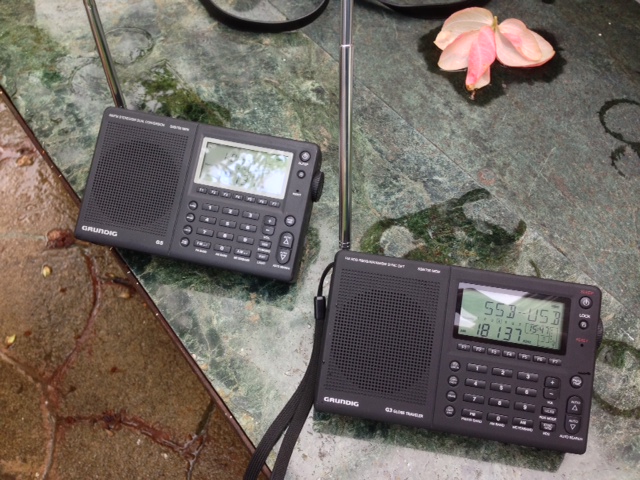
G3AndG5BelizeFor the past week, I’ve been traveling:  this time, in the inner-city section of Belize City on behalf of Ears To Our World, where we’ve been working with ETOW’s partner organization, The Belize Council for the Visually Impaired (BCVI).  I had the honor of working with a group of visually-impaired and blind children, giving each a self-powered shortwave radio, along with instruction on its use.

One of our talented advisory board members, David Korchin (KC2WNW)–also an avid SWLer–met me on this recent adventure. One afternoon, we found a moment to pull out our portable radios.  Turns out, he had brought his Grundig G5 while I had my Grundig G3. So we sat back to listen: to broadcast stations (including RRI and REE), to ham radio communications, and to some medium wave stations, including Radio Reloj on 790 kHz. Some great radio listening, by the way.

It was interesting to observe that in almost every case, the G3 had a slight edge on the G5. The G3 noise floor was slightly lower, and audio characteristics slightly better, than the G5’s. Where the G3 really had an edge, though, was on single-side band, where its selectivity was far superior to that of the G5.

With that said, if you purchase a G3, be sure to check out  your unit’s performance thoroughly–and keep your receipt. When Amazon last posted a sale on the G3, we had several reports of faulty units (check out the comment thread in this post). Though I cannot confirm this, I suspect these may be among the final units of the G3 production line.  Choose carefully, and you’ll enjoy a great radio.

By the way, I’ve always had good luck purchasing through Universal Radio.

VOA Radiogram this weekend

VOARadioGram(Source: VOA Radiogram)

Some listeners were impressed with the performance of last weekend’s surprise mode: MT63-1000 long interleave, especially as it was mixed with music. For that reason, VOA Radiogram for the weekend of 20-21 July will include a VOA News story in the MT63-2000L mode (200 wpm), followed by the same story in the MFSK64 mode (240 wpm).

Here is the lineup for VOA Radiogram, 20-21 July 2013:

2:20  MFSK16: Program preview

4:31  MFSK16: VOA News about quartz glass for data storage

2:04  MFSK32: Image of data stored in silica glass

3:59  MFSK32: VOA News about end of India’s telegram service

2:42  MFSK32: Image of sign at telegram office

2:53  MT63-2000L: VOA News about new materials for solar cells

2:32  MFSK64: Same VOA News about new materials for solar cells

1:10  MFSK32: Image of molecularspace.org logo

1:08  MFSK16: Closing announcements

1:11  Surprise image

The audio processor will not be used this weekend.

Please send reception reports to  [email protected].