Author Archives: Thomas

Guest Post: Pre-Internet Sources of Shortwave Information

Many thanks to SWLing Post contributor, Dan Greenall, who shares the following guest post:

Sources of SWL Information “Pre-Internet”

by Dan Greenall

When I first discovered the world of shortwave listening, many years before the internet, access to hobby related information was mostly available through over-the-air DX programs, monthly DX club bulletins, as well as a number of books and electronics magazines.  I joined a few clubs including the Midwest DX Club, SPEEDX, and the Ontario DX Association, and eagerly awaited each issue of Electronics Illustrated and Popular Electronics (early 1970’s) on the news stand.  Later, in the 1980’s,  Popular Communications and Monitoring Times came along, though these were not always easy to find here in Canada.


Ironically, nearly all issues of these magazines can be read today, over 30, 40 and even 50 years later, thanks to David Gleason’s not-for-profit, free online library

https://www.worldradiohistory.com/index.htm

You can also find the semi-annual (and eventually annual) Communications World (1971-81) which contained the popular White’s Radio Log.

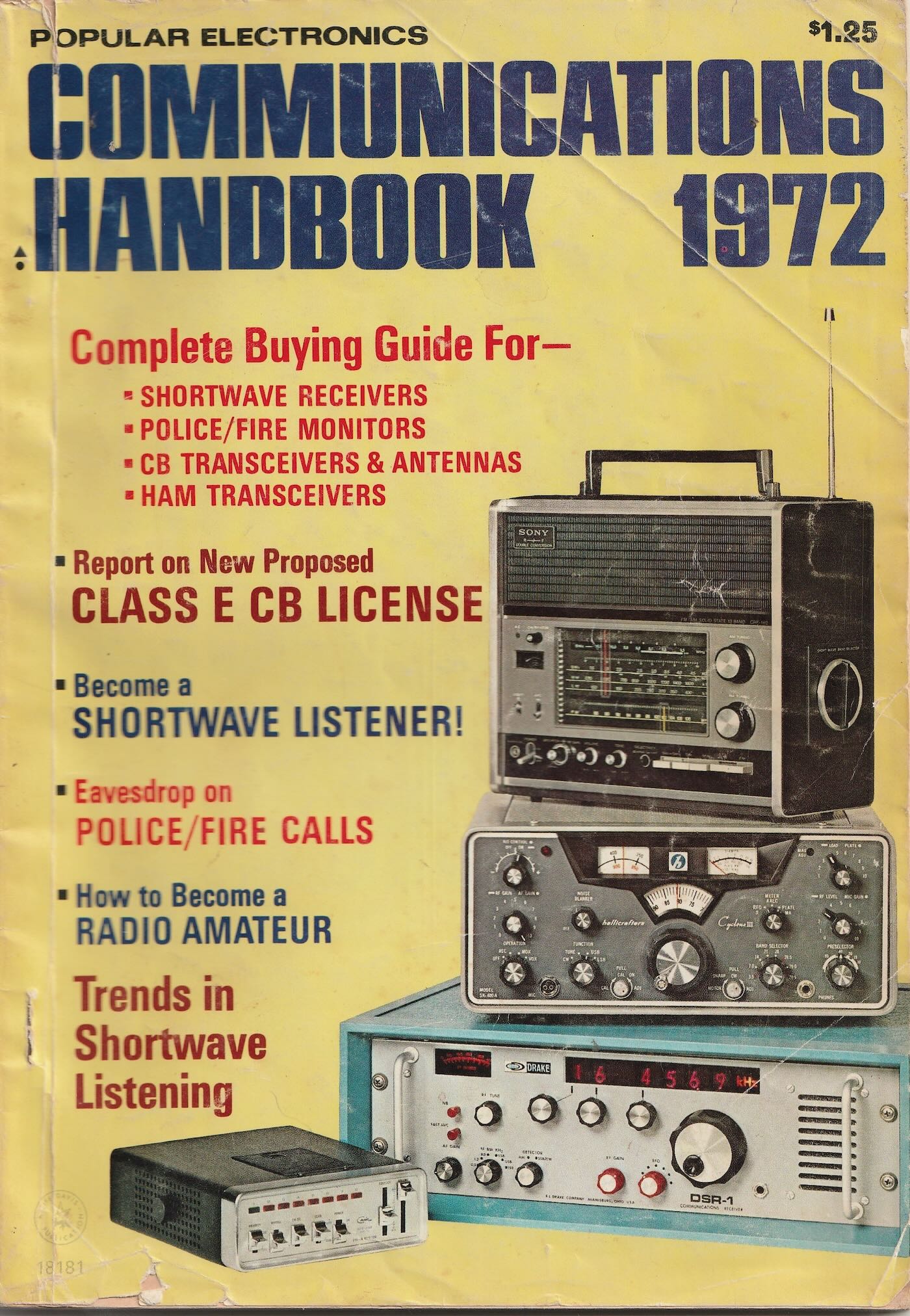
As well, five issues of the Communications Handbook can be found;  1963, 1966, 1967, 1974 and 1977.  It only came out once a year but was still a favourite of mine, so much so, that I still have my copies from 1971 and 1972.
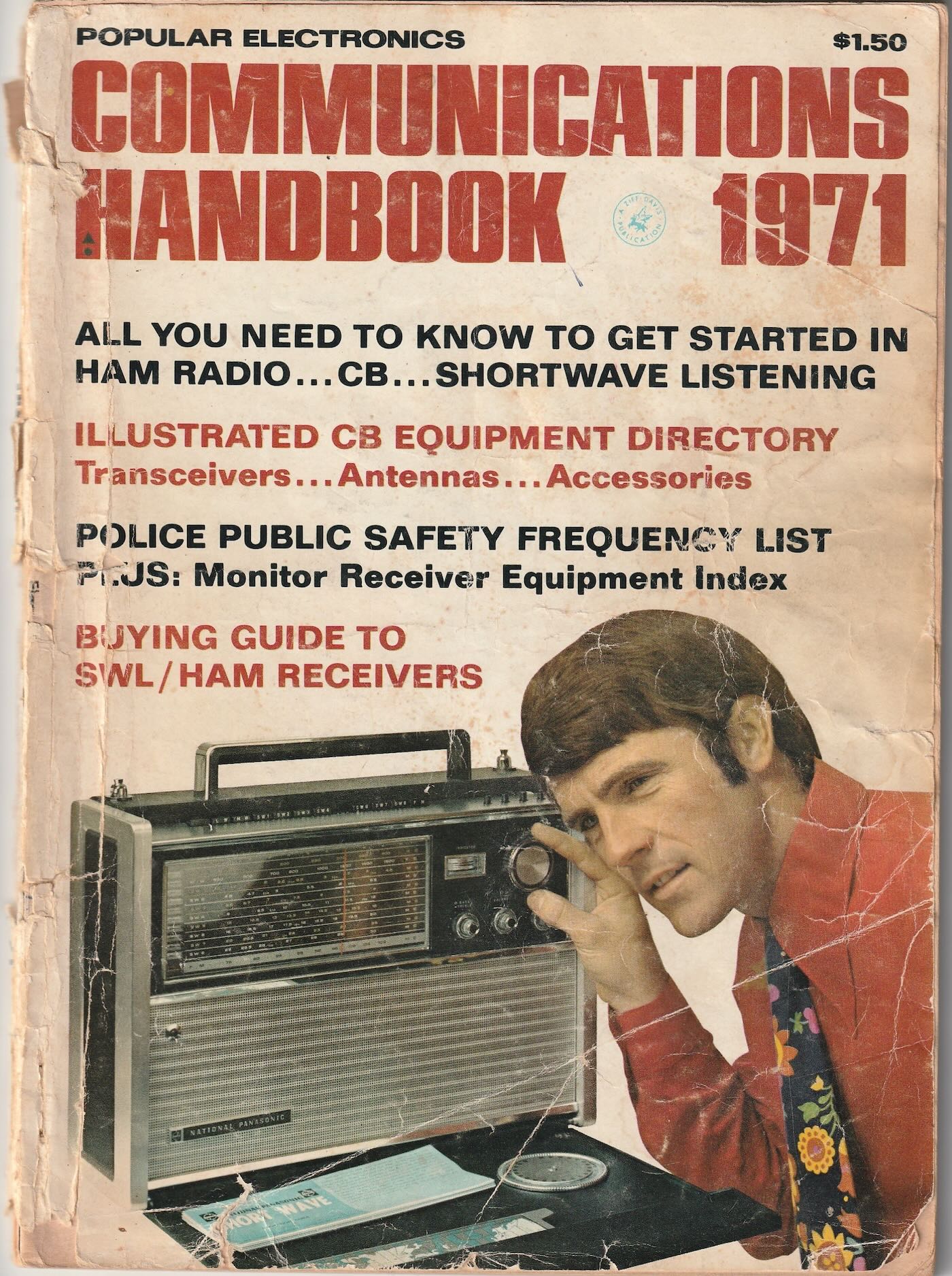
I have scanned parts of these and put them on the Internet Archive.  You can find them here:

Communications Handbook 1971: https://archive.org/details/page-09

Communications Handbook 1972: https://archive.org/details/page-20

Here are links that will lead to some of the other magazines:

As a bonus, all of the issues of the monthly SPEEDX bulletin (1971-95) have been made available here

https://www.worldradiohistory.com/Speedx.htm

And finally, a good read is Shortwave Voices of the World by the late Dr. Richard E. Wood written in 1969.  I still have my copy of it, but you can find it online here

https://archive.org/details/shortwave-voices-of-the-world-richard-wood-ed-1-pr-1-1969

WDX SWL registration program

My link to the 1971 Communications Handbook contains pages regarding the old WDX SWL registration program. I have found my old certificate from December 1971:
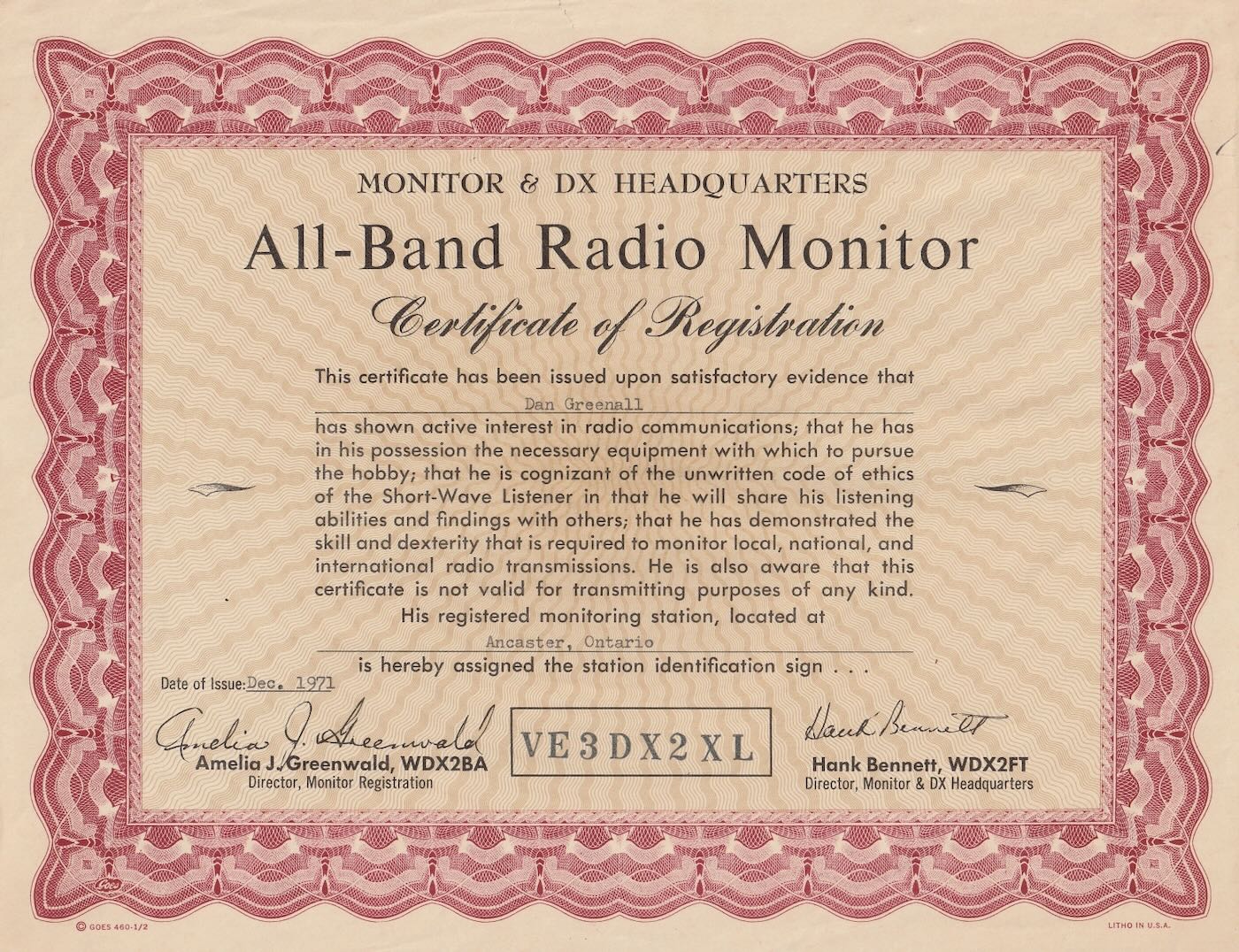
Wonder how many others still have theirs, or even the WPE ones from the 1960’s?
New Podcast from the Wireless Innovation Forum

Many thanks to SWLing Post contributor, Dennis Dura, who shares the following news item from EIN Presswire:

Wireless Innovation Forum Launches “Beyond the Radio Dial” Highlighting the Role Radio Spectrum Plays in Daily Life

Weather forecasting, climate, radar, GPS and more to be explored with industry experts in new video podcast

WASHINGTON, DC, UNITED STATES, March 27, 2024 /EINPresswire.com/ — The Wireless Innovation Forum (WInnForum) is pleased to announce the launch of a new video podcast about spectrum, titled “Beyond the Radio Dial.” The series addresses the role that the radio spectrum plays in everyday life. The title alludes to the familiar FM or AM radio dial and what lies beyond either end of the frequencies on that dial, although frequencies within the dial may occasionally be addressed too. [Continue reading…]

Checkout the new podcast episodes here: https://www.wirelessinnovation.org/Beyond-the-Radio-Dial

Episode 1

RNZ changes its pips!

Many thanks to SWLing Post contributor, David Iurescia, who shares the following news from Radio New Zealand:

RNZ’s pips are changing – Can you hear the difference? (RNZ)

RNZ National is changing the pips – the beeps that mark the start of each hour which play immediately before the news bulletin broadcast.

The pips were last changed in 2013 when a lightning strike damaged the clock which sent signals from the Measurement Standards Laboratory’s atomic clock.

The replacement sound was a little higher. (Continue reading…)

Rich’s propagation observations during the total solar eclipse

Many thanks to SWLing Post contributor, Rich Stahl, who writes:

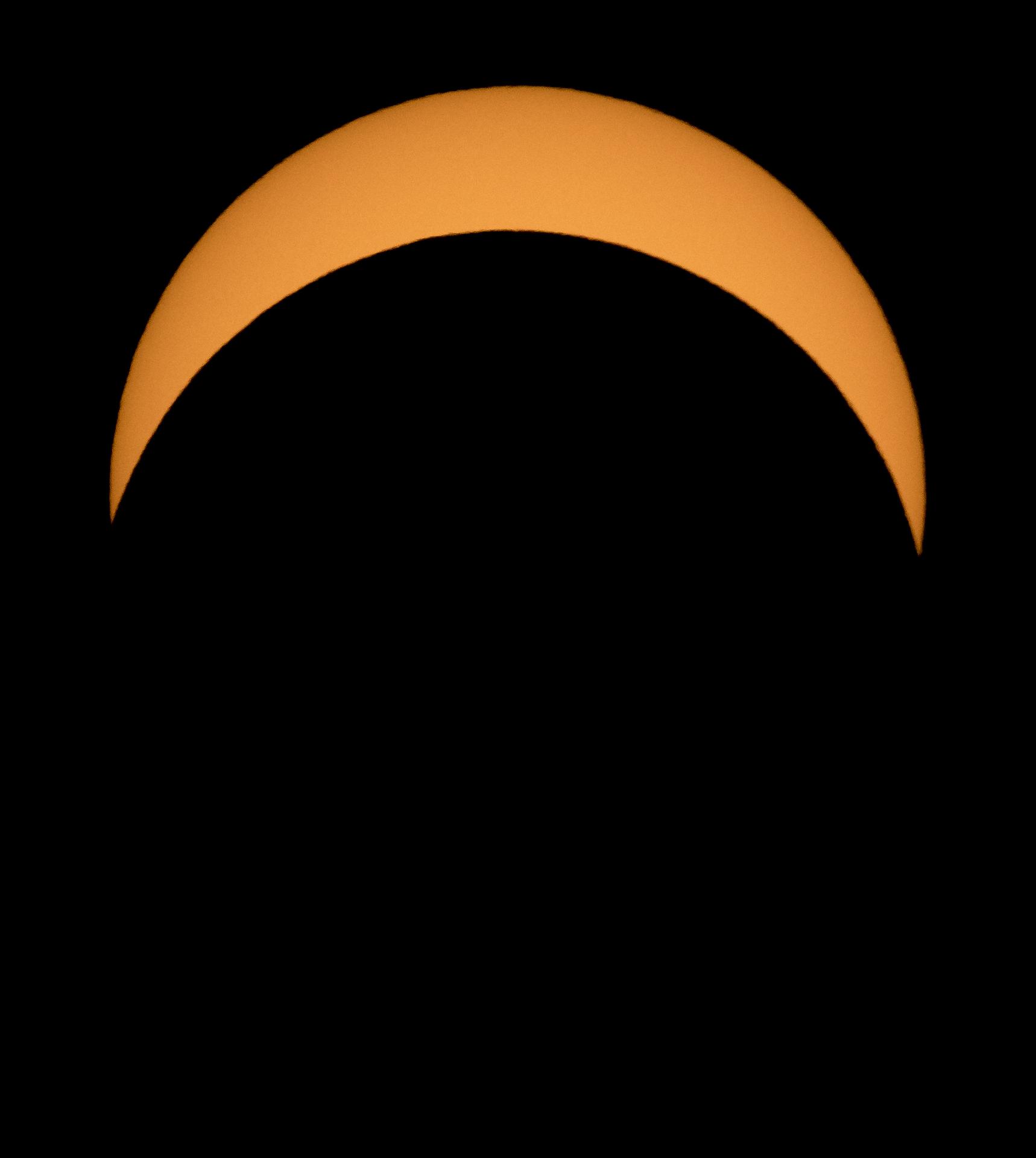
In Ocean View NJ, our eclipse started at 2:08, 3:23 totality, and ended 4:35. We have a daytimer here on 1020, WWAC, at 1900 watts, and I was curious if KDKA, at 50kw, also on 1020, would have any presence during the event. I used my Tecsun PL330, on the internal ferrite antenna, and did a band scan 530-1710 every fifteen minutes to see what it would capture. From 2:15 up to the 3:45 scan, the radio captured between eight and ten signals per scan. Up to this point, the sun still had the D layer fully ionized. But after the mid point, the 4:00 scan had 19 captures, the 4:15 scan had 38, and the 4:30 scan had 36. The D layer had obviously de-ionized considerably. The very next scan, at 4:45, captures back down to 9. The sun was back in business. And never did I hear a peep out of KDKA.

Rich Stahl
WR3V
Ocean View, NJ

Thank you for sharing your findings, Rich! Perhaps others can comment with their observations as well.

Carlos’ Shortwave Art and recording of Radio Havana Cuba (April 12, 2024)

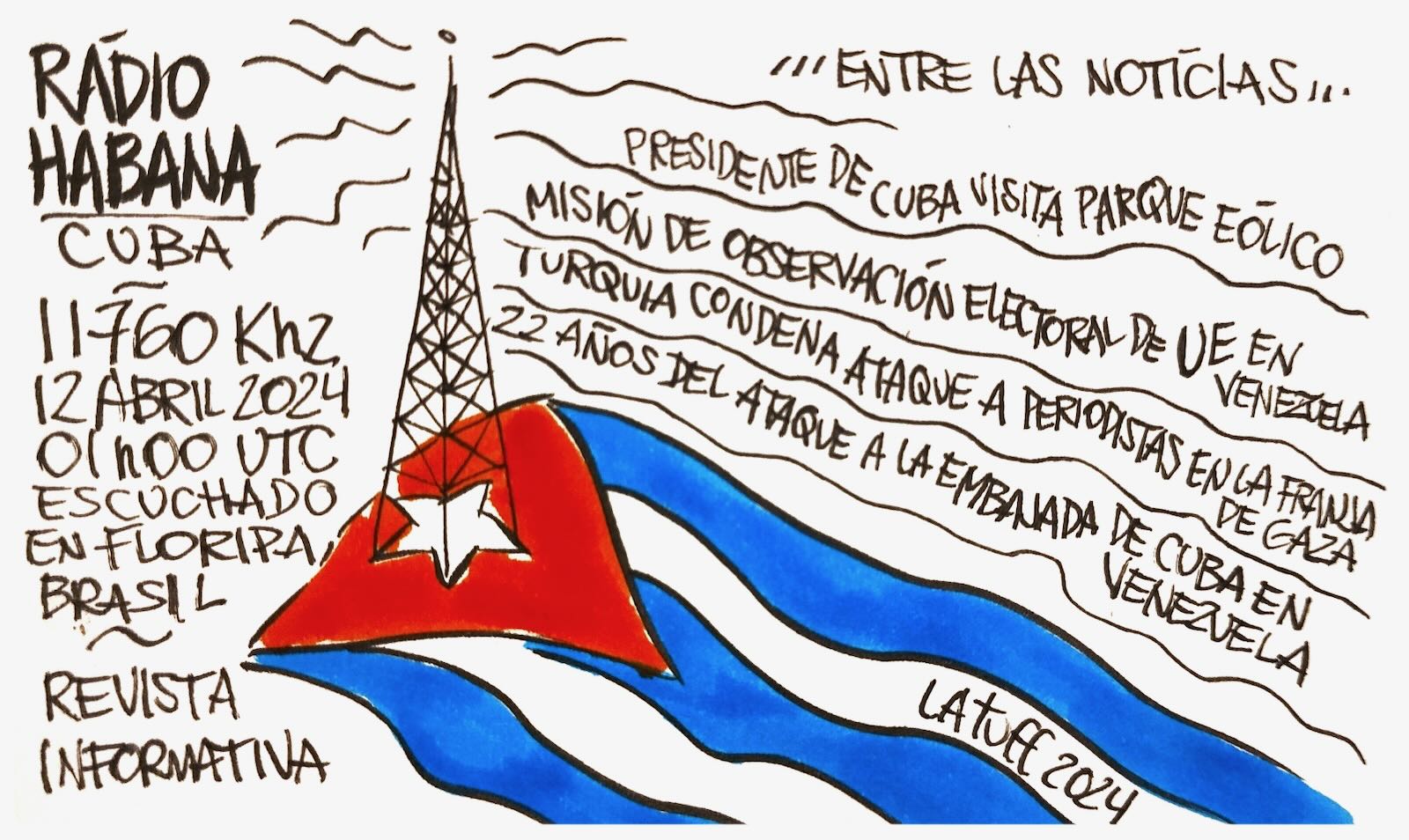
Many thanks to SWLing Post contributor and noted political cartoonist, Carlos Latuff, who shares his radio log art of a recent Radio Havana Cuba broadcast.


Carlos notes:

News bulletin from Rádio Habana, Cuba, on 11760 kHz, heard in Florianópolis, Brazil.

From the Isle of Music and Uncle Bill’s Melting Pot Return to Channel 292

Many thanks to SWLing Post contributor, Bill Tilford, who notes:

Beginning April 13 on Channel 292:

From the Isle of Music:
2nd Saturday of each month:
1100-1200 CEST/0900-1000 UTC on 9670 with beam D (Eastward)
Repeat 2100-2200 CEST/1900-2000 UTC on 6070

Uncle Bill’s Melting Pot:
3rd Saturday of each month:
1100-1200 CEST/0900-1000 UTC on 9670 with beam D (Eastward)
Repeat 2100-2200 CEST/1900-2000 UTC on 6070

The April 20 UBMP will be simulcast on 3955 from 2100-2200 CEST/1900-2000 UTC on 6070

Kostas improves the contrast on his FRG-7 digital display

Many thanks to SWLing Post contributor, Kostas (SV3ORA), for sharing the following guest post which originally appeared on his radio website:


FRG-7 digital display contrast improvement

by Kostas (SV3ORA)

The FRG-7 digital by Marcel Jacobs PA8MA, is a very well thought modification KIT for the Yaesu FRG-7 receiver. It really adds to it one of the things it misses (and it misses a lot) to become a more “serious” receiver in the modern era, the digital frequency readout and S-meter. If you are like me and enjoy classic radio gear, but you do not want to compromise much the every-day usability, I recommend you this KIT. I have to say here that, the first thing you would want to do if you use the receiver for SSB, is to perform my SSB-related mods as well.

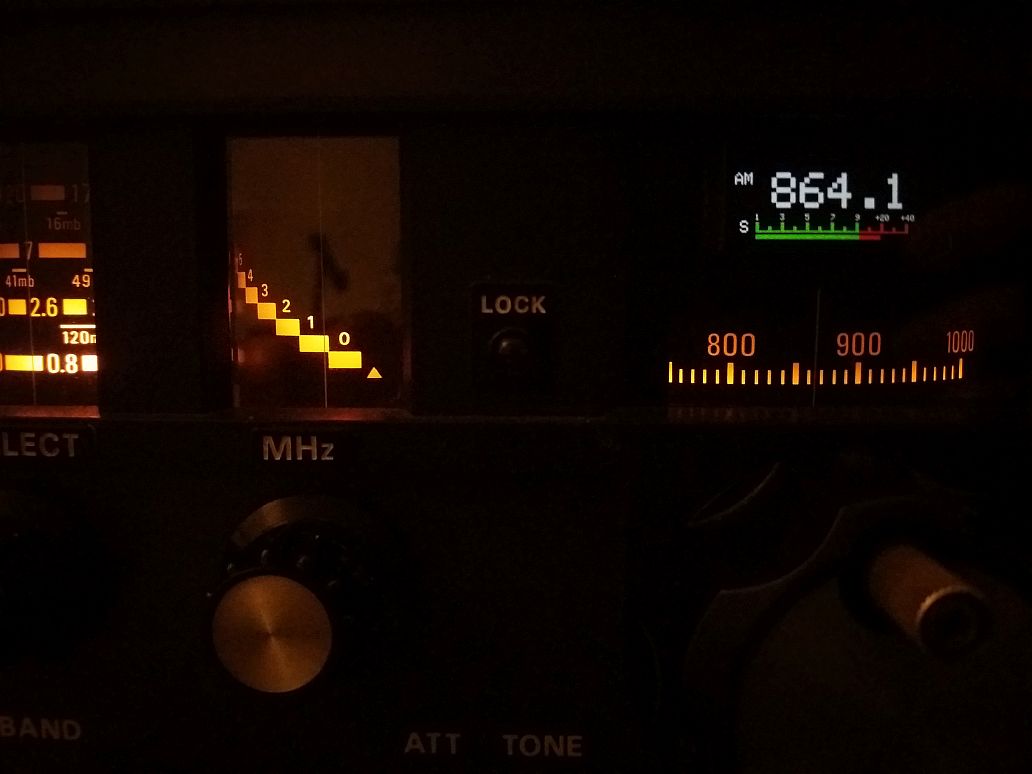
When I installed this KIT on my FRG-7 The first thing I did not like about it, was the very bright display which blasts your eyes with light especially at night on a low-lit shack. Not only that, but your eye will condinuously focus on the bright display and you loose the magic of the rest of the radio controls and displays. I wanted the digital display to be one of the parts of the radio and not the major thing that my eyes will look all the time. Marcel was smart enough to include 2 brightness levels in software. The low brightness setting does not actually change the backlight of the display, it just changes the graphics in more dim colors. As a result in either setting, the backlight color is very bright and this decreases contrast a lot. The background of the numbers in the display has a blue-ish color and not true black. Not only that, but the edges of the display, are visible too. I have solved all of these problems with a simple modification to the KIT.

The picture above, shows the display after my modification. The picture is taken on a dim-lit shack using my phone, with no further image processing. What you see in this picture, is exactly what it looks in reality, after my modification. Notice how the background of the display, remains pure black and the numbers and graphics of the display do not blind you anymore and are of the same brightness as the rest of the original backlit graphics of the radio. This allows your eye to wander around to the rest of the nice radio backlit things, without focusing all the time on a bright display. This is very relaxing to the eye and the brain as you scan for stations. You actually only look at the digital display when you want more accuracy. Compare this nice display contrast with the one presented on Marcel’s manual and you will notice the difference.

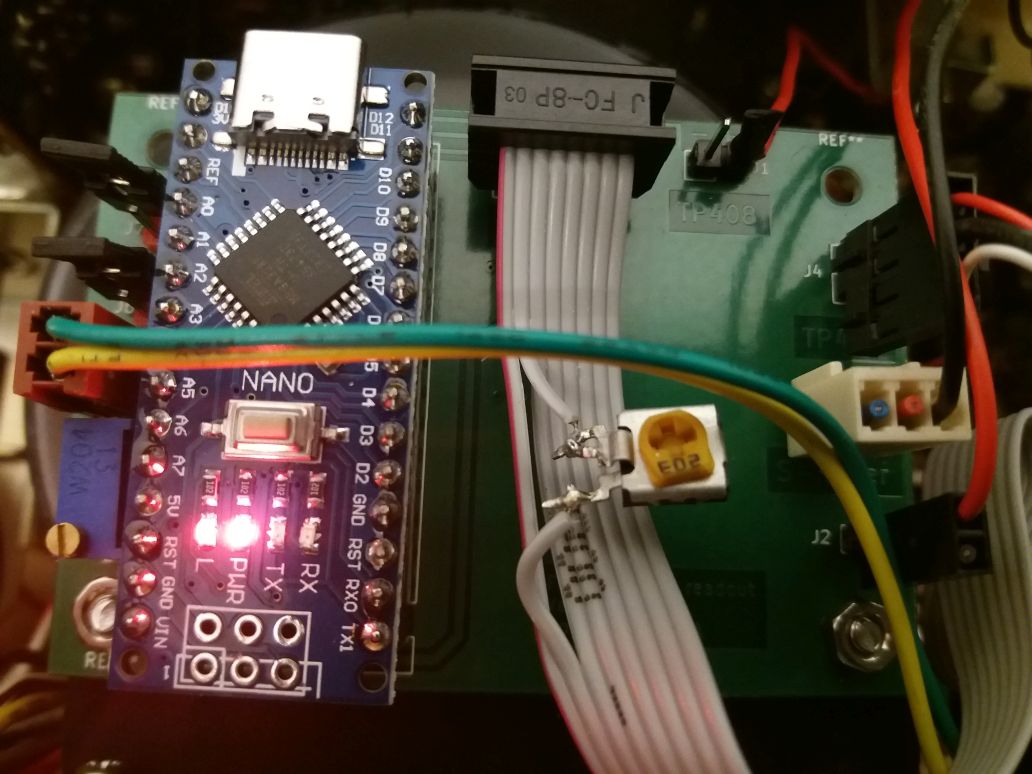
The modification is really simple and it does not need a schematic. It is just a 22k potentiometer, connected as a variable resistor like shown in the picture. I just cut the second cable (from the left), of the ribbon and then soldered the variable resistor there. That’s it. Depended on the light conditions in which you operate the receiver and on your personal preference, you can set the brighness from full to very dim. In the software setting, set the brightness to maximum. Then use this variable resistor to decrease it to your desired level.