Author Archives: Thomas

RNW will be closing English service at end of month

Radio Netherlands English service will be closing down on June 29, 2012. There will be a special program on their final day and listeners are invited to share their special memories of the service.  Additional shortwave frequencies are planned for this day and we will post them once available from RNW.
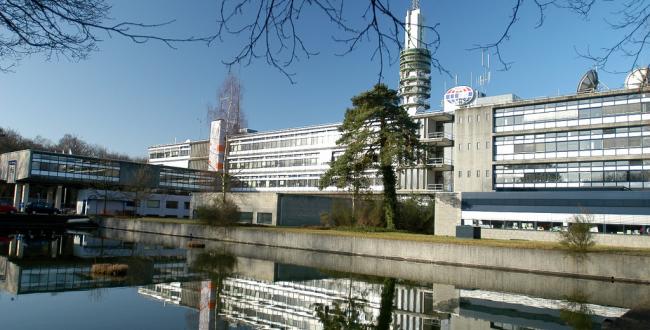
RNW headquarters in Hilversum, Netherlands (photo coutesty: RNW)

(Source: RNW)

Dear Readers,

We’re very sorry to inform you that the English service of Radio Netherlands Worldwide will be closing at the end of this month. As a result, this website will see some changes.

From 1 July 2012 there will no longer be a daily review of the Dutch papers. Our coverage of Dutch news stories will also cease. And, since RNW’s English webstream will end on 29 June, there will be no moreListening Guide.

However, we will continue to provide articles online relating to our new brief: promoting free speech in areas where people are not free to gather information or to form and express independent opinions.

Latest

You can check out the updates to this story lower on the page

Why?
The measures are a result of steep budget cuts imposed by the Dutch government and a concomitant change in focus. Providing the world with a realistic image of the Netherlands, as we have proudly done since 1947, will no longer be one of our statutory duties.

The last radio show
On 29 June we will broadcast a radio show looking back at the past decades of Radio Netherlands Worldwide. Have you got a memory to share? Please let us know, at the usual address, [email protected], or post a comment below this story, as many have already done. We’d love to hear from you.

Updates
Please keep checking this site for updates on our final day. There may be a surprise or two…

And, perhaps most importantly, thank you – for listening, reading, and riding this bumpy road with us over the years and through the recent, difficult times.

The RNW English team
Numbers Stations: The English Man came back

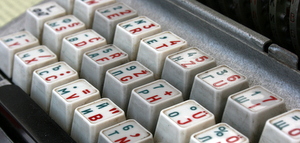
Two weeks ago this Friday, I caught and recorded the numbers station often referred to as the English Man. He was found in the pirate radio watering hole (of 6,925-6,990 kHz) on 6,949 kHz.

After sifting through more spectrum recordings taken the following evening by the Microtelecom Perseus, I realized that I caught him once again at the exact same time and frequency. I have his full transmission in the recording below.

Note: The English Man was broadcast in AM, but I had to dig the signal out of the noise. I used a tuning technique I referred to last year in a post–click here for more info.

Recording Radio History: The Queen’s Diamond Jubilee via BBC World Service

Diamond Jubilee at Buckingham Palace (photo: BBC)

Ten years ago, my wife–then fiancée–and I lived in the UK, and were fortunate enough to attend The Queen’s Golden Jubilee celebration on the vast lawn at Buckingham Palace. It was without doubt the largest party I’ve ever attended, packed to the gills with the British public–a thoroughly amazing event, featuring a who’s who of past-and-present British musicians and personalities, encouraging attendees to join them in their bit of fun–and, of course, God save the Queen.

Yesterday, I re-lived the energy of that party as I heard (and recorded) the follow-up event these ten years later–The Queen’s Diamond Jubilee, on the BBC World Service–as heard from remote Ascension Island.

When hearing live events like this on shortwave–especially ones like this that celebrate national heritage–I know I’m listening to history in the making. The crowds applauding and cheering in a live broadcast over shortwave reminds me of a former era when British Expats across the globe relied on the BBC World Service to connect them with ol’ Blighty.
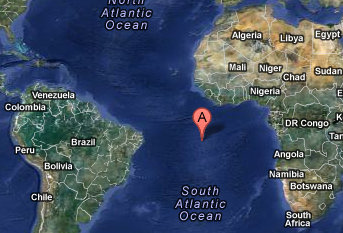


Ascension Island, marked with an "A" (image: Google Maps)

I recorded these broadcasts from my home in the southeastern US, hearing the BBC World Service relay station on the tiny, isolated Ascension Island in the South Atlantic. The broadcast was heard at first on 15,400 kHz, then moved to 9,915 kHz coinciding with their normal broadcast schedule. The broadcast, while completely intelligible, is weak in the beginning, but gains considerable strength by the end. There are summer static crashes heard as storms moved through the southeast US. I divided the broadcast into two parts, coinciding with my shift from one frequency to the other.

I also included a BBC WS news broadcast in Part 2 which followed the end of the show.

Either use the embedded Archive.org audio player below, or simply click here to download the mp3 files for Part 1 and Part 2.

I used the WinRadio Excalibur to record both of these segments. Its synchronous detection helped deal with fading (QSB) present at the beginning of the recording.

Once again, history is made…and archived on shortwave radio.  Enjoy!

Radio Australia’s Saturday Night Country is a part of my Saturday morning

Felicity Urquhart, host of ABC's Saturday Night Country. (photo: ABC)

Even though it’s well over 9,800 miles (15,800 kilometers) and many time zones from where I live, I listen to Radio Australia’s Shepparton broadcast site perhaps more than any other on the shortwave bands. For decades, it has beamed a broad and booming signal into North America on 9,580 kHz every morning. Well, I say “morning” here in the southeastern US, but in Australia, it’s their (or, for our Aussie readers, your) evening.

One show Radio Australia broadcasts that’s popular across the globe is ABC’s Saturday Night Country. Felicity Urquhart hosts the program, which showcases the best in Australian country and, indeed, country music worldwide. She knows her stuff, too–not only is she a talented host, but also an accomplished country music star in her own right. (What’s more–see above–she’s got “a face for radio”–? Try television:  she’s very photogenic.)

What I love about Saturday Night Country is that there’s lots of music, but also excellent interviews as Felicity chats with well-known and upcoming stars. Since the Radio Australia shortwave signal out of Shepparton is always so strong coming into the US, the audio fidelity is often on par with local AM (MW) stations.


I listen to the show many Saturday mornings, and I’m not even that big a fan of country music. And I’m not alone; several of you have written asking when I’d write a post about Saturday Night Country. For our readers, I’ve done one better:  check two hours out the latest show for yourself in the recording of ABC below (or click here for the mp3). The broadcast begins with a news segment at the top of the hour; if you like, fast-forward to 4:30 for the beginning of SNC:

Incidentally, I used making this recording as an excuse to test one of the newest receivers on my bench, the WinRadio Excalibur. Its recording functionality is perhaps the best in the SDR world–and, I’ve got to say, I’m most impressed with it. Out of the chunk of spectrum I recorded, I was also able to hear RCI’s Sackville site broadcasting All In a Weekend on 9,625 kHz. In the past, these two have had conflicting schedules between 8:00-9:00 local, but with the Excalibur’s three individual receivers, I can record one while listening to the other–or better yet, record both, and track down yet another station!

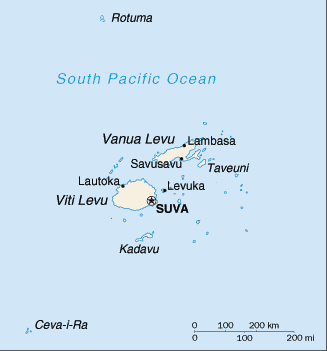
Domo I Viti: New Fiji clandestine station

I just received this message from Glenn Hauser via the Hard-Core DX group:

** FIJI [non]. As first reported exclusively on WORLD OF RADIO 1617 and DXLD 12-20:

HOT NEWS: A station for Fiji named Domo I Viti should start on 4 June at 0830-0900 on 11565 via WRN from Palau. Not sure what its agenda is, clandestine or at least political? Seems there are at least two programs/stations by same name, in Auckland and Sydney by expatriates. Related to either of them, originating where? E.g.:
http://www.aucklandfiji.org.nz/community_features_view.asp?newsid=408
(Glenn Hauser, OK, May 9, WORLD OF RADIO 1617, DX LISTENING DIGEST)

WRN confirms that this new clandestine starts June 4 at 0830-0900 on 11565 via PALAU, and will be weekly on Mondays only. It`s sponsored by the Fiji Freedom and Democracy Movement, based in Adelaide, South Australia.

If anyone can hear it, please note how much, if any, is in English, any contact info, and if possible record an ID. I haven`t found any Adelaide office, altho searching on ABC News stories gets some hits which aren`t very productive.

Note that HFCC has WHRI rather than T8WH registered on 11565 at 08-09. WHR schedules show Angel 4, the most likely transmitter, on 17650 at that time, and Angel 3 on 9930. 11565 was probably just a place-holder in HFCC. Searching WHR program schedules is fruitless (Glenn Hauser, June 3, DX LISTENING DIGEST)

Click here to check out Glenn Hauser’s DX program, World of Radio.

Note that we’ve covered Fiji in the past as their ruling party routinely blocks free press. Click here to read past articles referencing Fiji.

Voice of Greece plays music format during strike

On Monday, May 28, I recorded over 2 hours of popular Greek music programming from the Voice of Greece on 9,420 kHz with a Microtelecom Perseus. Propagation was excellent.

UPDATE: Once again, SWLing Post reader, Christos, provided more info on the strike and recording below:

This time only the journalists had gone on strike. So, no news were broadcasted, no newspapers, no news in internet portals. Announcements between songs concerned the artists and cultural events of the same day, such as theatre, movies, concerts etc. The programme recorded from 42nd minute till 99th was from ERT’s archive introducing contemporary songs. The announcements of this part were about the songs, the singers and the composers. The programme recorded from 100thminute and on contained songs of 60ties, 50ties and older. Music programmes’ producers made no comments about the strike of their colleagues.

Thanks, Christos!!!


You can listen via the player below, or simply download the MP3 by clicking here.

Click here to check out previous Voice of Greece recordings.

RFE: Radio Farda Families A Target In Iran

One of the points I often make is that repressive regimes can track and take action against citizens who read online content from banned/blocked media sources. Here is a case in point:

(Source: Radio Free Europe)

In an escalation of ongoing efforts to thwart Radio Farda, RFE/RL’s Persian-language Service, Iranian authorities are interrogating journalists’ family members in Iran.

Employees of Radio Farda believe that their journalism, which attracts over 10 million page views monthly on Radio Farda’s website, is the motive behind at least 20 incidents this year involving the interrogation and intimidation of their family members in Iran by officials of the country’s Intelligence Ministry.

In sessions that sometimes lasted for several hours, agents denounced the work of Radio Farda journalists and warned family members against having further contact with them. In several cases they instructed family members to tell their relatives to resign from their jobs and return to Iran; in one instance they demanded that a specific series of reports be discontinued. During questioning, family members were also asked about their foreign contacts and trips abroad.

The interrogations have targeted family members, who in some cases have been repeatedly summoned, in Tehran and at least six other Iranian towns and cities.

“This is a proxy war against Radio Farda. It shows the extremes to which the regime will go to prevent the exchange of information it doesn’t control,” said Steven W. Korn, RFE/RL president. “Our journalists make enormous sacrifices for the work they do and will not submit to this pressure on them and their families.”

Radio Farda, produced in and broadcast from Prague, is a leading source of uncensored information in Iran. Each month 1.5 million users inside the country defy the government by employing proxies to access Radio Farda’s website, which is blocked. Radio Farda and “Pasfarda,” its signature satire program, are active on social media, with a combined 300,000 Facebook fans. Iranians actively participate in Radio Farda’s weekly call-in shows, connect with it daily through hundreds of email and SMS messages, and despite government jamming, tune in to satellite radio and shortwave to hear its programs.

In media freedom surveys this year, Freedom House ranked Iran 192 among 197 countries surveyed and Reporters Without Borders ranked it 175 of 179.

Yet one more reason why shortwave radio is safer than the internet as a reliable source of news and information and one more reason why countries like Canada should not abandon this vital resource.