Author Archives: Thomas

Can you help Rob identify two mystery signals on the 20 meter band?

I received the following message from my buddy Rob (NC0B) who is trying to identify a couple of signals on the 20 meter band. Rob kindly gave me permission to post his email here on the SWLing Post with the idea that someone may be able to help him solve this:

The following is a description of two odd digital signals observed on 20 meters with transmission modes I do not understand. They may not amateur transmissions, but I have no way to decode them. They stick out like a sore thumb on 20m in the Extra portion of the phone band. The time of day on August 20th was between 11:50 AM and 12:00 PM MDT.

Two weeks ago I was in QSO on 14,170 kHz and occasionally there was the same 10 kHz wide digital signal but centered on 14,171 kHz. It sounded like the old Russian jammers buzz saw modulation. Those signals from decades ago were much wider, and or course we didn’t have high resolution spectrum scopes back then. Today the same transmissions occurred several times, and more than once a minute for about 5 seconds each. In total the transmissions may have occurred on and off for about 10 minutes.

Then after a few 10 kHz transmissions a different signal came on the air a few times with what looked like a digital modulated carrier plus digital sidebands on each side of the middle signal.

Look at the attached JPG file and I’ll try to make sense out of it:
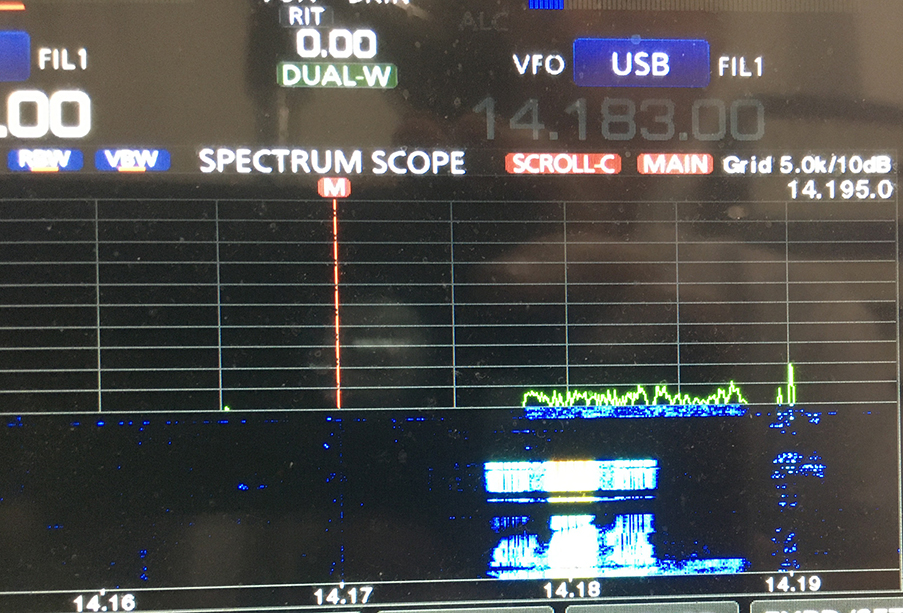
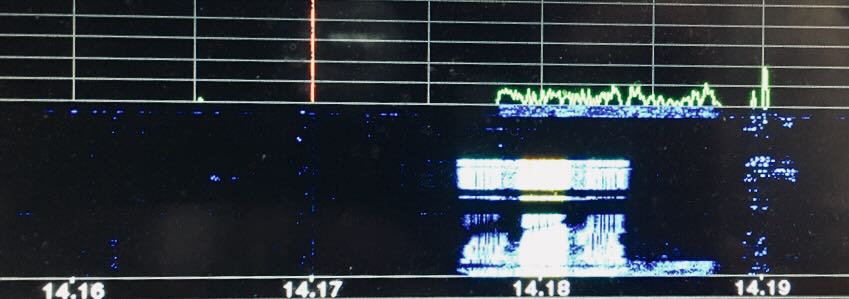
The waterfall image lasts about 50 seconds on the Icom IC-7610 set on slow. There are two different signals to differentiate in this image. The signal I observed two weeks ago and today is 10 kHz wide and today spans from 14,178 to 14,188. It shows up in green on the band scope, and just under it in blue on the water fall for about 3 seconds of the approximate 5 second transmission. You can also see at the bottom of the waterfall the previous transmission that has about 4 seconds worth saved on the waterfall running off the bottom. The horizontal span of the scope was set to 5 kHz per division.

Once the 10 kHz wide signal started, I went to Dual Watch so I could listen for KL7QOW on 14,170 kHz for a sked, and hear the buzzing signal on 14,183 kHz in SSB mode. That frequency placed the carrier position of the SSB 2.8 kHz bandwidth in the center of the 10 kHz wide signal.

Soon after I started observing the relatively flat spectrum of the 10 kHz signal, a new digital signal appeared about 3 kHz lower in frequency. At first it had a much stronger center modulated carrier about 2 kHz wide and then two symmetrical digital signals on each side within about a 6 kHz total bandwidth. I wasn’t able to capture the best picture of the 2nd signal as it appeared to be tuning up. The amplitude difference between the central signal and the separate sidebands initially was about 15 dB. Vertical divisions are 10 dB.

On the waterfall you can see the second type of signal is centered on about 14,180 kHz. The modulation depth of the outer pairs of signals were not constant, possibly due to selective facing. QSB was quite significant at this time at least to Alaska. You can see there was a short break of a few seconds in the 6 kHz wide signal. Every time I have seen the 10 kHz wide signal its amplitude across the transmission bandwidth has been fairly constant, always of short duration, and repeating several times within 10 minutes before terminating.

Does anyone have any idea what either of these transmissions are? I have heard of email digipeaters, but I would not think their bandwidth would be this wide.

Rob, NC0B

SWLing Post community: Please comment if you can help Rob ID these signals!
Radio Waves: AM/FM Receiver Sales Stabilize, Asheville Radio Museum Adds Model HS2, Legacy remains of WSY, and Farewell to WCFW

Radio Waves:  Stories Making Waves in the World of Radio

Welcome to the SWLing Post’s Radio Waves, a collection of links to interesting stories making waves in the world of radio. Enjoy!


AM/FM Receiver Sales Have ‘Stabilized’ Even As Audio Turns Up On More Devices. (Inside Radio)

Anyone who has tried to find an AM/FM receiver in a big box retailer knows they are not as easy to find as they once were. It is little surprise then that the Consumer Technology Association expects fewer to sell this year. But at roughly five million units now sold each year, CTA expects that number to hold steady in the years to come, in part due to the role radio plays during emergencies.

“That category has stabilized,” said Rick Kowalski, Director of Industry Analysis and Business Intelligence at CTA. “It’s a low number relative to other categories, but there’s a steady demand, just in terms of people having an AM/FM radio for those situations where you might need a battery-powered radio as a backup.”

CTA forecasts 4.7 million traditional radio receivers will be sold this year in the U.S. That is six percent lower than the five million units sold in 2021. “Looking out in the next five years. It’s not going to get much lower than that,” Kowalski said in an interview.

CTA projects 24.5 million smart speakers will sell this year, or roughly five-times as many as traditional radio receivers. But in what may be a surprise to many, that estimate is actually two percent lower than the 25 million smart speakers that CTA says were sold last year. [Continue reading…]

“Bringing it home” Asheville Radio Museum adds local piece of history to its collection (WLOS)

ASHEVILLE, N.C. (WLOS) — The Asheville Radio Museum has added a new piece of history to its’ collection!

It’s a 1922 radio receiver built by an Asheville-based business.

The model HS2 radio the museum procured is only one of two known to exist.

Collector and restorer Robert Lozier found that it was the first name brand radio built in North Carolina.

News 13 spoke to the director of media communications Peter Abzug about why this radio is so significant.

“Having this radio here, in Asheville, where it was built is really significant,” he said. “It’s bringing it home. Although the company itself didn’t last for years and years, it did employ people and it was a significant part of Asheville’s history, and something we can be very proud of.”

Click here to watch the video at WLOS.

Legacy remains of WSY, Alabama’s first radio station (Alabama News Center)

Innovation is at the historic heart of Alabama Power, beginning with its founding in 1906 and Capt. William Patrick Lay’s vision of electrifying the state by harnessing the power of Alabama’s rivers.

But the company’s embrace of another cutting-edge technology, just 16 years after Alabama Power’s incorporation, is also historic.

One hundred years ago this year, on April 24, 1922, Alabama Power hit the airwaves with the state’s first operating radio station. WSY (an acronym for “We Serve You”) began broadcasting from rented space in a building on Powell Avenue in Birmingham.

The 500-watt AM station was initially designed as a company tool, to provide better communications among employees – especially those in the field and at remote generating plants. In fact, radio technology was so new – regularly scheduled radio programming in the United States started only in 1920 – Alabama Power engineers had to design and build most of WSY’s transmitting equipment.

“We began assembling the set … with intentions of using it for purposes of operation of the system exclusively,” wrote George Miller, the employee in charge of the station, in the July 1922 issue of the company’s Powergrams. “The broadcast feature came up, though, and materially changed our plans.”

Indeed, a month before the station went on the air, The Birmingham News published a do-it-yourself piece about “how to make your own radiophone receiving set” so local residents could pick up WSY when it began broadcasting.

Interest in the station was so strong that within weeks it began offering entertainment programs, according to “Developed for the Service of Alabama,” the centennial history of Alabama Power, written by noted historian Leah Rawls Atkins.

Dee Haynes, with the Alabama Historical Radio Society, recalled one story that underscores WSY’s popular embrace. Soon after WSY went on the air, earpieces began disappearing from the handsets of payphones all over Birmingham, apparently because people were swiping them to use in home-built receiving sets. [Continue reading…]

FAREWELL TO FM: A Grandson’s Recollections of His Family’s Legacy Radio Station, WCFW (Volume One)

For 54 years, WCFW has been a beloved independently owned radio station on 105.7FM. But for lifelong Eau Claire resident Parker Reed, it has been more than that: it’s his family’s life, love, and legacy.

A catchy jingle – featuring the melody “WCFW, where FM means fine music” – came across a young radio station owner’s desk in 1969.

It was short, simple, and it worked. The owner paid $25 for it, and more than 50 years later that same jingle – which has aired thousands of times on 105.7FM radio – exemplifies the values of WCFW in Chippewa Falls and the couple who have owned it for over half a century: simplicity and consistency.

My grandparents, Roland and Patricia Bushland, have owned and operated WCFW since its inaugural broadcast on the airwaves on Oct. 20, 1968. Earlier this summer, they decided to end their 54-year stint in radio, selling the legacy station to Magnum Media – a Wisconsin-based media organization owned by Dave Magnum who now owns 25 radio stations across the state and will take over operations of the quaint, easy-listening station later this fall.

It’s a bittersweet moment – for the community, yes, but especially for our family, for whom the station has been an integral part of our lives for decades.

“It’s hard to not have mixed feelings about it, because it was our life for so long,” said my grandmother, Patricia Bushland. “When you start something, and you’re the only people who ran it all those years, you get attached to it. But after so many years, I’m thrilled to death that someone new is coming in, and we can finally take a break.”

When my grandfather, Roland, was young, he would draw pictures of radio towers during school – as his life too began with radio, front and center. My great-grandfather Roy Bushland owned and operated multiple Bushland Radio Specialties storefronts in Chippewa Falls and Eau Claire since the early 1930s – a business where my grandfather got his start in 1952 after he graduated Chippewa Falls High School as salutatorian. [Continue reading…]


Do you enjoy the SWLing Post?

Please consider supporting us via Patreon or our Coffee Fund!

Your support makes articles like this one possible. Thank you!

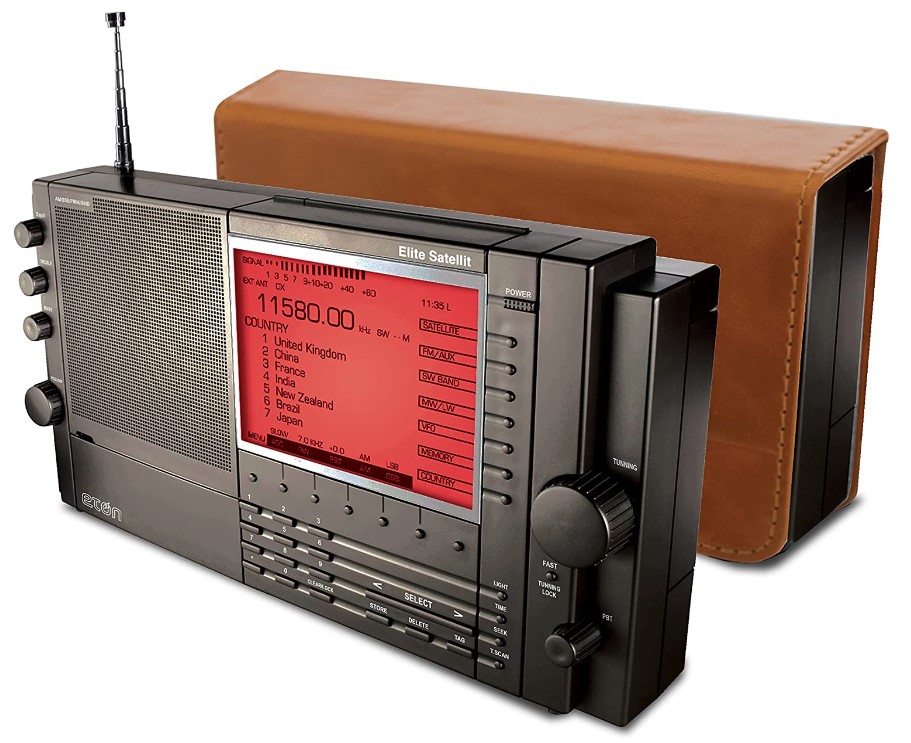
Eton Elite Satellite Update (August 20, 2022)

Eton Elite Satellit HD

Eton Elite Satellit Update (August 20, 2022)

As many SWLing Post readers have pointed out, Universal Radio has posted the following update to their product page for the Elite Satellit:

Our initial allocation of radios arrived 08/17/22. Our Q/C testing detected a problem with the radio. We are working closely with Eton to find a solution to the issue. We will begin shipping radios as soon we are satisfied the radio fully meets specifications.

Some early adopters noted that the receiver controls freeze when engaging HD radio stations. We suspect this may be one of the issues.

Universal Radio will no doubt post updates as soon as they’re available. For now, though, they are not shipping the Eton Elite Satellit. We assume this will be the case for other retailers as well.

Internal Photos

Many thanks to SWLing Post contributor, Noel, who shares the following internal photos he took of the Elite Satellit (click images to enlarge):

Radio Waves: US Emergency Alert System Vulnerabilities, Tape Measure Antennas, Eight Year Old Chats with ISS, and Power of Prison Radio

Radio Waves:  Stories Making Waves in the World of Radio

Welcome to the SWLing Post’s Radio Waves, a collection of links to interesting stories making waves in the world of radio. Enjoy!


“Huge flaw” threatens US emergency alert system, DHS researcher warns (ARS Technica)

Hackers can disrupt legit warnings or issue fake ones of their own.

The US Department of Homeland Security is warning of vulnerabilities in the nation’s emergency broadcast network that makes it possible for hackers to issue bogus warnings over radio and TV stations.

“We recently became aware of certain vulnerabilities in EAS encoder/decoder devices that, if not updated to the most recent software versions, could allow an actor to issue EAS alerts over the host infrastructure (TV, radio, cable network),” the DHS’s Federal Emergency Management Agency (FEMA) warned. “This exploit was successfully demonstrated by Ken Pyle, a security researcher at CYBIR.com, and may be presented as a proof of concept at the upcoming DEFCON 2022 conference in Las Vegas, August 11-14.”

Pyle told reporters at CNN and Bleeping Computer that the vulnerabilities reside in the Monroe Electronics R189 One-Net DASDEC EAS, an emergency alert system encoder and decoder. TV and radio stations use the equipment to transmit emergency alerts. The researcher told Bleeping Computer that “multiple vulnerabilities and issues (confirmed by other researchers) haven’t been patched for several years and snowballed into a huge flaw.”

“When asked what can be done after successful exploitation, Pyle said: ‘I can easily obtain access to the credentials, certs, devices, exploit the web server, send fake alerts via crafts message, have them valid / pre-empting signals at will. I can also lock legitimate users out when I do, neutralizing or disabling a response,’” Bleeping Computer added. [Continue reading…]

Just how good is a tape measure antenna anyway? (Hackaday)

Amateur radio operators have played a longstanding game of “Will It Antenna?” If there’s something even marginally conductive and remotely resonant, a ham has probably tried to make an antenna out of it. Some of these expedient antennas actually turn out to be surprisingly effective, but as we can see from this in-depth analysis of the characteristics of tape measure antennas, a lot of that is probably down to luck.

At first glance, tape measure antennas seem to have a lot going for them (just for clarification, most tape measure antennas use only the spring steel blade of a tape measure, not the case or retraction mechanism — although we have seen that done.) Tape measures can be rolled up or folded down for storage, and they’ll spring back out when released to form a stiff, mostly self-supporting structure.

But [fvfilippetti] suspected that tape measures might have some electrical drawbacks, thanks to the skin effect. That’s the tendency for current to flow on the outside of a conductor, which at lower frequencies on conductors with a round cross-section turns out to be not a huge problem. [Continue reading on Hackaday…]

Broadstairs eight-year-old to feature on NASA website after radio chat with ISS astronaut (The Isle of Thanet News)

A Broadstairs eight-year-old has chatted with an astronaut aboard the International Space Station and a recording of the conversation will feature on the NASA website.

Isabella Payne spoke to Astronaut Kjell Lindgren as the ISS flew overhead last week.

The youngster was with dad Matthew who is a license holding amateur radio enthusiast and tutor. He and Isabella are both members of Hilderstone Radio Society.

Matthew said: “Isabella has been a member of the radio club ever since she was born and has been playing with the radio since she was six. Because I have the full licence she can sit on my knee and use the radio to speak to people as long as I am controlling it. Everyone at the club can do that. She has been involved in a few radio events, Children On The Air events, and will hopefully go for her own licence soon. [Click here to read the full article and view the photos.]

The power of prison radio in giving voice to the voiceless around the world (ABC)

“I plan my life by the radio these days, my contact with the outside world in a sense…”

The first ever international prison radio conference has just been held in Norway, bringing together representatives of prison radio shows from 19 countries, including Australia, where Indigenous people continue to be grossly over-represented in prison populations.

Prison radio shows, wherever they are in the world, all work to give voice to the voiceless and empower people by enabling them to tell their own stories.

Click here to listen to the podcast episode.


Do you enjoy the SWLing Post?

Please consider supporting us via Patreon or our Coffee Fund!

Your support makes articles like this one possible. Thank you!

Alan Roe’s A22 season guide to music on shortwave (version 3)

Many thanks to SWLing Post contributor, Alan Roe, who shares his A-22 (version 3) season guide to music on shortwave. Alan provides this amazing resource as a free PDF download:

Click here to download Music on Shortwave A-22 v3 (PDF)

Thank you for sharing your excellent guide, Alan!

This dedicated page will always have the latest version of Alan’s guide available for download.

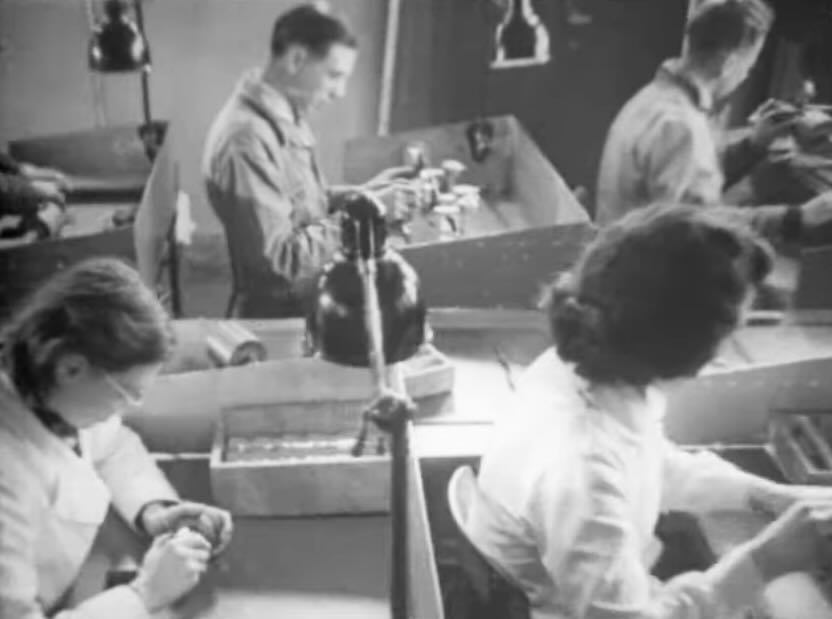
Video: The Erres KY-418 radio set WWII era assembly line

Many thanks to SWLing Post contributor, Adid, who writes:

The Erres KY-418 Radio set assembly line. You must watch this:

Click here to view on YouTube.

My heart goes to the poor guys who work under all that machinery noise with no ear plugs or with no mask when spray paint.

Everything is hand made in-house even the loudspeakers, coils or the rotary switches….

Just remember that WWII is on while it was made and I don’t think the KY-418 was a cheap radio…

Regards, Adi

Thank you for sharing this, Adid. You’re right: there were a few generations of folks who lost much of their hearing early on due to the constant noise on factory floors. 

That said, I’ve been enjoying these videos of early radio production lines. Thank you!

Julian spots a Panasonic RF-3000A on eBay

Many thanks to SWLing Post contributor, Julian, who writes:

Thomas,

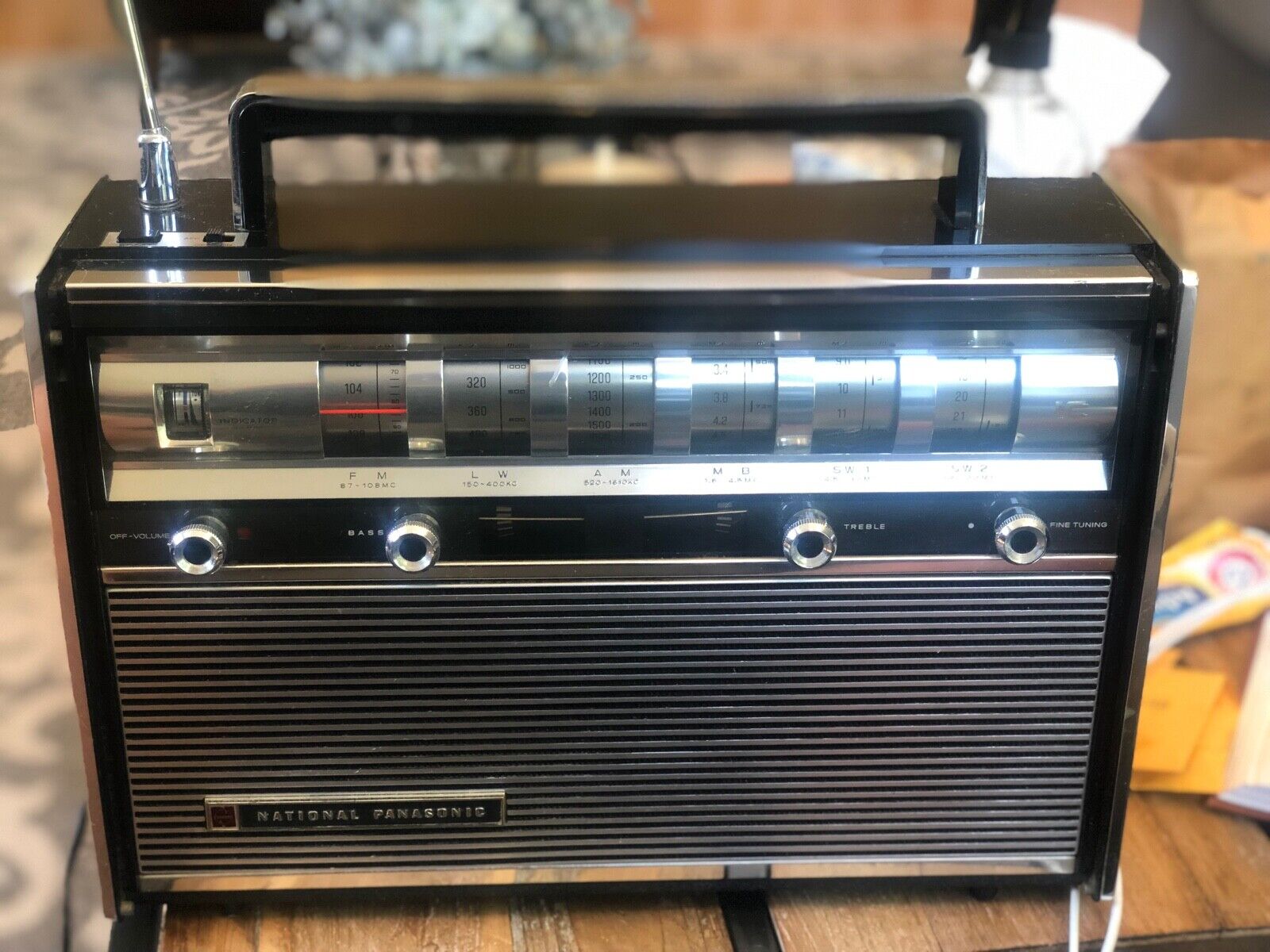
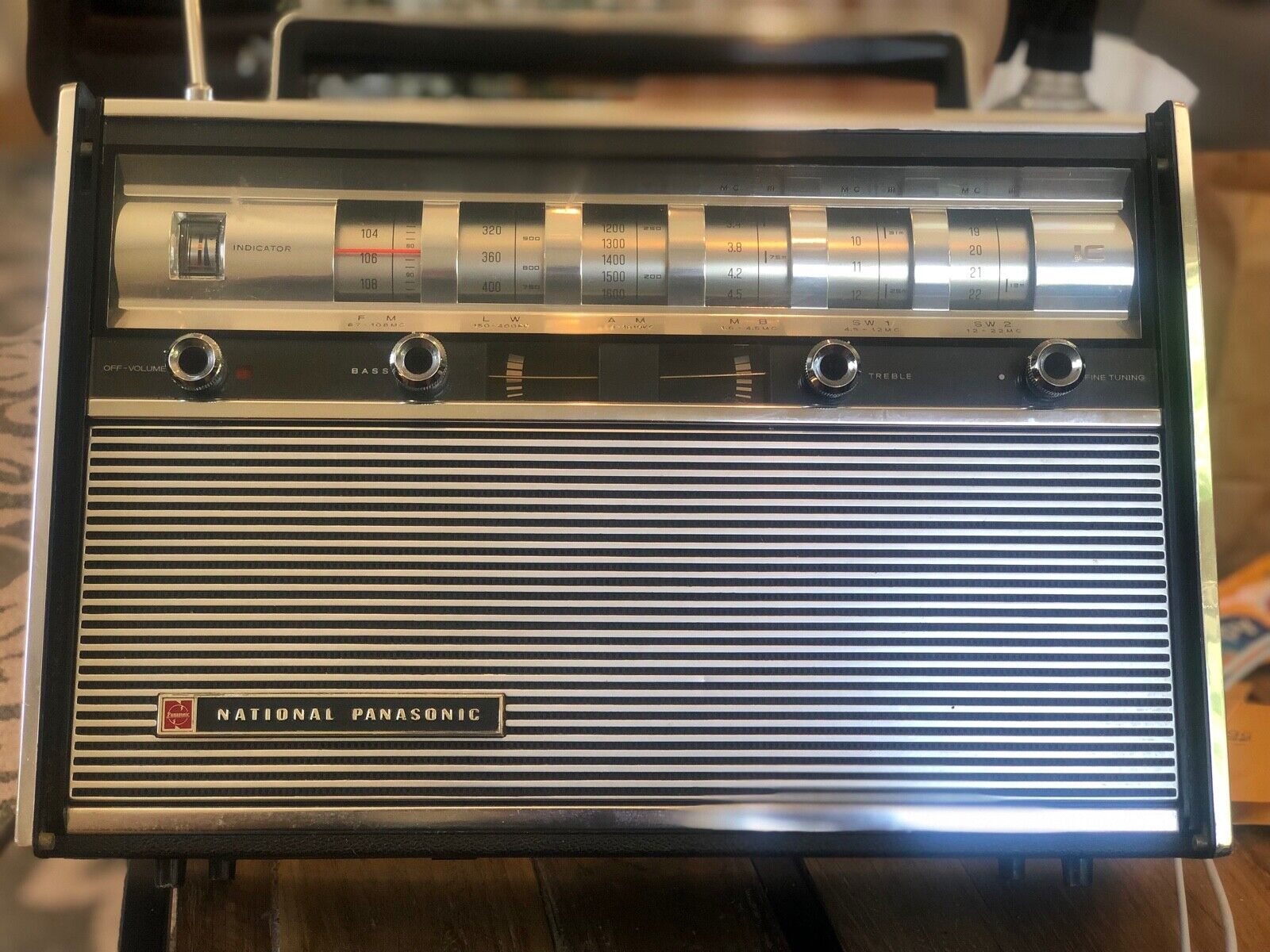
I stumbled across this listing for a Panasonic RF-3000A so I thought I’d share it in case some SWLingers interested in or who collect vintage solid state radios are interested in the following listing for a Panasonic RF-3000A for US$125.00.

73
Julian

Click here to view on eBay.

Thank you for the tip, Julian! I don’t think I’ve ever seen this model of Panasonic before. At first blush, it looks like a Barlow Wadley.

Based on the description of the radio, it sounds like it might need a little work. I think a re-capping would be in order and I’m sure the pots and switches need an application of Deoxit.

Perhaps our resident Panasonic collectors will let us know if this radio is rare or common? I doubt it’s exceptionally rare since there have been 3 offers made on it in the past. Please comment!