Author Archives: Thomas

Jon reviews the VITE VT-111 receiver

vite-vt-111

Image: jontabor.tk

Many thanks to SWLing Post reader, Jon Tabor, who writes:

I’m new to SWL, but found your site a few months ago, and have been loving it ever since.

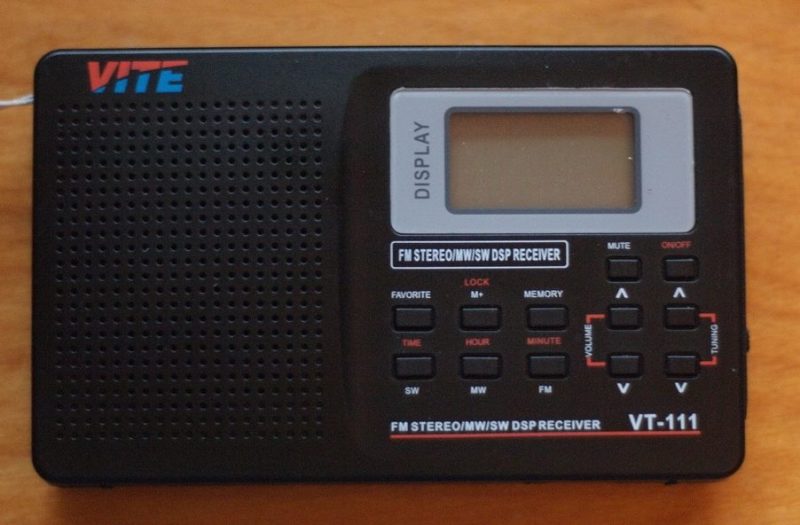
I recently picked up, for about $11 off eBay, a cheap MW/SW/FM radio called the VITE VT-111, which appears to be a rebadged (updated?) Basbon DS-858, which I know you’ve seen before.

Okay, it’s not a great radio, but it was $11! I know, I know, it’s a terrible way to get started in SWL, but did I mention it was $11?

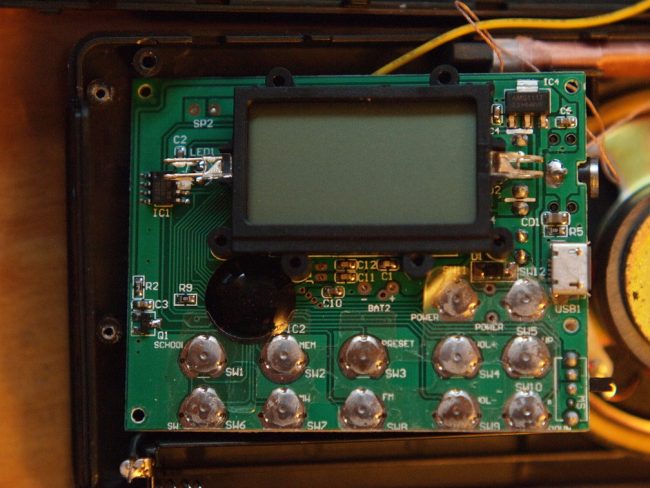
Anyway, I opened it up and found some differences between the photos you posted of the Basbon, as well as what appears to be an I²C bus in there; I’m not familiar with I²C busses, but I thought maybe some of your readers might find it interesting to see the guts of this radio and how it differs from the Basbon, or at least see the insides of yet another cheap radio.

vit-vt-111-inside

Image: jontabor.tk

Here’s the link:
http://jontabor.tk/wordpress/?p=31
Thank you for sharing, Jon!

You’re reminding me that I have a VITE SRW-710S sitting on the shelf and must review it soon. One reader was curious if its on-board recording feature would be effective on shortwave. We’ll soon know!

Is the end near for Vatican Radio’s shortwave service?

radio_vaticano

Many thanks to SWLing Post contributor, Andrea Bornino, for sharing the following article from espressonline.it:

Goodbye, Jesuits. Vatican Media Get a New Face and New Boss

And this with a Jesuit pope, no less. Vatican Radio will stop broadcasting on shortwave. And “L’Osservatore Romano” will also be absorbed into a single “content hub.” Under the command of Monsignor Dario Viganò

by Sandro Magister

[…]

Because in effect Vatican Radio costs a great deal. It does not run advertising, its revenues are paltry and its numerous linguistic sections push to about thirty-five the number of journalists on the payroll. The total shortfall fluctuates between twenty and thirty million euro per year.

Well then, Monsignor Viganò doesn’t want to hear about shortwave anymore. He sees it as antiquated and to be dismantled, because it has been supplanted by the web. While instead for Fr. Lombardi it continues to have an essential role “of service to the poor, the oppressed, the minorities, rather than of subjection to the imperative of the maximization of the audience.”

They are two antithetical visions. But the marching route appears to have been marked out already. In Africa, where internet access is sporadic, Viganò has announced an agreement with Facebook through which the pope’s messages will be brought to 44 countries by cell phone, through an app.

By December, in short, Vatican Radio will cease to exist as a self-contained reality. It will be incorporated into a single centralized “content hub,” or in Viganò’s words, into “a single center of multimedia production of texts, images, audiovisuals and radio podcasts in multiple languages,” beneath a single editorial leadership held by Viganò himself today and soon to be handed over to a “task force of journalists,” many of them drawn from Vatican Radio itself and adapted to the new role.[…]

Read the full article by clicking here.

I can’t quite tell if this is a news item or opinion piece.

Post readers: Have you noted other sources confirming the closure of Vatican Radio’s shortwave service?  I know this topic is certainly on the table at Vatican Radio, especially since it’s been discussed in the past.

HDSDR publishes a new Beta release

hdsdr-screenshot

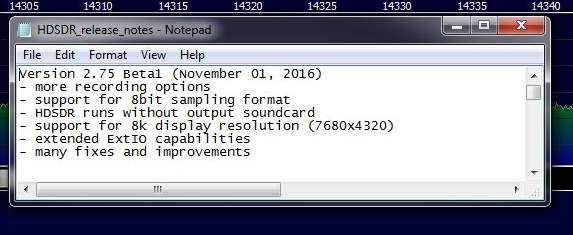
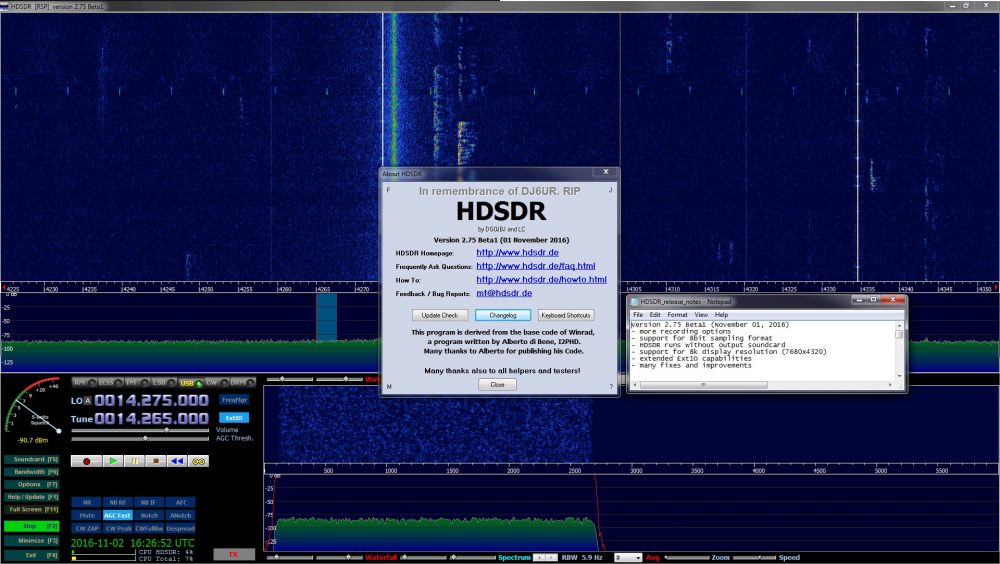
Many thanks to SWLing Post contributor Mike Ladd who notes that HDSDR has just published a new 2.75 Beta release.

Mike included the screenshot (above) which includes the following release notes:

hdsdr-screenshot

Click here for the HDSDR website and to download the new Beta release.

Thanks for the tip, Mike!

Anniversaries of BBC and CBC broadcasting

Pilot-Model-TV

Many thanks to SWLing Post contributor, Kris Partridge, who writes:

A day or two late, but I don’t know if you have this about CBC:

(Source: Southgate ARC)

Canada’s public broadcaster, the CBC, is 80 years old

Modelled somewhat on the BBC, the Canadian Broadcasting Corporation came into being on November 2, 1936.

Surprisingly many of the issues that led to the creation of the CBC, are still around today.

In 1936, there were 74 radio stations across the country; three were CBC stations and four more were leased.  All however were dwarfed by signals sweeping across the border into Canada from more powerful US stations. Concerns of US domination of Canadian airspace, is still a concern 80 years later.

Full article here:
History: Nov 2, 1936 -Canada’s Public Broadcaster birthday: 80 today

Also yesterday was the 80th anniversary of the start of Television broadcasting in the UK

(Source: BBC Blogs)

The BBC’s first British television service launched 80 years ago today, on 2 November 1936. To mark the occasion our colleages at BBC History have launched a new website celebrating the landmark anniversary combining archive material from the early days of television.

The site is packed full of video and audio footage telling the story of television including its invention, the opening night at Alexandra Palace in 1936, TV closure during the war and its resurrection in 1946, as well as TV’s milestone moments such the Olympics and the Coronations of 1937 and 1953. We’ve selected some choice clips below to whet your appetite[…]

Read the full article and watch the archived video by clicking here & more here.

Additional links:
http://www.bbc.co.uk/news/entertainment-arts-15551270 & http://www.bbc.co.uk/news/entertainment-arts-15554897

Unfortunately due to various geo restrictions the one hour long programme from BBC4 last night is not viewable on iPlayer (catch up TV) outside the UK, sorry about that.

Fantastic! Thank you Kris. I’ve really enjoyed viewing the archived footage on the BBC Blog.

Chris’ summary of Halloween pirate radio activity

excalibur-screen-grab

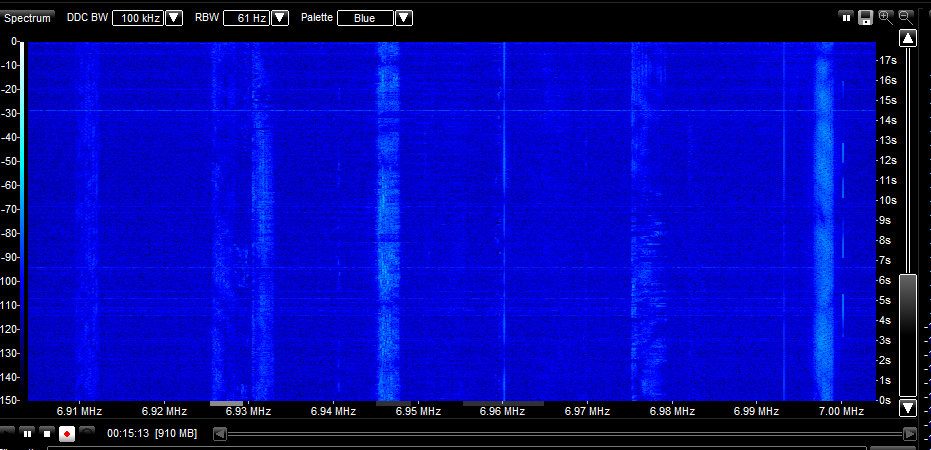
I had hoped this Halloween weekend would bring out a lot of shortwave pirates and it surely did! At one point Monday evening, I noted no less than five pirate radio stations broadcasting simultaneously between 6910 – 7000 kHz. You can see the four SSB and one AM signal in the spectrum display above.

Chris Smolinski, once again, has posted a Summary of Halloween 2016 Shortwave Pirate Radio Activity in North America where he lists all of the pirates logged on the HF Underground for the full weekend. Check out the post on RadioHobbyist.org.

I was busy with family activities much of the weekend, but fortunately captured a lot of pirate spectrum to review and listen to later!