Author Archives: Thomas

An eBay caution: some sellers are out for a buck–or hundreds

RF2200
SWLing Post contributor, Dan Robinson, has recently noticed exorbitant prices demanded by certain sellers on eBay. Dan writes:

As readers of SWLing Post know, Ebay prices–at least asking prices–can often go completely off the scale.

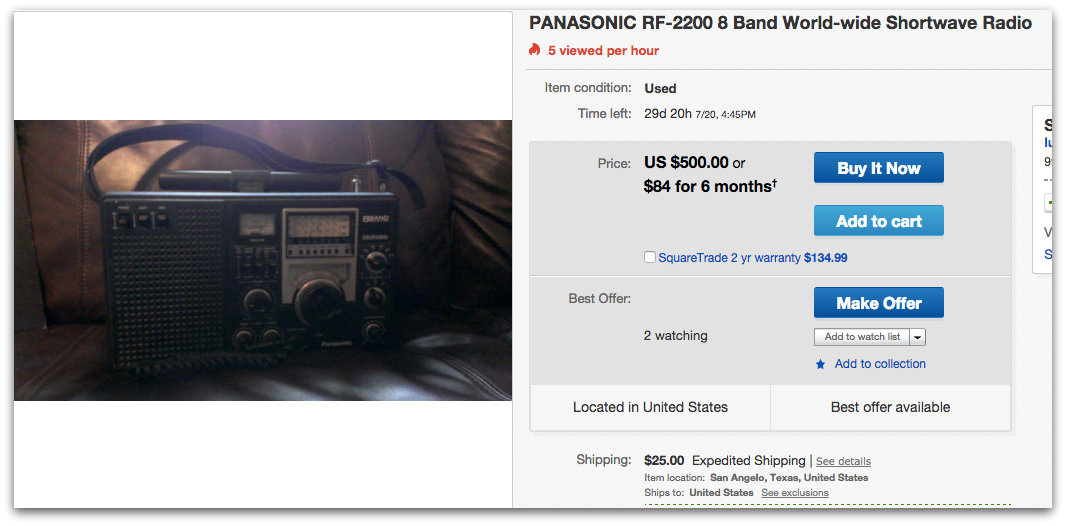
While it’s true that prices can be as high as the market will bear, some recent examples are cases in point. The RF-2200 by Panasonic was an amazing radio for its time, competing with the SONY 5900W and some other models back in the early days of sophisticated portables. The 2200 was known, and is still respected, for its directional AM loop antenna, and is a prized part of the stables of many SWL’s today.

But let’s face it…only a 2200 found new-in-the-box, or in [like]-new condition, should fetch anything over $250-300. Other examples recently include a DX-302 for which the owner was seeking something like $1200. Price inflation has also been seen with SONY ICF-6800Ws. The [difference] with these sets is that they truly are in new or 10.0 condition, worth several hundred dollars.

New SONY ICF-2010s–[and] there are still some circulating that are new-in-the-box or in [like]-new condition–can and do bring prices north of $400, sometimes more. So do new-in-box SONY ICF-SW100s if they are complete with all accessories, in the box–but beware, they should be the newer modified versions and not the old version (you can tell this by looking at the hinge on the SONY, which should have a notch to indicate the revised version of the radio).

Another classic portable that deserves somewhat higher pricing is the Panasonic RF-B65. In [new-in-the-box] condition, these can go for more than $300.

So, [unless] you’re seeing astronomically high prices for RF-2200s, stop and think about it. These are old portables, and you should not be paying exorbitant prices–UNLESS you [encounter] a time capsule with a radio in the box that was never used. Even so, buyers need to ask multiple questions of sellers to protect yourself.

I agree completely, Dan. If you want to purchase an item at a fair market price or even a bargain, you must do your research before simply using the “Buy It Now” option on eBay. There are plenty of sellers who charge fair prices still; leave the stratospheric-priced items on the eBay shelf.
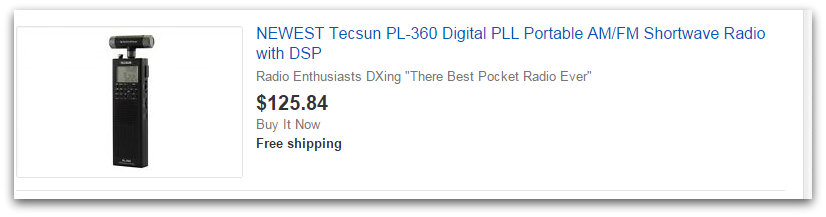
Tecsun-PL-365-Ebay-Crazy-Price

A case in point (above): never mind the grammar error in the above listing, the $125 “Buy It Now” price for the Tecsun PL-365 is frankly excessive. The PL-365 is identical to the CountComm GP5/SSB–a radio I recently reviewed–and is available new from Universal Radio for $79.95 plus shipping. And since there are currently no other listings for the PL-365 on eBay (I’m not sure why) this price might appear reasonable to a new buyer.

This same seller initially offered the Tecsun PL-365 for a much higher price–in excess of $180, I believe. While this seller has excellent ratings, and no doubt would stand behind the product, the markup is simply too high for me to endorse (hence, no eBay link here).

In the past, I’ve also noted a semi-rare vintage radio–a “boat anchor” variety with a market price of perhaps $1,500–up for auction with a first bid amount in excess of $20,000 US! Yet I felt confident of the $1500 market price because I checked and cross-referenced it in Fred Osterman’s Shortwave Receivers Past & Present, which provides fair market values.

So, while I continue to support eBay, which remains one of the most secure platforms from which to buy unique and vintage goods on the open market, I want to encourage readers to heed Dan’s warning: research all pricing before making radio purchases on eBay…and keep the holes out of your pockets. Note that I will never directly link to unreasonable eBay listings.

Shortwave Radio Recordings: Nigerian Armed Forces Radio

NigeriaAt 06:00 UTC this morning, I recorded one hour of the Nigerian Armed Forces Radio test on 13,775 kHz. This broadcast was transmitted from a 250 kW transmitter in Issoudun, France.

Hypothetically, this may have been the last test transmission of the NAFR as WRMI’s announcement stated the test period would last only one week, beginning June 30th.

Please comment if you continue to log the Nigerian Armed Forces Radio on 13,775 kHz at 06:00 UTC!

Click here to download this recording as an MP3, or simply listen via the embedded player below:

Note that SRAA and SWLing Post contributor, Richard Langley, also recorded the Nigerian Armed Forces Radio on July 4th–click here to listen.

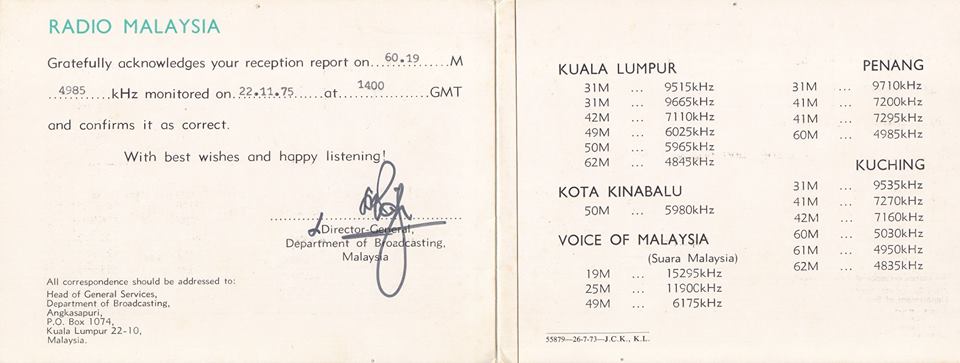
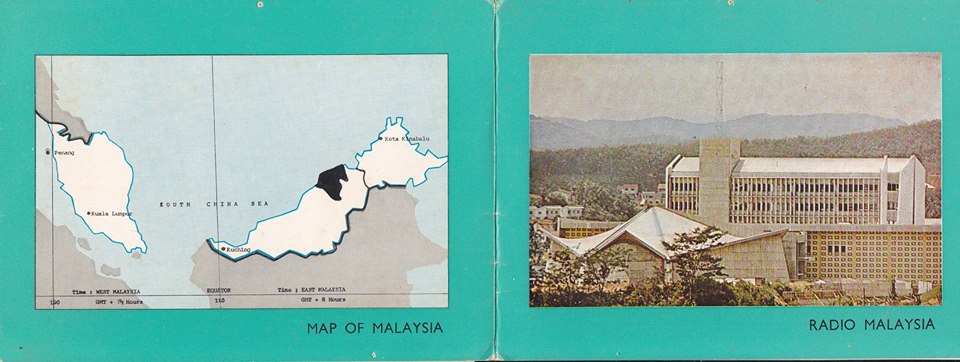
Radio Malaysia QSL Card

1796642_586212328138088_2007208208_n

Many thanks to SWLing Post reader,  Timm Breyel, who writes:

While browsing your site I noticed the QSL Gallery page. Interesting. I have many old QSLs from the 1960s and 1970s, all of which are stored away in the States, all except one. It’s a 40 year QSL from Radio Malaysia via Penang Island. The station was received in Denver, Colorado in 1975.

1962803_586212388138082_2102188524_n

It’s not the most attractive of QSLs, but it certainly is quite rare.

Timm, I love this QSL card and I have never seen one like it before. Thanks so much for sharing it with us!

Christoph’s photo tour of Friedrichshafen 2015

Photo by Christoph Ratzer

Photo by Christoph Ratzer

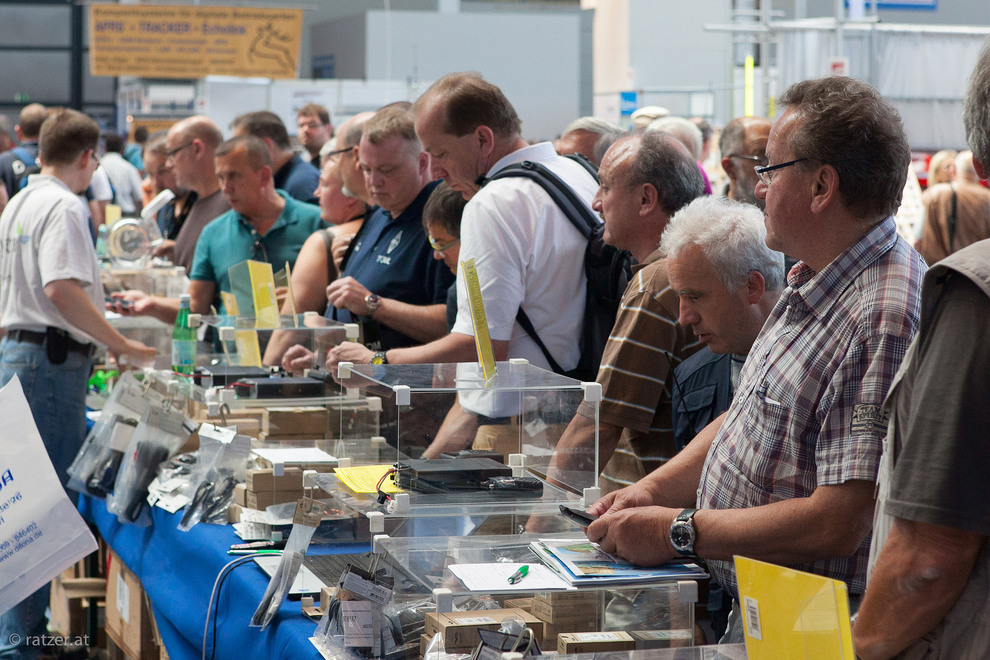
SWLing Post reader, Christoph Ratzer, has posted a photo gallery of the 2015 Friedrichshafen Ham Radio convention in Germany.

Click here to view Christoph’s gallery.

Many thanks, Christoph, for this fine photo tour! I actually recognize a couple of friends in those photos. I have always wanted to visit Friedrichshafen and I certainly hope to someday.

Readers: Check out Christoph’s website Kurzwelle Ratzer AT and the A-DX Fernempfang Facebook page.

Shortwave Radio Recordings: WWV changes announcement format,1971

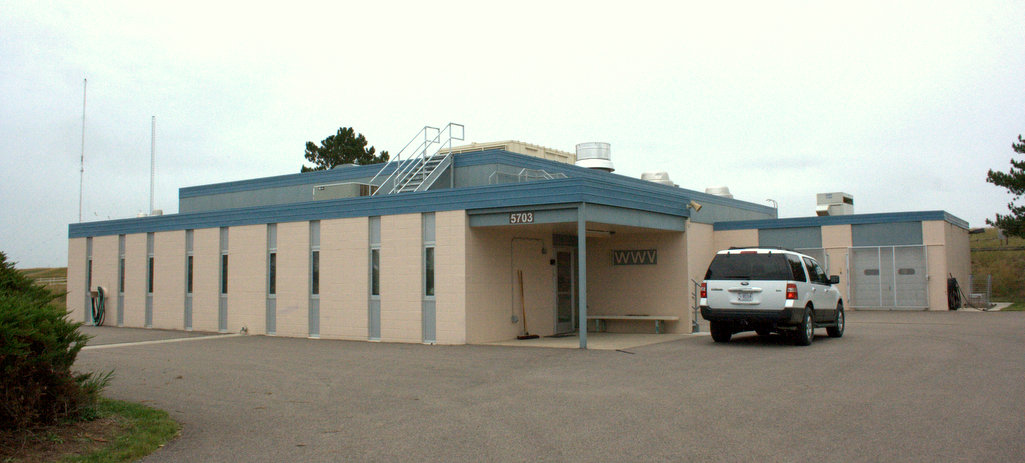
WWV's transmitter building in Fort Collins, Colorado (2014)

WWV’s transmitter building in Fort Collins, Colorado (2014)

Shortwave Radio Audio Archive contributor, Brian D. Smith, recently contacted me; I was enthused when he described the recording he was sharing:

This recording captures the last 5 minutes of WWV’s old format (giving the time every 5 minutes) and the first 5 minutes of the new format (giving the time every 1 minute), which took place on July 1, 1971 UTC.

Apologies for the less-than-stellar audio quality, but I recorded this as a 15-year-old fledgling SWL with limited knowledge of audio recording techniques. So I simply placed the microphone from my cassette tape recorder next to the speaker on the receiver and hit the record button. The signal quality wasn’t the greatest, either — lots of QSB and QRM — but I still managed to get what I was going for.

The resulting recording has accompanied me everywhere since then, preserved only on its original cassette, until 2008, when I finally decided it was time to learn how to transfer it onto my hard drive, burn it onto a CD and stop having to rely on the integrity of 37-year-old audio tape.

Even as a teenager, I regarded the WWV changeover as historic, and felt I should attempt to record it for posterity. Consider yourself posterity!

Brian received this broadcast on 10 MHz care of a Hallicrafters S-108, with random length of wire attached to the back of the receiver serving as an antenna. Location was Franklin, Indiana.

As Brian mentions, the audio quality is a little rough, but this is still quite a treasure of a recording!

Click here to download as an MP3, or simply listen via the embedded player below:

Again, thanks so much for bringing us this recording, Brian! We look forward to any other archived recordings you–or any other readers–may have to share with us here at the Post.

Papua New Guinea broadcasting 15th Pacific Games via shortwave

PacificGamesSWLing Post contributor, Rob Wagner, has shared the following update on his blog:

It’s quite difficult to hear Papua New Guinea these days now that nearly all their shortwave transmitters have closed and moved to FM. BUT….In the last day or so, PNG’s National Broadcasting Corporation has been transmitting on shortwave with two new outlets. NBC is the host broadcaster of the 15th Pacific Games, being held in the capital Port Moresby. The games begins tomorrow July 4 and runs through till July 18. The following schedule was noted from on-air announcements as follows:

6075 kHz – 1900 to 2159 UTC
9860 kHz – 2200 to 0959 UTC
6075 kHz – 1000 to 1400 UTC
12025 kHz – 2200 to 1000 UTC (to Pacific Island communities)

Many thanks for sharing this news, Rob!

Nigel Holmes also sent an update confirming that the transmitter site is Brandon and that the transmitter can run a 20 kW carrier. Nigel notes:

The aerials are HR 2/2/ 6-12 MHz arrays so about -6 dB cf. the arrays at Shepparton.

[…]The broadcasts have a power of 20 kW AM up from 10 kW when the site carried Radio Australia programming.

As of time of posting, I can hear the games here in the eastern US on 6,075 kHz, but the signal is very weak and the propagation window will close soon. I will also listen on 12,025 and 9,860 kHz.

Check out the Mount Evelyn DX Report for more details.