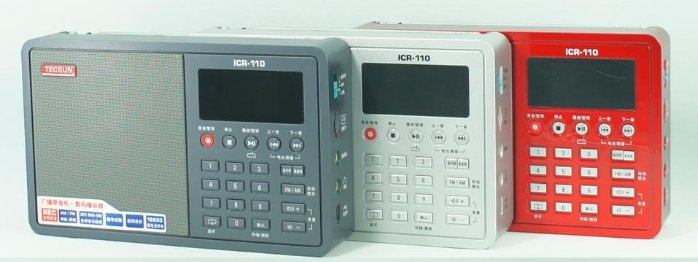
The Professor, over at The Radio Kitchen, has just published an excellent review of the new Tecsun ICR-110: an AM/FM radio with built-in MP3 recorder and player. While the ICR-110 is a little quirky, those of you looking for an affordable AM/FM recorder may find the ICR-110 a cost-effective tool. The price on eBay is $46 US shipped from Hong Kong.
While The Professor is kindly sharing his full review below, I would strongly encourage you to hop over to The Radio Kitchen to read this review, then browse his extensive collection of archived articles. I’m especially fond of his AM radio articles, bandscan recordings and the lost/found sounds he features on The Audio Kitchen. Thanks, Prof!
A Review of the Tecsun ICR-110 Radio Recorder
In a number of ways, the Tecsun ICR-110 is unlike any radio I’ve experienced. The operation is almost too simple. It’s idiot-proof in a way that will please some and frustrate others. At the same time it’s an innovative multifunctional device that works very well. For less than fifty bucks (including shipping from China) you get a sensitive AM/FM radio, an MP3 player and recorder, an amplified hi-fi speaker for your phone or laptop and an external sound card for your computer.  Not bad, right?
It’s cool. But hardly perfect. The built-in MP3 player/recorder interface is as primitive as anything I’ve seen. But it does make nice radio recordings. People who gather podcasts online or archive radio shows on their own could find the ICR-110 quite useful. For me it was an affordable impulse buy, but others may find this shiny box practical for any number of reasons. One thought I had: the 110 could easily upgrade or replace someone’s aging AM/FM cassette recorder.
It looks just a bit like the new Tecsun PL-880, but it’s not in the same league. And it’s lighter. Less oblong. While the more advanced electronics in the 880 add heft, both radios beat with the heart of a high-performance DSP radio chip. Don’t expect any of the bells and whistles of the 880 on this one, yet the raw medium wave reception is almost comparable. And they both have a surprisingly warm and rich sound. When you play music at room volume on the ICR-110 the sound is impressive in your hands. It’s more hollow than the 880 and you can really feel it throb with signal.
After playing with this radio for over a week, I like it. I’d even say it’s kinda cute. The display says “HI” when you turn it on, and it comes in three colors. I opted for red. Despite the lack of English on the radio or in the manual, after a little trial and error I felt like I had mastered most of the functionality. And the more familiar I get with the ICR-110, the more I’m starting to think we may eventually see more radios with a similar feature set. And that might not be such a bad thing.
New Toys from the Far East
Through my adventures in translating Chinese web sites, I’ve concluded that the ICR-110 is just one example of a new generation of radios and media players they’re building over there. Most aren’t packaged or marketed for the rest of the world (at least not yet) and Tecsun is only one of many brands in the game. The Tecsun PL-880 seemed to kind of come out of nowhere for many of us in North America, but after taking a look at all of these brightly colored radios and media players being sold overseas it puts some of the wonders of the PL-880 in context.
The 880 quickly earned street cred in the greater SWL community for good reason. It’s a nice machine. Specifically built as the flagship radio of the Tecsun line, the PL-880 is like a greatest hits package of features that have impressed many of us who have handled Tecsun winners like the PL-660 or any of their DSP family of ultralights. With the addition of some contemporary technological frosting, Tecsun has come up with a reasonably priced super radio of sorts for shortwave listeners all over the world. Like anything these days, opinions will vary, but considering the current price tag of just over a hundred and fifty dollars, I challenge anyone to come up with a new shortwave radio in that price range that’s a better deal than the PL-880, or more fun to use.
 This creative streak in Chinese electronics is the result of a rash of consumer devices being created to take advantage of the “radio on an IC chip” technology pioneered by Silicon Labs here in the U.S. The development of these DSP processors has made it possible to include excellent radio reception on all sizes and shapes of radios and media players at a low cost.
As the price of flash memory continues to drop, it’s a nice bonus that so many of these new Chinese devices also play MP3 files from storage you slide into an SD card slot. And having the ability to play high fidelity music is greatly enhanced by the trend to integrate an innovative audio chamber into many of these things. Looking through the little holes in the speaker plate, you might notice Mylar diaphragm with a front vent mounted alongside the speaker. First seen on these shores on the Meloson M7, this setup provides a fuller bass and treble response in a small package, with audio that’s less mid-rangy than most portables.
While the PL-880 display is a little brighter and more yellow than the black on orange display we’ve seen on recent Tecsun radios, most of the new ones reverse that color scheme. The ICR-110 and other new Tecsun products sport dark black displays, with all the reception information provided in bright orange text and symbols. Perhaps you heard that Eton here in America is giving their line of shortwave portables a makeover of sorts. Part of their new look will include changing over to this same orange on black display. And no surprise, those radios will be coming from China.
Most radios from that part of the world seem to come with a USB port lately. And although there are more interesting options these ports could provide, so far most are rigged as simple power inputs for charging batteries inside the radio (using either your computer’s USB port or an external AC charger). Instead of using traditional AA cells, a lot of this new gadgetry is powered by Li-Ion batteries, either flat cellphone batteries or those beefy 18650 cells. Many laptops are powered by a few of these, but the ICR-110 and the PL-880 just need one. (Inside the battery pack for the Tesla Model S you’ll find seven-thousand of those things packed together!) Many believe the 18650 will become the standard for the next generation of electronic products. But they’re not your mama’s D cells. If you’re not familiar with these batteries, it’s good to learn their quirks and to know how to avoid having bad things happen. And don’t buy the really cheap ones on eBay.
Good Radio, Weird Tuner
When it comes to purchasing an ICR-110 you don’t have a lot of options. Unless you live in China. At the time of this writing, there’s only one overseas eBay dealer offering it for sale. It wasn’t a vendor I’ve used before, and while the radio did arrive here safe and sound, a few of the pitfalls of buying from China were part of the deal. The English in the emails was a bit mangled. The online tracking was dysfunctional. And it took almost a month to get here.
For a while now, I’ve gotten great service and fast shipping from Anon-Co in Hong Kong. Over the years, I’ve had problem-free transactions with any number of Asian eBay dealers as well, but it’s always smart to do some research and check ratings and feedback before you buy goods on eBay. It seems that most vendors avoid selling Chinese-text radios internationally. But a representative at Anon-Co told me you can inquire via email (at this address) if you’d like to order an ICR-110 directly from them. And they say they’re working on an English language manual for the 110 as well.
 On the eBay page where I found the ICR-110, the description combined real specs with a sloppy copy-and-paste job from the description of another radio. Despite what I read there, there is no “power/volume knob” on the 110. More significantly, it doesn’t have a “tuning wheel” either. (Come to think of it, you don’t see those power/volume knobs much these days.) The 110 has a power switch on the right side. And all volume adjustments happen via two buttons on the lower right corner on the face of the radio. But oddly there are no tuning controls – only scanning buttons. And a keypad.
It’s not all Chinese on the radio case. The switch marked “AM/FM” is easy enough to figure out. But if you press and hold that button for a second or so, Tecsun’s ATS (auto tuning storage) will kick in and the 110 will scan the band for signals and store them as presets. It works well, most of the time. Using it at night on the AM band, I was impressed by how many  fringe stations it found. But it often misses one or two. Once ol’ ATS skipped over the monstrous fifty-thousand watts of Radio Disney, which pollutes a swath of the AM band from just a few miles away. Maybe the radio includes some artificial intelligence chip as well.
Under the display, there are five round buttons which primarily control the MP3 player/recorder. However, the rewind and fast-forward buttons also serve as scanning controls. A simple push will nudge the tuner over to the next (or the previous) frequency caught by the last ATS grab (labeling them as CH:01, CH:02…). And if you only punch in one or two digits, the radio will automatically take you to that “channel” in the ATS database. Holding either button down a little longer the radio will scan anew for the next signal strong enough to trigger it to stop searching. But that’s all it will do. Unlike other scanning functions I’ve used, this one has a mind of its own. It may not stop at your favorite weak station it passes along the way. If you are determined to tune to a particular frequency, the keypad will always get you there. Just type in the numbers and you’re listening to it instantly. Nonetheless, taking away the art of tuning will probably turn off many in the DX crowd, despite the fact that it pulls in a lot of signal.
 There are a couple of settings you can actually change. A pair of buttons with Chinese text above the AM/FM button adjust each band for international use . Press the left button while in radio mode and it will toggle to expand the FM band down to 64 MHz (for Russia and Japan) or back to the standard FM band for the rest of the world (starting at 87 MHz). The button on the right changes the MW scanning step. When I got the radio the first ATS scan barely found any stations. Then I realized it was because the step was set at 9 kHz. After an extended session of button pushing I finally figured out how to change the step to 10 kHz, the North American standard. Despite the Chinese characters everywhere, this was probably the only thing about the ICR-110 that wasn’t immediately easy.
A Bare Bones MP3 Recorder and Player
Since the golden age of the radio/cassette boombox, I’ve always been attracted to radios that let you keep what you hear. And there are plenty of digital recorders with built-in FM radios to choose from nowadays. But AM? Not so much. In close quarters, digital audio circuitry tends to broadcast a little noise on medium wave. So in order for the old and new technologies to get along, you need some shielding, or something. For the most part, Tecsun seems to have gotten this right. I’ve gotten nice, clear, AM radio recordings from the ICR-110’s tuner– I’d prefer to be able to set recording levels, but the ALC seems to work well.
After extensive experimenting, I did hear a bit of noise introduced into the ICR-110 while recording weak AM signals. Like a bad spot on a vinyl record, I heard a brief “phhhht” sound come around about every twelve seconds. I’m guessing it might be the sound of data packets being arranged on the memory card. In retrospect, this might have been related to having a low battery. I’ve only heard it happen a couple of times.
While there don’t seem to be any settings for the recording feature, I was really happy to see that it creates MP3 files at a reasonable bitrate (for radio recordings), and not those horrible low-sample rate .wav files or in some annoying and proprietary nonstandard format. (Oh, it’s not an Apple product so we don’t have to worry about that..) It fills the micro SD card with 128kbps stereo MP3 files (which I think are actually dual mono files). Considering that this radio doesn’t seem to tune in stereo, it’s a shame that the recording isn’t mono by default. It encodes using a non-standard sampling rate of 32kHz (instead of 44.1kHz), but that’s not something you’ll notice on a radio recording. Another funny thing, since there’s no way to set the date or time on the ICR-110, you’ll notice when you pull the flash card up on your computer that the MP3 files you’ve recorded have no date stamp. So, if you need to recall when you were making a particular recording you might wanna write yourself a note.
 In some ways, the ICR-110 is like a slightly larger version of the Meloson M7 or M8, except it also records. Like the Meloson, it gives you a lot of boom in a small box. But it’s a measure bigger so it sounds even better. And like the Meloson, the MP3 playback display is super primitive. All you see is the assigned sequential number for the track playing. But what makes the Meloson a formidable little music player (especially for travel) is that you can fill a flash card up with a few hundred or a few thousand songs and shuffle the whole lot of them for many hours of random fun. As far as I can tell, the 110 will ONLY play the files in order, period. For that reason I think it’s more practical for playback of podcasts or radio shows, unless you have some songs you want to listen to in alphabetical order for some reason.
When you’re listening to an MP3 file and then switch to the radio or shut the thing off, and then resume MP3 playback at a later time, it will start playing the file where you left off. This is a nice feature if you’re in the middle of an hours-long MP3 file (and holding down that fast forward or rewind button to find your place will take forever).
There are other quirks as well. When you’re recording from the radio you can change stations, but only by clicking through the ATS presents. While recording you cannot scan the band up to the next station by holding down the button. And you can’t change bands either. Of course, if you’re recording through the line input you can do whatever you want. And when you stop the recording it immediately starts playing it back to you. And the recording is noticeably louder than when you heard it the first time. It’s almost jarring. When you hit stop, playback ceases and it resumes playing the radio (or the line source audio) at the previous volume.
The ICR-110 treats the files you import onto the flash card differently than the ones you record. When you turn it on or switch to MP3 mode it automatically starts playing the last imported file played. Unless I’ve missed some setting, it appears that no matter what folder structure you’ve established on the card the 110 will simply play through each file on the card in alphanumeric order by path and name. But the recordings made with the radio are stored in a system folder the radio creates named “RECORD0″ (at least that what it’s called on my card). The pair of Chinese text buttons that change the parameters of AM and FM will also switch the MP3 player’s focus from the folders you’ve made on the SD card to the system RECORD0 folder, and back again. When in either mode you can move through the files in those folders by pressing the rewind and fast forward button once. However, when holding those buttons down the player will actually rewind or fast forward (silently) through the file at hand.
I also own another AM/FM radio recorder, the CC Witness. And while they do some of the same things, they’re very different gadgets. The CC Witness is a much smaller and more complex thing. And you’ll pay a lot more for that. You can program it to record up to 20 different radio programs on AM or FM throughout the week, and encode them at bitrates you choose. But the line recording input doesn’t have ALC like the Tecsun. When recording via the line input with the CC Witness, I’ve found it’s better to dampen the  incoming audio with a headphone volume control adapter to avoid distorted recordings. Of course the CC Witness is nice, but everything about it feels very 2003. Not that I mind that at all, but the CC Witness is overdue for an update. My biggest complaint about the CC Witness has been the tuner. They could start there.
The CC Witness came into being when C. Crane smartly transformed a language learning tool called the TalkMaster Slim in Asia into an AM/FM VCR-like tool for all of us. And after spending some time with the ICR-110 I think this radio might have been engineered for a similar purpose.
Apparently in Japan (and probably other countries) language lessons are commonly broadcast on medium wave. A digital AM radio recorder would make a lot of sense for somebody learning a language that way, but if you shop around you’ll discover that there are very few digital devices that include an AM radio, let alone offer you the ability to record AM radio programs. So it’s not surprising that the few gadgets that offer this option might cater to language students. Like the CC Witness, the ICR-110 also has a looping feature. While playing an MP3 file, you can press the button at the bottom left corner of the keyboard to select the beginning and ending of a chunk of audio and the radio will play it back ad infinitum, for pronunciation practice or mind control. Whatever works. But it’s not like the voices in your head. When you press the stop button, the repetition ends. Once I discovered this feature, it made me think that the odd instant feature (when you stop an ongoing recording) is probably related to language acquisition as well.
A Radio, A Sound Box
And lastly, the ICR-110 is a fine speaker for your phone or your laptop, or anything really. It’s certainly portable and has a warm, full sound. All it takes is a 3.5mm patch cord inserted into the outlet above the headphone jack. The display will read “LINE’ and the speaker will emit any audio coming through that cable. However, like some of the other new Tecsun radios, the ICR-110 is different than radios we’ve seen before. When you connect the radio with the  USB port on your computer it does more than just charge the battery. You’ve also probably just added an external sound card to your computer. When this is occurring you’ll see “PC” on the display.
I didn’t have much trouble navigating this, but depending on how your computer is set up (and your understanding of how it is set up), suddenly having another sound card may be problematic. I’ve used any number of external sound cards with computers over the years and when you attach and detach those things you may temporarily lose sound or change some settings. But if you were to use the ICR-110 as your primary computer speaker this could be an ideal scenario once you get it set up, with just one cable between the radio and the computer providing both the sound and power to the speaker.
I must say, other than that I haven’t really figured out what real advantages there might be to having the ICR-110 become a separate USB audio device when you plug it in. One thing I did notice: when connected to the computer USB, I hit record on the radio, and much to my surprise it recorded me. I don’t know where the microphone is hidden on this thing, but it’s there somewhere. Again, this feature may be related to using the 110 as a learning tool.
Perhaps there are more hidden settings on this thing, like all the easter eggs found on PL-880. But I kind of doubt it. I’ve tried holding down numbers of the keyboard and such, but nothing special seems to happen.  And I wouldn’t be surprised to see the MP3 playback and recording features of the ICR-110 added to a future version of the PL-880.
As I mentioned, the ICR-110 is just one example from a new wave of Tecsun radios and media players. You can find this radio’s FM-only little brother, the ICR-100, on eBay, but you can take a look at the family of new Tecsuns here and here. And if twenty years of Tecsun radios has shown one consistent trend, I think it’s safe to say that you’ll see some of their new line of gadgets re-branded (and perhaps transformed a bit) for international distribution, and ultimately bearing logos like Eton, Kaito, C. Crane or Roberts. Or maybe some Radio Shack nameplate.
Bottom line, many of these new Chinese gadgets offer great sound and decent radio reception at a good price. They’re fun to carry around and I don’t remember portables ever sounding this good. The ubiquitous flash card slot and MP3 playback seems like something that’s been a long time coming. As flash memory gets cheaper every day, one of these players and a packed memory card offers a world of high-fidelity music that fits easily in a knapsack, or even a pocket, at a price a pauper might afford. But the MP3 interface has got to get better.  The displayed information and the choice of settings for these MP3 players (and recorders) on these devices is a far cry from all the playback options and ID3 tag information you see on devices from Apple or SanDisk, or with almost any contemporary digital audio player.
I’m a big fan of Rockbox, the open source alternative firmware for digital audio players. Over the years I’ve installed it on dozens of MP3 players, making them more versatile and more fun to use. And if the idea of being able to tweak and perfect your player beyond the stock settings sounds appealing, you might wanna check out their site and see if they’ve adapted Rockbox for your device. A few years ago SanDisk famously sent some Rockbox developers one of their new players at the time to help them reverse engineer their hardware. I wish Tecsun would do the same thing. A marriage of the Rockbox firmware, with over a decade of creating a highly stable and adaptable audio playback firmware, together with these handsome and innovative radios, would be a real technological game changer. And who knows? Maybe some of those old and tired electronics titans like Sony or Panasonic might actually wake up and start making innovative radios for this century for a change.
 The predictions of the demise of over-the-air broadcast radio have always seemed a bit overblown to me. Maybe once they give every paper clip and bone in your body a URL, we can just surrender to that surging internet everywhere spirit and do everything online. Until then, the old AM/FM technology works fine (and it’s nice to consume media without logging in). This DSP technology paves the way to keep terrestrial radio around as one choice of many in our media landscape for a while. Sure, there are good arguments to be made that the programming on AM and FM is overdue for new thinking, but there’s plenty of dreck streaming on the web as well.
The truth remains– the old technology is stable, practical and proven. Why not improve it and make it more available, instead of trashing it? And why not include SD card slots on every kind of media player out there? Years ago when technology was in flux, we bought converters to dock to our radios and televisions so we could receive FM in our cars and UHF stations in our homes. But soon all those tuning options were built in. So after over a dozen years of fastening iPods and smart phones to the stereo, isn’t it time that our listening experiences have to include docking little gadgets to bigger ones?
And perhaps, in between listening to their favorite songs and podcasts, people might turn the radio back on every once in a while. Just for fun.
(This review originally appeared at the Radio Kitchen)