Shortwave listening and everything radio including reviews, broadcasting, ham radio, field operation, DXing, maker kits, travel, emergency gear, events, and more
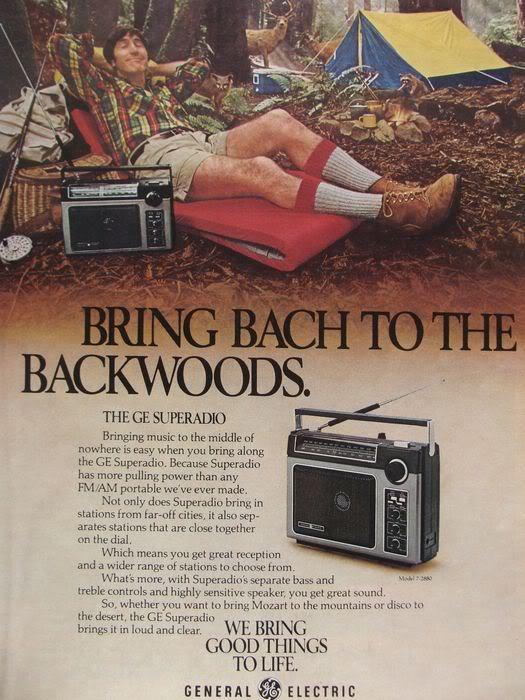
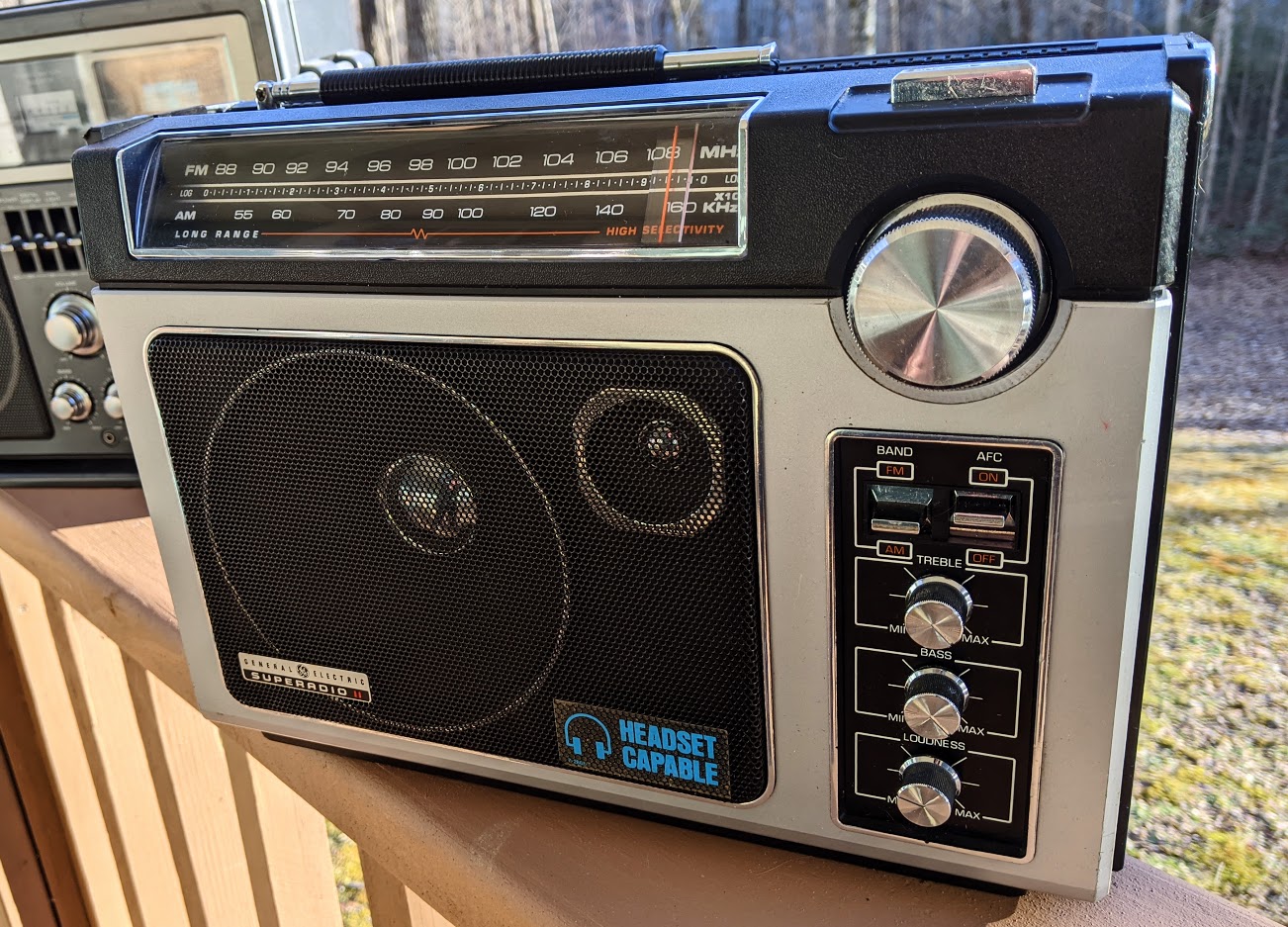
If you own a GE Superadio I or Superadio II and you would like an expert to restore and/or replace the capacitors, you’re in luck!
Chuck Rippel (K8HU) has announced that he will start repairing and restoring GE Superadios for anyone interested. In the past, he’s done this on a case-by-case basis when time allowed, but he has stocked up on top-shelf components and cleared off his workbench to bring Superadios back to life.
Chuck asks that you contact him via email if you would like your Superadio recapped or repaired.
You can reach Chuck at:
A note about the Superadio III
As mentioned above, Chuck only works on the SRI and SRII models.
Chuck notes that the issue with repairing SRIIIs is: “[working with] the tuning mechanism and putting it back together so it works and the dial is in reasonable calibration. If the dial cord comes off, it’s terrible to tray and re-install so, I stay away from model III’s.“
A new ultra-low-power method of communication at first glance seems to violate the laws of physics. It is possible to wirelessly transmit information simply by opening and closing a switch that connects a resistor to an antenna. No need to send power to the antenna.
Our system, combined with techniques for harvesting energy from the environment, could lead to all manner of devices that transmit data, including tiny sensors and implanted medical devices, without needing batteries or other power sources. These include sensors for smart agriculture, electronics implanted in the body that never need battery changes, better contactless credit cards and maybe even new ways for satellites to communicate.
Apart from the energy needed to flip the switch, no other energy is needed to transmit the information. In our case, the switch is a transistor, an electrically controlled switch with no moving parts that consumes a minuscule amount of power. [Continue reading…]
It’s about paid subscriptions — to the manufacturer, not the radio station
Apps for everything from optional equipment to entertainment is a big attraction for auto manufacturers.
For AM or even FM radio in cars, the solution could be worse than the problem: When manufacturers stop including radio as an in-console function, the workarounds make radio less local and face unimaginable competition, but what will roll out next is even more concerning.
The straight scoop
AM interference in electric vehicles, leaving radio out of the entertainment center, making radio more difficult to access — these are the real problems that the radio industry now faces.
Fact: Electromagnetic fields generated in non-gasoline engines make AM virtually unlistenable, spurring manufacturers to leave it out.
FM is more resistant to electromagnetic fields so for the present it survives.
Ford’s popular F-150 Lightning, Tesla, Volvo, Porsche and Audi have removed AM from their electric cars.
Tesla will sell consumers an app to get radio or satellite radio for a rental fee through internet delivery that gets around the electromagnetic interference. [Continue reading…]
Many thanks to SWLing Post contributor, JP, who shares a link to the FCC Pirate Radio database:
Pirate Database
In accordance with section 511(g) of the PIRATE Act, the following databases are provided to identify (i) each entity against whom an enforcement action for pirate radio broadcasting has been issued, and (ii) licensed radio stations.
Pirate Radio Database
Licensed AM and FM Radio Station Database
As far as islands go, Manhattan is one of the most famous and instantly recognisable. But if you were to charter a boat and sail around its coastline and through New York’s natural harbour you’d come across many more islands so small that hardly anyone knows are there. There are around thirty or so of these odd little islands, all mostly uninhabited or privately owned and strictly off limits, but filled with strange tales and peculiar histories.
Many of these islands are tantalisingly close to New York City, but remain out of reach. As travel writer Robert Sullivan put it “the islands are our silent neighbours. It is easy to live here and never notice them.”
[…]This story however, is about one such tiny island, just 150 feet square, and so small you can barely spot it on Google Maps unless you knew where to look. Once known as Little Pea Island, it is located about a mile off shore from Pelham Bay Park in the Bronx, and has room enough for just one building. It has been home to a Jazz Age era swanky yacht club, a radio station and for a while, the home to a glitzy Hollywood showbiz couple who ran a morning radio show from their home on the island. The last owner recently renovated the island into a self-sufficient, five thousand square feet luxury home, which today lies empty. [Continue reading the full story…]
A new ultra-low-power method of communication at first glance seems to violate the laws of physics. It is possible to wirelessly transmit information simply by opening and closing a switch that connects a resistor to an antenna. No need to send power to the antenna.
Our system, combined with techniques for harvesting energy from the environment, could lead to all manner of devices that transmit data, including tiny sensors and implanted medical devices, without needing batteries or other power sources. These include sensors for smart agriculture, electronics implanted in the body that never need battery changes, better contactless credit cards and maybe even new ways for satellites to communicate.
Apart from the energy needed to flip the switch, no other energy is needed to transmit the information. In our case, the switch is a transistor, an electrically controlled switch with no moving parts that consumes a minuscule amount of power.
In the simplest form of ordinary radio, a switch connects and disconnects a strong electrical signal source – perhaps an oscillator that produces a sine wave fluctuating 2 billion times per second – to the transmit antenna. When the signal source is connected, the antenna produces a radio wave, denoting a 1. When the switch is disconnected, there is no radio wave, indicating a 0. [Continue reading…]
It was a reader, Mario Filippi, who set me on this path. He posted a comment that said, in part: “An interesting place to DX would be the segment between 1500 – 1590 kc’s where there are a number of news stations, one being federal news on 1500.”
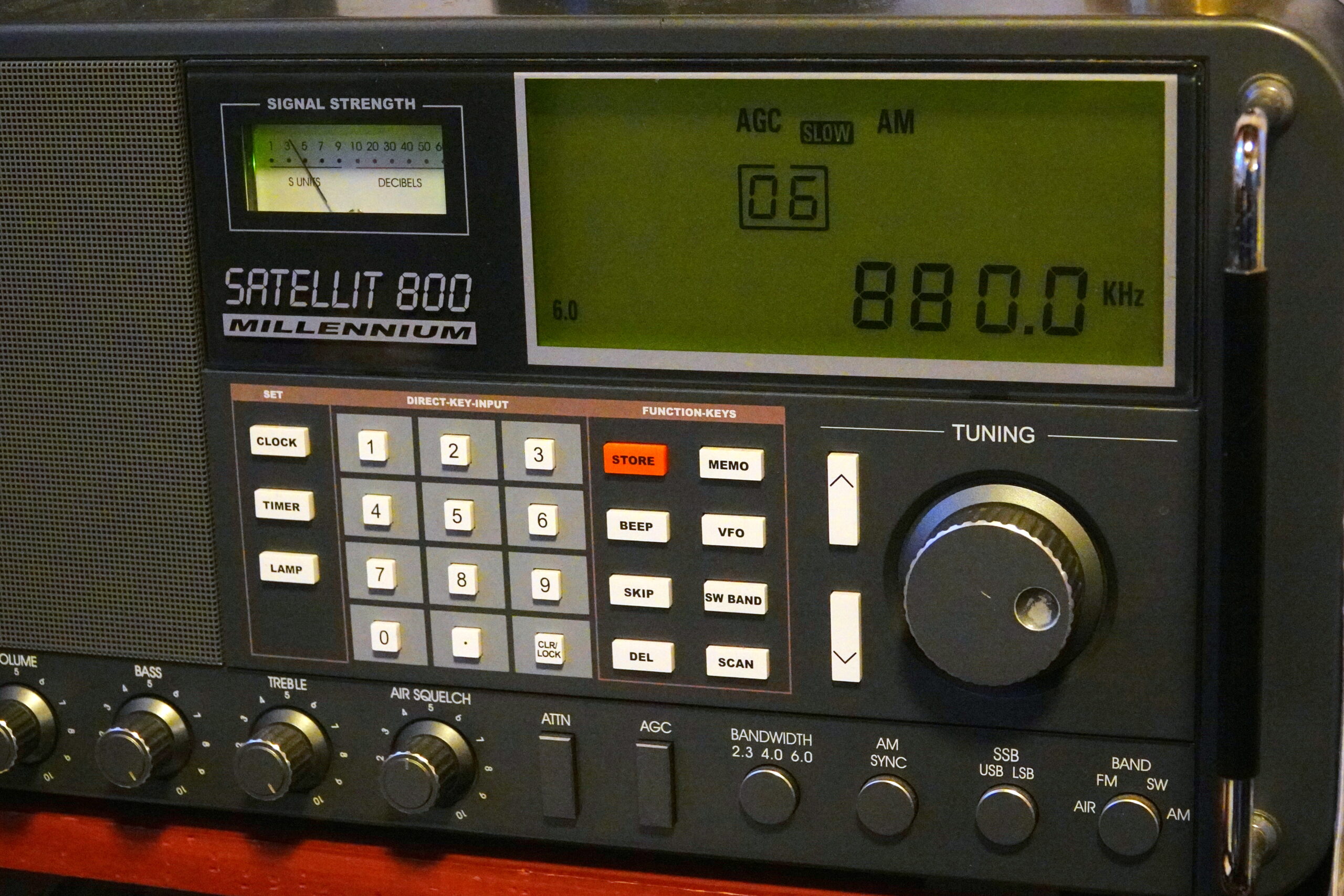
Huh, I thought, federal news? I wonder if I can hear that. So I hooked up the MFJ 1886 Receive Loop Antenna to my Grundig Satellit 800 receiver and tuned to 1500. With the 800’s whip antenna, I heard mostly static; switching to the 50-foot indoor room loop, pretty much the same; same thing with the 1886 with the amplifier turned off. But turn the 1886’s amplifier on, and it was like getting slammed against the wall by the schoolyard bully: LISTEN TO ME! A big, fat, S9 signal, sounding like WGY 810 just a few miles from me. Wow, I thought, this loop can really pull out a signal.
A little research revealed, as nearly as I can tell, that Federal News 1500 is in Washington, DC, over 300 miles from me. Over the next few days I would occasionally check on Federal News 1500 using the 1886 loop, and typically it was loud and clear here in Troy, NY.
Hidden behind a curtain, the 3-foot aluminum loop of the MFJ 1886 works well for MW DXing.
Early this morning, Jan. 28, 2023, a thought crept into my brain: how many big, fat, MW signals could I detect with the combo of the Satellite 800 and the MFJ 1886 loop antenna? (Bear in mind that my 1886 rests flat against a window and is NOT rotatable in its current configuration.) Here’s the log, with station IDs when I could get them.
TimeFrequencyStation
1100Z 1520 WWKB Buffalo
1102Z 1530 Milwaukee? Sports, Australian open
1106Z 1540 CHIN Toronto, old time radio programs
1112Z 1560 religious music
1115Z 1660 orchestral music, Strauss waltzes
1118Z 540 middle eastern music
1121Z 660 WFAN, NYC
1124Z 700 WLW, Cincinnati
1127Z 710 WOR, the Voice of New York
1129Z 730 French language, Canada mentioned
1132Z 750 WSB, Atlanta
1134Z 770 WABC, NYC
1135Z 790 ortho doctor show
1138Z 860 French language, Canada mentioned
1140Z 880 WCBS, NYC
1142Z 1010 WINS, NYC
1144Z 1020 Talk
1146Z 1030 WBZ, Boston
1148Z 1050 WEPN, ESPN radio, New York
1149Z 1060 KYW, Philadelphia, PA
1153Z 1090 WBAL, Baltimore
1154Z 1110 WBT Charlotte, NC
Bottom line: it was immense fun, tuning around for “fat” MW stations in the early AM. Periodically I checked the other antennas as I traversed the band, but universally the MFJ 1886 was better at pulling them in.
The potential sale of one of the country’s only major manufacturers of high-power FM broadcast antennas is causing concern among public radio engineers who have long depended on the company for challenging projects such as directional antennas and multistation combiner systems.
Antennas and combiners made by Shively Labs carry the signals of many major stations, from Boston’s WBUR to Dallas’ KERA/KXT to Seattle’s KUOW. Shively’s headquarters in Maine boasts one of the few test ranges needed to fully prepare complex directional antenna systems for real-world performance.
Founded in 1963 by former RCA engineer Ed Shively, the company has been owned since 1980 by Howell Laboratories, an engineering firm that now has a wide range of product lines. Those include water purification systems, dehydrators and an increasing amount of contract work for the U.S. Navy.
While its military and commercial marine business has grown, broadcast antennas have become a smaller piece of the company’s portfolio, said Shively VP Angela Gillespie. [Continue reading…]
Catching signals from others is how we have started communicating as human beings. It all started, of course, with our vocal cords. Then we moved to smoke signals for long-distance communication. At some point, we discovered radio waves and are still using them for contact. This article will describe how you can tune in using Fedora Linux and an SDR dongle.
My journey
I got interested in radio communication as a hobby when I was a kid, while my local club, LZ2KRS, was still a thing. I was so excited to be able to listen and communicate with people worldwide. It opened a whole new world for me. I was living in a communist country back then and this was a way to escape just for a bit. It also taught me about ethics and technology.
Year after year my hobby grew and now, in the Internet era with all the cool devices you can use, it’s getting even more exciting. So I want to show you how to do it with Fedora Linux and a hardware dongle. [Continue reading…]
There’s something missing from the newest F-150 Lightning truck
These days, the auto industry is as disrupted as broadcast radio. Like the radio companies – a group of independent operators, each moving down a different pathway – automakers are highly individual companies. Continue reading →
It was 1913, the year of the Binghamton Clothing Company Fire, and the year after the Triangle Shirtwaist Fire and the sinking of the Titanic.
Several major disasters that had left the region and the nation reeling from the loss of human life amidst a growing industrial base in the country. Thousands of immigrants were arriving to find new lives and work among the huddling masses. Many of those would make their way to the Binghamton area to find employment in the many cigar and shoe factories scattered on the landscape.
It was important to find a feel-good moment in the ever-rapidly increasing technology world that was changing the way we performed our work and lived our lives. Communication growth was one aspect of those changes. The number of newspapers and their influence was important, but so was the development of what we today call radio – originally known as wireless telegraphy, using radio waves to transmit telegraphic signals from point to point.
The first practical incarnation of wireless telegraphy was created by Guglielmo Marconi of Italy. The discovery of those waves had been made only about two decades prior to his use of those to transmit telegraph signals. In 1897, he formed the Wireless Telegraph & Signal Company in the United Kingdom. The company would later be called the Marconi Wireless Company, and continued to work on the ability to send these wireless signals farther and farther. Eventually, he also worked to see if these signals could be transmitted and received by moving objects, such as ships at sea and railroad trains. [Continue reading…]
Orson Welles’ contrived The War of the Worlds news bulletin “interrupted” a radio broadcast in 1938 to advise terrified listeners that aliens had invaded the Earth. As many as 12 million people were tuned in, according to NPR – and perhaps a million of them apparently worried that it was actually happening.
We’ve gained historical perspective on the stunt, even while the way we consume media has vastly changed over the decades that followed. Critics would later downplay the impact of The War of the Worlds, with some arguing that newspapers purposely over-sensationalized the broadcast to cast doubts on the trustworthiness of then-new technology that was siphoning off ad revenue.
What’s clear is that signal intrusions – including unauthorized hijacking of radio, television or satellite feeds – have continued ever since. They’ve served a variety of purposes, as you’ll see on the following list. Many were a form of political protest, while others were just looking to have a little fun. All of them trace back in some way to Welles’ fateful “interruption.”
Southern Television Broadcast
Nov. 26, 1977, England
Viewers of an early evening Southern Television broadcast in England were alarmed when an electronic voice purported to represent the “Ashtar Galactic Command” overtook the audio of a news segment for a full six minutes. The message, which was accompanied by a pulsating sound and eerie distortions, said: “For many years, you have seen us as lights in the sky. We speak to you now in peace and wisdom as we have done to your brothers and sisters all over this, your planet Earth.” This strange voice went on to advise humanity to “abandon its weapons” in order to participate in a “future awakening” and “achieve a higher state of evolution.” It also warned viewers that government officials weren’t who they claimed to be, and that they were leading the unwitting public into a New World Order. The hack ended with a final message: “Have no fear, seek only to know yourselves, and live in harmony with the ways of your planet Earth. We hear at the Ashtar Galactic Command thank you for your attention. We are now leaving the planes of your existence. May you be blessed by the supreme love and truth of the cosmos.” The interruption prompted a flood of phone calls from an understandably concerned audience then living under the threat of Cold War. A local newspaper said “thousands” of viewers were horrified; one man described the experience as “very eerie indeed” and said it “sounded very authentic.” A woman said she had to call her friends to make sure she wasn’t “hearing things,” adding that “it sounded like a genuine voice from outer space and was quite frightening.” An investigation revealed the Independent Broadcasting Authority’s Hannington transmitter had rebroadcast the signal from a nearby, unauthorized transmitter. The mastermind behind it all was never identified.
Researchers in Drexel University’s College of Engineering have developed a thin film device, fabricated by spray coating, that can block electromagnetic radiation with the flip of a switch. The breakthrough, enabled by versatile two-dimensional materials called MXenes, could adjust the performance of electronic devices, strengthen wireless connections and secure mobile communications against intrusion.
The team, led by Yury Gogotsi, Ph.D., Distinguished University and Bach professor in Drexel’s College of Engineering, previously demonstrated that the two-dimensional layered MXene materials, discovered just over a decade ago, when combined with an electrolyte solution, can be turned into a potent active shield against electromagnetic waves.
This latest MXene discovery, reported in Nature Nanotechnology, shows how this shielding can be tuned when a small voltage—less than that produced by an alkaline battery—is applied.
“Dynamic control of electromagnetic wave jamming has been a significant technological challenge for protecting electronic devices working at gigahertz frequencies and a variety of other communications technologies,” Gogotsi said.
“As the number of wireless devices being used in industrial and private sectors has increased by orders of magnitude over the past decade, the urgency of this challenge has grown accordingly. This is why our discovery—which would dynamically mitigate the effect of electromagnetic interference on these devices—could have a broad impact.”