Category Archives: AM

Update 2: Sangean DT-160CL v Sony SRF-39FP

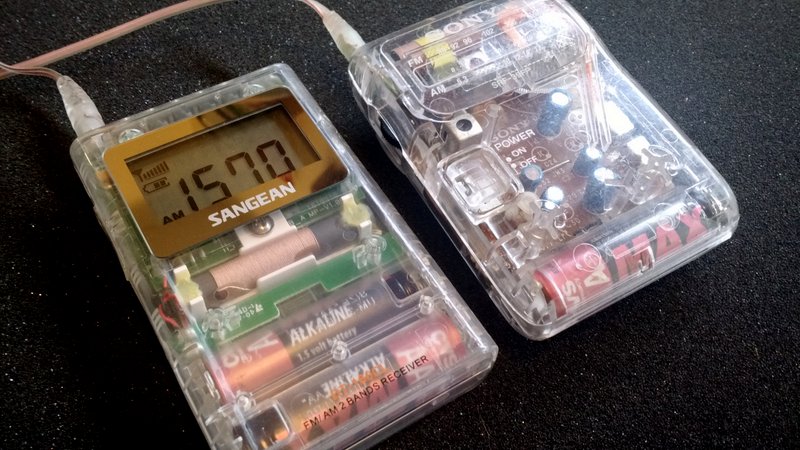
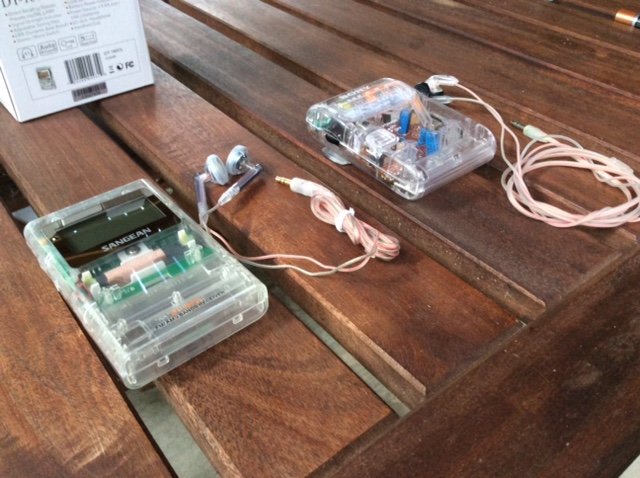
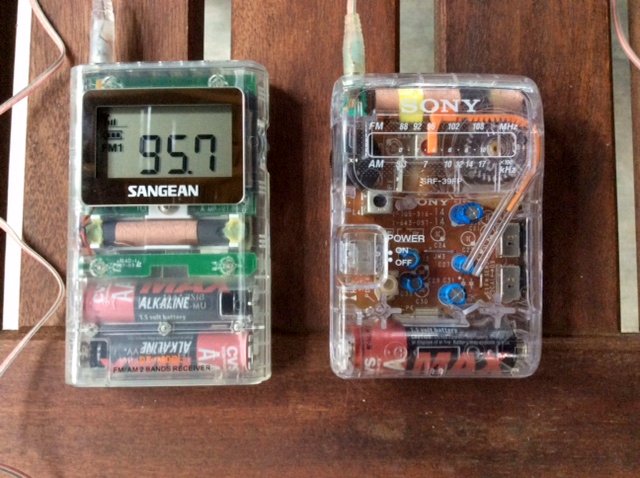
Sangean-DT160CL and Sony SRF-39FP

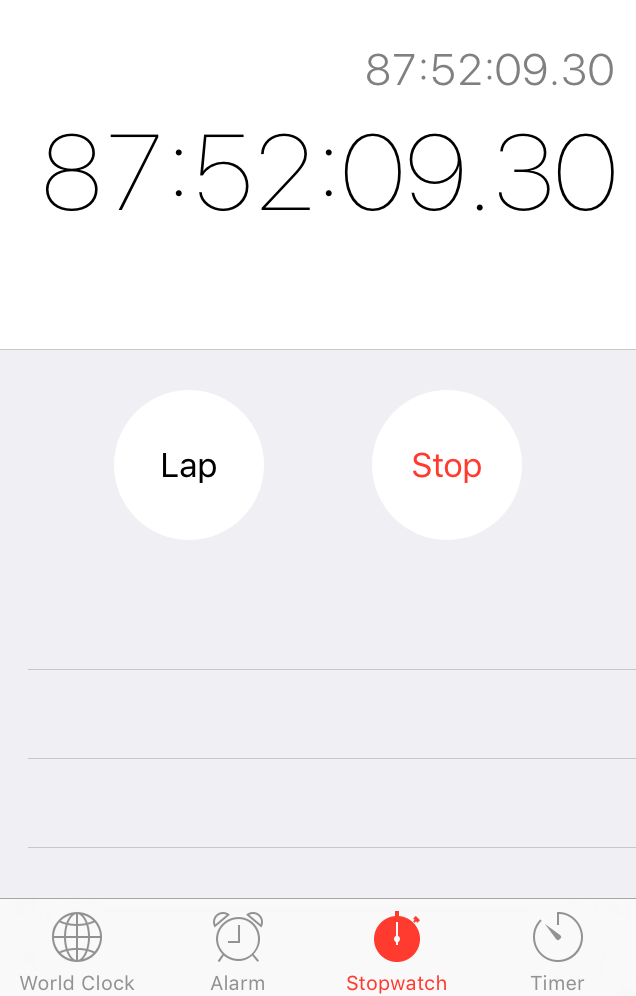
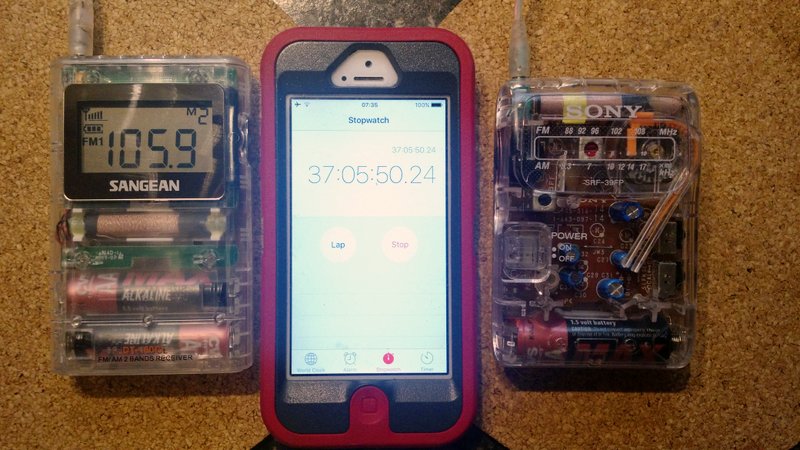
It’s been eighty seven (!!!) hours since I started the Sangean DT-160CL versus Sony SRF-39FP endurance test and both radio are still going strong.

My iPhone stopwatch has been tracking the test.

My iPhone stopwatch has been tracking the test.

I’ve tuned both radios to my SSTran AMT3000 AM transmitter which is currently re-broadcasting the UK 1940s Radio Station on 1570 kHz.

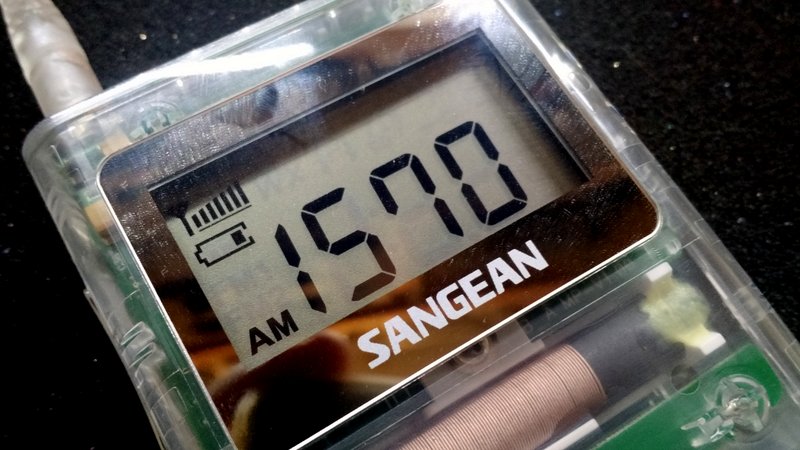
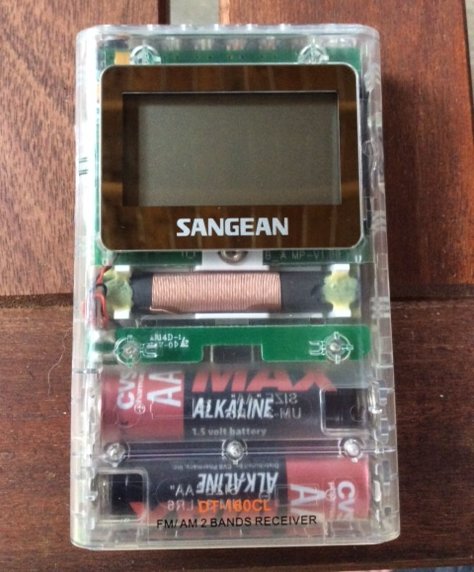
The Sangean DT-160CL still shows two of three segments on the battery indicator (see above).

The Sony SRF-39FP seems to have no indication of quitting anytime soon–it’s still sensitive and audio sounds great.

I believe the Sony SRF-39FP is rated for 80 hours of playtime, and I’m sure if I had turned it on and off numerous times during the test, it might have had an impact on battery performance. It’s still going strong, though.

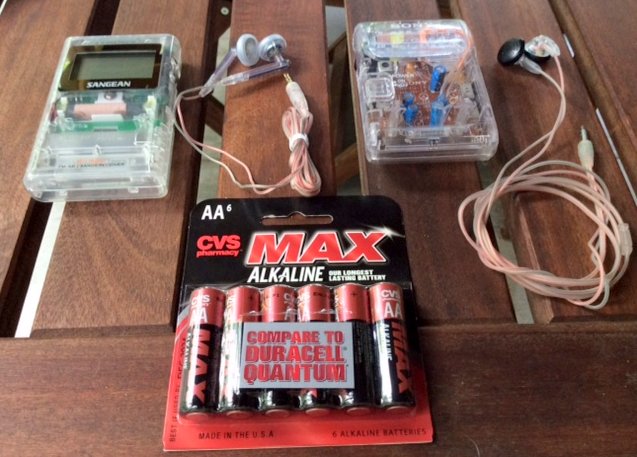
I am using advanced alkaline (CVS Brand) batteries in both radios. These should give each radio better battery life than standard alkaline or rechargeables.

Regardless which radio wins this test: both have already proved themselves “Holy Grail” battery misers!

I’ll be monitoring the radios very closely today as we pass the 90 and 100 hour mark!

Sangean-DT160CL-BatteryIndicator

UPDATE: Shortly after making this post–at almost exactly 88 hours and 30 minutes into the test–the Sangean DT160CL’s battery indicator lost a battery indicator segment. It’s now only showing one of three battery segments. Could the end be near for our DT-160CL? Stay tuned!

Follow this review thread by bookmarking the following tag: Sangean DT-160CL v Sony SRF-39FP.

Update: Sangean DT-160CL v Sony SRF-39FP

Sangean_DT-160CL_21

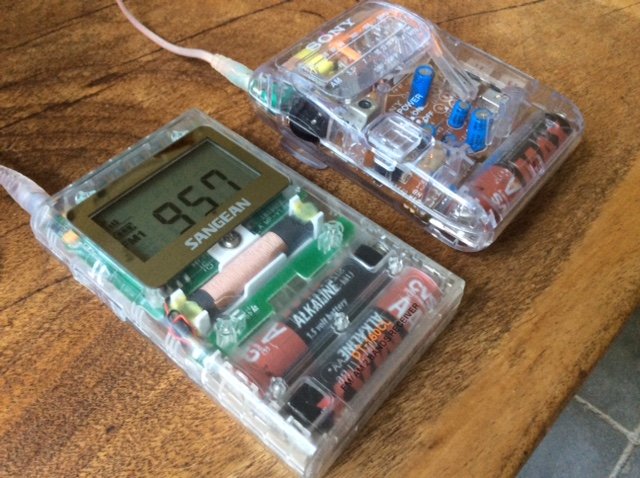
It’s been thirty seven hours since I started the Sangean DT-160CL versus Sony SRF-39FP endurance test and both radio are still going strong.

Sangean-DT-160CL_and_Sony-SRF-39FP

So far, the DT-160CL’s battery indicator still shows full voltage. The SRF-39FP has no battery indicator, but through experience I know it’s nowhere close to quitting.

I’ve spent some time tuning both radios and comparing them on mediumwave/AM and FM.

The DT-160CL does an amazing job on the FM band and has a definite edge on the SRF-39FP.

On AM, however, the SRF-39FP seems to wipe the floor with the DT-160CL.

In truth, though, it’s tough to evaluate performance and audio while the endurance test is ongoing, so I should reserve judgement. During the battery endurance test, I’m using the supplied earbuds from both radios. The Sangean’s earbuds a fairly large and uncomfortable in the ear–they make the audio sound hollow and too focused on mid-range tones. In truth it’s pretty much the same thing for the 39FP’s buds.

I can’t wait to use some of my proper in-ear buds on the DT-160CL and evaluate its audio characteristics on AM and FM.

Follow this review thread by bookmarking the following tag: Sangean DT-160CL v Sony SRF-39FP

Paul’s review of the Kaito KA108

Many thanks to SWLing Post contributor, Paul Dobosz (K8PD) who shares his review of the Kaito KA108. Paul originally wrote this for the Michigan Area Radio Enthusiasts and has kindly allowed us to post it here:


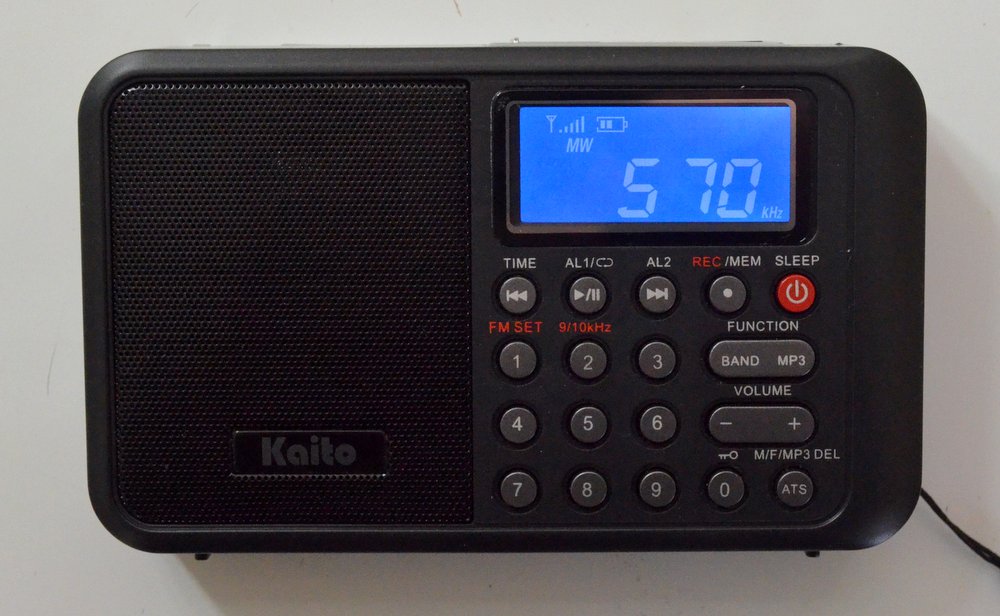
Kaito KA-108 Review
Kaito-KA108-AM

by Paul Dobosz (K8PD)

Kaito just introduced a pocket sized DSP based MW/SW/FM receiver with some interesting features missing in other SW receivers its size. I just got my hands on one for the first time a couple of months ago and am getting familiar with its features, performance, and quirks. I first saw the KA-108 at the Consumer Electronics Show in early January when I visited the Kaito booth and spoke with Walter about their newest radios. There are no schematics included with the KA-108 and I haven’t cracked open the case but based on the functionality, size, and price point it appears that the KA-108 utilizes the now common DSP based receiver architecture found in most of the new portable radios.

First of all, a brief run down on the features and functions of this compact little radio.

  1. Compact Size –  5.5” x 3.25” x 1.1” Weight 9 oz
  2. Frequency Coverage – MW: 520 – 1710 KHz, FM: 64 – 108 Mhz, SW: 2300 – 23000 KHz
  3. Memories – 400 (100 MW, 100 FM, 200 SW)
  4. Power – BC-5 Rechargeable LiPo 3.7V battery
  5. Other Features
    • Timer/Clock radio dual alarm function
    • MP3 Timer record & playback to/from a Micro SD card
    • Standard USB port that accepts a thumb drive.
    • Exceptional Bass Response for travel sized radio
    • “Auto Store” feature will scan and store frequencies
    • Battery charging via micro USB (no wall wart to carry)
    • Audio “line In” can be used as computer or MP3 speaker

Most radios have their good and not so good points and the Kaito KA-108 is no exception. Here is a rundown on the LA-108’s “HITS & MISSES”

The HITS

This radio is small and lightweight which makes it an ideal travel radio.  The control layout features a full keyboard for frequency entry as well as up and down keys that will search for signals when held down.  The fit and finish are excellent and the keys have good positive tactile feel.  There are two rocker switches, one for volume up/down and the other for band/mode selection.  The radio comes with a decent user manual and quick start guide.  The manual’s English is a little awkward in places but is fully understandable.

The backlit LCD display is brightly lit with large white numbers on a blue background.  It is easy for older eyes to read, even without glasses.  The signal strength meter is actually fairly useful which is rare for radios at this price point.  

The standard frequency step is matched to channel spacing for the band in use with exception of the FM band which tunes in 100 KHz increments instead of the US standard 200KHz steps when the frequency range is set to the North American band.  The FM band can be set up to tune all the way down to 64 MHz if desired but since TV has migrated from analog to digital the usefulness of that coverage is minimal for North American users.  AM is 9 or 10 KHz step capable with a frequency range to match all parts of the world.  In addition to the standard frequency steps, the thumbwheel encoder can be used to fine adjust the frequency between the standard increments in 1 KHz steps.

The MP3 playback is very pleasant to listen to.  I tested it with several different genres of music with consistently good sound quality.  I haven’t tried the recording function yet but it is definitely a nice feature, especially in such a compact package.  The KA-108 has a standard USB input (not mini or micro) behind a sliding door on top of the radio for external memory devices like thumb drives.  MP3s can be played and audio recorded to/from this port as well as the Micro SD card slot aside of it.   I’m also hopeful that the USB port may be capable of upgrading the radio firmware in the field.   If not, that’s another feature that Kaito should definitely consider for future versions of the KA-108.  (More on that later)

One feature I really like is the rotary tuning thumbwheel encoder on the side of the radio.  It has a light detent feel that allows you to manually tune the radio in 1 KHz steps to easily allow you to move to one side of a signal.  Frequency entry via the numeric keyboard is straight forward and intuitive with exception of the non-standard location of the zero key to the right of the bottom row of the numeric keys.  

The FM reception is excellent with bass response that makes you wonder how such a mellow sound comes out of such a small box.  Despite the 1.5” speaker, the audio has lots of bass and lacks the “tinny “sound of most travel portables with small speakers.  It plays loudly without distortion.

MW reception was typical for a radio with limited space for a small ferrite antenna and I was able to hear the usual SWBC stations and time/frequency UTE’s on the HF bands.  SW reception using just the 20” whip was just OK with easily listenable strong signals found on most of the active SW bands 2MHz and above.  The KA-108 is AM only on the HF bands (no SSB or CW).  There are some quirks with the MW and AM reception that I’ll cover in the MISSES section of this review

The MISSES

I never thought I would complain about a portable receiver with a “too tight” a bandpass filter but the KA-108 is a first.  The bandpass filter for MW &SW are extremely narrow which when coupled with the KA108’s exceptionally strong bass response, reduces the intelligibility of the received audio on the MW and Shortwave bands.  I have been able to mitigate the situation a little bit acoustically by covering a portion of the speaker grille with my hand or placing a small tube in front of it which seems to attenuate the bass and improve the overall audio response but the audio is still lacking in the higher frequencies that make things like music and the human voice more intelligible.  

Tuning 1-2 KHz off of the carrier frequency with the thumbwheel helped improve things a little bit similar to the way you might use IF shift on a high end tabletop receiver.  I also noticed that stronger stations that have a signal that spills further down the filter’s skirts had better audio response than those that lacked sufficient strength to spill over the filter response curve. I am hopeful that Kaito will offer a firmware upgrade to open up the bandwidth.  If the USB port used to play thumb drives has hooks into the radio’s CPU then it might be possible to open up the bandwidth and improve the MW and SW audio without cracking open the radio case to re-flash the CPU or make a hardware change.  The bandwidth issue is the largest single miss for the KA-108 in my opinion

I found a few buzzes and whistles on the MW band and you can hear the CPU clock oscillator strongly at 12MHz.  I haven’t looked inside of the radio yet but I would imagine that some of the MW noise can be tamed with a bit of internal shielding.  

I also found the AGC setting to be a bit too abrupt, jumping up and down in almost a step function with a signal whose level was fluctuating quite a bit.  That’s another minor software adjustment to consider for the next edition.

Due to the KA-108’s small size, the whip antenna is rather short (only about 20”) which means the front end must have a lot of gain leaving it more vulnerable to overload.  I was able to receive a the stronger SWBC stations while sitting in the middle of my house but I also heard another faint signal under the SW stations.  The interfering signal turned out to be a local 1KW AM station on 145o KHz whose transmitter is about 4 miles from my home.  It was present in the background while listening to SWBC and was heard standalone on its 2nd and 3rd harmonics which were most likely generated internally due to the high gain front end.  The short SW antenna does create the need for higher front end gain but should be accompanied by a high pass filter behind the SW whip antenna or at least a 10dB attenuator.  Either or both of those features would reduce AM BCB intrusion while listening to SWBC.  

In the coming weeks I’d like to do some parametric measurements on the KA-108 and will also see how it behaves with a longer antenna and antenna tuner with low pass filter ahead of it.  That should be a good test to see if a simple filter can eliminate the AM intrusion.  Improvements to widen the AM/SW filter bandwidth and reduce the AM overload should be high priority improvements for the next version of the KA-108.  

Summing It Up

I found the KA-108 easy to operate as I’ve explored the AM/SW/FM and MP3 operating modes and it’s a nice sized radio for casual listening when I’m at home or to take with me as I travel for use as an alarm clock, music player, and radio in one compact package.  

The KA-108 has potential with a few software and hardware tweaks. Fixing the MW/SW bandwidth is #1.  A simple high pass filter that rolls off just above the AM broadcast band behind  the SW whip antenna is #2.  I can live with a few buzzes and tones but why not fix them with a little inexpensive shielding while adding the other fixes.  

The KA-108 will never match the performance of tabletop or lunchbox sized portables, but if you’re looking for a nice little radio that will almost fit in your shirt pocket with nothing more than a micro USB cable to tote along for battery charging, and a radio that sounds twice its size, this radio fits the bill.  I hope that Kaito will address the issues I’ve noted with future software/hardware revisions to improve the performance of the KA-108 and maybe even offer a way for current owners to field upgrade their radios.  


That’s a thoughtful and fair assessment of the Kaito KA108, Paul. It’s a reminder that, with a few strategic tweaks, the KA108 could be a great little portable. Thank you for sharing your review with us! 

The Sangean HDR-16: Dan takes notice

HDR-16

Many thanks to SWLing Post contributor, Dan Hawkins, who comments in reply to our post about the Sangean HDR-18:

Darn. Just when you thought you read a review of the latest Sangean radio another one comes out. I have yet to find a review of the Sangean HDR-16.

[The] HDR-16 is a portable AM-FM HD radio with stereo speakers. Runs on household AC power or four C cells. At 10? long this is not exactly pocket sized but small enough for beach or nightstand duty. I wonder how fast it eats up the C batteries?

I don’t think HDR-16 will hit the shelves until mid-September.

Dan then followed up with pre-order prices:

That Adorama price is correct! I just noticed that Universal Radio also has a pre-order price of $99.99.

$100 US is not a terrible price for a quality portable AM/FM stereo analog/digital radio. Indeed, that may be the best price I’ve seen for that particular feature set. I bet four C cells will power it for quite a long time, too.

At second glance, the HDR-16 has an impressive feature list (via Sangean):

  • HD Radio digital and analog AM / FM-Stereo reception
  • 10 Memory Presets (5 FM, 5 AM)
  • PAD (Program Associated Data) Service
  • Support for Emergency Alerts Function
  • Automatic Multicast Re-Configuration
  • Automatic Simulcast Re-Configuration
  • Auto Ensemble Seek
  • Real Time Clock and Date with Alarm and Sleep Function
  • 2 Alarm Timer by Radio, Buzzer
  • HWS (Humane Wake System) Buzzer and Radio
  • Snooze Function
  • Tone & Bass Control
  • Information Display for Channel Frequency, Call Sign, Radio Text, Audio Mode, Service
  • Mode, Signal Quality and Clock Time
  • Easy to Read LCD Display with Backlight
  • Battery Low LED Indication
  • Auxiliary Input for Additional Audio Sources
  • Record Output for Connecting to Hi-Fi System or Recording from Audio Program
  • I/O Jacks: DC In, Line-Out (Rec-Out), Aux-In, Headphone and HD / FM Rod Antenna

The feature set sounds like something that would appeal to my buddy Jeff McMahon. He’s been looking for a bedside radio for quite a while. This one has a “Human Wake System”–perhaps meaning the alarm gradually increases the volume? Of course, I question if the HDR-16 will perform well on the AM broadcast band–I suppose it depends on how well the receiver is shielded from CPU noises, etc.

I might be tempted to grab one of these and test it. I like the price tag much better than that of the HDR-18, though I’m not sure its audio fidelity will be comparable. While I doubt I can receive an HD broadcast from my home, it might be fun trying.

Have any SWLing Post readers pre-ordered the HDR-16? Care to do a review?

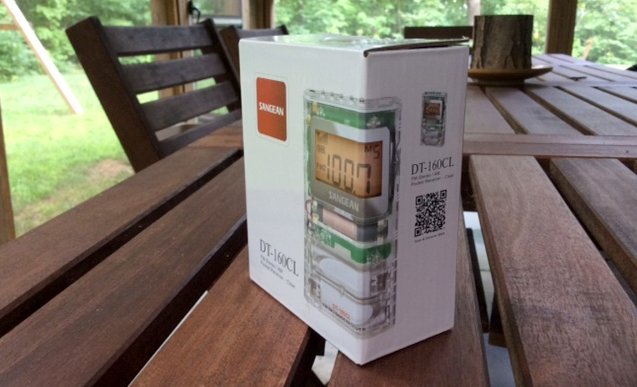
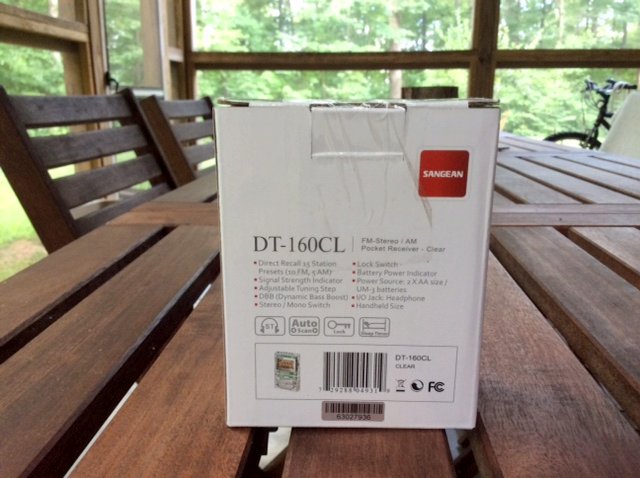
Unboxing the Sangean DT-160CL and setting up an endurance test

Sangean_DT-160CL_1

Yesterday, I received my Sangean DT-160CL–the correctional version of the DT-160–from AmazonSangean_DT-160CL_2

Even though the Amazon product page showed 5 units in stock on July 29, and though I get free two day shipping via Amazon Prime, my  DT-160CL took four business days to arrive. Out of curiosity more than anything else, I asked Amazon why the delivery would take four business days instead of two my Prime membership promises.

Amazon replied that stock levels weren’t correctly displayed on the product page at time of ordering since the DT-160CL was selling so quickly.
Sangean_DT-160CL_3

Amazon apologized for the confusion and–though I wasn’t seeking one at all–they issued a $10 credit!  Wow–thanks, Amazon!

Sangean_DT-160CL_4

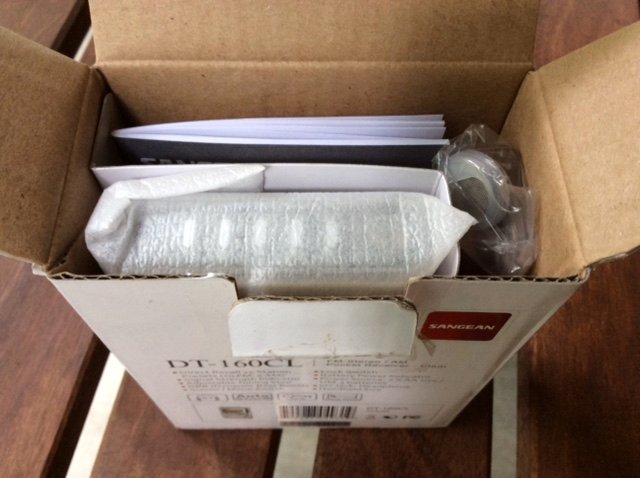
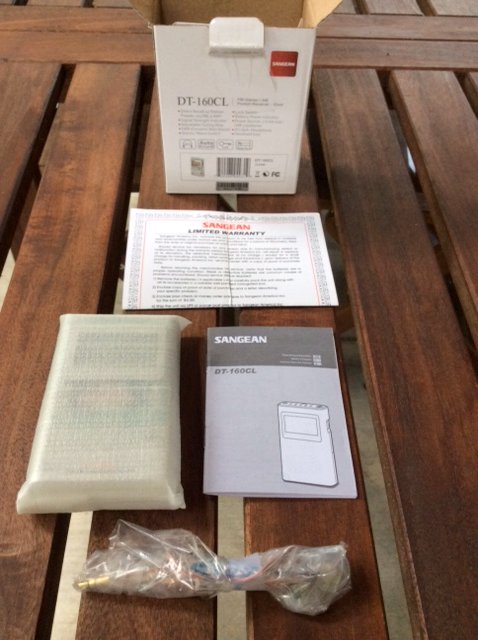
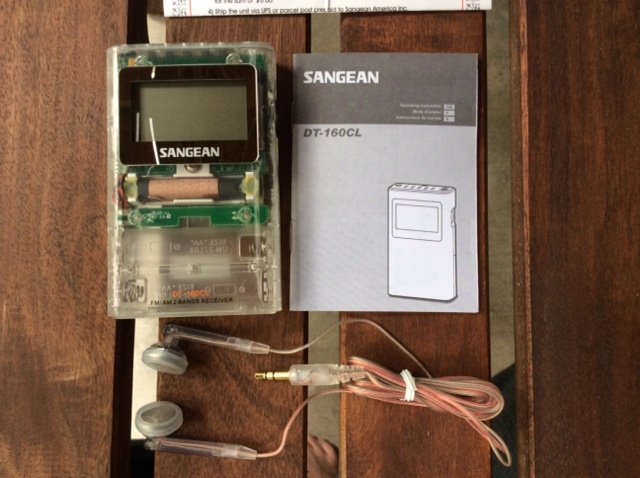
The DT-160CL is supplied with a set of clear earbuds, an owner’s manual and a warranty card.

Sangean_DT-160CL_6

Sangean_DT-160CL_8

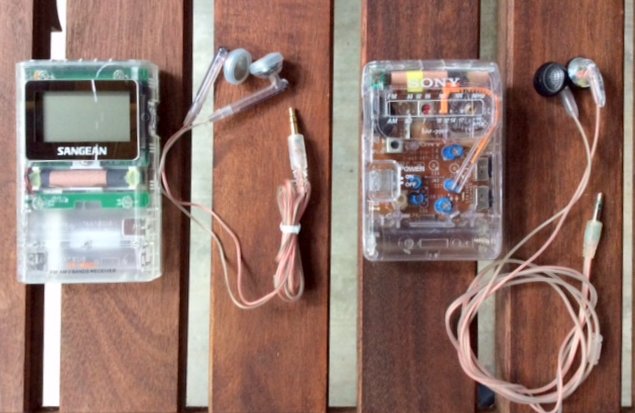
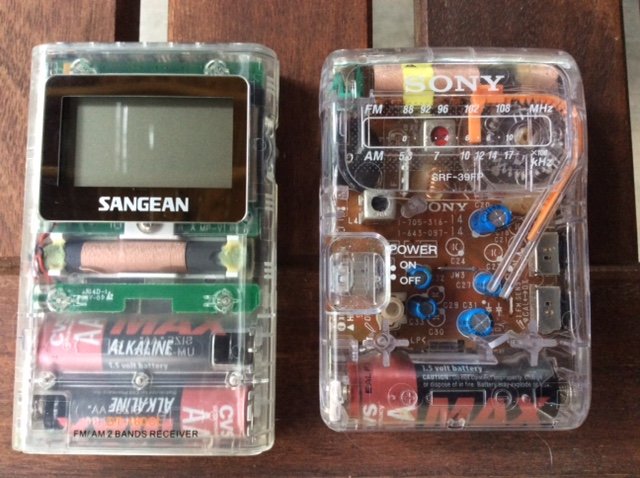
The Sangean DT-160CL is very close in size to the venerable Sony SRF-39FP–the SRF-39FP has slightly more depth and a little less height.

Sangean_DT-160CL_16

The DT-160CL’s clear case, while sturdy, feels marginally more supple than that of the Sony SRF-39FP.  Though I haven’t been able to confirm, the DT-160CL chassis feels like a polypropylene product while the SRD-39FP feels like polycarbonate. From the photos above, one can see that the DT-160CL’s case is a touch more opaque/cloudy than that of the SRF-39FP.Sangean_DT-160CL_10

Endurance test

Other than overall receiver performance, I’m very interested in battery performance since Sangean touts a 100 hour run time on two AA batteries (for the DT-160 series).

Having used the Sony SRF-39FP for a few years, I can attest to an incredibly long battery life as well. No doubt, those purchasing the DT-160CL for use in a correctional facility place a lot of value on battery performance.

Sangean_DT-160CL_13

I stopped by our local CVS pharmacy to purchase fresh alkaline batteries for both radios. CVS had a sale on their own (generic) version of the Duracell Quantum alkaline batteries.  I purchased a set and popped them in both radios.

Sangean_DT-160CL_14

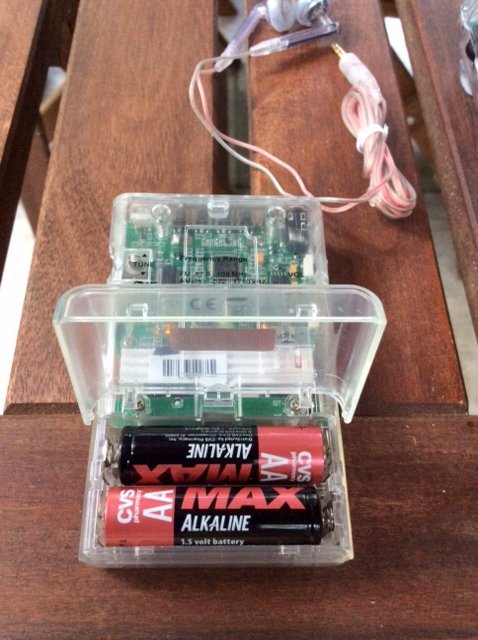
The DT-160CL has a hinged battery cover and holds two AA cells.

Sangean_DT-160CL_15 Sangean_DT-160CL_16

The SRF-39FP only needs one AA battery.

Sangean_DT-160CL_17

After plugging in the supplied clear ear buds, I turned both radios on and adjusted the volume to a comfortable, moderate listening level.

I matched the audio levels for both units and tuned to my favorite classic rock FM station: WXRC 95.7 MHz.

WXRC is a fantastic benchmark FM station as it’s about 130 miles away (as the crow flies), but has an exceptional propagation footprint. My best FM receivers, when ideally-placed in my home, and telescoping antenna fully-extended, can receive WXRC in stereo lock with no interference.

Sangean_DT-160CL_21

I’m happy to report that both the DT-160CL and the SRF-39FP can receive WXRC quite easily when I’m holding the unit in my hand and standing in a part of my house where the signal is strongest.

In truth, I didn’t have time to evaluate receiver performance last night–I was more eager to begin the endurance test which, by the way, officially started yesterday (August 3, 2016) at 22:30 UTC.

I can’t wait to discover which radio will win!

Follow this review thread by bookmarking the following tag: Sangean DT-160CL v Sony SRF-39FP

Medium Wave DX: CBC Radio 1 Gander, 1400 kHz, remarkably clear signal in Oxford UK

CBC Radio 1, Gander, heard in Oxford UK

A really great signal from CBC Radio 1 Gander – the best I’ve ever heard on this or any other medium wave frequency, complete with a clear station ID and very much out of season so-to-speak. I can’t remember recording any Medium Wave transatlantic signal with an audio bandwidth filter of 7 kHz, which says everything about the relative strength of this signal; 2.5 to perhaps 4 kHz would be more typical. As the subscribers to my youtube channel Oxford Shortwave log will know, I dabble in Medium Wave DXing, however, it requires a lot of patience because conditions of good propagation can occur quite infrequently. This is where the band recording features incorporated into the Elad FDM-SW2 software (and similar software for other SDR receivers) come into their own, allowing you to record the entire medium wave band, for example, for later analysis. As for the Wellbrook ALA1530 active loop antenna, I can’t praise it highly enough, both in terms of combating QRM and overall performance as a function of compactness.

Recorded in Oxford UK using an Elad FDM DUO and Wellbrook ALA1530 active loop antenna (indoors) on 29/06/16 at 03:00 hrs UTC.

Clint Gouveia is the author of this post and a regular contributor to the SWLing Post. Clint actively publishes videos of his shortwave radio excursions on his YouTube channel: Oxford Shortwave Log. Clint is based in Oxfordshire, England.


Selecting a budget antenna for urban radio listening

Urban-City-Cityscape

Yesterday, an SWLing Post reader contacted me with questions regarding budget antenna choices for an urban apartment. He’s about to purchase an SDR, but knows that a decent antenna capable of coping with urban radio interference is a critical component.

I suggested that, since I’m no expert with urban interference, he pose his question to the SWLing Post community. Here’s his reply and request:

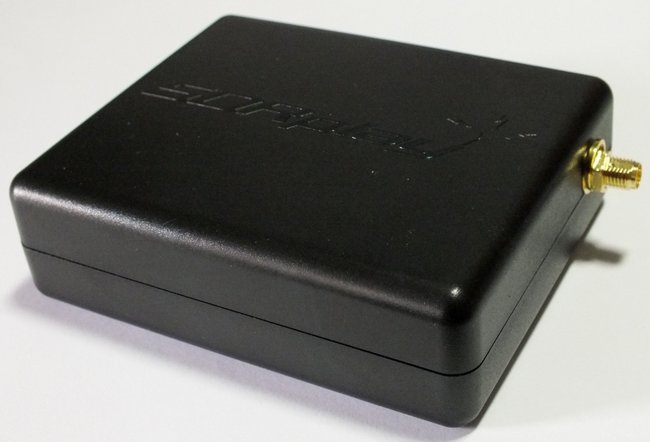
I know I’m a little behind some of my other radio friends, but I’m finally moving up to a software defined radio. Specifically the affordability of the SDRplay RSP and all good reviews for it have encouraged me to make the leap.

The SDRplay RSP software defined radio

The SDRplay RSP software defined radio

I suppose it should go without saying that once I purchase an SDRplay I would like to use it, which might not be so easy. I live in a big city full of RF pollution, and most of my listening will be in a room where there’s a fair amount of electronic gadgetry.

So, without spending a lot of money, I’m curious if any of your readers might have suggestions about what I might purchase as a “starter kit” for a new SDR user in such a scenario. I also plan to take the SDRplay with me when I have forays out of the city, but I envision that some sort of long wire might be sufficient for listening out in the countryside.

I live on the second floor in an urban apartment, and have two windows in the room where I’ll be listening. There is zero chance that I can hang or attach anything on the outside of the house here. So, my most pressing question is about antenna ideas. I’ll need something inexpensive, as I mentioned, and something “off the shelf.” I don’t have the skills or tools to really “build” anything, unfortunately. So is there some less than pricy antenna or antennas I should look at? Or is there some hope of doing something with a long wire indoors?

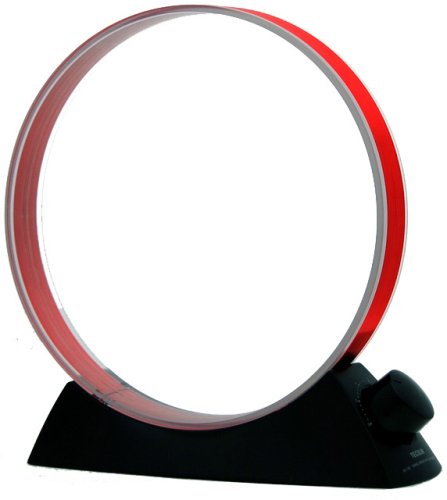
Tecsun AN-100 portable loop antenna

Tecsun AN-100 portable loop antenna

And will my little Tecsun AN-100 AM loop antenna going to help me at all? I mostly plan to listen to MW and the HF bands, but I will inevitably check out signals far up the bands as well. So advise about listening to these bands is also of interest to me.

Other than that, I understand it’s important to attach the SDR to the laptop with a USB cable with ferrite chokes. And it probably wouldn’t hurt to buy some extra ferrite chokes to attach to other cables I might be using. I also plan to buy a NooElec mini-balun for use with a long wire antenna, and I already purchased a PowerMate USB knob because I still prefer to do my “tuning” that way.

So other than those basics my questions would be regarding connecting cables and adapters, and the best lengths of cable to use. Should I have some cable between the balun and SDR? I believe I’ve read that it’s better to have a longer USB cable and a shorter coax to the antenna, correct? And when it comes to using a wire antenna, are there preferences as far as what type or gauge of wire to use?

I am also interested in any general suggestions or tips from SDR users on getting started. In general, I’m pretty good with navigating through software, it’s usually the hardware issues that stump me. I’m looking to spend between $100 to $150 tops on everything besides the SDR, and I’d like to hear about peripherals, cables, adapters and connectors which when added all together won’t bust my bank.

I’m sure there’s plenty of people who read this wonderful blog who have plenty of useful knowledge regarding SDR listening on a budget. And I hope a few could share a little of their experience and collected wisdom on this topic here, for me and for others considering turning their computers into receivers…

Indeed. I appreciate this reader’s question, since many listeners live in environments with heavy radio interference. While we’ve published a number of posts touting the virtues of magnetic loop antennas, I don’t think we’ve ever looked for solutions at or below $150 US. While this may be a challenge, I’m also certain there are a number of readers who’ve found solutions to this problem.

So, Post readers, what might you do–or have you done–in similar circs?  Please feel free to comment, and let’s explore inventive and affordable solutions for this reader!