Many thanks to SWLing Post contributor, Nils (DO6AN), who shares the gorgeous stamp (above) celebrating twenty years of radio in the DDR.
Thank you, Nils!
Many thanks to SWLing Post contributor, Nils (DO6AN), who shares the gorgeous stamp (above) celebrating twenty years of radio in the DDR.
Thank you, Nils!
IMPORTANT UPDATE – Amanda Dawn Christie notes:
“Unfortunately [this video] was never supposed to be public – it was an accident on my part. The film will be viewable soon though, for seven days. May 26 to June 1. It is being hosted by a gallery in Montreal. That upload was only a test for them, and should never have been public. I was in a hurry, trying to get it uploaded before I packed my hard drives before I moved and I guess I didn’t check all the settings. Sorry about that. I appreciate the enthusiasm though.”
SWLing Post friend and filmmaker, Amanda Dawn Christie, has just uploaded a version of her film Spectres of Shortwave to Vimeo where it can be viewed free of charge:
Many thanks to SWLing Post contributor, Ulis (K3LU), who shares the following story of a popular CB Radio QSL Card design and print house:
73s and 88s :: The Ballad of Runnin Bare and Lil White Dove
We set a custom screensaver on Our AppleTV. Told it to pull images from Flickr tagged with “British Columbia.” After my wife and kids and I spent a few weeks in Vancouver and in various places on Vancouver Island, it had become one of our favorite places. We missed it.
And so, at night, after a show or movie ended and the AppleTV sat idle for a few minutes, a slideshow would automatically begin. The Parliamentary Buildings in Victoria, the Inner Harbor, the wild, rocky, tidepool-rich shores of Tofino, the murals of Chemainus.
Then, every once in a while, an illustration of some sort. I couldn’t tell what. A one-panel comic? Some kind of advertisement or flyer? It would be gone from the screen before I could really get a good look. Weeks would go by and I wouldn’t see it until, once again, there it was. It looked old, like something from the 60s or 70s. And it had numbers on it, like a code or a message: 73s and 88s.
It was the numbers that got me. Like the park rangers in The Shining calling for Wendy Torrance on the radio: “This is KDK-1 calling KDK-12. KDK-1 calling KDK-12. Are you receiving me?” They seemed to be saying something. But what? I had to find out. So, I took to Google, and began my search.[…]
FYI: Although the CB Radio landscape is quite different than it was in the 70s, most modern shortwave radio receivers can tune to CB channels. Here’s a quick tutorial from our archives.
Radio Waves: Stories Making Waves in the World of RadioBecause I keep my ear to the waves, as well as receive many tips from others who do the same, I find myself privy to radio-related stories that might interest SWLing Post readers. To that end: Welcome to the SWLing Post’s Radio Waves, a collection of links to interesting stories making waves in the world of radio. Enjoy!
Many thanks to SWLing Post contributors Alan Hughes, Michael Bird, Zack Schindler, and Dennis Dura for the following tips:
Radio Marti began Digital Radio Mondiale (DRM) shortwave transmissions on Feb. 4. Part of the U.S. Agency for Global Media (USAGM), Radio Marti broadcasts news and other programs to Cuba. The DRM shortwave transmissions are from USAGM’s Greenville, North Carolina, site.
USAGM has transmitted in DRM before. There were some transmissions from Briech, Morocco, in the early 2000s. Greenville tested DRM in 2009 in partnership with what was then known as HCJB Global Technology. So why are they back now after an absence of over a decade?
“We want to experiment a bit with different modes and services available on DRM. We also want to help push the development of low-cost receivers and the best way to do that is to put some transmissions on the air, explains Gerhard Straub, director of USAGM’s Broadcast Technologies Division.[…]
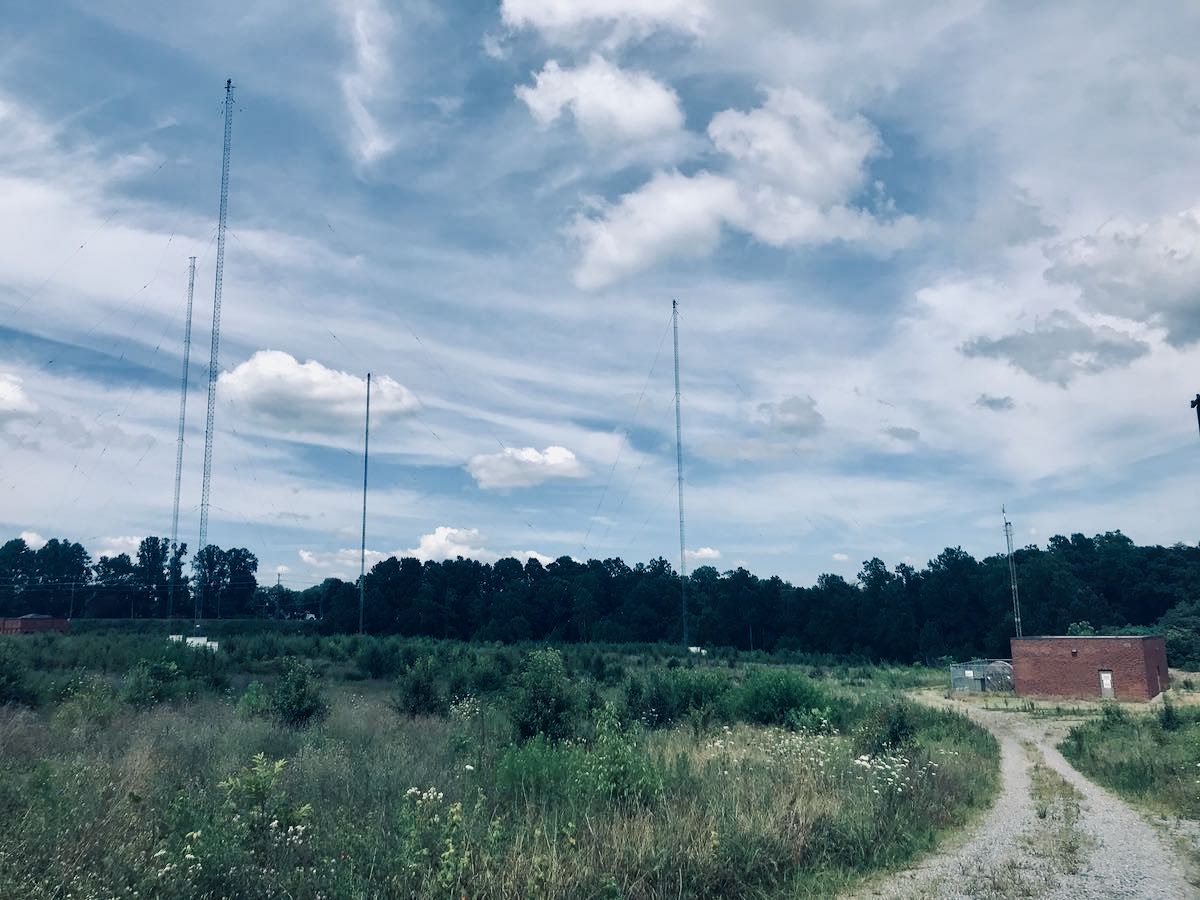
Amateur radio enthusiasts are pushing for the former site of Radio Australia in Shepparton North to be upgraded and retained as a national museum of radio broadcast history.
Members of the Shepparton and District Amateur Radio Club and The Vintage Radio Club of North East Victoria are due to present a 25-page proposal to an anonymous consortium of buyers said to be interested in acquiring a 258ha block of land along Verney Rd.
The block includes two buildings and several large broadcast towers on the former site of Radio Australia. The site is currently owned by BAI Communications.
The Shepparton club’s assistant secretary, Geoff Angus, said the proposal would be presented to Greater Shepparton City Council for forwarding to the consortium.[…]
Zack Schindler writes:
I have been watching a show about paranormal activity on the History Channel called The Secret of Skinwalker Ranch. In the episode this week they hired a professor to do a balloon launch with some RF sensors. In this episode they also showed the APRS.FI webpage and I was able to read his callsign from an APRS tracker, KM4MRH.
The professor used an APRS tracking device. On the right side of the page link below you can click on Other SSID’s to see other balloon launches he has done. Normally when there is a balloon launch you can see the data from it going up and down. This page shows the Skinwalker balloon launch data transposed over a map. https://aprs.fi/#!call=a%2FKM4MRH-3&timerange=3600&tail=3600
Sadly they are using these for measuring RF fields rather than these.
Terrestrial music stations have a major cultural opportunity right now, but employees say a muddied strategy is standing in the way
Radio personality Kevin Ryder was “baffled” by KROQ’s “cold, heartless attitude” when he and his morning-show team were fired at the end of March. The station has long been an alternative/rock staple in Los Angeles, the second-largest market in the country, and Ryder had been on the air for more than 30 years.
“The new people in charge now weren’t here for the building of the world-famous KROQ,” Ryder, one-half of the popular Kevin & Bean Show, said on air when the station let him go, live one final time. “I don’t think it means anything to them. It’s a numbers business, and there’s no family aspect to it anymore. It’s only numbers, but this place was built without numbers. It was musicians, artists, and the special relationship between music, the station, and our fans.”
AM/FM radio provides localized, round-the-clock information and entertainment via friendly neighborhood voices — so in theory, it’s the perfect platform in a global crisis that forces hundreds of millions of people to stay home. But Ryder is one of many in the radio community — including on-air hosts, music directors, program directors — who have been shocked by sudden job losses in recent weeks as COVID-19 has spread across the U.S., and news out of the industry has been one bad thing after another. Why is terrestrial radio missing the opportunity here — and how should it be fighting to get back on top?[…]
Please consider supporting us via Patreon or our Coffee Fund!
Your support makes articles like this one possible. Thank you!
Many thanks to SWLing Post contributor, Balázs Kovács, who shares the following announcement:
[Check out the] Smithsonian Open Access, where you can download, share, and reuse millions of the Smithsonian’s images—right now, without asking. With new platforms and tools, you have easier access to nearly 3 million 2D and 3D digital items from our collections—with many more to come. This includes images and data from across the Smithsonian’s 19 museums, nine research centers, libraries, archives, and the National Zoo.
As Balázs points out, there are hundreds of radio photos in the archive.
What a treasure trove! Since many of us are sheltering at home, it’s the perfect time to take a deep dive into the SOA archive! Thank you for sharing!
Many thanks to SWLing Post contributor, Matthew, who shares the following tweet from Helen Leigh:
This sculpture at the Tate Modern blew my mind this week. It’s a wire sculpture inspired by the International Space Station that functions as an antenna for a ham radio.
Twice a day it plays live audio and data transmissions from the ISS as it passes overhead.
Click here to view on Twitter.
Fascinating! Goes to show that the Tate Modern is always chock-full of amazing discoveries. Thank you for sharing this, Matthew!
Many thanks to SWLing Post contributor, Ed, who writes:
SWLing Post readers might be interested in hearing this BBC World Service radio documentary about a political tech art project that uses visible light beam voice comms across the Mexico<>U.S. border to bridge communities. There’s a website that explains how it all works. I guess ~500 TeraHertz is technically radio?
(Source: BBC World Service)
BBC World Service – In the Studio
Rafael Lozano-Hemmer’s Border Tuner
Released On: 19 Nov 2019
Imagine huge searchlights which can be seen over a ten mile, 15 kilometer radius talking to one another across two countries. This is exactly what electronic media artist Rafael Lozano-Hemmer is creating this November between Ciudad Juárez in Mexico and El Paso in Texas.
Called Border Tuner, the project will see enormous bridges of light connecting the US-Mexico border for the first time.
When lights from the stations (three on each side) are directed at each other and they manage to make a connection, a massive bridge of light is formed. This activates microphones and speakers allowing participants to communicate with one another across the border. The “light bridge” flickers like morse code as the participants listen and speak to one another. If they don’t like what they are hearing they can retune to a different light beam.
This is not the first time Rafael Lozano-Hemmer has used search lights in his art but he’s never done anything on this scale or with this complexity before. Born in Mexico City in 1967, he first produced a remote-controlled searchlight project in 1999 for the Zócalo Square in Mexico City. Since then he has created installations in dozens of cities around the world where the public controls the searchlights using the internet, mobile phones, megaphones or heart rate sensors.
Presented by Monica Ortiz Uribe
Produced by Emma Betteridge for the BBC World Service
Fascinating concept! Thank you for sharing, Ed!