Category Archives: Broadcasters

Lansing Named CEO of the Broadcasting Board of Governors

John Lansing (Source: BBG)

John Lansing (Source: BBG)

(Source: Broadcasting Board of Governors Press Release)

WASHINGTON – The Broadcasting Board of Governors (BBG), the independent federal government agency that oversees all U.S. civilian international media, today announced the appointment of John Lansing as Chief Executive Officer and Director of the BBG. Lansing will begin his service at the BBG in September.

Lansing joins the BBG with nine years of experience as President of Scripps Networks, where he is credited with guiding the company to become a leading developer of unique content across various media platforms including television, digital, mobile and publishing. As President of Scripps Networks, Lansing was responsible for strategic and operational oversight of the $2.5 billion division of Scripps Networks Interactive, including the company’s portfolio of six cable networks – Food Network, HGTV, Travel Channel, DIY, Cooking Channel and Great American Country – and the $100 million Scripps Networks Digital division. Prior to joining Scripps Networks in 2004, Lansing was Senior Vice President for Television in the broadcasting division of the E.W. Scripps Company, managing the company’s portfolio of 10 network affiliated television stations. Earlier, he held various senior management positions at Scripps-owned affiliates, including WEWS TV in Cleveland, Ohio and WXYZ TV in Detroit, Michigan.

Most recently, Lansing was President and Chief Executive Officer of Cable & Telecommunications Association for Marketing (CTAM), a marketing association comprised of 90 of the top U.S. and Canadian cable companies and television programmers. There, Lansing oversaw the development of business strategies and marketing initiatives that position cable television companies for continued growth as they compete with emerging digital content platforms.

Lansing also brings a deep understanding of journalism from roles as an award-winning Photojournalist and Field Producer, Assignment Manager, Managing Editor, and News Director at several television stations earlier in his career.

Lansing is currently Vice Chair of the Bellarmine University Board of Trustees and was named to the Bellarmine Gallery of Distinguished Graduates in 2010. He serves on the National Advisory Board of the Bellarmine University’s Institute for Media, Culture & Ethics; National Council for Media and Public Affairs of George Washington University School of Media & Public Affairs; and, until recently, the Poynter Institute for Media Studies Foundation, one of the nation’s top schools for professional journalists.

“John is a proven executive and a remarkable, transformative leader in multiplatform content strategies, development and distribution,” said BBG Chairman Jeff Shell. “With his journalistic sensibilities and success in leading media companies through periods of challenges and growth, John is the ideal person to lead the BBG as we accelerate efforts to shape a global, world-leading media organization that is up to the challenges of the 21st century.”

“We are very fortunate to have John take on the CEO role at this critical time when U.S. international media is on the front line of the United States’ most important and complicated foreign policy issues,” added Shell. “From eastern Ukraine to China to ISIL and Iran, the programming of the BBG is the most important, and in many cases, the only voice of honest and open journalism. John also understands that conveying and critically assessing official U.S. policy is a key component of BBG’s mission. American leadership in the world depends in part on international audiences knowing where the United States stands with respect to their countries and the issues that affect them.”

“I thank Chairman Shell and the Board for this opportunity to help lead this fantastic organization,” said Lansing. “As one of the world’s largest media enterprises, the BBG provides balanced, reliable and authoritative news in the face of partisan media and heavy propaganda from repressive nations and extremist groups. I am honored to enter into public service and to join a team of world class journalists and media professionals who are dedicated to expanding freedom of information and expression worldwide. I also welcome the opportunity to work with this distinguished Board, which has steadily guided the BBG forward.”

Chairman Shell also thanked André Mendes for his service as BBG Interim CEO. “On behalf of the entire Board, I would like to express our deep appreciation for the tireless work of André and his dedicated team. During this transition period, André and his colleagues have worked diligently to produce outstanding results and to spur on forward momentum at the BBG.”

BBG’s Critical Importance in a Fragmented World and Rapidly Changing Media Environment

U.S. International Media (USIM) operates today in a challenging environment in which global audiences have vastly increased access to information from both public and private sources and in which modes of communication are changing in fundamental ways.

The global information space has become a battleground, where new international actors have “weaponized” information to try to undermine not only Western values but also Western resolve to confront the challenges of the 21st century. The emergence of well-funded state-sponsored broadcasters have demonstrated how propaganda can directly influence events on the ground. Elsewhere, non-state actors including al-Qaeda, ISIL and Boko Harem are using social media to recruit fighters and sow fear.

The BBG is sparing no effort to bring global audiences alternative narratives – built on accurate, fact-based journalism – to foreign propaganda in Ukraine and across the former Soviet Union as well as in the Middle East, South Asia and the African Sahel. MBN’s Raise Your Voice, an interactive audience engagement initiative on TV and radio in Iraq exemplifies BBG’s response, empowering moderate secular and religious voices to discuss the root causes of ISIL while providing Iraqi leaders with constructive feedback on the lives and hopes of the Iraqi people.

Gallup research underscores impressive results, most notably where extremism is a palpable threat; BBG networks boast weekly adult audiences of 44% in Iraq, 53% in Afghanistan, 28% in Iran, 51% in Somalia, and 18% in Nigeria. Globally, BBG networks increasingly are engaging new audiences, reporting on issues of human rights, government corruption and other issues, which contributes toward an all-time high measured BBG weekly audiences in excess of 215 million and rapid growth across all media platforms including social media and mobile.

Telling America’s story is a significant part of BBG’s statutory mandate. BBG covers the United States in all of its complexity, reflecting the nation’s democratic process, so that the countries that are struggling to nurture their own democratic systems might learn from the American experience.

BBG has also developed a robust portfolio in Internet anti-censorship. The agency focuses not only on disseminating content, but also on expanding access to the Internet, and offering to citizen and professional journalists the tools to report safely without detection by government surveillance. Increasingly, this work is important in countries such as China, Venezuela and Iran that are bolstering their firewalls to stop the free flow of information.

About The Broadcasting Board of Governors

The Broadcasting Board of Governors is the independent federal government agency that oversees all U.S. international media. BBG is also the name of the board that governs the agency.

The BBG Board is focused on how to best leverage the combined power of the five media networks it oversees – Voice of America (VOA), Radio and TV Martí, Radio Free Europe/Radio Liberty (RFE/RL), Radio Free Asia (RFA), and the Middle East Broadcasting Networks (MBN) – in countries where vital U.S. interests are at stake and freedom of the press and freedom of expression are under attack.

All current BBG Board members have been confirmed by the U.S. Senate to their positions since August 2013. Board members are well-respected leaders in U.S. foreign policy, media, and government and operate in a collegial bi-partisan manner.

Current Board members include: Jeff Shell, Chairman of Universal Filmed Entertainment; Matthew Armstrong, author and former Executive Director of the U.S. Advisory Commission on Public Diplomacy; Dr. Leon Aron, Resident Scholar and Director of Russian Studies at the American Enterprise Institute; Ambassador Ryan Crocker, Dean of the Bush School of Government and Public Service at Texas A&M University, whose 37-year career in the U.S. Foreign Service included service as U.S. Ambassador to Afghanistan, Iraq, Pakistan, Syria, Kuwait, and Lebanon; Michael Kempner, founder, president, and CEO of MWW, one of the world’s top five independent public relations agencies; Ambassador Karen Kornbluh, Executive Vice President of External Affairs for Nielsen and former U.S. Ambassador to the Organization for Economic Co-operation and Development (OECD); and Kenneth Weinstein, President and CEO of the Hudson Institute. Secretary of State John Kerry is represented on the Board by Under Secretary of State for Public Diplomacy and Public Affairs Richard Stengel, former managing editor of TIME.


Radio Caroline and a crystal radio: “The making of a rebel”

Radio Caroline circa 1960's.

Radio Caroline circa 1960’s.

Many thanks to SWLing Post reader Mike, who shares a link to this story from the blog
République No.6:

Growing up in Piennes Lorraine, Radio Caroline the making of a rebel

[A]t night with my younger brother we would listen to a “pirate radio station” on a boat that would put real good music on, crusing the international waters between England and France. He burst in laughter and told me: That’s Radio Caroline“. That was it. My brother and I would listen to that station nearly every night on an old “galena radio receiver” with a huge antenna hidden in the attic built with copper wire we stole at the mine. I mean we didn’t really steal it, it was everywhere. It was the wires used by miners to connect detonators to batteries when blowing new tunnels and locals were using it for all sorts of things, like holding parts in chicken coop to tie tomato or green bean plants to stakes and could be found everywhere.

Actually at first we set the antenna in our bedroom but somehow it wasn’t long enough not to mention mom who saw it and tore it down giving her an other excuse to punish us. So we decide it to place it in the attic where no one ever went.

The most difficult part was going to the attic, there wasn’t any stairs. We had to bring a ladder to the trap leading to it. Mom was watching us like a hawk, looking for any excuses to punish us.[…]

Read the full story at République No.6.

Radio Serbia International recording and final farewell

Location of Serbia (green) and the disputed territory of Kosovo (light green)in Europe (dark grey). Source: Wikimedia

Many thanks to SWLing Post reader, “Mutezone,” who writes:

“I want to share a link to a video of Radio Serbia International’s English service recorded on the 4th of July 2015…

[…]I have been monitoring for RSI during the last week of July but got nothing. I have also been monitoring 6100 kHz after the July final date of transmission as according to RSI’s website, there are “Pirates stalking Serbian short wave” due to the termination of the station. However I have not received any odd transmissions on this frequency at the moment.”

Thanks for sharing this recording/video and, especially, for capturing RSI’s interval signal.

I was unable to hear RSI’s final broadcast on July 31, 2015.

If any SWLing Post readers managed to record RSI’s final broadcast–in any language–please contact me so we can add it to the Shortwave Radio Audio Archive.

Regarding the end of Radio Serbia International (or International Radio Serbia), the following final post was published on their website. I’ve included the full note, for archival purposes, in case the RSI website goes offline in the future:


The End of Radio Yugoslavia – International Radio Serbia

RadioSerbiaThanks for sharing the recording and for including a few minutes of the RSI interval signal. RSI was always a difficult broadcaster for me to catch here in North America, though I heard them a number of times via the University Twente Web SDR.

Dear friends, Radio Yugoslavia – International Radio Serbia, ceases to exist on 31 July 2015. For you, our faithful listeners from all over the world, and also for us who have worked on this radio, the only consolation would be the fact that this only state short-wave station in Serbia, which has existed for 79 years, will be remembered as an efficient and reliable promoter of Serbia worldwide. No one has ever presented valid reasons why this media, of rich tradition, range and staff potentials, and with big plans until yesterday, should cease to exist. Unfortunately, the assessments not based on arguments were louder than serious analyses and recommendations of experts, professionals and numerous listeners that the world radio service is necessary for Serbia, that it presents the country worldwide in the best manner possible and that no serious state will renounce such an effective diplomacy.

Our significance has been confirmed by the letters of thousands of listeners from all over the world. Some listened to us because of our information programmes, some because of economic topics, while many got to love our country, Serbia, because of its tradition, beautiful and interesting landmarks and the rich heritage they were acquainted with by listening to International Radio Serbia. Regardless of your affinities, you have all told us that you were listening to us because of our objectivity and the possibility of hearing us at any time and everywhere, for such is the power of short waves.

The Serbian government, however, believes that the closing down of Radio Yugoslavia – International Radio Serbia – is a justified move. Regardless of the fact that the state of Serbia is in an economic crisis, that each saved penny is precious, that many citizens have been rendered jobless, that new work positions should be opened, it has become unclear to the very end why the only state short-wave station has suddenly become too expensive after 80 years. We are, however, certain, that Serbian citizens, taxpayers, who have financed us for all these years, would have decided differently had they been asked to.

What remains, after all, is the pride we feel because of the history of our radio as well as the hope that the voice of Serbia will reach our listeners wherever they are.

Thank you, dear listeners from all over the world, for having trusted us all these years! Radio Yugoslavia – International Radio Serbia now greets you and signs off.

Source: http://voiceofserbia.org/content/end-radio-yugoslavia-%E2%80%93-international-radio-serbia#sthash.rvvWUjgx.dpuf

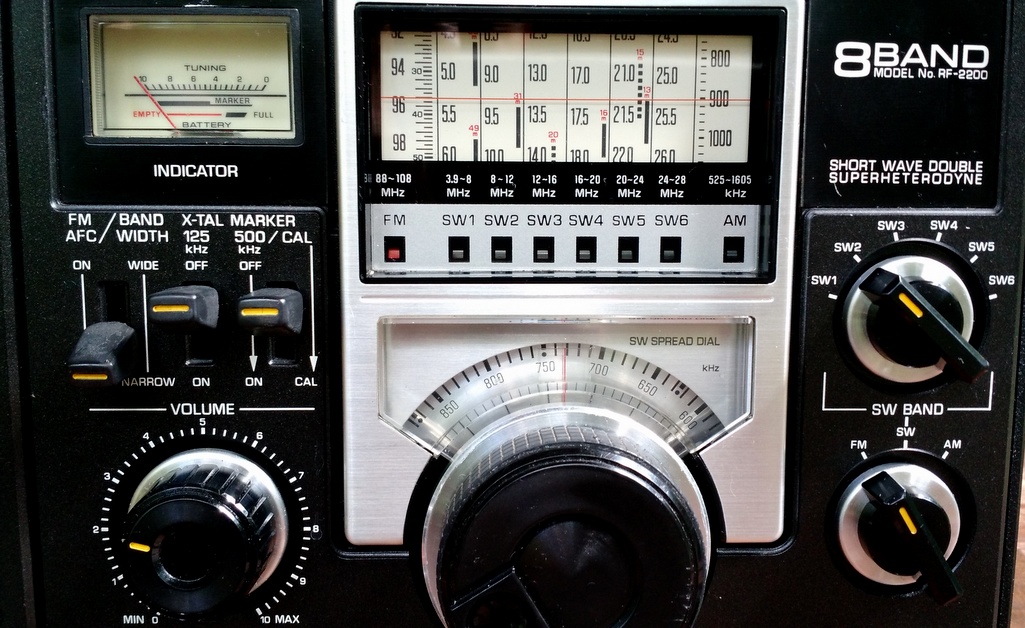
Tuning in to AM broadcast history and the venerable RF-2200

Panasonic-RF-2200-2

Many thanks to SWLing Post contributor, Eric (WD8RIF), for sharing a link to this excellent article in the Illinois Times by James Krohe Jr. Here’s an excerpt:

Tuning in: Making a small world bigger and the big one smaller

So much of happiness, I’ve realized, depends on getting tuned in. When he was a young married, my father used to tune in the console radio in the living room of the Krohe family mansion on Manor Avenue to the live broadcasts of big-band music “from the beautiful Blue Room in the Roosevelt Hotel” in downtown New Orleans. He was able to be in two places at once thanks to WWL-AM, whose 50,000-watt clear channel signal was beamed north. For all I know, while he tapped his toe on the sofa in Springfield, Inuit couples were jitterbugging on the tundra.

For Springfield teens in the 1950s and ’60s, getting a chance to listen to what kids in bigger cities had already decided they liked was important. WCVS-AM was just crawling out of its cocoon, having crawled into it as a country station and emerging as a rock station – although in the late ’50s there wasn’t that much difference. “Rock ’n’ roll” was, in stations like WVCS that catered to mostly white markets, rockabilly and pop-ish country ballads. (Geezers will recall when Brenda Lee was, briefly and laughably, marketed as a rock artist.)

For Top 40 music, as for so many other things, if you wanted to get the really good stuff you had to go to the big city. Around here that meant WLS-AM, WCFL-AM out of Chicago (whose Ron Britain made Soupy Sales look, or rather sound, like Noel Coward), and KXOK-AM out of St. Louis. George Lucas’s American Graffiti brilliantly captured the ways that car radios, transistors, radio stations blaring over PAs in drive-ins, permeated the bubble in which teenagers then lived.

Later I learned I could hear WBZ out of Boston if I acted as the antenna on my transistor. (“Turn on, tune in, drop out” to me meant losing the signal when I lighted a smoke.) WBZ was one of the first stations with the newest 45s from Britain, which allowed us yokels to hear The Yardbirds while the records were still on their way to Midwest stations by stagecoach from Boston harbor.

Continue reading…

Krohe also mentions the virtues of the Panasonic RF-2200 which is, in my opinion, one of the best AM broadcast portable receivers ever.

Click here to read the full article at the Illinois Times website.

Side note: The Panasonic RF-2200 still has a loyal following among mediumwave DXers of the world. The RF-2200 can be found on sites like eBay (click here to search), but make sure you’re purchasing from a reputable seller and not over-paying.

Peter’s archived recordings include KBC

SX-99-DialSWLing Post reader, Peter (K3KMS) writes:

In a post dated October 25, 2014, you mentioned listening to the ‘Giant Jukebox’ radio program on The Mighty KBC Shortwave.

For the past year or so, I have been a big fan of said program, and I try to listen to it every Saturday evening (0000 UTC, I’m located in Delaware). When I am able to listen, I record the program using my Drake R8B, and I archive the obtained recordings on my website.

The link to the archive web page is provided below (scroll down to the 7375 khz and 9925 khz table rows). I was hoping that you might share said link with your readership so that they, too, can experience this (in my humble opinion) awesome radio program at their leisure!

http://21centimeter.com/Shortwave_Archived_DX.html

Many thanks, Peter, and I’m quite happy to share your recordings. Like you, I’m a big fan of The Mighty KBC–we’re most fortunate to have a broadcaster like KBC on the shortwaves! I look forward to checking out your other recordings as well.

The WSJ features Willis Conover

Willis Conover, The Voice of America (Source: Wikimedia Commons)(Source: Wall Street Journal via Any Sennitt)

The Radio Broadcaster Who Fought the Cold War Abroad but Remained Unheard at Home

By DOUG RAMSEY

During the Cold War, listeners in captive nations behind the Iron Curtain huddled around radios in basements and attics listening to the imposing bass-baritone voice of the man who sent them American music. His greeting—“Good evening, Willis Conover in Washington, D.C., with Music U.S.A.”—was familiar to millions around the world. At home, relatively few people knew him or his work. A proposal for a postage stamp honoring Conover may give hope to those who want the late Voice of America broadcaster to be awarded a larger mark of distinction.

For 40 years, until shortly before his death in 1996, Conover’s shortwave broadcasts on the Voice of America constituted one of his country’s most effective instruments of cultural diplomacy. Never a government employee, to maintain his independence he worked as a freelance contractor. With knowledge, taste, dignity and no tinge of politics, he introduced his listeners to jazz and American popular music. He interviewed virtually every prominent jazz figure of the second half of the 20th century. His use of the VOA’s “special English”—simple vocabulary and structures spoken at a slow tempo—made him, in effect, a teacher of the language to his listeners.

Countless musicians from former Iron Curtain countries have credited Conover with attracting them to jazz, among them the Czech bassists George Mraz and Miroslav Vitous, the Cuban saxophonist and clarinetist Paquito D’Rivera and the Russian trumpeter Valery Ponomarev. On the Conover Facebook page established in 2010, Ponomarev wrote that Conover had done as much for jazz “as Art Blakey, Duke Ellington, Horace Silver, Count Basie, Charlie Parker, Miles Davis and Dizzy Gillespie.” Conover’s New York Times obituary said, “In the long struggle between the forces of Communism and democracy, Mr. Conover, who went on the air in 1955 . . . proved more effective than a fleet of B-29’s.” In his publication Gene Lees Jazzletter, the influential critic wrote, “Willis Conover did more to crumble the Berlin Wall and bring about the collapse of the Soviet Empire than all the Cold War presidents put together.”[…]

Continue reading at the Wall Street Journal…

Regular SWLing Post readers know that I’m a huge fan of Willis Conover. Much like VOA’s Leo Sarkisian, Conover represented some of the best diplomacy this country has had to offer. [I’ve actually had the honor of meeting and interviewing Leo Sarkisian at his home in Maryland, a few years ago–one of the highlights of my career.]

Are there any SWLing Post readers out there who listened to Willis Conover from behind the “Iron Curtain?” Please comment!

Rep. Salmon introduces bill to defund Voice of America

Rep. Matt Salmon (AZ-05)

Rep. Matt Salmon (AZ-05)

(Source:  sonorannews.com via Dan Robinson)

WASHINGTON, D.C.—Rep. Matt Salmon (AZ-05) announced the eighth Shrink our Spending Initiative bill focused on highlighting and cutting wasteful, taxpayer-funded programs. Upon introduction of his latest bill to eliminate federal funding for Voice of America, Salmon released the following statement:

“My eighth SOS bill is aimed at cutting yet another duplicative, federal program and saving you 212 million dollars by doing so. While originally commissioned to provide a ‘clear and effective presentation’ of U.S. policy, Voice of America (VOA) has veered from its original mission and become a government-funded news outlet. The United States already funds organizations that disseminate unfiltered news to regions of the world that lack a free press.

“Technology has also rendered Cold War relics, such as VOA, obsolete. The rise of the Internet and social media, especially in closed countries have connected the world in ways we could have never imagined, and with their success, and other U.S. taxpayer-funded broadcasting programs, it makes fiscal sense to eliminate this superfluous, federally-funded entity.”[…]

Click here to read the full article.

Click here if you would like to contact Rep. Matt Salmon.