Shortwave listening and everything radio including reviews, broadcasting, ham radio, field operation, DXing, maker kits, travel, emergency gear, events, and more
Beginning April 18th, 2015, PCJ Radio International will have a week of programs broadcast to Europe. The one hour transmissions will be our service to the Pacific.
Time: 2000 – 2100 UTC
Schedule
April 18 – The Happy Station Show
April 19 – The Stuph File Program
April 20 – Focus Asia Pacific/Switzerland In Sound
April 21 – Jazz For The Asking
April 22 – Nash Holos
April 23 – Focus Asia Pacific/Vintage Media Network
April 24 – Media Network Plus/Special Program
Special QSLs will be issued for this transmissions.
Radio Exterior de España has posted an updated broadcast schedule (in Spanish) on their website. I have translated and pasted the shortwave schedules below:
Radio Exterior de España transmits its programming from 18:00 to 22:00 hours, Coordinated Universal Time, Monday through Friday. Broadcast frequencies and coverage areas are:
Africa and South Atlantic, 15,450 Khz , 19 meter band.
South America, 17,715 Khz , 16 meter band.
North America, 17,855 Khz , 16 meter band.
Middle East and Indian, 15,490 Khz , 19 meter band.
And on Saturdays and Sundays:
Africa and South Atlantic, 21,620 Khz band of 13 meters (14 to 18 hours), and 15,450 kHz band of 19 meters (18 to 22 hours).
South America, 17,715 Khz band of 16 meters (14 to 18 hours).
North America, 17,855 Khz band of 16 meters (14 to 18 hours).
Middle East and Indian, 15,490 Khz band of 19 meters (14 to 18 hours).
(In case you’re keeping tabs: yes, REE is still on the air, though basically as a relay of RNE.)
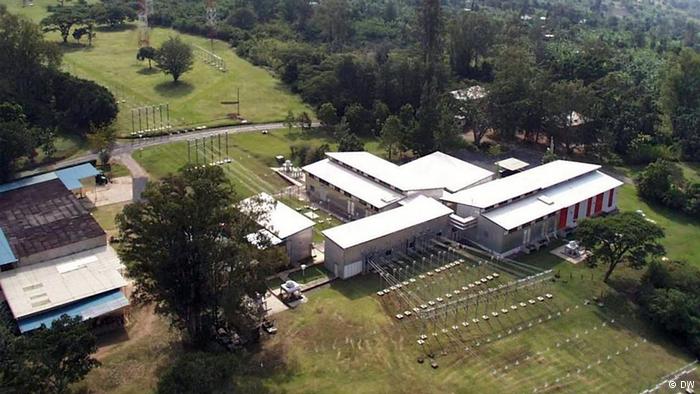
DW’s relay station in Kigali (Source: Deutsche Welle)
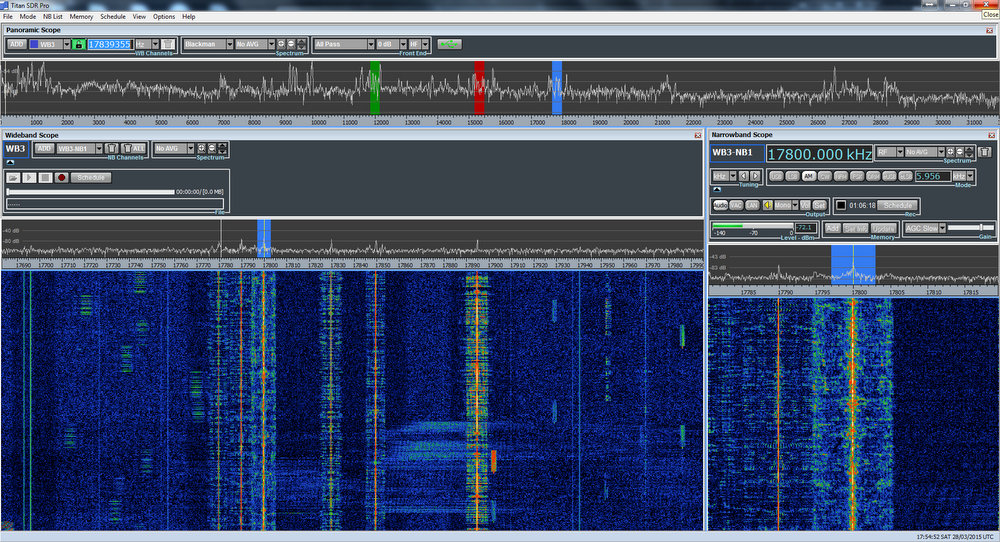
Yesterday, Deutsche Welle transmitted its final broadcast from the Kigali, Rwanda relay station. Since I’ve only had moderate luck hearing the Kigali site the past few days–especially on 31 meters–I fired up the TitanSDR Pro (which is still currently under review) and set it to record all three final afternoon broadcasts from Kigali on 12,005, 15,275 and 17,800 kHz.
As you can see from the screenshot above, Kigali produced a very strong signal on 17,800 kHz. The TitanSDR recorded the full broadcast, starting with one minute of the transmitter tuning, then one hour of DW’s French language service, followed by one hour of DW’s Hausa language service…then the transmitter went silent.
The recording begins around 1659 UTC on March 28, 2015 on 17,800 kHz:
Kigali’s early days
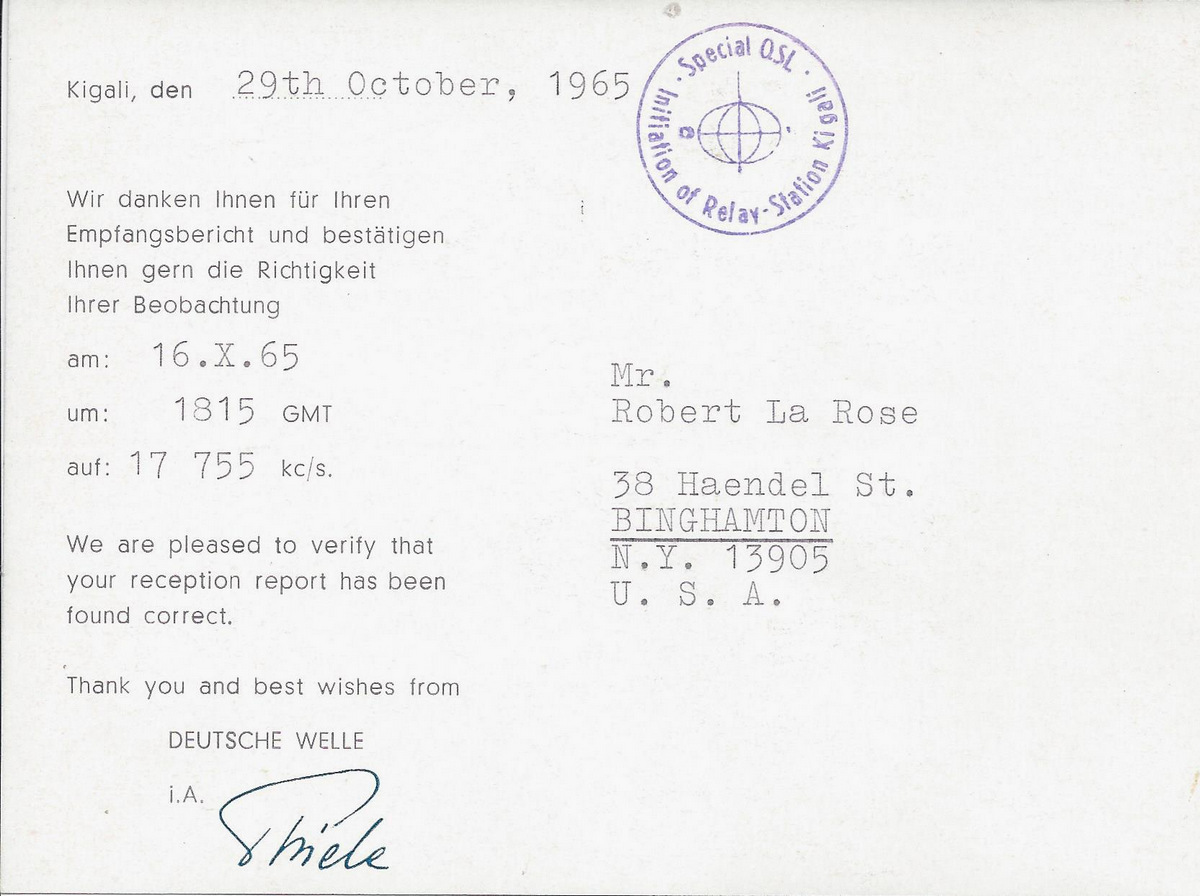
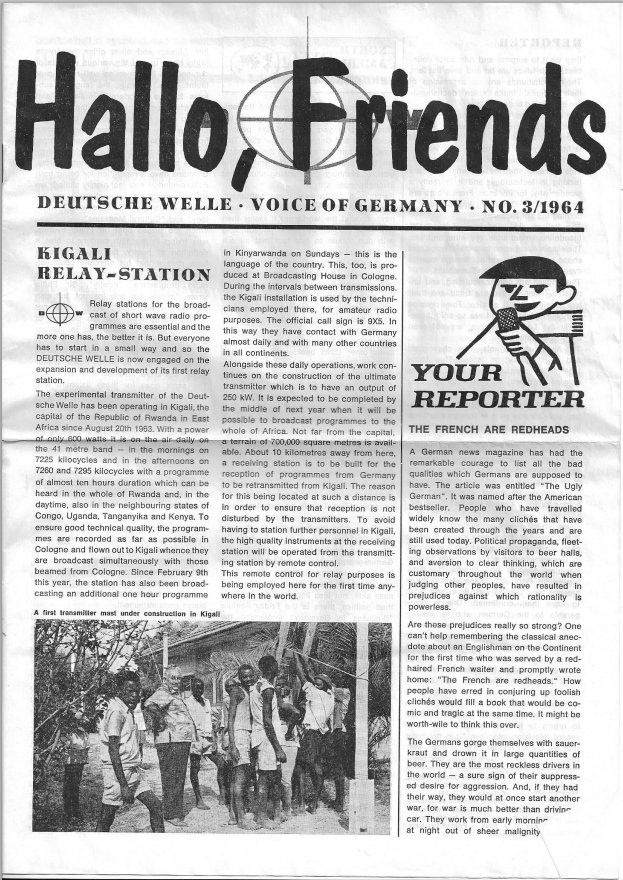
Last week, SWLing Post reader Bob LaRose (W6ACU) sent me the following message and scans:
“Here’s some nostalgia from [when the Kigali relay] opened, 50 years ago!”
Bob then followed this with another email:
“I dug into the “vault” and I found [the] 1964 Third Quarter issue of “Hallo, Friends” from Deutsche Welle that talks about the “new” Kigali station as it was being built. The 1965 issues did not cover the actual inauguration.”
Many thanks to SWLing Post reader, Mike, who notes this brief announcement from Radio Taiwan International:
“Starting from March 29th, RTI will terminate its transmission to Europe on 3965 KHz and to Africa on 11975 KHZ following the end of cooperation between RTI and RFI. Listeners in the two continents are encouraged to listen to our [programs] online.”
Many thanks to SWLing Post contributor, Richard Cuff, for sharing this article from The National:
Radio wars: information battle heats up as Russia and China muscle in
For about 70 years it was the base of the BBC World Service. Bush House, with its grand marble entrance in central London, stood as a powerful symbol of the BBC, home to the short-wave radio services that delivered news to dozens of countries in more than 40 languages. But the lights went out in 2012 when the World Service moved to the more prosaic Broadcasting House; two years later it lost its annual £245 million (Dh1.341 billion) grant from the UK’s government.
Both changes are symptomatic of the BBC’s less certain place in the broadcasting world as other countries significantly ramp up recruitment and funding for their own equivalent services.
Last December, Peter Horrocks, the BBC World Service’s former director, warned that the West was losing the “information war” with Moscow as the old Cold War foe pumped out wave after wave of pro-Kremlin propaganda on its rapidly expanding radio, TV and online platforms.
Horrocks had called for a rethink on financial assistance from the UK government as, even before the grant was ended, cutbacks in 2011 forced the closure of five language services and some short-wave broadcasts.
“We are being financially outgunned by Russia and the Chinese. Medium to long term there has to be an anxiety about the spending of others compared to what the BBC are putting into it,” he said.
It is now all too clear that established broadcasters that are based in the West, such as Radio Free Asia, Voice of America (VOA), Radio Free Europe (RFE) – funded mainly through an agency of the US government – and the BBC are facing increased competition. Last November, Moscow rebranded its international English-language radio service: Radio Sputnik replaced the Voice of Russia and funding was increased for a new state-owned global news agency, Rossiya Segodnya.
Meanwhile, Beijing’s China Radio International (CRI) is an important part of the Communist Party’s foreign policy. CRI uses internet, short wave and satellite to broadcast around the world in dozens of languages, while Radio Sputnik has ambitions to broadcast in 30 languages across more than 130 countries by the end of the year.[…]
If you enjoy listening to The Mighty KBC, you’ll want to note these frequency changes and additions:
Frequency changes for The Mighty KBC
We are delighted to announce that from the 1st June 2015, KBC will be heard daily on medium wave. We will broadcast on 1602 kHz between 07.00 – 19.00 CET from transmitters aboard the LV Jenni Baynton.
Our Sunday shortwave transmissions will continue on 6095 and we will add an extra hour onto 7375 transmission.
To facilitate these latest changes, our Saturday 6095 transmissions will end on Saturday March 28th but all regular shows will be maintained on a new KBC Internet stream which will be available online 24/7.
Also, look out later this year for KBC on DAB+
We hope you enjoy our new outlets and will join KBC on MW, SW, DAB+ and Online.
Check out our website kbcradio.eu and our FB page facebook.com/TheMightyKBc for all the latest news.
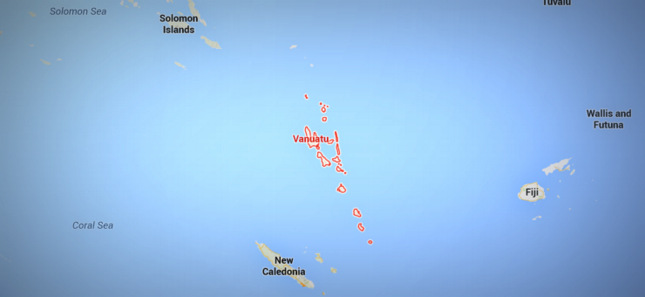
Broadcast communications that were knocked out by Cyclone Pam have been fully restored.
Francis Herman, the ABC’s program manager for the Pacific Media Assistance Scheme, says transmission engineer Steve White and local technicians have fixed Radio Vanuatu’s short and medium wave service to a level better than before the cyclone.

 (Source: PCJ Press Release)