Category Archives: Broadcasters

ABC Friends: “Plea For Urgent Ministerial Action” to retain NT service

Many thanks to SWLing Post contributor, Phil Brennan, who shares the following press release from ABC Friends.

ABC Friends represents the community’s interest in independent national public broadcasting:

MEDIA RELEASE
5/1/2017

NEW THREAT TO LIVES IN OUTBACK
PLEA FOR URGENT MINISTERIAL ACTION

An urgent call for ministerial action to protect short wave services in Northern and Central Australia has been made by ABC Friends National.

“It is the responsibility of both the Minister for Communications Senator Fifield and the Foreign Minister Julie Bishop to respond to this very real need with urgency,’” said ABC Friends National President Margaret Reynolds today.

ABC Friends National sent a letter in December to Communications Minister Mitch Fifield, urging him to intervene so as to guarantee the ABC had sufficient funding to maintain the short wave service – which is so essential in rural and remote areas.

“Furthermore a number of Pacific Island states also rely on this service especially in the current cyclone season,” Margaret Reynolds said, “Pacific leaders have expressed concern about a loss of this service.”

”It is unacceptable to simply blame the ABC when government funding has been reduced so severely in recent years.”

“The ABC cannot provide adequate communication services for all Australians in isolated regions as well as support our Pacific neighbours if it is constantly facing funding cutbacks.”

“The Australian Government must accept that, ultimately, short wave services can provide early warning and be an important preventative disaster measure,” she said.

Further Information:

Margaret Reynolds
National President ABC Friends
Caversham Park featured on The Fifth Floor

Many thanks to several SWLing Post readers who shared this excellent radio documentary on the BBC World Service website:

The Fifth Floor: Watching the World

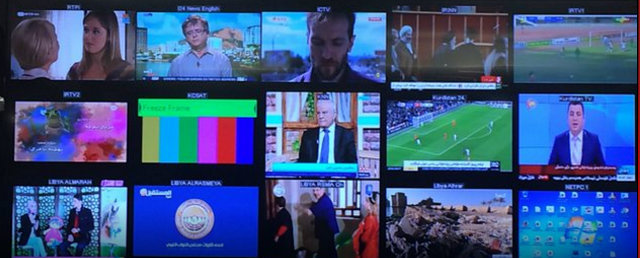
Caversham Park is the home of BBC Monitoring which for over 70 years has been the eyes and ears of the BBC, watching, translating and analysing the world’s media and social media. David Amanor visits the former stately home to meet some of the journalists who’ve witnessed history unfold in their own countries, from the Cold War to the Syrian conflict.

Senior Editors Simona Kralova and Chris Greenway take us back in time to tell the story of how this grand house become a hub for information gathering, from the era of morse code and typewriters to satellites and social media.

Sifting information from misinformation has always been part of the service’s DNA. Ukrainian Vitaliy Shevchenko, Iraqi Mina al-Alami, and Source Manager and morse code man Al Bolton discuss the challenges of sourcing reliable information in the past, and today.

Watching distressing news from home is part of daily life for many journalists. Vesna Stancic from Bosnia, Syrian Lina Shaikhouni and Pinar Sevinclidir from Turkey discuss the personal impact of living the story.

There are also lighter moments to be enjoyed at Caversham, particularly for the musical, including Co-ordinating Editor Tom Mulligan, and Iranians Arash Ahmadi and Mahtab Nikpour, who do a good turn on the guitar, jaws harp and drums when not analysing Iranian politics and tales of chubby Chinese squirrels.

Click here to listen to the radio documentary on the BBC website.

Vatican Radio being absorbed into new Secretariat for Communications

Many thanks to SWLing Post contributor Andrea Borgnino who shares this item from the National Catholic Register:

[O]n December 31, 2016, after more than 80 years of operation, Vatican Radio is being absorbed into the new Secretariat for Communications. The move is part of Pope Francis’ reorganization of Curial offices, and is intended to make better use of the Vatican’s limited financial resources. According to Catholic World News, broadcasting programs will continue—at least for the near-term future—but Vatican Radio will no longer have its own corporate identity.

Today, Vatican Radio employs a staff of 355 representing 59 nationalities, mostly lay people, who together produce more than 66 hours of daily programming (24,117 hours annually). There are currently 45 languages used on air, and 38 languages on the website. Programs are broadcast via short wave, medium wave, FM and satellite.

In recent years, Vatican Radio has experimented with digital transmission technologies (DRM, T-DAB, T-DMB). Their news reports and bulletins have been widely distributed through newsletters, podcasts, audio and video, paving the way to a Web TV. Vatican Radio and CTV began their own YouTube channel in 2010, operating in four languages, and on Twitter (6 channels).

Today with the reform of Vatican communications operations, Vatican Radio director Msgr. Dario Vigano has indicated that he plans to pare down short-wave radio operations. Other broadcasts will continue, but with an eye to controlling costs: Vatican Radio has been losing between €20 and €30 million ($21 – $31.5 million) annually.[…]

Click here to read the full article.

Broadcasting Board of Governors reduced to advisory status

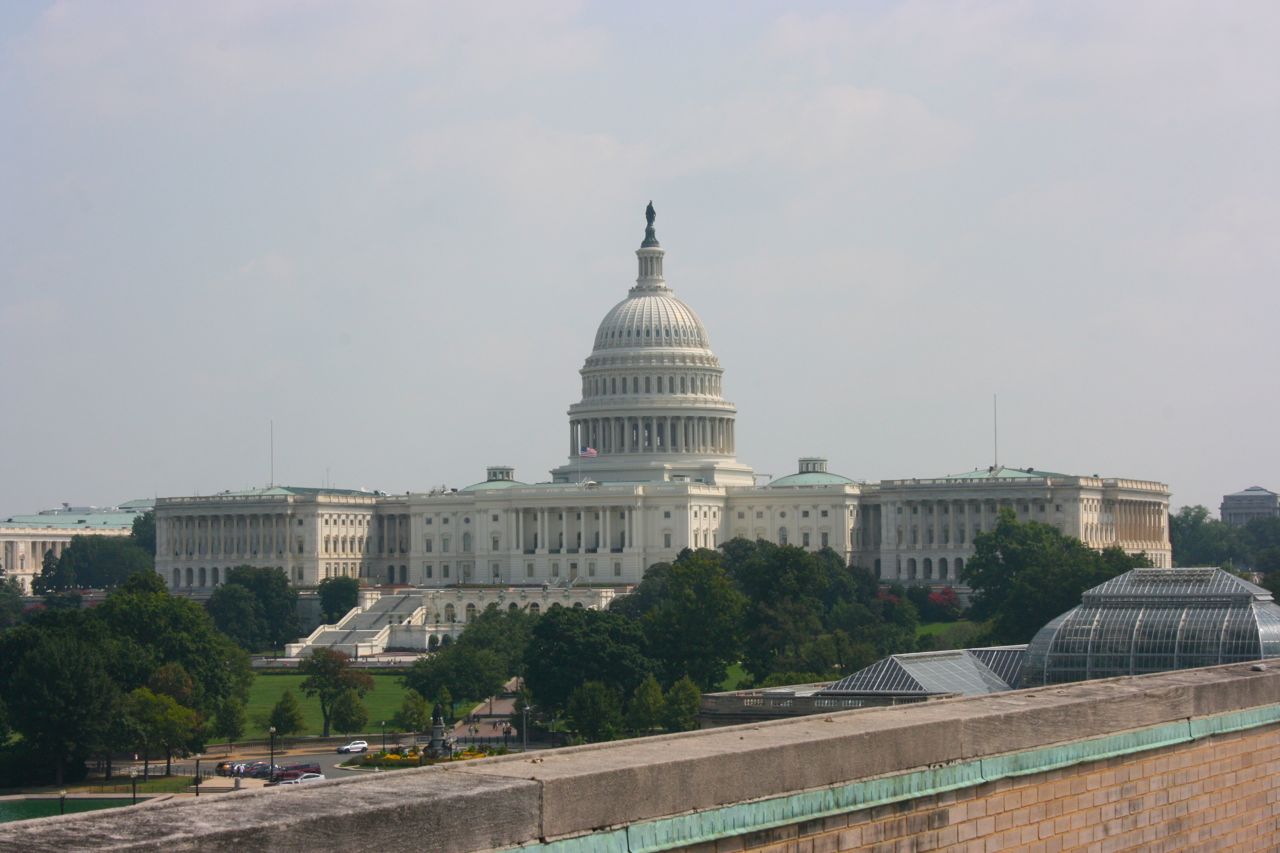
View of the Capitol Building from the roof of the Voice of America on 330 Independence Ave., S.W.

(Source: BBG Watch via Dan Robinson)

President Barack Obama has signed into law S. 2943, the “National Defense Authorization Act for Fiscal Year 2017,” which includes a provision to reduce the Broadcasting Board of Governors’ (BBG) governing board to an advisory status while making the BBG CEO position subject to a future nomination by the president and vetting and confirmation by the U.S. Senate.

While signing the legislation into law, President Obama expressed reservations about several of the 2017 NDAA provisions dealing with the U.S. Department of Defense. President Obama also had some reservations about the amendment dealing with the BBG, but they are not likely to have any practical effect during the waning days of his presidency.

[…]PRESIDENT OBAMA: “My Administration strongly supports the bill’s structural reform of the Broadcasting Board of Governors (BBG), which streamlines BBG operations and reduces inefficiencies, while retaining the longstanding statutory firewall, protecting against interference with and maintaining the professional independence of the agency’s journalists and broadcasters and thus their credibility as sources of independent news and information. Section 1288 would elevate the current Chief Executive Officer of the Broadcasting Board of Governors to the head of the agency and reduce the current members of the Board, unless on expired terms, from serving as the collective head of the agency to serving as advisors to the Chief Executive Officer. While my Administration supports the empowerment of a Chief Executive Officer with the authority to carry out the BBG’s important functions, the manner of transition prescribed by section 1288 raises constitutional concerns related to my appointments and removal authority. My Administration will devise a plan to treat this provision in a manner that mitigates the constitutional concerns while adhering closely to the Congress’s intent.”[…]

Read the full article on the BBG Watch website.

Farewell, Firewall: Kim Elliott’s take on what the NDAA means for US international broadcasting

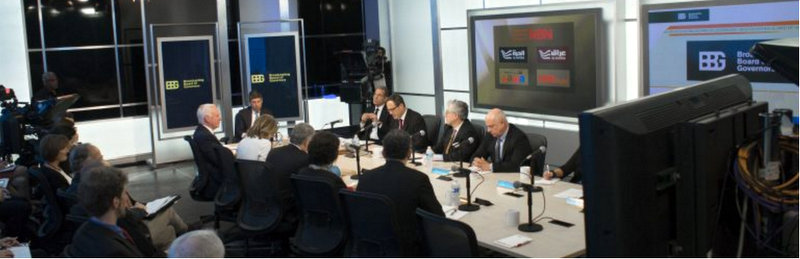
The Broadcasting Board of Governors (Photo BBG)

(Source: USC Center on Public Diplomacy)

Farewell, Firewall

Deep in the massive FY2017 National Defense Authorization Act is a provision to eliminate, in its present form, the U.S. Broadcasting Board of Governors. The NDAA has been passed by the House and the Senate and is expected to be signed by President Obama. The BBG is the topmost authority of the elements of U.S. government-funded international broadcasting: Voice of America, Radio Free Europe/Radio Liberty, Radio Free Asia, Radio and TV Martí, and the Arabic-language Alhurra TV and Radio Sawa. Together they broadcast in 61 languages.

This BBG’s demise eliminates the “firewall” of a nine-person bipartisan board with fixed and staggered terms, and replaces it with one politically-appointed CEO. This change will have consequences.

Traditionally, people around the world huddled around a shortwave radio to get news from abroad. Increasingly, they watch an international news channel via cable or satellite television, or access a foreign website or social media outlet. Whatever the medium used, the need for a credible alternative to domestic state-controlled media is the main reason international broadcasting has had an audience since the 1930s.

Credibility is the essence of successful international broadcasting. The shortwave frequencies, satellite channels, and online media are full of propaganda, but serious news consumers seek out the news organizations that they trust.

International broadcasting in languages such as Burmese or Hausa has little commercial potential. National governments must step in to provide the funding. The foremost challenge is to ensure that the journalism is independent from the governments that hold the purse strings.

To achieve this, there is no substitute for a multipartisan governing board. Its main function is to appoint the senior managers of the broadcasting organization, so that politicians don’t. This is how “public service” broadcasting corporations throughout the world, e.g. BBC, Canadian Broadcasting Corporation, Australian Broadcasting Corporation, maintain their independence.

When a government is directly involved in the production of news, the results are generally deleterious. The outcome can be as extreme as the lies and distortions of German broadcasts before and during World War II. Or the output can be something like the stultifying commentaries that filled much of Radio Moscow’s schedule during the Cold War. And, as can be observed by watching Russia’s RT or China’s CCTV News on cable TV, propaganda can also be manifest by emphasizing some topics, while downplaying or ignoring others.[…]

Read Elliott’s full article on the USC Center on Public Diplomacy website…

162 kHz longwave: CSA France seeks expressions of interest for broadcast license

(Source: Southgate ARC via Mike Barraclough)

French 162 kHz Broadcast Licence

The French Superior Council of Audiovisual (Content), CSA, is calling for expressions of interest in broadcasting on 162 kHz

They say: In accordance with the provisions of Article 26 of the amended Freedom of Communication Act of September 30, 1986 and at the request of the Government, the CSA decided to withdraw from Radio France the use of the 162 kHz frequency for broadcasting of France Inter.

In order to determine whether the Commission should initiate the procedures necessary to appeal the 162 kHz frequency, it decided to issue a call for expressions of interest for the broadcast of a radio service on the 162 kHz frequency.

Responses are expected no later than January 16, 2017.

Announcement in French
http://www.csa.fr/Espace-juridique/Decisions-du-CSA/Frequence-radio-162-kHz-appel-a-manifestation-d-interet

Now’s the time to grab longwave DX!

If you’ve been wanting to log France Inter as longwave DX, you’re running out of time. France Inter is shutting down their 162 kHz longwave service on December 31, 2016.

I’m grateful to SWLing Post contributor, Ron, who has persistently reminded me that these are some of the last days to catch France Inter as LW DX here in North America.  Indeed, he shared a bit of interesting and encouraging news a couple weeks ago:

On the Radiodiscussions DX forum, Jim Farmer over in San Antonio got and recorded France Inter on 162 khz using a PK loop and Sony 7600GR.

The PK Loop he’s referring to is this one and, of course, the Sony ICF-SW7600GR is one of my staple portables.

While I’d love to try to grab France Inter with my Sony, my schedule makes it very difficult to arrange. Fortunately, I have SDRs which allow me to record spectrum throughout the night, then review the recordings in the morning.

Throughout the month of December, I’ve been recording a small chunk of longwave spectrum–with my WinRadio Excalibur–during the night and reviewing it in the morning in hopes that I could grab an opening from France Inter.

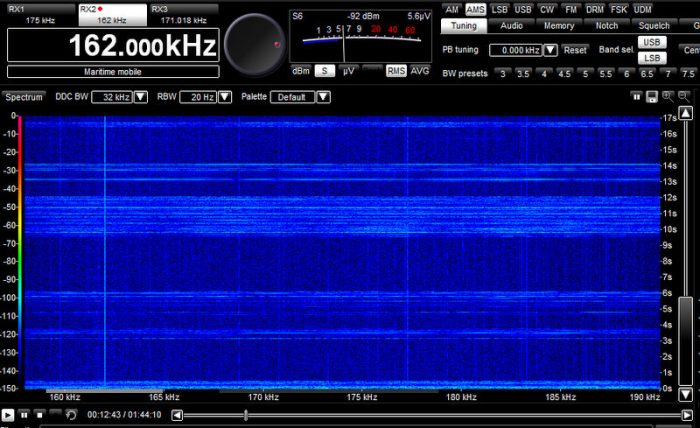
I was rewarded on December 19, 2016 around 0300 UTC. Though there was atmospheric noise that night in the form of static crashes, I snagged France Inter on 162 kHz.

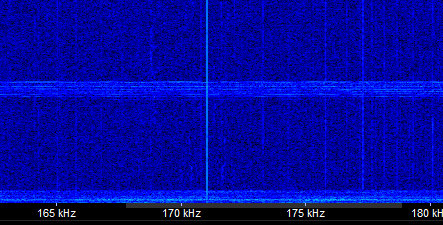
My spectrum display from the Excalibur.

The 162 kHz carrier was barely above the noise floor (see above), so it was certainly weak signal DX. Here’s an audio sample:

Click here to download the mp3 file.

When that short LW opening happened, I was also able to snag Medi 1 from Morocco on 171 kHz. Again, not fantastic copy, but I’m happy:

Click here to download the mp3.

Mind you, both France Inter and Medi 1 only transmit at 2,000 watts–that’s flea power compared to our shortwave broadcasters. It’s amazing those signals can even hop the Atlantic.

Correction…an SWLing Post reader, qwerty.am, comments:

Actually, the power of France Inter and Medi1 is 2000 kW and 1600 kW respectively. So the power of most SW broadcasters should be called a “flea power” in comparison to what is used on longwave. The smallest output on LW band in Europe is 50 kW, it’s used by Denmark and Czech Rep. The 162 kHz transmitter is closing on Dec 26th, according to the latest news.

Wow!

Again, if you’d like to grab  longwave stations before they disappear, now is the time! Our LW broadcasters are disappearing rapidly. Fortunately, winter (here in the northern hemisphere) is the best time to chase LW DX.

Thanks, again, Ron for your encouragement! I’ll keep listening and recording!