Category Archives: FM

Richard’s initial impressions of the Sony XDR-S41D FM/DAB receiver

Many thanks to SWLing Post contributor, Richard Langley, who recently attended a conference in Paris and picked up a Sony XDR-S41D. Richard writes:

The workshop closed around noon on Friday so I spent part of the afternoon walking around the nearby Darty consumer electronics and appliance store.

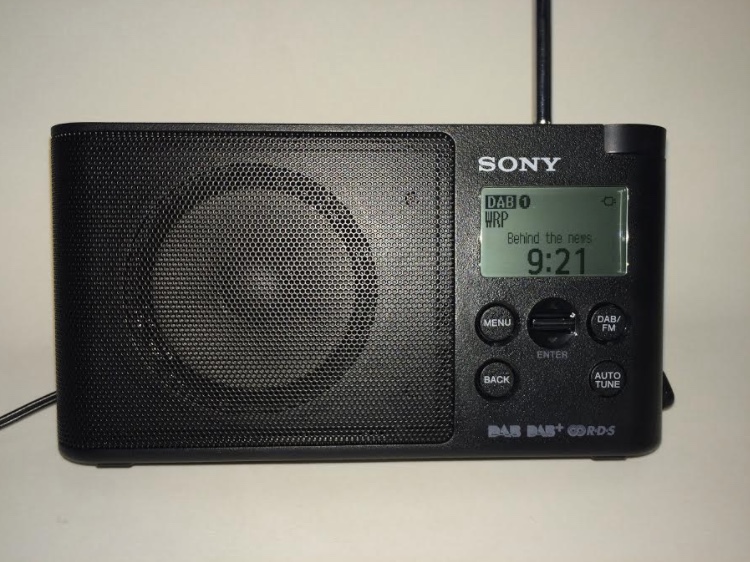
I wanted to buy a DAB/DAB+ portable receiver just to see what Europe was doing with digital radio. I bought a recently introduced Sony XDR-S41D DAB/DAB+/FM(with RDS) receiver for 79€ (about 11€ off list price).

I can use it in North America to listen to FM and take it with me when I visit Europe for DAB/DAB+ as well as FM.

It has reasonable sound from its 8-cm speaker and pretty good stereo sound on headphones. It has an automatic search mode on both DAB/DAB+ and FM and creates a list of available stations.
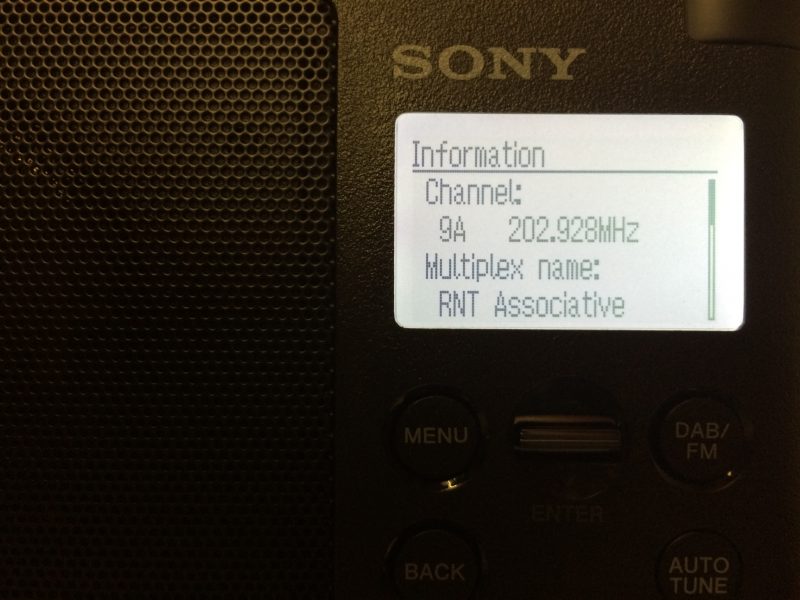
In my hotel room in the 13th arrondisement, I could receive 46 DAB+ stations. One of the stations is World Radio Paris (WRP) and they provide English language programming 24 hours per day from BBC World Service, Public Radio International, Radio France International, and Radio Canada International, among others as well as their own programming.

Another available station was Medi 1, which just dropped its shortwave transmissions. I recorded some of the WRP programming:

Audio Clip 1 (MP3)

Audio Clip 2 (MP3)

There is no line output from the receiver but I was able to use the earphone output and crank the volume to maximum to get an acceptable recording level without noticeable distortion.

Happy with my purchase and can’t wait to go back to Europe again, say to England, to try out DAB+ there.

I also spotted three receivers with SW capability on the shelves at the Darty store:

  • Panasonic RF-3500 for 45€
  • Brandt BR200D for 45€
  • Brandt BR120A for 15€

You don’t see SW receivers in North American consumer electronics stores anymore and I’ve not spotted any in airport duty free stores lately either.

I’ve been listening to the XDR-S41D at home and it sounds pretty good on FM, too, and does a good job of displaying the RDS information although a character or two is sometimes cut off the end of the data but that could be the fault of the station. Need to investigate that some more.

By the way, the radio doesn’t come with a case but I found (just before I was going to toss it) that it just fits in the magnetic-clasp case of one of those Air Canada amenities kits that they give you in business class (see photo below).

That’s the second Air Canada item I have recycled. They used to use full-ear headphones with disposable foam covers. They were a perfect fit for the deteriorating covers on my old Sony noise-cancelling headphones. I’ve since upgraded to Bose. 😉

Thank you for sharing your thoughts, Richard! The Sony XDR-S41D sounds like a keeper for sure and is certainly compact enough to easily accompany you on travels to Europe. I was not aware of World Radio Paris either–I see they’re available via TuneIn, so I’ll add them to my WiFi radio station favorites!

RadioWorld free eBook: Propagation Analysis for Profit

(Source: RadioWorld via Sheldon Harvey at the International Radio Report)

Latest Radio World eBook explores radio broadcast coverage tools and how to get the most out of them

Broadcasters have endless “what if” questions about their radio station’s signal. How would my coverage be affected if I … moved my FM antenna? Changed height? Increased transmitter power? Added a fill-in translator?

This ebook reveals that new software tools and data sets have changed the game when it comes to answering such questions. The book is targeted to FM, AM and shortwave broadcasters both in the U.S. and abroad. We talk to consulting engineers and other experts about the state of propagation analysis.

What tools are available? How do they work? What does a user need to know about contours, population data, mapping and terms like Longley-Rice? What resources are available online? When is it time to use a professional consultant?

This is the 33rd in Radio World’s hugely successful free eBook library. Read it here!

Click here to request the eBook via RadioWorld.

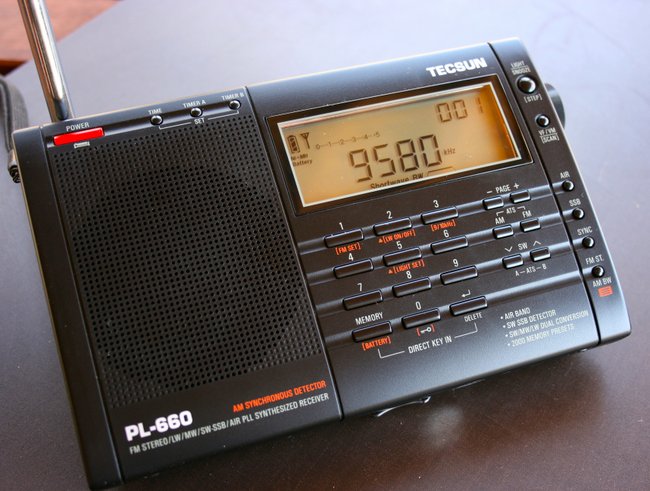
Tecsun PL-660 Hidden Feature: FM Calibration

Many thanks to SWLing Post contributor, Rick B, who writes:

I just thought I’d share with you a hidden function I discovered documented on the web for the Tecsun PL-660. It’s how to calibrate the FM band if you have a radio that is off frequency.

As my current PL-660 is accurate on FM, I haven’t had to try this myself. But perhaps it could save someone else from having to return/exchange a radio.

http://kaito.us/miscellaneous/qa/how-to-calibrate-the-pl660-on-the-fm-band.html

“Re-calibrating FM, radio needs to be on and set to FM band. Tune to the desired frequency/station you wish to listen to, press “SYNC” for about 3 seconds back light will flash. Tune up until the frequency/station sounds more clear press “1” to confirm re-calibration. If done correctly the correct frequency/station will be displayed on the display. Keep the battery in for all the time…”

Very cool!  Thank you for sharing the tip, Rick!

Mystery solved: Remember the 8 Track FM radio converter?

Sunday morning, I attended the Sainte-Foy flea market in Québec City. When I’m in QC, I love attending this particular market because of the amazing variety of things for sale. It’s a proper community event.

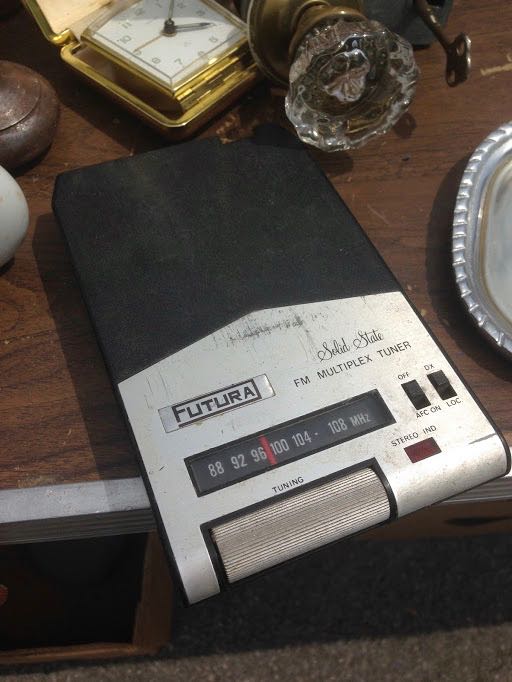
As I was browsing the various tables, I happened upon one of these:

Talk about a blast from the past!

Yesterday, I posted a cropped photo of this radio and it was quickly identified as an 8 Track FM radio converter by Ken (N2VIP). Steve Yothment found the same unit under a different brand and Bill Lee even found a Futura branded unit on the Internet. Of course, many others figured out this was an 8 Track to FM radio converter. Impressive sleuthing!

These radio tuners were popular in the days of the mobile 8 Track players–in that time period right before FM was standard in car radios, but 8 Track was somewhat prevalent.

My father had a similar FM radio converter for his 1966 Chevy pickup. As a kid, I thought the thing was fascinating! You simply inserted the unit into the 8 Track player and voilá!, FM radio!

I never quite understood how the FM reception was so decent considering there was no external antenna of any sort.

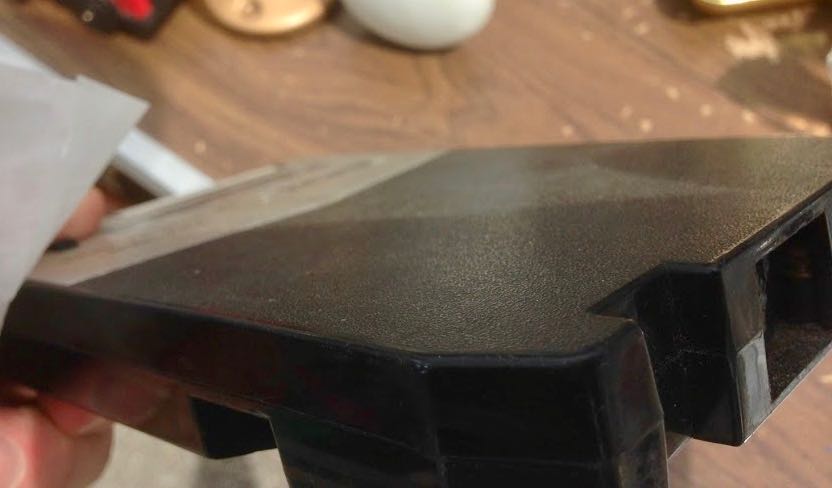
The rear of the converter looks like an 8 Track cartridge minus the magnetic tape.

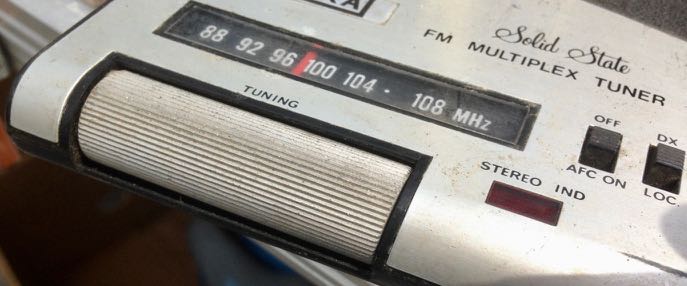
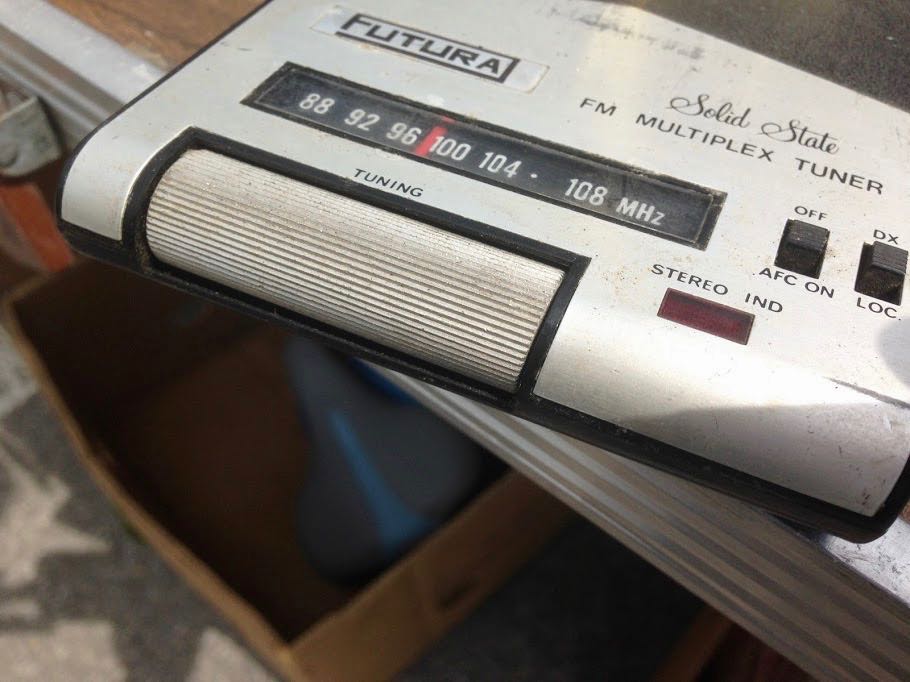
Taking a closer look at this particular FUTURA brand converter, I’m impressed with the number of features on such a compact front end:

  • Analog FM dial
  • Red LED stereo tuning indicator
  • AFC OFF/ON switch
  • DX/Local switch
  • A wide, vertically-oriented tuning knob

I’m curious: how many Post readers had an 8 track FM radio converter in their vehicle? Or, did you ever have an Audio Cassette to 8 Track converter? Please comment! Also, you should check out some of the comments from our previous post.

And thanks for being sports about my “Mystery radio challenge“–I knew savvy Post readers would ID this tuner in no time!

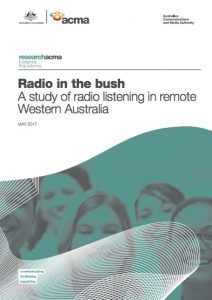
ACMA report on radio listening in remote Western Australia

Image: ACMA

Many thanks to SWLing Post contributor, Phil Brennan (VK8VWA), who shares the following:

I spotted this bit of research from the Australian Communications and Media Authority regarding radio listening habits of people living in remote Western Australia.

Click here to download report (PDF).

It shows that radio very much remains a big part of people’s lives in the bush, particularly AM radio. I’m sure these findings would be replicated in the Northern Territory where I live, but as you are only too aware, we’ve had our remote SW radio service axed by the ABC. Anyway, it may be of interest to you and your readers.

Thank you for the tip, Phil.  This is a pretty fascinating report. As you mention, the use of AM radio is quite heavy–no doubt due to the vast broadcast footprint. It’s this sort of report that should have been done prior to any decision about axing ABC’s NT shortwave service.

Jason praises the Sangean H201

Many thanks to SWLing Post reader, Jason, who leaves the following comment in in reply to David’s recent review of the Sangean H201:

I have this radio, purchased 26 Feb 2012 (so mine has lasted over 5 years) from Amazon US.

Cost me $58 Australian dollars for the radio and a further $40 to ship it down here but tell you what, it was worth it!

This is easily one of my best radios. The DX is amazing (I have received low frequency AM stations during the daytime with no issues). Examples include: Horsham VIC on 594 AM (450km away from my locale) and Broken Hill NSW on 567 AM and it’s only a 500 watt transmitter (480km away from me).

Anyone looking for a AM radio with very good long distance reception should consider this, especially if you are going to be using it on a boat, at the beach, or of course in a shower or tub.

That’s very encouraging, Jason–thank you for sharing! The H201 might also be an ideal AM/FM radio for someone who likes listening to radio on the deck or patio as it can withstand the occasional rain shower. Can you tell I’ve been known to leave radios outdoors?

Note that Jeff McMahan doesn’t recommend using the H201 in the shower, however, as his unit only lasted two years in this environment. In truth, the shower is a pretty brutal environment for even “waterproof” radios–even though Sangean markets the H201 as such.

Too bad Sangean doesn’t make a shortwave version of the H201–yeah, wishful thinking, I know!

The Sangean H201 can be purchased from a number of retailers including Amazon, NewEgg, WalMart and, eBay.

David recommends the Sangean H201 AM/FM waterproof shower radio

A few weeks ago, SWLing Post reader, David Lang, asked for a radio recommendation–one to replace the shortwave receiver that once lived on his bathroom countertop. Since he primarily wanted to listen to a local AM broadcaster, I recommended he go a different route with his next rig to save money and extend the radio’s longevity.

I suggested the ($61 US) Sangean H201 which is specifically designed for humid environments. I had considered this receiver as a gift in the past, but had never actually used one myself. I felt like it was a pretty safe bet, though. David purchased the H201 and recently shared his review:

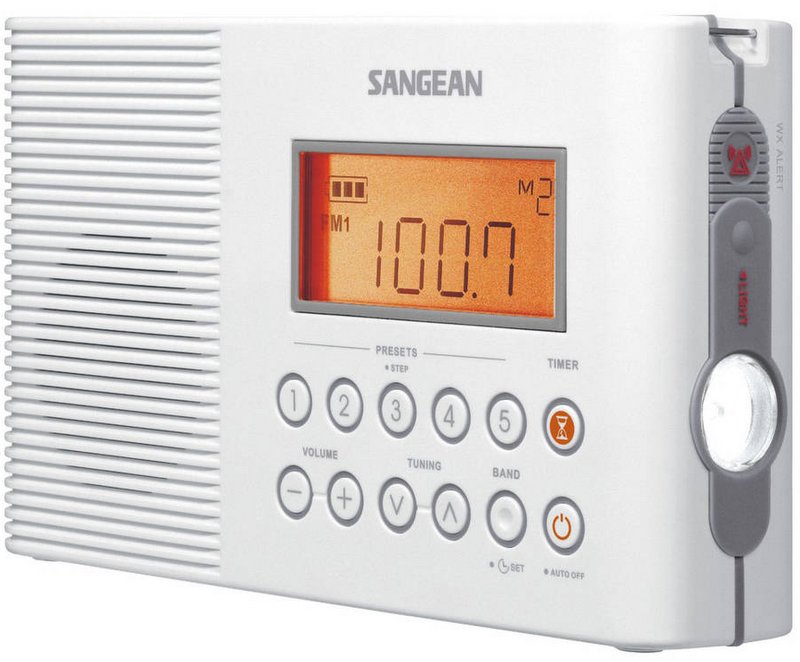
Well, I’m so glad that I was patient and waited for a reply before I bought a radio to replace the old one that I had in my bathroom. I think the Sangean H201 is going to be the perfect replacement. I don’t know if anyone has provided a review for this radio but here are my thoughts at the moment:

The H201 is compact. Not quite as small as my 909 but just the right size to sit on my bathroom countertop and not take up near as much room as the radio it replaced.

Its appearance is clean, simple and intuitive. It’s also waterproof, a feature that is comforting since it will spend most of its life in the humid environment of a bathroom. The display is large and easily read. The display includes battery strength indicator, band, memory preset, weather alert and frequency in the display. The buttons are just the right size and have a distinct but smooth action.

It might have been better for me if the power button had been on the top instead of the bottom right hand face of the cabinet but that is in no way a deal killer.

The H201’s reception is fine for what I need it to do which is receive the primary AM radio stations for our metroplex area (Dallas/Fort Worth) which brings me to my next section of commentary; sound quality. The sound quality of the H201 is exceptional. It’s crystal clear and leans toward the warm side. I’m talking about timbre. My sangean 909 also has great sound but is brighter in timbre. Think about the difference between a French horn and a trumpet. The 909 is a trumpet, the H201 is a French Horn or perhaps a Euphonium. I like the amber display and the half circle carry handle that turns in or out of the cavity in the back of the radio is really convenient.

At times I have to adjust the position of the radio to eliminate a bit of static on AM but I think that’s pretty typical for AM. My comments here are not near as technical as some reviews I’ve read on other radios, particularly short wave models.

While I use and appreciate many of those types of features on my other radios, for my purposes I’m not sure the ‘technical’ is necessary to promote the positive aspects of this radio.

Bottom line: I like it because it fits perfectly for the purpose I needed. Even in a non-humid room, this little rig is a great, simple portable radio for AM/FM local station listening. Thanks so much for the suggestion!!

Cheers!
David Lang

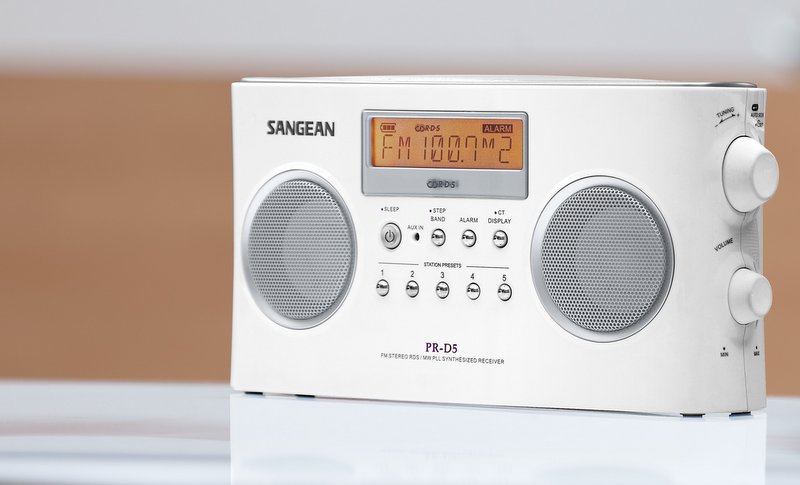
Thank you for taking the time to share your thoughts, David! I’ve been very pleased with Sangean radios that employ this particular chassis style (like the Sangean PR-D5BK Sangean PR-D9WSangean PR-D7, and even the Sangean WFR-28). These models tend to have a durable feel, robust hard plastic body and the audio is pleasant from the built-in speaker(s).

The Sangean H201 can be purchased from a number of retailers including Amazon, NewEgg, WalMart and, of course, eBay.

Thanks again, David!