Shortwave listening and everything radio including reviews, broadcasting, ham radio, field operation, DXing, maker kits, travel, emergency gear, events, and more
Many thanks to SWLing Post contributor, Mike Ladd (KD2KOG), who shares the following guest post. Note that the following tutorial is also available as a PDF (click here to download).
Basics to decoding Inmarsat L-Band signals using the RSP SDR
by Mike Ladd
Note: CHECK WITH YOUR LOCAL LAWS BEFORE DECODIING ANY SIGNALS FROM THE INMARSAT SYSTEM
(some text taken and edited from the RTL-SDR Blog website)
This document is not a definitive guide to Satcom, L-Band transmission or the Inmarsat system. This is a collection of information that I have found scatter throughout the internet and re-compiled into a document, this document. My aim is to help you get started and hopefully guide you in the right direction. Expect typographical mistakes, inaccuracies, or omissions
Inmarsat is a communications service provider with several geostationary satellites in orbit. Inmarsat provides services such as satellite phone communications, broadband internet, and short text and data messaging services. Geostationary means that the Inmarsat satellites are in a fixed position in the sky and do not move.
The Inmarsat 3-F(x) satellites have transponders transmitting data in L-Band (1.5 GHz) that can be decoded.
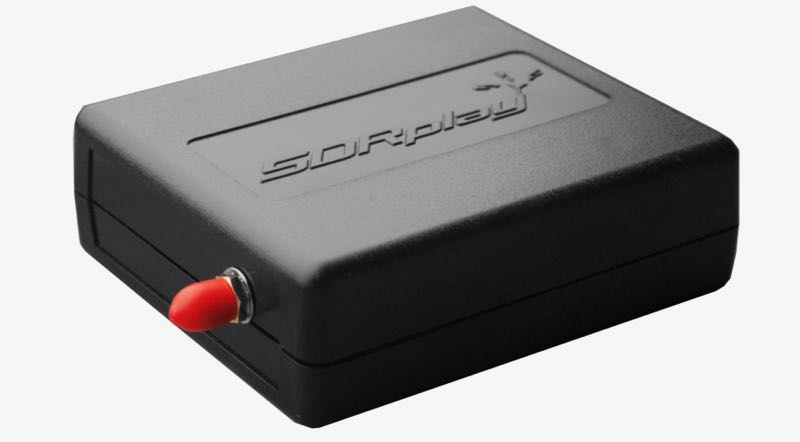
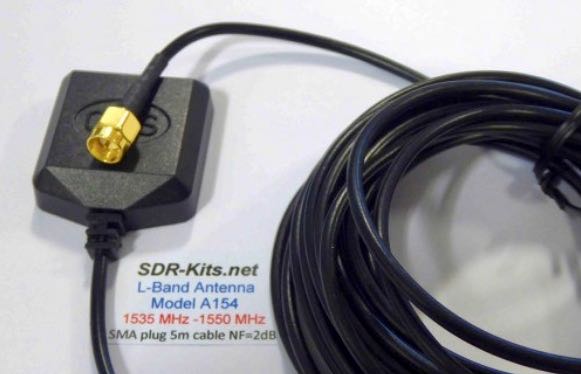
The modes we will cover in this document are Aeronautical (Classic Aero or ACARS) and Inmarsat-C (STD-C) using an RSP1a, RSP2/2pro or RSPduo connected to the SDR-Kits modified L-Band patch antenna. The Inmarsat system is not limited to only these types of networks. We are limited to the decoders available. https://en.wikipedia.org/wiki/Inmarsat
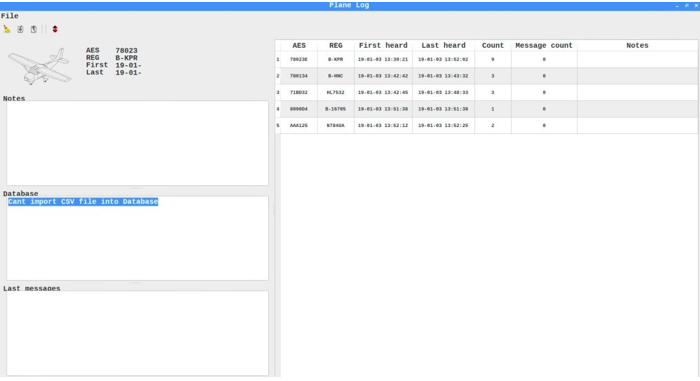
Two of the most popular decoding applications are JAERO used for ACARS and Tekmanoid STD-C Decoder used for decoding STD-C NCS transmissions on the Inmarsat 3-F(x) satellites
Virtual Audio Cable: A virtual audio cable allows you to pipe audio from application (SDRuno) into another application (a decoder like JAERO) digitally. I will assume SDRuno is already installed with your device attached and functioning properly.
You can now download a virtual audio cable package.If you already have a virtual audio cable package installed, you can skip to the next section. If you don’t have a virtual audio cable application installed, you only need to choose one and only install one of the two, either one works fine
Close any running apps, install the virtual audio cable and reboot your computer. When your computer boots back to your desktop, your computer will now have a virtual audio cable pair installed on the system.
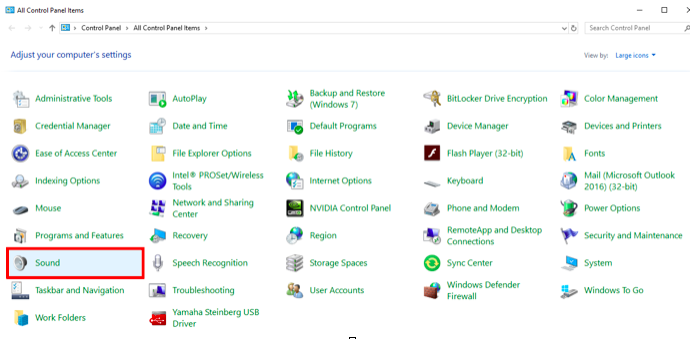
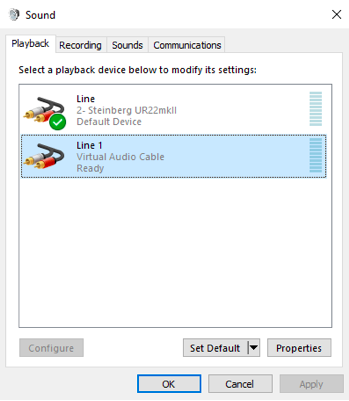
You can verify by going to your Control Panel and double clicking the Sound icon. VB-Cable and Virtual Audio Cable will only install a single virtual audio cable pair, one is for the input (Recording) and one is for the output (Playback). A single pair is all that is needed (as shown below).
JAERO
(some text taken and edited from the JAERO website)
JAERO is a program that decodes ACARS (Aircraft Communications Addressing and Reporting System) messages sent by satellites (in this case Inmarsat) to Airplanes (SatCom ACARS). This is commonly used when airplanes are well beyond VHF range.
JAERO also allows for decoding and demodulation of voice calls, due to local laws and privacy, I will not show or discuss how to do this. You can find more information about that JAERO feature online.
JAERO can be downloaded from the link provided on the first page of this document. After downloading the installer, simply double click the setup file and install it on your primary drive.
Tekmanoid STD-C Decoder
(some text taken and edited from the USA-Satcoms website)
Inmarsat STD-C is a data or message-based system used mostly by maritime operators. An Inmarsat C terminal transmits and receives on L-Band to various geosynchronous satellites that service each major ocean region.
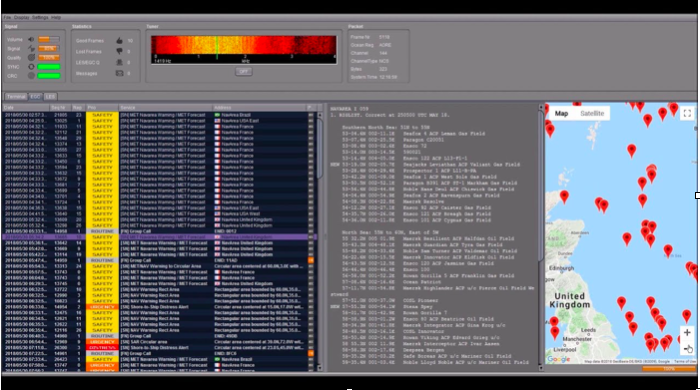
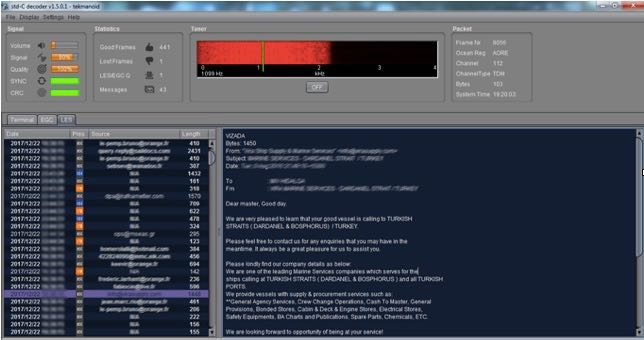
The Tekmanoid STD-C decoder will decode STD-C Inmarsat EGC (enhanced group call) and LES (land earth station) messages. Some of these messages contain private information. Reception of these messages may not be legal in your country; therefore, your local laws should be checked.
The Enhanced Group Call (EGC) service is a message broadcast service with global coverage (except the poles) within the Inmarsat-C communications system. Two of the services provided are:
FleetNET and SafetyNET
FleetNET is used to send commercial messages to individuals or groups of subscribers (for example, individual companies communicating with their own Mobile Earth Stations (MES). SafetyNET is used for broadcasting Maritime Safety Information (MSI) such as Navigational warnings, meteorological warnings, meteorological forecasts and other safety related information (including Distress Alert Relays) from official sources.
The LES station acts as an interface (or gateway) between the Inmarsat space segment and the national/international telecommunications networks.
The Tekmanoid STD-C decoder requires Java JRE in order to run. The link for the Java runtime environment is on page 2 of this document. For information contact the developer direct [email protected]
There are alternatives to using the Tekmanoid STD-C decoder, but in my opinion the other decoders available do not perform as well on low end systems or even work without needing “helper” applications to be installed. Tekmanoid STD-C decoder is very easy to use and works great on my low-end system using minimal system resources.
Putting all the pieces together
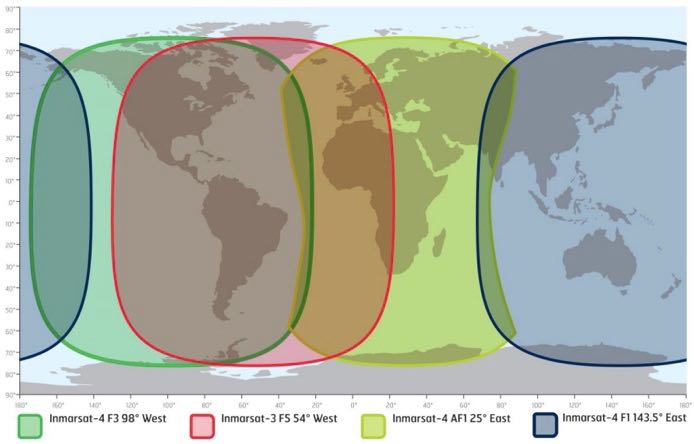
ACARS and STD-C messages will transmit via the Inmarsat satellite deployed within your coverage area/region, you will need to choose the Inmarsat satellite that is closest to your coverage area.
Note that only different frequencies are used between ACARS transmissions and STD-C transmissions. You will only need to receive from one of the available 3-F(x) Inmarsat satellites.
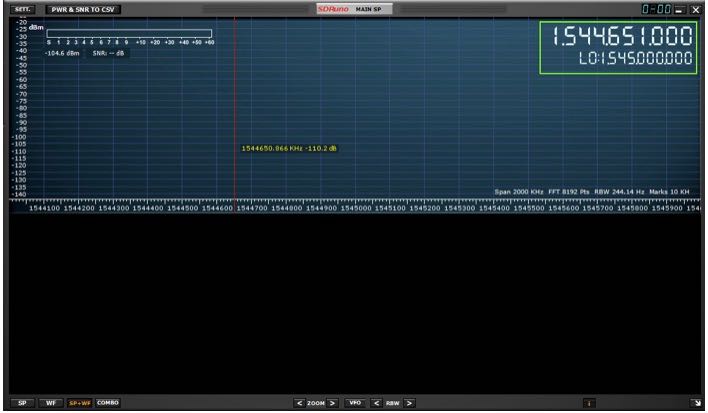
L-Band ACARS transmissions are in the 1.545 GHz range but STD-C messages are on fixed frequencies (shown on page 8)
Since STD-C transmissions are broadcasted on fixed frequencies, we want to monitor the TDM NCSC channel, again these are fixed for the following Ocean Regions. Choose the region closest to your location (page 9).
Inmarsat satellite: Inmarsat-4 F1 (IOR) Direction: 25° East Frequency: 1.537.10 GHz
Inmarsat satellite: Inmarsat-4 F1 (POR) Direction: 143.5° East Frequency: 1.541.45 GHz
I will assume you have located the Inmarsat satellite that covers your region. I suggest using a compass on your mobile phone to pinpoint the general direction. The direction is in ° (degrees). I am referencing true north, not magnetitic north (traditional analog compass). https://en.wikipedia.org/wiki/Magnetic_declination
You can also download an app for your smartphone called Satellite AR (Android and IOS). After you locate the correct direction of the Inmarsat satellite, you will want to place the L-Band patch on a flat metal surface. I have read that the receive pattern of this patch antenna is z (about 85-90°, straight up). Point the top of the antenna facing the Inmarsat satellite. Using the roof of my car worked just fine, just remember to point the front of the antenna at the satellite.
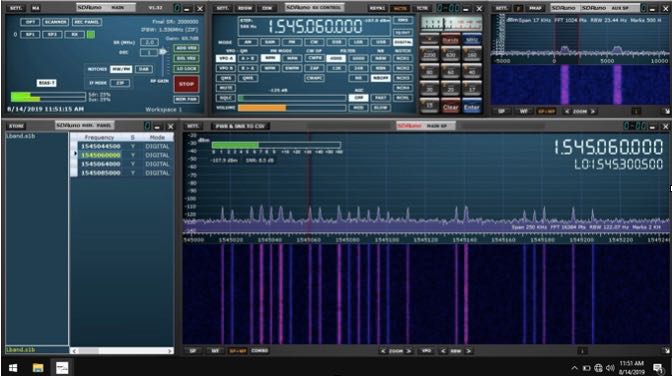
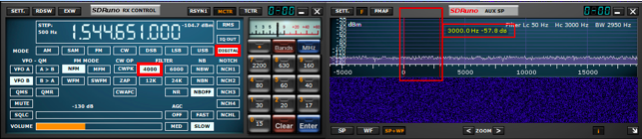
Launch SDRuno and click the PLAY button, remember that if the RSP(x) is in ZERO IF mode, give frequency separation between the VFO (top frequency) and LO (bottom frequency). In LOW IF mode this is not needed. I suggest running a sample rate of 2 MHz, larger bandwidths are not needed.
The SDR-Kits patch antenna requires that the RSP(x) Bias-T be enabled. The Bias-T option is enabled within the MAIN panel of SDRuno. See the SDRuno manual located here. https://www.sdrplay.com/docs/SDRplay_SDRuno_User_Manual.pdf view page 17.
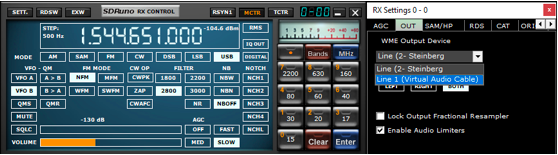
Select the Virtual audio cable as the output in SDRuno, this is selected via the RX Control panel. SETT. button and clicking on the OUT tab.
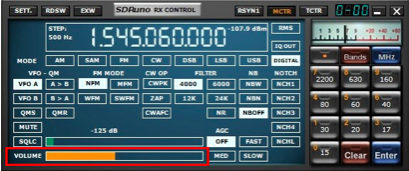
Have SDRuno’s Volume slider (RX Control) at about 35-40%
Upper sideband is recommended but I found the best mode to use for L-Band ACARS or L-Band STD-C decoding is DIGITAL with a filter width of 3k.
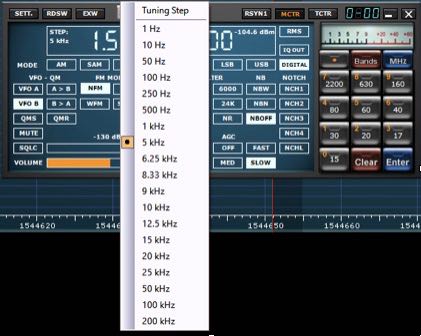
Be sure to set a proper step size (right click the RX Control frequency readout). The step size is not important for STD-C transmissions because these signals are only on one frequency for the satellite in your region but L-Band ACARS signals will be on many frequencies. Setting the proper step size will avoid issues when you point and click on signals you want to decode using the JAERO decoder.
You will want to center the signal with a little breathing room within the AUX SP filter passband. The filter slopes are very sharp. Keep the signal centered and away from the extreme edges (red markers).
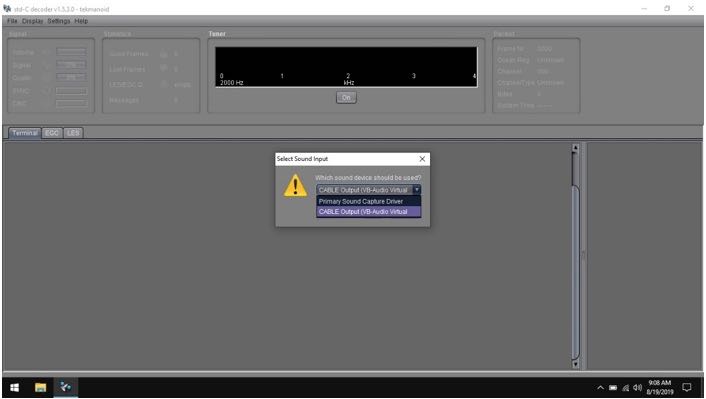
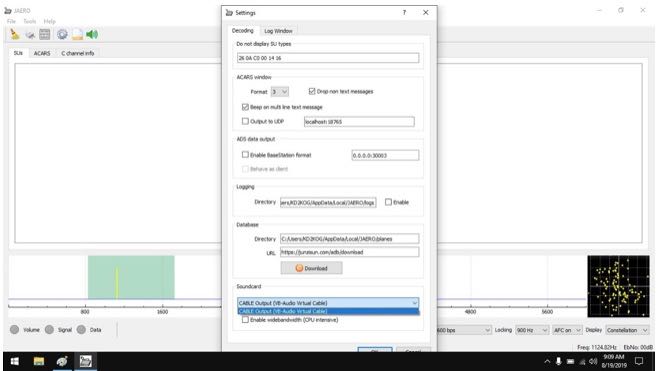
Select your virtual audio cable within the decoder’s audio input preferences.
The Tekmanoid STD-C decoder sound properties are located under Settings in the toolbar menu.
JAERO’s sound settings is located under the Tools menu and Settings.
For STD-C decoding use the frequency from page 8 of this document, remember we only want to monitor the TDM NCSC channel in the Tekmanoid STD-C decoder.
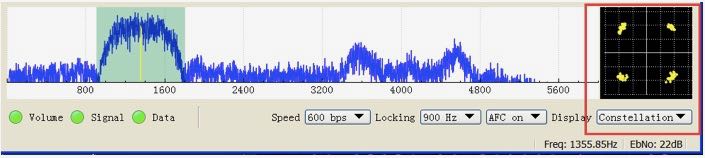
For JAERO decoding, I suggest you start in the 1.545 GHz portion and observe the constellation in the JAERO decoder.
The signal to noise ratio (SNR) needed for successful decoding in these decoders will need to be greater than 7dB. When working with a weak satellite signasls, try decimating the signal using SDRuno’s decimation feature. (MAIN panel, DEC).
I hope this document helps you get started decoding Inmarsat L-Band transmissions from the I3-F(x) satellites. I am sure I missed some key features, remember this is only a primer/basics to decoding these types of transmissions.
Warmest of 73,
Mike-KD2KOG
Many thanks for sharing your tutorial here on the SWLing Post, Mike! This looks like a fascinating activity that really requires little investment if one already owns an RSP or similar SDR. I’m certainly going to give L-Band a go! Thank you again!
Many thanks to SWLing Post contributor, TomL, who shares the following guest post:
Summer Daytime DXing 2019
by TomL
I took note of the mediocre band conditions this summer amongst amateur radio operators as they were making off the cuff comments about still being in a solar minimum. Some had gone out and bought upgraded transmitters to solve the problem (MOAR WATTS!). And more power thrown at a weak ionosphere does seem to help get a signal farther. I had not been out since the spring and decided to find out for myself. But instead of more watts, I wanted more height.
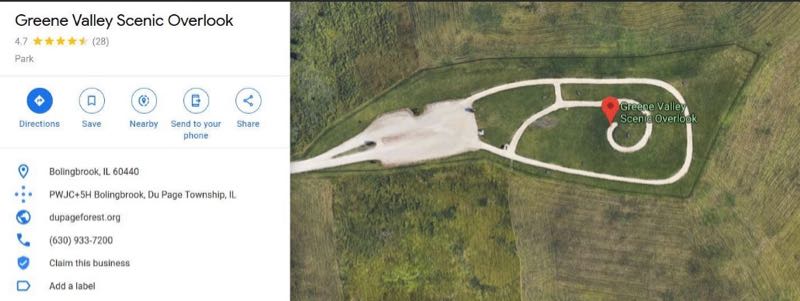
Greene Valley Scenic Overlook is open to the public from May through October on weekends only (and only from 11am-6pm). It was the largest land fill (aka, garbage dump) in Illinois, now covered over and producing captured methane gas. On August 3 & 4, I ventured over there to see if its 190 feet above the surroundings might help my radio reception.
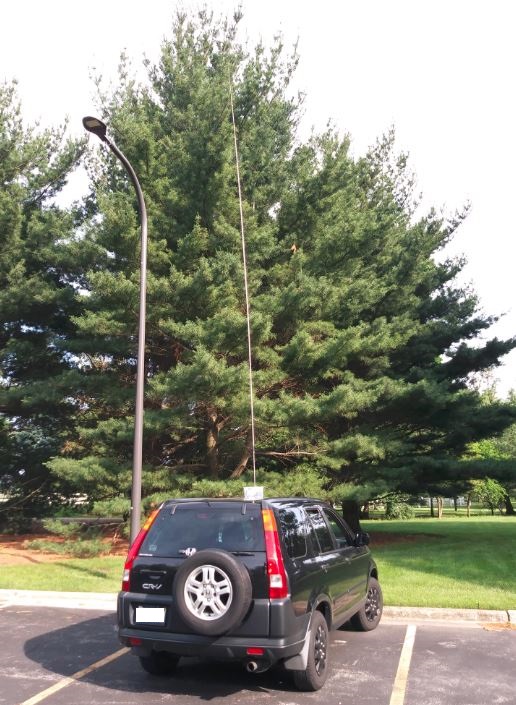
After trying my luck with a 12 foot vertical antenna on a tripod (and numerous children running around it chasing butterflies or looking at the view of Chicago), I went out the next day and parked away from anyone and put up my 19 foot vertical on the roof of the car. This setup is still amazing to me and works much better than the tripod mounted antenna, probably because it has a proper ground plane as well as being 7 foot taller.
So, yes, the conditions were so-so, not too bad and not too good. Lots of weak signals and some empty frequencies that I had expected to hear some South American stations around the 5 – 10 kw range. Weak stations from Asia were more scratchy sounding than usual even with the extra 190 feet of height. Here are 5 broadcast recordings as a sample (times in UTC):
Running out of things to listen to, I wandered over to the 20 meter amateur radio band and found a different situation. Propagation was decent between the Western hemisphere and Europe. Lots of “pile ups” going on with people trying to make contact with their trans-Atlantic counterparts. Some said they were running 500 watts or more, so more power does seem to help! Here are 5 recordings to show how active it was:
This outing was quite educational and I find it curious that people running 1000 watts or less are able to be heard well between continents but the large broadcasters were difficult to hear. Antennas pointed in the right direction, at the right time of day and frequency, can certainly do amazing things, plucking those weak signals out of the air so easily. And I do think the extra height had something to do with hearing this magic, too!
Happy Listening,
TomL
NOTES:
An easy way to lookup amateur radio operator “call signs” is to go to web site QRZCQ.com which does not need a login. Some records may be out of date, but most of it is accurate.
Setup used was a cheap Dell laptop, Windows 10, SDR Console 3.03, connected to the AirSpy HF+, a Palstar amplified preselector, and an old Kiwa BCB filter, then going up to the car roof magnetic balun (a Palomar MLB2) which is then connected to the 4 magnet base and the MFJ 19 foot stainless steel antenna. You can read about it here:
Brilliant report, Tom! It’s true: the bands are fickle, but like you I always find interesting things to hear on HF. I think your setup using your vehicle as the ground plane for the antenna is a fantastic idea. Plus, set up is easy, self-supporting, and you’ll never have to worry about a park ranger, for example, complaining because you have a wire suspended from a tree. And when there are no trees? You’re still golden.
Thanks for sharing your experience and DX! Amazing that even with mediocre conditions, you still snagged some distant signals.
Many thanks to SWLing Post contributor, 13dka, who shares the following guest post and review:
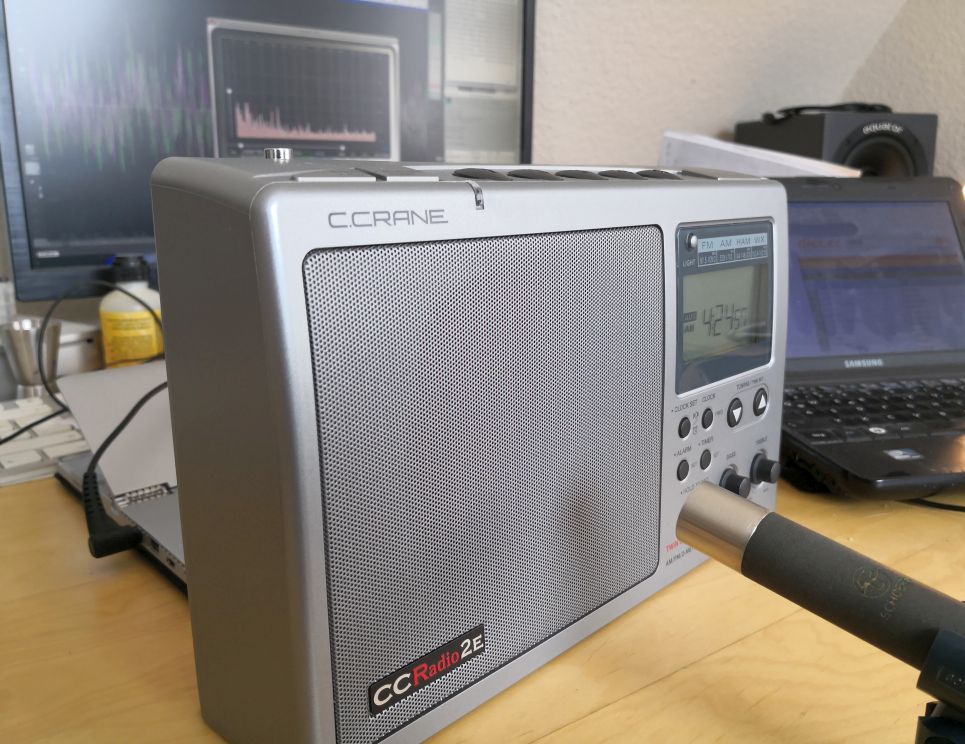
Do I really need this radio? A very belated review of the C.Crane CCRadio 2E
by 13dka
Ever since my relapse into radioholism a few years ago, I had a craving for a top-notch medium wave radio. This became even more of an urge when Germany abandoned the AM BC band just like many other European countries, leaving a band full of new opportunities but little left to receive during the day, at least with all the average portables I own. When checking the options, there’s no way around Jay Allen’s website if you want to know what’s best on MW, and I learned how little choices there are on the summit of the “5-star”-radios. Over the years I kept looking for an RF-2200/DR-22 et al but they are few and far between over here, and buying a dusty old radio with an unknown history, likely in need of repairs, restoration and alignment, for an insane premium price (up to 400€!) from a stranger was not exactly a pleasant prospect for me.
The CC Radio 2E and its predecessors, successors and siblings are the only radios in the topmost 5-star bunch that can be bought new and at a reasonable price. Sadly, the best product for the European market is only a 4 1/2 star radio and I realized that I have to buy a radio clearly made for the USA only, and accept the parts that don’t make any sense over here (120V, 10kHz AM spacing only, WX band). The problem: getting one shipped to Germany was rather complicated until Amazon.com made that much easier last year.
Performance comparisons
AM Broadcast Band
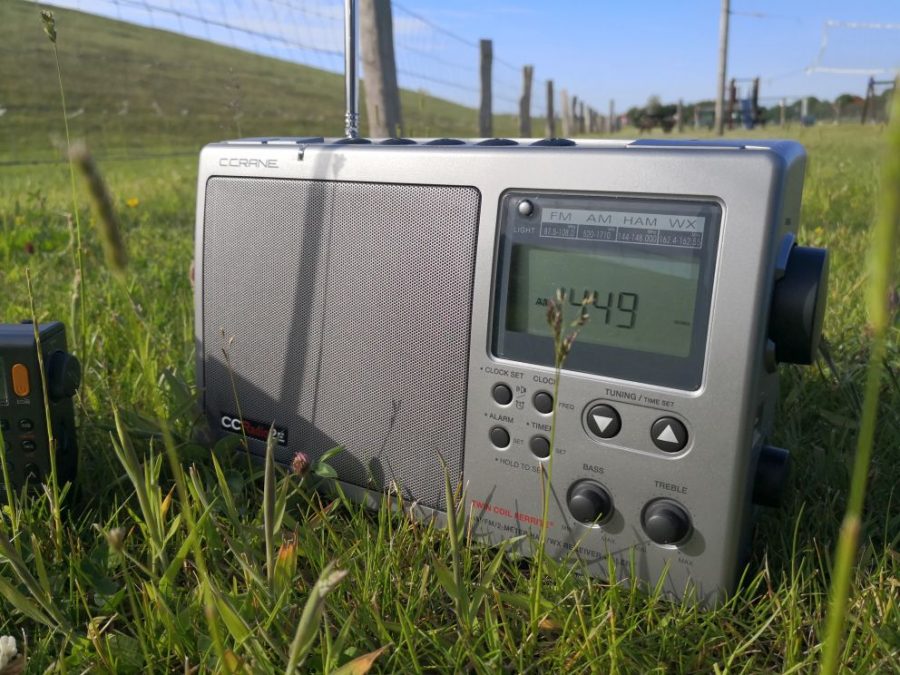
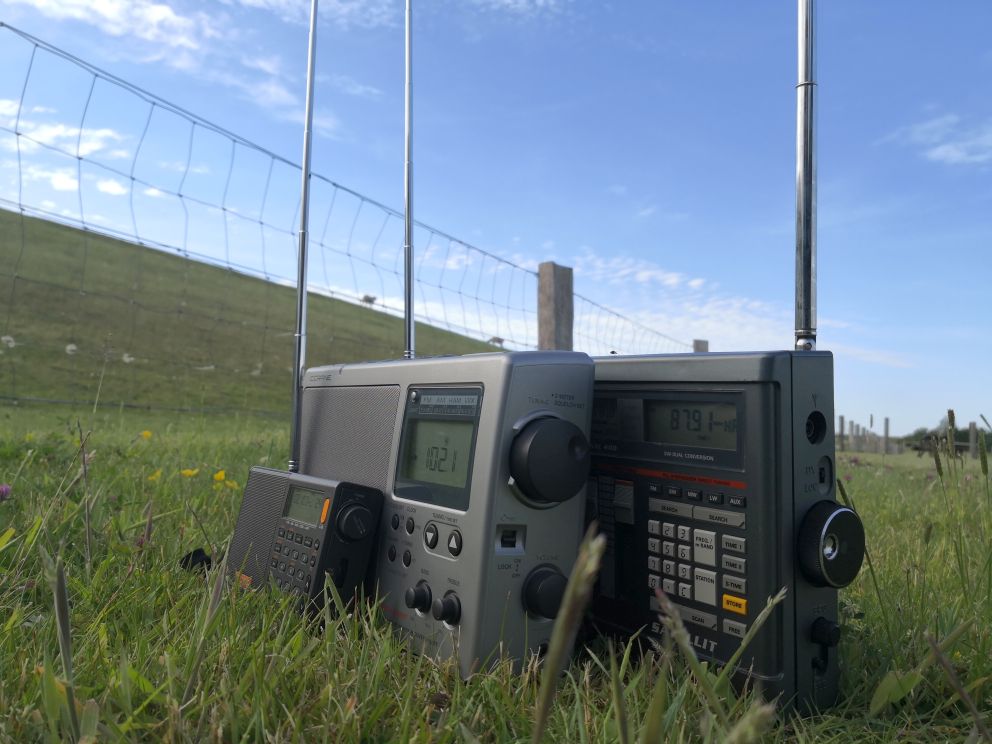
After 2 weeks of gleeful anticipation it finally arrived last month and I rushed to the mall to buy plenty of ‘D’-cells, then to the dike to answer my own, most pressing question: “how much better is a top tier Jay-Allen-5-star radio than my average 3-star radios anyway?”. I wasn’t sure what to expect from the 2E, partly because the videos I could find compared it with other good AM radios, or they didn’t compare it at all and sometimes the radio didn’t even get turned on. Nothing really related to the radios I have, after all they represent a whole bunch of popular radios people currently own with a similar (around average) AM performance, like the Tecsun PL-nnn, Eton Executive Satellit or Field, or ICF-7600, Zenith TO/R-7000 to name a few older types – and I was looking forward to fill that gap!
Sensitivity
Spoiler alert: the CCR2E’s sensitivity obviously bests all of my other portables. Duh! It should, because my example of the PL-660 isn’t good on AM at all, the XHDATA D-808 [read my full review here] is a 2-1/2 star radio and the Tecsun S-8800 [read my full review here] is a 3-star radio on the “Jay Allen rating scale”, even though I’d rate my examples of these radios the other way around – my D-808 has a tiny sensitivity edge over my S-8800.
So how much better is it? Here’s a cellphone video letting the radios speak for themselves, alas with plenty of wind noise (sorry, it’s usually windy here at the coast!). Make sure you watch it past the somewhat unspectacular first minute:
I hope you’ll agree that this is pretty impressive, and that’s the kind of results I was hoping for. There’s also a simple way of quantifying how much better it is in numbers: if I tune across the band in the afternoon and note all frequencies that clearly show signs of a station (not counting how well it comes in, just the pure existence of some signal that can be identified as “broadcast station”), the D-808 has 11 frequencies populated, the CCR2E has 25. That’s more than twice as much, the 2E has twice as many stars, sounds about right. Let’s also keep in mind that the XHDATA or the Tecsun represent “average”, “serviceable” or “decent” AM radios that are quite satisfactory for most people, and yet there is apparently a whole world between an average radio and the top of the heap. To be honest, I didn’t expect how dramatic the difference would turn out.
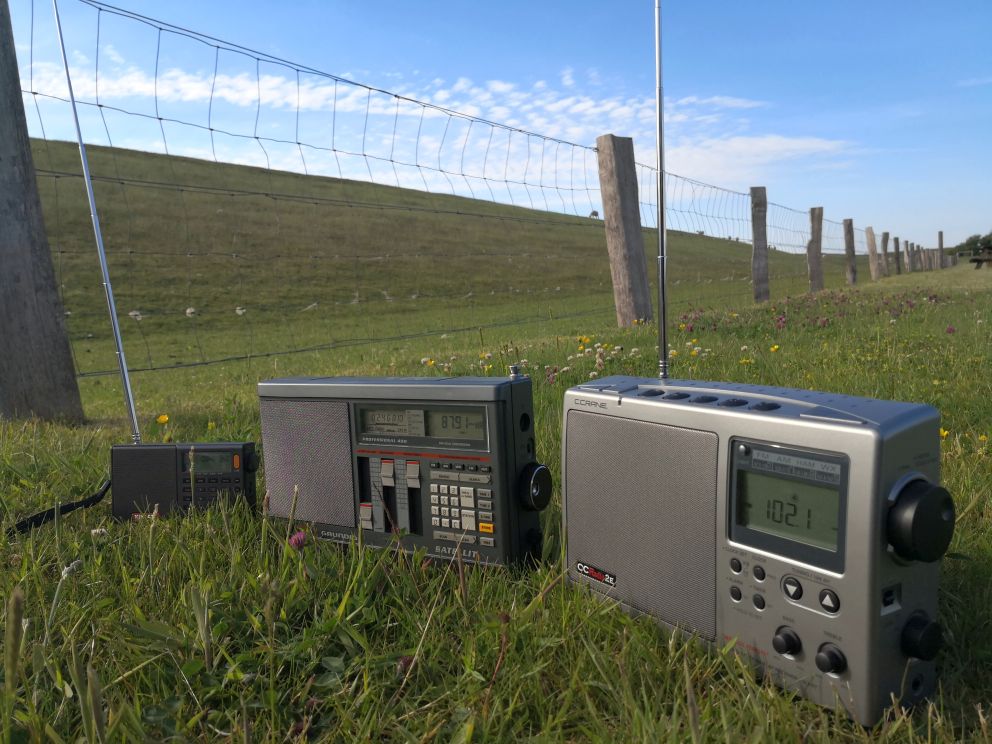
That made me curious how my battered old Grundig Satellit 400 would do, after all it was always a tad better than the other portables I have (Jay Allen might rate it 3-1/2 stars), and MW is the only thing in it that still really works. I decided to buy it the last bunch of batteries of its life and took it to the dike:
Evidently the Grundig is a bit more sensitive than my other average radios but without much benefit. Stations with some appreciable level turn out a bit better but it fails at the same stations as the other radios and the C.Crane unsurprisingly runs circles around the Grundig as well. The first and the last station recorded in this video demonstrate that nicely – my favorite low power benchmark station (1602 kHz) transmitting with 100W from a moored old pirate radio ship was just making it over the noise on the S-8800 in the previous video. The Satellit picks it up OK but with more noise. The last station is the BBC transmitter in Redmoss (Aberdeen, Scotland), which is pretty crystal clear on the CCR2E while the Satellit has only little remnants of modulation and the D-808 is at least on par with the Satellit there. That station pretty much didn’t exist on the S-8800 in the previous video either and I wish I’d know why this example turns out so extreme, why the 2E and that station like each other so much.
The closest stations in these videos are in The Netherlands, 150+ miles away and have only 100W, most of the UK stations are between 350 and 420 miles away (most of them not very powerful either), Scottish stations are around 500 miles from here and the Redmoss 2kW BBC transmitter on 1449 kHz with its beautiful signal is 490 miles. Given that this is daytime groundwave reception with no help from an external antenna, I consider this pretty darn impressive. But keep in mind that a part of the impressive results is due to the low noise location and the conductive North Sea water being only 50m from my position behind the dike, then stretching most, sometimes all of the distance between the radio and the transmitters, which definitely helps groundwave propagation a lot.
To put the benefit in some more practical metrics – my average radios pick up at most 3-4 stations in a halfway sufficient quality for continuous listening during the day, the 2E makes that at least 8-10 stations. While sensitivity is playing a somewhat lesser role at night, it’s pure fun to browse the band and discover stations that didn’t stick out of the noise enough in the past. It is undeniably an exceptionally sensitive and stunning AM receiver.
Selectivity, overloading resilience
The 2E has a wisely chosen single bandwidth more on the narrow side. Given the intended purpose of this radio, I think one can live very well with the “one size fits all” setting and the intelligibility remains excellent. At night when the band is getting crowded even over here, the 2E has absolutely no trouble separating the channels.
Other reviews mentioned that its dynamic range may not be sufficient to cope with local blowtorches and I’m sure that this is true. I don’t have local blowtorches, but I tried coupling wire fences between 200 and 1000m (600-3,000′) to the loopstick antenna, and it could cope with those arrangements better than the S-8800 and the D-808: at night, both of the latter present some roar between the stations on the lower end of the band (which is of course mostly intermodulation products). Both radios then need some looser coupling from the coupling coil, on the the S-8800 I can also lose the preamp stage (“local” switch) to mitigate this, the D-808 can’t do that and has the most problems with images, for example clearly discernible images from the top of the NDB band just 100 kHz lower in the same band.
The CCR2E stays pretty quiet on the few frequencies the fence antennas leave unpopulated. In other words, its frontend may not be as good as the one in some vintage receivers, but it still takes more of a beating than e.g. the Tecsun S-8800 with its improved (over the PL-880) frontend.
AGC
Lacking really strong signals, I can’t comment much on all of the AGC action but I too think it doesn’t pull up weak signals as much as other radios. That makes the 2E appear even less noisy between stations, but being desperate to catch some transatlantic DX before sunrise (yawn!) despite the season being over, I found myself a few times with the volume knob turned up all the way to the right stop on some quiet channels, while the band was filled elsewhere with considerable signals from that 3,000′ fence. The time constants are more on the slow-ish side, thunderstorm impulses make the signal dive away for half a second and it seems to struggle with weaker stations that come with a fast fading. SDRs with fully adjustable AGC characteristics sure have spoiled me.
FM Broadcast Band
Sensitivity
FM sensitivity is excellent in all of the portables I have (S-8800, D-808, PL-660) and the CCR2E can match their performance, there are generally only very little differences between all those. As mentioned in my S-8800 review, I found its sensitivity can’t fully match the PL-660 and the D-808, even though it employs the same DSP chip type as the D-808. I briefly compared the CCR2E with the S-8800 on FM (simply because both are big radios, and I guess I wanted the 2E to win this too).
Comparing portables on FM is a bit of hit and miss though – you need to find borderline weak stations to begin with, and then you have to make sure each radio’s whip antenna is adjusted for maximum signal, and you need to put one radio at a time on the table, because otherwise the whip antennas can interact with each other and make it hard to find the optimal antenna postion/tilt/rotation. When I tried the CCR2E at the dike, a complete lack of tropo conditions limited the number of test stations a lot, and the remaining stations were not really weak enough to find a clear winner among the two. Both radios were on par most times, sometimes it felt like once the 2E gets a bit of signal it will present it a tad less noisy than the S-8800.
But then a very borderline faint Dutch station on 88.1 MHz made it over the North Sea with much noise on the S-8800. No matter what I tried with the 2E (antenna gymnastics, raising, repositioning, lifting up and tilting the whole radio and swearing at it), it picked up nothing at all. That looked much like the 2E is actually less sensitive than I thought, but as it turned out later there is a much happier explanation for this:
Selectivity
Since the day I got it, I had the impression that the 2E has a narrower FM filter than my other radios. Tuning 50 kHz next to a weak station makes it almost disappear and 200 kHz off a local station gave me much hope for letting a weaker station pass unharmed. Now when I checked the station listings for my Dutch mystery station on 88.1 MHz it turned out to be very unlikely that I received the station listed there for 88.1 – “Radio 10” in Hilversum has only 3 kW and is a bit too far away, without any tropo help anyway. What’s way more likely is that I actually heard the much closer 60 kW “NPO 2” transmitter in Smilde on 88.0, that is, its upper sideband on 88.1. To understand this you need to know that Dutch (and AFAIK French) FM stations like to plow their channels with some rather hefty FM deviation unknown in Germany. The wider filter of the S-8800 picked up so much of that extra-wide deviation that I could identify the language. I could not hear the station on its actual frequency 88.0 MHz either, because a much stronger local station on 87.9 was whacking it.
The CCR2E just didn’t pick up any of the surplus deviation from 100 kHz lower, which is a quite striking evidence for a narrower filter (<200kHz), and this might also explain why it appears more sensitive when it picks up some weak station – a narrower filter means a better SNR on FM. I did not read Jay Allen’s “FM shootout” (where the 2E is the topmost radio as well) before tried the radio and I’m not sure yet if I’d put it above all other radios too. But it’s very safe to say that the 2E is likely about as sensitive as all of the contenders in the very crowded 5-star class in the “FM shootout” and its selectivity might be giving it an advantage over other radios. Too bad such a good performer on such a short antenna doesn’t have an external FM antenna input and RD(B)S.
2 Meter – VHF and Weather Band, SSI
Short story, there is no NOAA WX band in Europe, and my local 2m repeaters don’t even seem to transmit their ID every 10 minutes anymore like they were supposed to do in ye olde days, maybe they’re gone. Analog VHF ham radio has ceased to exist around here and if we’d have some catastrophic event, all a 2m receiver could do to help you is emitting some soothing white noise.
I will use this section to talk about the signal strength indicator on the CCR2E instead. With 12 discrete bars it has a better resolution than e.g. average portables, which often try to look like they had even more bars but actually have 5 sections of 4-bar groups, in other words they just have 5 real bars. The better resolution of the 2E is certainly helpful, for example when you pair it up with some kind of tuned external antenna – but it seems to indicate levels with some delayed response and that ruins it a bit.
Sound
The 2E has a quite satisfying bass and treble response for music listening on FM (if you turn up the controls). It has the biggest speaker of all of my portables and creates some audio that rather reminds me of a small home stereo than a portable radio. However it doesn’t have the power to really do “loud” and the bass may run out of breath and distort pretty soon on some music styles.
For a few days I couldn’t quite put my finger on why it didn’t put that much of a smile in my face like the S-8800 or my old Satellit 400 do, and I remembered the quite controversial ratings of the 2E’s sound I had read. I felt that it doesn’t have that special “big portable” in-your-face bass sound my other big radios have, a sound that was burned into my eardrums by all the big Grundigs and Nordmendes I had since when I was a teenager.
The answer might be quite simple though: the 2E has a much wider frequency response than those radios, it actually reaches down lower and the treble range is also extended. What we (OK, at least I) perceive as that “warm” and “big” sound in those old portables is actually “pseudo-bass”. Pseudo-bass is a psychoacoustic effect that tricks our brain to perceive louder and fuller bass when actually only the first harmonics (typically one octave higher) of bass instruments are heard, for example because the speaker is too small to actually render the fundamentals, with the “bass” tone control boosting the harmonics instead. The 2E sounds more like a small 2-way hi-fi speaker and tries to do “real bass” rather than pseudo-bass, which is much more demanding in many ways. Pseudo-bass is also much less depending on automatic loudness correction at low volumes, so the 2E seems to lack bass at “bedroom” volumes sometimes, compared to the Tecsun or the Grundig. Though once a station plays the right music and the 2E is turned up a bit, it’s getting quite obvious that it can sound even bigger than those other radios.
On AM the CCR2E can even produce too much bass that needs to be dialed back: like talk radio dominates the US AM band, its EU pendant is still reigned by pop/rock stations (usually employing lots of signal processing for extra-fat sound). On those stations, the CCR2E can be bassy to a degree where the bass is almost sounding detached from the rest of the signal, as if it’s coming from a different, stronger station. It’s a more boomy, “wet” or maybe a hint less “musical” bass sound, this is rather a wordy description of impressions and not a complaint though. It just doesn’t massage my auditory cortex the same way the other radios do, which is of course a matter of taste and “getting used to it”.
The tone controls are modern and efficient like the ones you find on the S-8800 – compared to my old Satellit, they have a steeper roll-off at well-chosen cutoff frequencies so you can eliminate just the hissy top end in the treble range or remove all that rumble below 200Hz, leaving the midrange in between untouched. On the positive end of the knob range, they just add deep bass and a nice clarity on the top, as if the 2E had a tweeter.
So it does sound great and I can see now why the successor radio, the C.Crane Radio 3 got upgraded with Bluetooth. But the 2E is a great powered speaker as well, it has an AUX input radio nuts can use to boost the audio of an SDR connected to a laptop or a small SW portable to the same level of fidelity. The manual claims that the 2E has a battery endurance of 250 hours, which would mean it should serve all day for at least a whole week as an awesome powered speaker for your other radios out in the woods, and it even might become the best speaker (with very useful tone controls!) in your home shack. This works so well that I deem this a serious (and perhaps often unconsidered) asset.
Quirks
One thing I don’t like a bit is a strange scratchy narrowband distortion that seems to come up within a certain level range. It’s independent from the station, the frequency or the noise on it (and not to be confused with multipath distortion), it’s showing up across the band and is solely depending on the input signal as it seems. It doesn’t affect stronger signals (so there shouldn’t be anything overloading) but if a station hits a certain low signal level it’s quite permanent and also quite disturbing, if there’s fading the noise will come and go when it passes through that level range. The only way to mitigate that prickly “frying pan” sound is turning the treble knob all the way down. I don’t know if that’s a bad case of demodulator distortion or some AGC related malfunction and for some reason beyond my understanding (strong out-of-band signals playing a role maybe?) this does not always happen. Still a bit of a fly in the ointment.
A rather harmless little quirk I (among others) found is happening when I recall preset stations on AM: under unknown circumstances the 2E will not tune the antenna properly so I need to change the frequency and tune back to get full signal. I assume that the coil tuner setting is saved with the preset, and when the environment of the loopstick changes (like when you saved the preset at a different place), the saved tuner setting does not fit anymore. Retuning, then saving the preset again should fix that.
Rather fast fading can have a similar effect on the tuning process, if I tune and retune to such a station, I may end up with different signal meter readings and volume every time – it seems that the integration time window used to automatically tune to peak signal can be too short in relation to the fading speed and that may lead to a less than optimal match of the coil. Admittedly, tuning to peak signal on fickle stations like that is just as hard for a human being. Since the tuner seems to rely much on locking onto a carrier, offset tuning (e.g. like DXers often do to optimize reception of a station with a strong channel neighbor) may not work as well as with regular receivers, signal and volume can drop quite dramatically when tuning 1 kHz to the side, and it sounds like this is bad for the SNR too.
My example of the 2E has a “birdie” between 99.7 and 100.0 MHz, which luckily doesn’t make any noise on FM. It doesn’t seem to harm reception much (if at all), I can still get a rather weak Danish station on 99.9 MHz but I can’t tell what effect it has on stations on the other affected frequencies.
External AM antennas
This is not a quirk, it’s rather a design decision I deem not working anymore in many (if not most) of today’s homes, or simply an oversight: the CCR2E is yet another radio that has screw terminals for an external AM antenna but no means to take the internal loopstick out of the circuit. This is not a problem as long you are using radio and antenna in an electrically quiet and interference-free environment, in which you may not even need an external antenna because the CCR2E is such a good performer. If you want to use one anyway, the 2E will benefit only from antennas with considerable gain, very lossy designs that trade gain for low noise and high SNR (like BOG, LOG, EWE…) may not even leave a clue of their existence on the 2E.
If you live in the city, in an apartment building, a crowded neighborhood or just a modern home and want to let your family use computers, appliances, switching-type wall warts and so on while you listen to distant stations, an external antenna may be the only way to enjoy the radio’s performance but even an antenna with lots of gain will not help getting rid of the hash and noise of the digital world. It may increase the signal a bit to improve the SNR, but the noise level will stay the same because it’s being picked up and added back by the internal loopstick. I think that any ambitious modern receiver should take the ever-worsening noise situation into consideration. Paradoxically, back in the 50s and 60s local noise was much less of an issue but a lot of radios had switchable loopsticks. They were all tabletops though and to be fair, I know only one portable radio with that feature (and that’s a scanner which sucks on AM).
The hardware
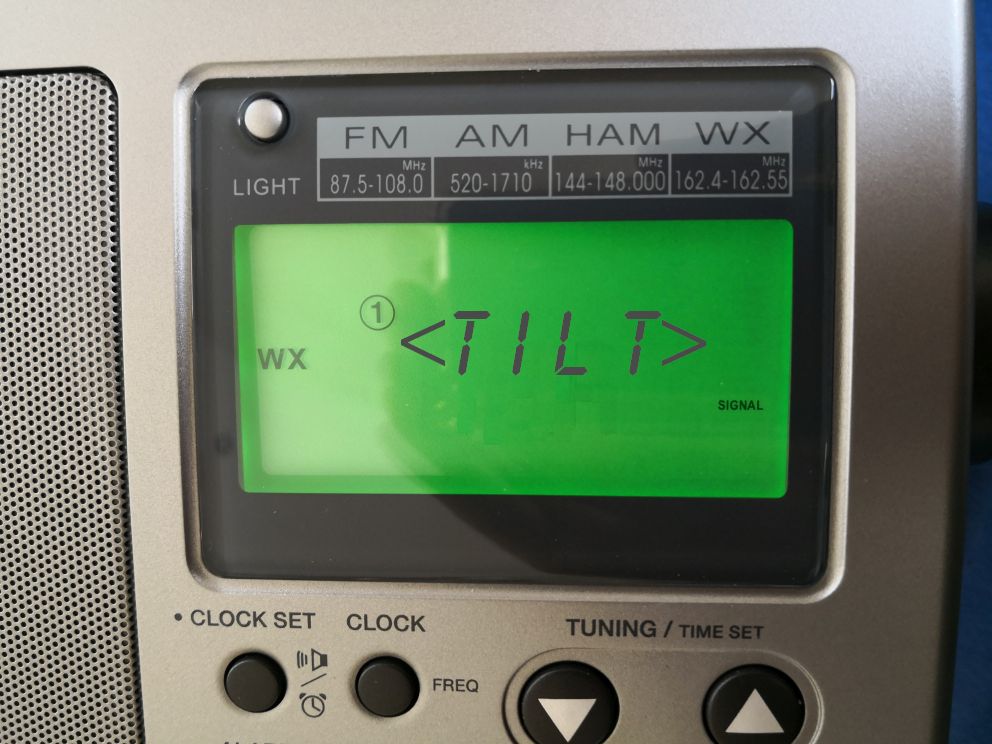
First off, using this radio is generally very straightforward. The only thing I needed to learn from the manual was how to keep the frequency on display, which is only possible with newer versions of the firmware. My radio was manufactured in January 2018 and it has this option, plus an updated version of the printed manual, now describing that (and the antenna calibration) procedure. (Just hold the “Clock” button, then immediately hit the ‘1’ memory button on top. The radio should emit a beep and from then on the display will show the frequency.)
You may want to think twice about buying the “Titanium” version of the radio. The product photos on Amazon were showing the radio with somewhat different and darker hues between grey and champaign, so I spontaneously decided to not buy yet another black radio. What I pulled out of the box was blindingly silvery and yelling “plastic” though, so don’t let any pics fool you – “Titanium” is just a fancy name for the same old standard “light grey-ish/silvery plastic” seen on a billion products from the Far East in the past 50 years. A matter of taste of course.
If it wasn’t obvious to everyone already – this bulky radio is more like a “portable tabletop”, it’s only little more “portable” than a big old Transoceanic or Grundig Satellit with a broken handle. New radios get lighter and lighter even when they get big (like the S-8800), the CCR2E brings gravity back into the game, so on the plus side it will stay put on the table when you push a button, or when there’s an earthquake.
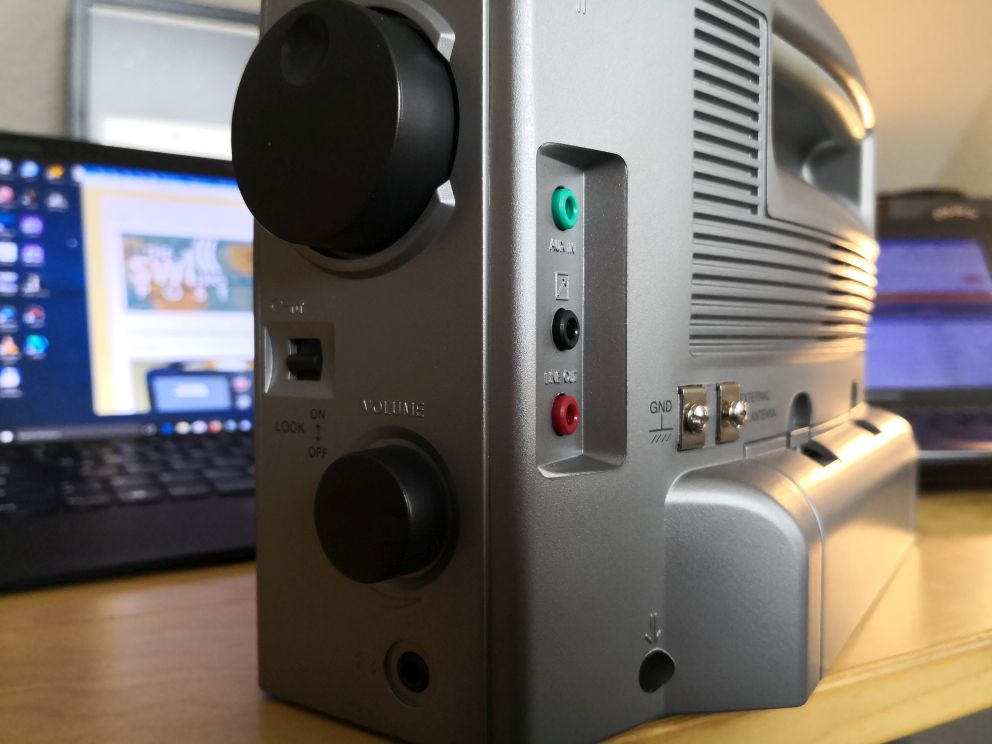
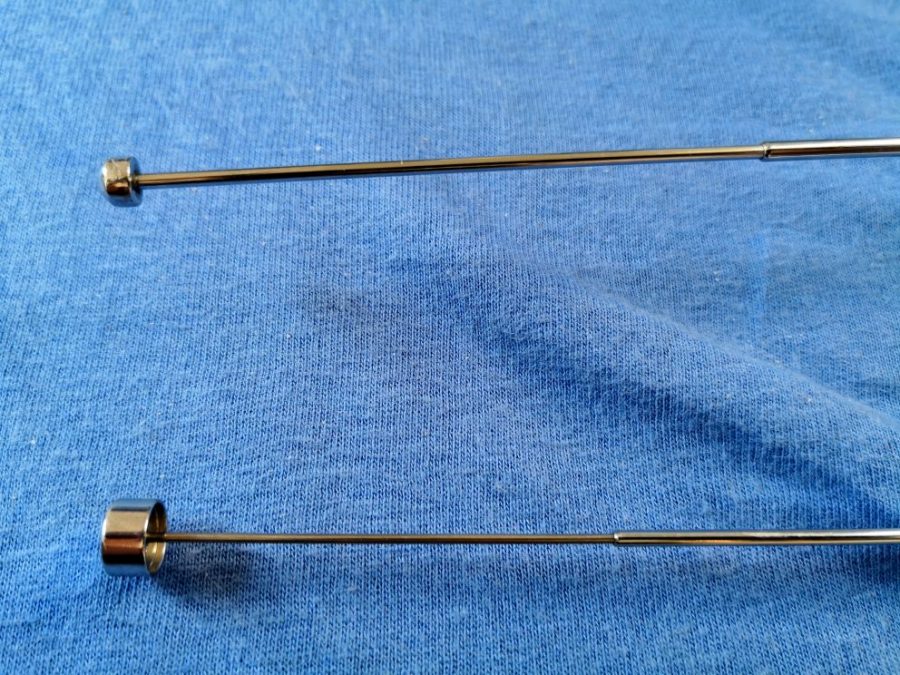
While it does radiate some quality feel (nothing is loose, wobbly or rattling), the tuning knob is the exception: it has a tiny bit of play and it feels and sounds like it had a former life as a hairspray can cap. The stepping/rasterization of the encoder resonates in that cap and if you want to tune to a distant frequency on the dial you just need to say “rien ne vas plus” before you turn the knob to create a great acoustic impression of a roulette table. On the other hand, the solid steps of the encoder causing that sound are very precise and the sound helps me counting the 9 steps I need for hitting the next channel in the European AM BC band. Some reviews also complained about the flimsy FM whip and I used to think the D-808’s whip is flimsy, but this one has a top segment with a diameter of one millimeter, the antenna is the shortest of all my radios and looks exactly like the whips I’ve seen on most of the cheapest (<$20) radios I came across. But that doesn’t affect its function of course – that is, while it lasts.
Now that’s even more a matter of taste, but I just can’t leave the design uncommented. I’m still undecided whether it looks more like a hi-tech humidifier than a radio or not, luckily it says “Radio” in red letters on the speaker grille but still… I don’t know if it’s the complete lack of “retro style” and its sober, “senior-friendly” approach or just the color – whichever way I look at it, it ain’t the most handsome radio of the pack. I think I can get over it, provided I never watch any of Thomas’ videos featuring his gorgeous RF-2200s again. So all it can do to win my heart is working well, that is, very, very well. Let’s see if it succeeded:
Summary/Verdict
The C.Crane CC Radio 2E is an extraordinarily sensitive radio on AM and certainly among the best on FM. It puts some effort in picking up AM stations that most other portables won’t and that’s what it really does as advertised. Like any other radio (so that’s not Bob Crane’s fault like some disappointed Amazon reviews allude), it will not be able to do that in noisy, interference-infested environments and not even an external antenna might help much with that, because the internal loopstick stays on. In an electrically quiet environment though, it’s nothing short of marvelous.
It has a great sound and to my own surprise, I found its qualities as a powered (also long-lasting battery-powered) speaker for other radios a serious asset. It’s simple and easy to use but that also means it lacks all advanced features that would help in difficult, “hardcore DX” reception cases. With its bulky form factor, the built-in power supply, the 4 D-cells, the weight that all brings and the lack of a proper handle, it might not fit into everyone’s understanding of “portable” and its specs are rather meant to cater the needs of American homes. However, importing it to Europe can make sense even with the extra taxes and shipping (which means a 40% markup in Germany), at least for AM radio lovers who want top performance and avoid the problems vintage portables can bring. It’s at any rate a sensible choice if your favorite station is somewhat beyond the range of average radios, if you just want more stations to choose from, or if you enjoy general daytime groundwave DX, all without making an external antenna a necessity.
Of course the CCR2E is not the mythical “perfect radio” either. The muting and automatic loop-tuning when browsing the band isn’t great, it has a few quirks, a flimsy whip antenna and a tuning knob with a cheap feel to it but then again, it’s not an overly expensive radio either and its price/performance ratio is certainly appropriate and attractive. It may not be much to look at but I like it anyway because – among all the all-rounder radios I have – it’s the specialist doing that one thing really well: making AM radio feel like it used to be.
So do I really need this radio? Maybe I don’t, but now that I’ve learned how excellent it really is, I know that I really, really wanted it!
Wow! What a brilliant review! I absolutely love the details you fit into your evaluation and your wit, too (especially that bit about the tuning knob possibly having “a former life as a hairspray can cap”–!). Ha ha!
No doubt the CCRadio 2E is a solid performer and among the best AM portables currently available. While the CCRadio 2E has been replaced by the CCRadio 3, many 2E models can still be found on Amazon (note this is an affiliate link), and eBay (partner link).
Many thanks to SWLing Post contributor, Roseanna, who shares the following guest post originally published on her blog, The Girl with the Radio:
Unexpected FM madness!
I would like tho share with you a once in a lifetime Sporadic-E event that happened to me today along with videos of the catches I received during it.
It was about 12:00 UTC (1PM local time) and I was listening to NRJ on my personal FM transmitter (106.3MHz) when all of a sudden my pop music fuzzed and turned into classical music. It was then that I knew something was happening and I didn’t want to miss it!
I jumped up, got out my phone camera and started scanning around trying to find distant FM stations and my goodness did I get some amazing catches!
There was no tropo forecast for my area nor some of the places I heard and I wasn’t prepared in the slightest so I ask for your forgiveness on the shaky unprofessional footage and I hope you enjoy watching the following catches that I received!
For those interested my setup is a Sony ST-SE570 with a “bunny ear” telescopic aerial with the ground positioned vertically and the feed positioned horizontally. I put the feed to be facing at 90 degrees East to West.
Disclaimer: the order in which these stations were received has been altered to make this blog post more fun, the times in UTC are in the video titles for those of you interested in the chronological order in which I received these stations!
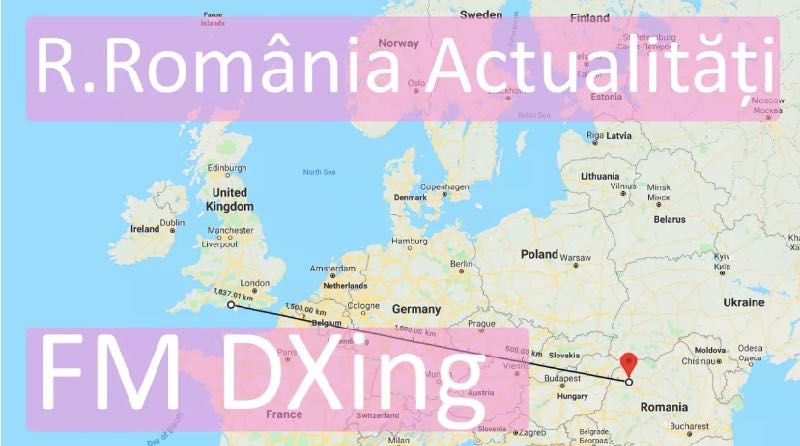
And this catch …. I have no words to describe my sheer amazement, surprise, shock and excitement hearing a station from Romania (Over 1800km / 1100 miles away) that is broadcasting at only 2kW. It is on the same frequency as France Musique broadcasting at 160kW which is much much closer; I still can’t believe I heard this at all!
After all that excitement we now stop over in Slovakia!
This is a much less insane catch compared to the last few but it is still awesome! Disclaimer: I skipped a load of fading in the recording where it fades.
And here is SRo 1 again, however this time a much lower powered transmitter compared to the last one and yet the signal is still really good and most of the RDS data was decode-able!
This is Retro Rádió a 50kW station in Hungary. It was broadcasting over BBC Radio Wiltshire and I even got RDS!
I hope you all enjoyed going on this radio tour of Romania, Hungary, Slovakia and Czechia with me, I certainly did!
Thank you ever so much for reading and watching and I hope to see you around for my next adventure!
And thank you, Roseanna, for taking us on your FM travels! Isn’t RDS an amazing tool for grabbing station IDs during these FM DX openings–? Well played! Again, many thanks as I enjoyed your FM tour of eastern Europe.
Being a radio buff – or shall I say an ALL radio buff – I cannot fully comprehend that “people are no longer dependent on radio”. But I do acknowledge that technology has allowed us to manage our time better. And having a local podcast of news does appeal to many (yes, I suppose even to me at times).
It’s a very short article – three paragraphs – but I challenge the readers to comment: are you no longer dependent on radio? Okay – that’s a loaded question to this audience – just look at this post within the past 24-hours! But we’d also like to know: is there anything in your area, like this article describes of St. Louis Public Radio, where your local stations are turning to podcasts or other means to reach and/or expand their target audience?
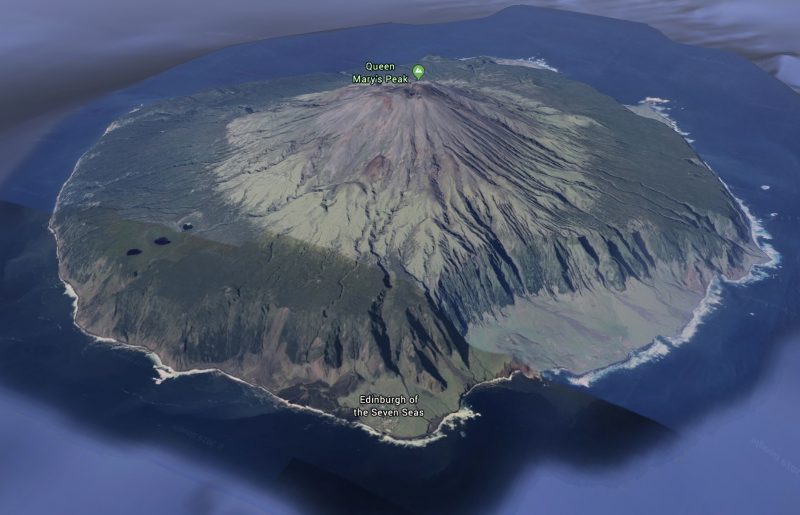
The remote South Atlantic island of Tristan Da Cunha (Image via Google Earth)
Many thanks to SWLing Post contributor, Dan Robinson, who shares the following guest post:
Ultra-Rare Tristan da Cunha QSL: The Art of the Hunter-Killer QSL Pursuit
by Dan Robinson
Those in the QSL collecting community are likely to have noticed the recent appearance on Ebay of one of the rarest QSL cards in existence.
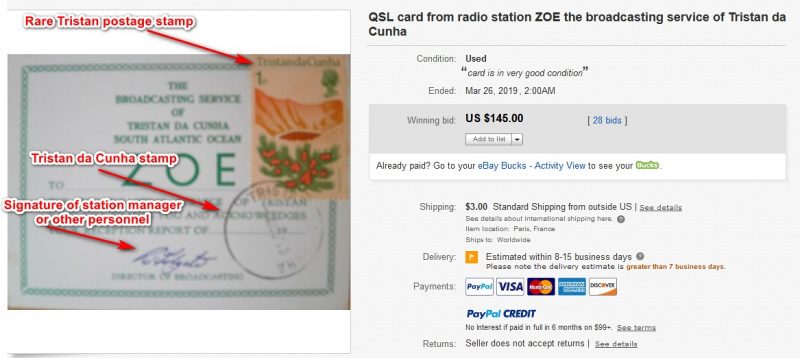
The QSL from Tristan da Cunha showed up around March 19th with a six day auction window, by a seller in France who also listed a number of other older QSLs.
For a description, the seller wrote: “QSL card from radio station ZOE the broadcasting service of Tristan da Cunha 1973. A very rare and sought after QSL. Seldom seen on Ebay. . .”
Understatement to be sure. Along with QSL letters directly from Biafra, the breakaway state in Nigeria many decades ago, QSLs from Tristan da Cunha are pretty much NEVER seen.
ZOE Tristan was a station intensively sought by thousands of DX’ers when it occupied the 90 meter frequency of 3,290 kHz with a power of only 40 watts.
Only a handful of DX’ers ever heard and QSL’ed Tristan. In this story still accessible online–three persons from South Africa are described as having received QSLs, along with two others, in the UK and in Florida, USA.
As a young DX’er, I remember reading the entry in the WRTH and the feeling of frustration with the reality that it was impossible to hear with my receivers, largely due to its limited broadcast time and hour of transmission which I recall was 2000 UTC.
eBay bid history
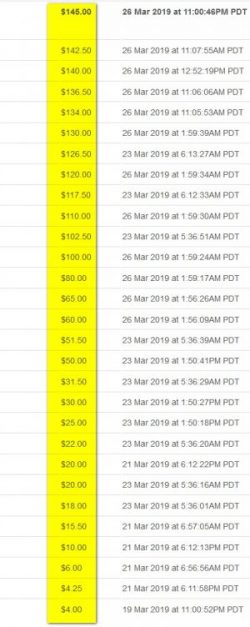
As the hours ticked away in the auction, the number of bids increased. The ending time fell in overnight hours EDT. This increased chances of obtaining the card for a lower price, though bidders in other parts of the world would surely be stationed at their PCs and on their phones in the final hours of the auction.
I have been one of the most active QSL hunters in the world, and there are specific strategies involved in competing for QSLs.
For purposes of this article, I’ll just note that these involve constant attention, especially toward the end. As an auction nears conclusion, it’s important to “test” the bid level to assess the likelihood of the item selling at that or a much higher price.
Some cards or verification letters have the potential to bring hundreds of dollars. I assessed that this Tristan card could bring as much as $500-$1,000 depending on whether someone had “gone high” with an automatic “knock out” bid using either the Ebay system or other auto-bidding site.
As you can see in the image, from a starting price of $4.00 on March 19th the Tristan card had reached only $50.00 several days later on March 23rd. The $100 mark was reached on March 26th. One bidder retracted his $150 bid at one point.
On the final day March 26th, it was anyone’s guess how high the Tristan card could go. The card only inched up in small bid increments, surprising given its rarity.
If one assumed that any of the four bidders involved placed a “knock-out” auto-bid, and if two had placed such a bid, in the final seconds the Tristan QSL could quickly shoot up from the $142.50 level to whatever the extremely high maximums would be.
Due to the rarity of the card, my bid fell in the “knock out” category. I went to sleep reasonably confident, but concerned the competition could drive the price of the card through the roof.
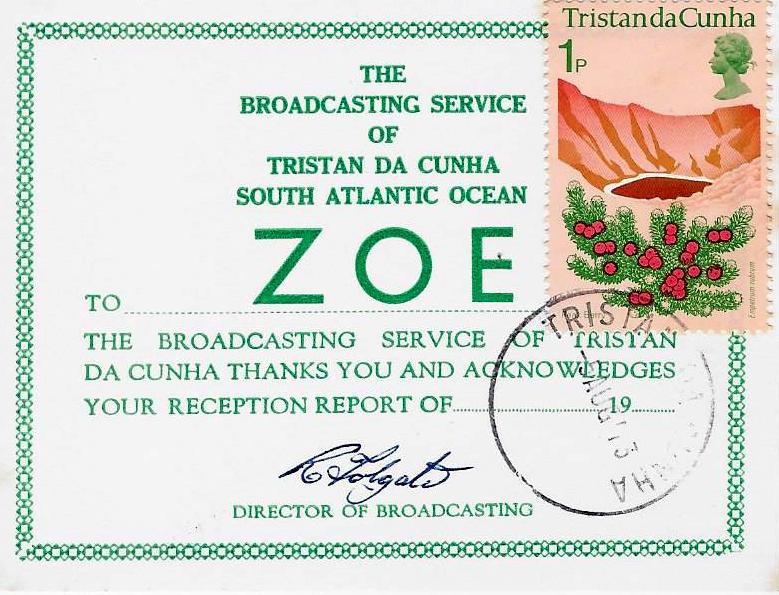
When I awoke the next day, I was relieved — the Tristan card, complete with its original postage stamp, rubber stamp mark, and signature by the station, was mine. The price: an astoundingly low $145.
Such is the excitement involved in being a “hunter-killer” QSL card collector. As I noted in SWLing Post last year, I now own three of the world’s rarest QSLs.
That is–actually two ZOE QSLs. About a decade ago, while scanning Ebay listings for QSLs, I was astounded to see a ZOE card listed as part of a group of amateur radio QSLs being offered by a seller in Europe.
I couldn’t believe what I was seeing. Until that point I had seen not a single ZOE QSL appear since the Ebay market for QSLs began to heat up in the late 1990s
The card did arrive with the original envelope in which it was sent to a European DX’er, complete with a postage stamp and postal mark for Tristan.
Why that particular ZOE card was not signed by someone at the station, and why it was placed in an envelope rather than post marked on the card itself, remains a mystery.
Back to the story noted above, about the group of South African DX’ers who were among the few worldwide to have heard Tristan da Cunha.
In that article, the author notes that two other DX’ers, one in the U.S., one in Europe, had received QSLs from Tristan.
With a bit of online sleuthing, and help from some fellow DX’ers, I was able to determine that one of those two, Dave Sharp, is indeed still with us.
In response to an email inquiry, Dave provided the following history:
“I forget when exactly I heard the station, but it was 1984 or just prior, as I was still in high school. I was in Florida at the time and was using a rotatable three element beam ham antenna. [I] heard threshold talk from a woman with a deep voice and this apparently matched to voice of the Radio Tristan announcer at the time.
[I] received a reply from Pat Patterson, the Tristan postmaster and a Ham radio operator himself. Since my reception report was tentative, I felt a QSL wouldn’t have been issued if they hadn’t been reasonably confident of reception.
I received a personal letter, stamp bulletin, and a small QSL, bright green on white background, with “ZOE” across the front.
Long story, but many of my personal belongings were lost over the years and this includes my entire QSL collection (which had been left in possession of my sister).
Needless to say, I received a fair bit of ridicule after coming forward with the QSL. To emphasize, my report was tentative and they decided to issue a reply.”
It remains to be seen if other ZOE/Tristan da Cunha QSLs will surface in the future, and of course it is unknown how many of the cards that were sent out to the few DX’ers who heard, or claim to have heard, the station, still exist.
Wow! Thank you for shedding light on the history of ZOE Tristan Da Cunha QSLs. At those meager power levels, from such a remote location, and during that broadcast window, I can see why ZOE must be one of the rarest of QSL cards. I’m happy to know you obtained the card, too, Dan as you have such a long history of properly archiving and sharing your cards. As you just did. Thank you!
One of my favorite DXing locations was this little cottage at the El Rancho Hotel just outside San Ramon, on the edge of the Amazon jungle in Peru. At $18/night, including breakfast, the hotel was a bargain, and there was plenty of room for my delta loop.
A Guide To Vagabond DXing
By Don Moore
Ever since I served as a Peace Corps volunteer in Honduras in the early 1980s, Latin America has been my primary focus for both DXing and traveling. So when I retired in 2017, my main goal was to begin taking long annual trips . . . and I do mean long. From October 2017 to May 2018, I traveled through Peru, Ecuador, and Colombia visiting about fifty different towns and cities. This year, I’m on a five-month trip through southern South America. In Latin America you can get just about anywhere cheaply and easily by bus, so that’s how I get around. It’s also a great way to meet people and to see the countryside. But luggage can become a burden, so I limit myself to a single mid-sized wheeled suitcase and a large knapsack. And that means that my mobile DX shack has to be very carefully planned.
Your plans may not include multi-month odysseys like mine, but I think my experiences will help you prepare to DX on your next trip, wherever it might be. Of course, what makes a good mobile DX shack depends on what your DX interests are. I consider myself a station collector, in that I want to make loggings of lots of new and different stations and to build up an understanding of radio broadcasting in different regions. So on my travels I concentrate on the medium wave broadcast band and longwave beacons, with maybe little bit of shortwave utility DX. (There’s not much on shortwave broadcast that I can’t also hear at home.)
Take the DX Home With You
For years my standard DX travel gear was a Sony ICF-2010, a cassette recorder, and an old Radio West ferrite loop antenna. But listening time was always limited since it was a vacation. There were other activities on the agenda and I was generally too tired to get up early for DXing. I always went home with some interesting loggings and audio recordings, but once I left for home the DXing was done.
SDRs have changed all that and now my first rule of travel DX now is take the DX home. The best souvenir of a trip is the hundreds of hours of DXing that I take home with me. In a 2016 trip to central Colombia, I made about 300 MB of recordings of the medium wave band. While listening to them later I logged over 400 stations from twenty countries (and I still have about half the files to go through). I never would have even gotten close to that many stations listening on my Sony like an ‘old-fashioned’ DXer, hi!
Lately, I’ve been accumulating SDR files much faster than I could possibly go through them, so it’s a fair question to ask what the point is. When will I ever listen to them all? Like most DXers, I’m not fortunate enough to live in a perfect DX location. When conditions are mediocre, I’d rather spend my DXing time going through some more interesting SDR files. And, I know I’ll have lots of good DX waiting for me years from now when I’m no longer able to travel the way that I do now. For me, SDR recordings make much better souvenirs that some cheap tourist trinkets that will gather dust on a shelf. It doesn’t matter whether your travels take you to a nearby park or to a distant continent. SDRs can preserve the DXing experience for years to come.
My Mobile DX Shack
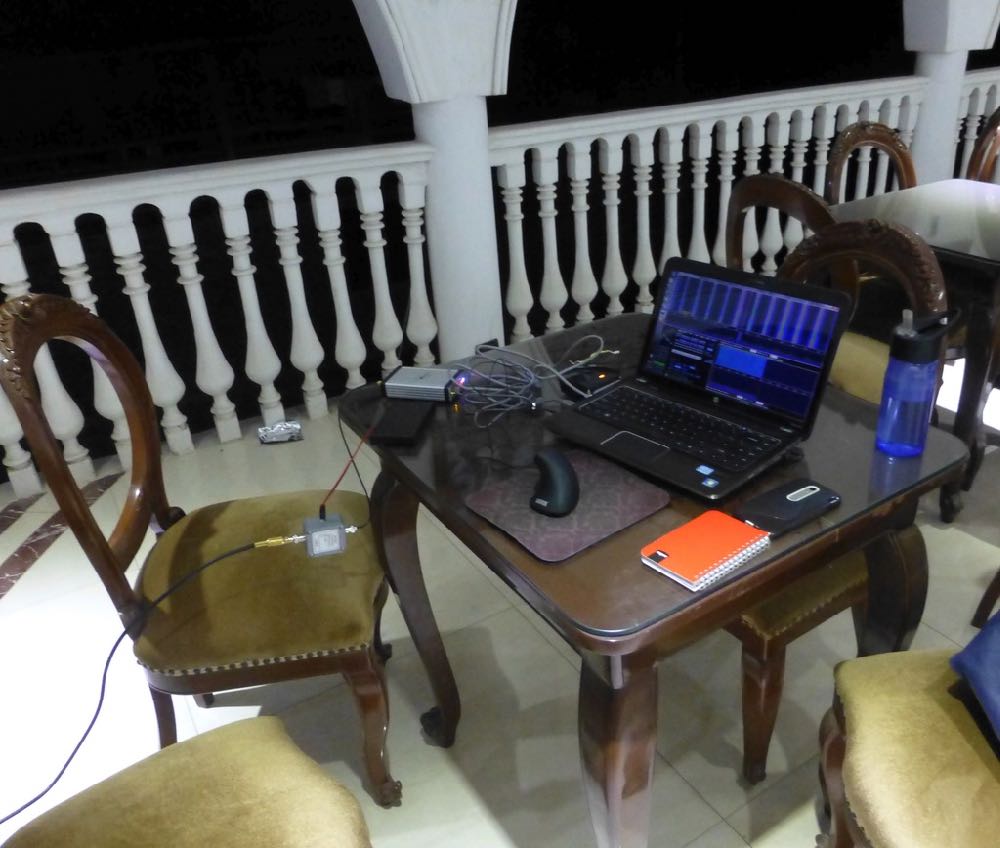
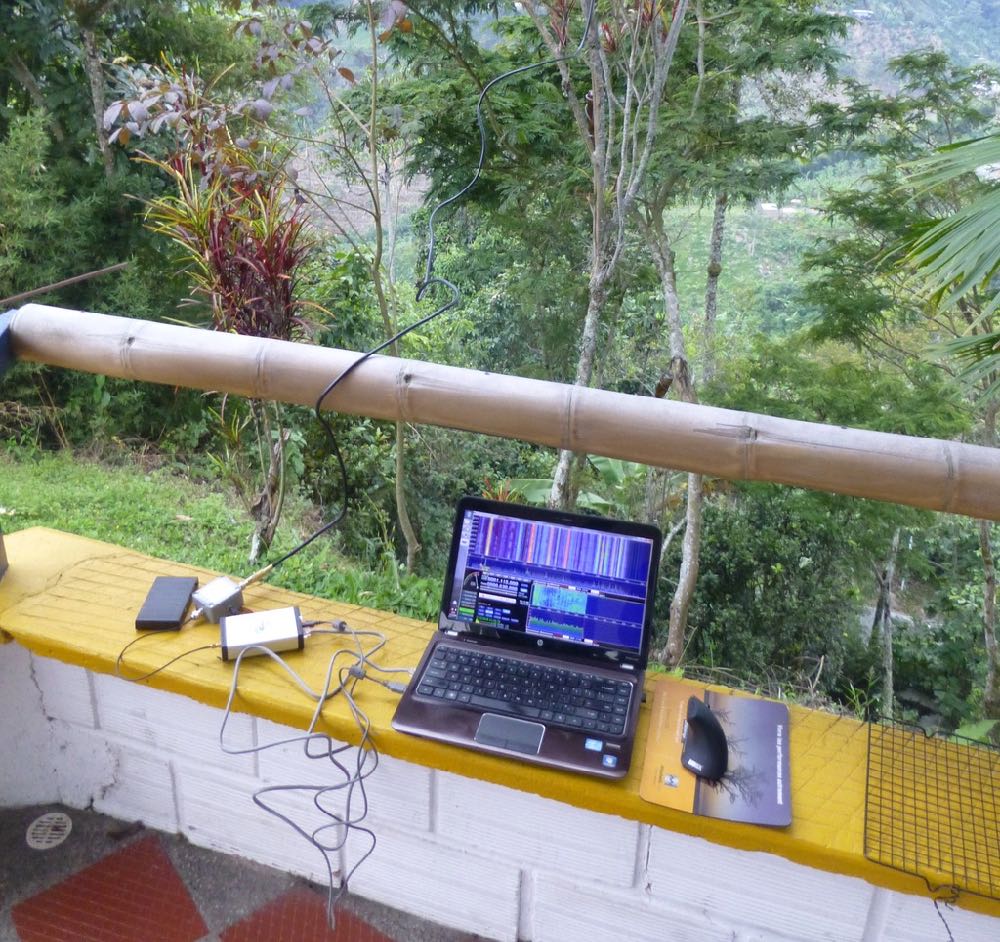
This is my typical DXing setup with the Afedri. The rooftoop terrace at the Hotel Rosa Ermila ($10/night) in Cascas, Peru was the most elegant place I’ve ever DXed from, but reception was only average with the PA0RDT dangling from the railing.
The centerpiece of any DX shack is the receiver. On my 2017-18 trip, I had an Afredri SDR-Net with an SDRPlay RSP1 as a backup, but this year I replaced the Afedri with an Elad FDM-2. Together, my two SDRs are smaller than all but the smallest portable receivers. Of course I also need a laptop, but I’m going to take one anyway. An important consideration in selecting a travel SDR is to get something that is powered off the laptop’s USB connection so that it is easy to DX totally off battery power if line noise becomes an issue.
The other vital component of DXing is the antenna. A good on-the-road antenna for SDR DXing has to be small, easy to erect, broadband, and versatile. That sounds like a lot to ask, but the perfect DX travel antennas do exist.
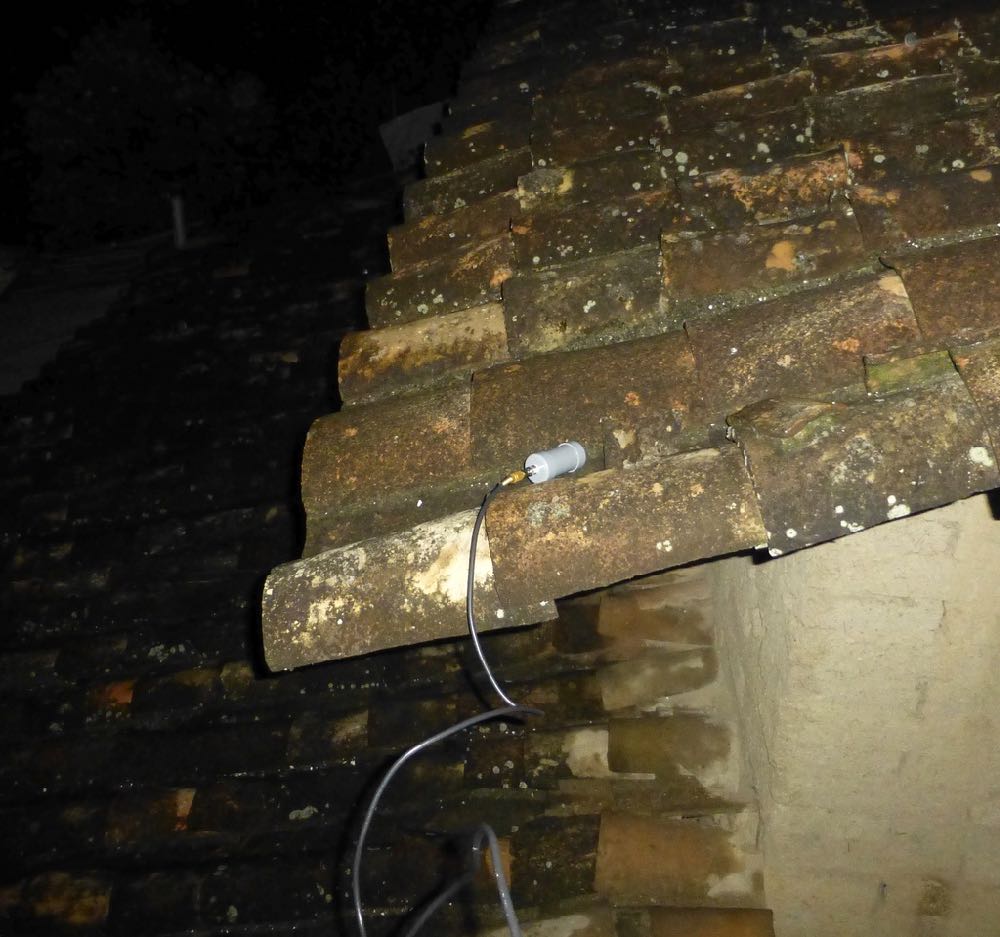
For compactness and ease of use, nothing can surpass the PA0RDT mini-whip. How good is it? That’s what I used to log over 400 medium wave stations in Colombia in 2016. I just attached the unit to my coax and threw it about three meters up into a short tree. The antenna works best when mounted away from nearby structures, but sometimes I’ve gotten decent results placing the PA0RDT on balconies and windowsills of tall buildings. It’s mostly a matter of luck as to how bad the local noise levels in the building are and how much the building itself may block signals. Using a short support, such as a broom or a hiking pole, it may be possible to mount the unit a meter or so away from the building.
While it’s best to mount the PA0RDT away from obstructions, the antenna might give good results anywhere, even on the neighbor’s roof. (Just make sure it’s not likely to get stuck. Pulling the unit out of a stubborn papaya tree is no joke.)
The biggest drawback of the PA0RDT for serious MW and LW DXing is that it is non-directional. For a directional antenna, a Wellbrook loop is great if you’re traveling by car, but that one-meter diameter aluminum loop doesn’t fit in my suitcase. Fortunately, a few years ago Guy Atkins and Brett Saylor told me about an alternative: buy a Wellbrook ALA-100LN unit and attach it to a large homemade wire loop. Now my travel kit includes two nine-meter lengths and one eighteen-meter length of #18 stranded copper wire. The wires can be spliced together for loops of 9, 18, 27, or 36 meters circumference, according to what fits in a location. Erection of a wire loop is easy enough with a suitable tree branch. I just throw the wire over the branch and then form it into delta (with the bottom running just above the ground) using two tent stakes and some short cord to hold the corners. The ALA-100LN unit goes in the bottom center.
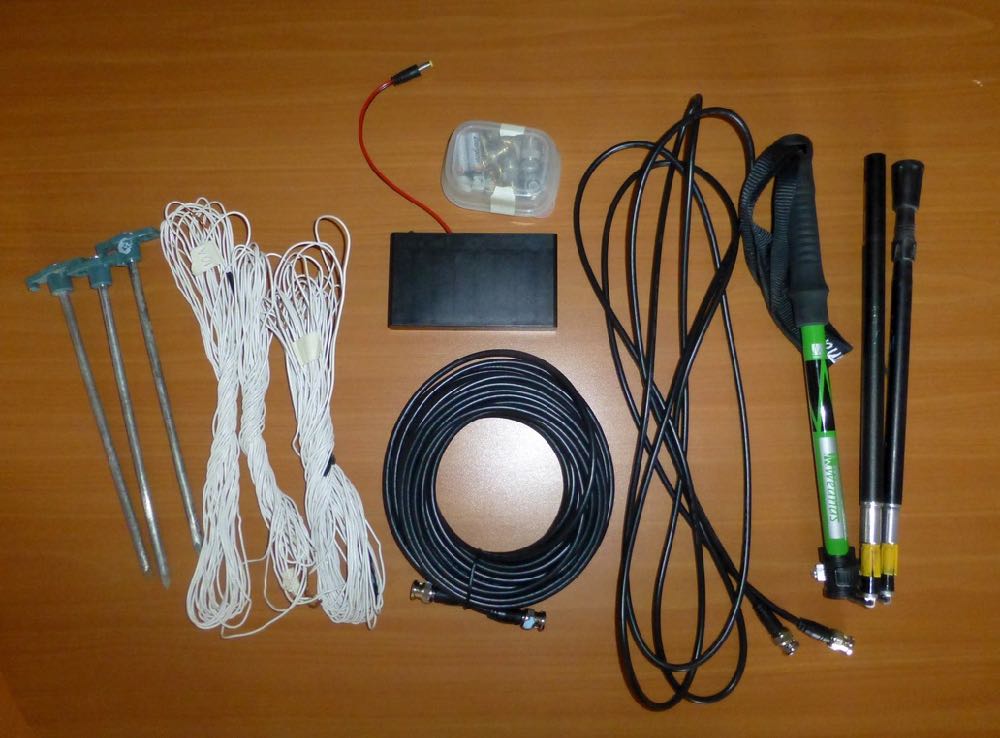
Items that go in my suitcase, left to right: tent stakes and wire for the Wellbrook loop, a small box with more adapters, another battery box, 50 foot coax, 12 foot coax, and my hiking pole. The pole doubles as a support for the PA0RDT sometimes.
The loop doesn’t have to be in a delta; that’s just often the easiest to erect. I’ve successfully used squares, rectangles, trapezoids, oblong diamonds, and right angle triangles. Any balanced shape with the ALA-100LN in the bottom center should be bi-directional in a figure-eight pattern. Non-balanced shapes will work equally well but with unpredictable directionality. Just keep the wire in a single plane and place the ALA-100LN unit someplace along the bottom.
Both the PA0RDT and the Wellbrook require a 12V power supply. The North American version of the Wellbrook comes with an excellent noise-free 110V power supply, but that’s of no use in 220V countries and also I want to be able to DX totally off battery power when necessary. Fortunately both antennas use the same size power connector, so I carry three eight-cell AA battery packs for remote power.
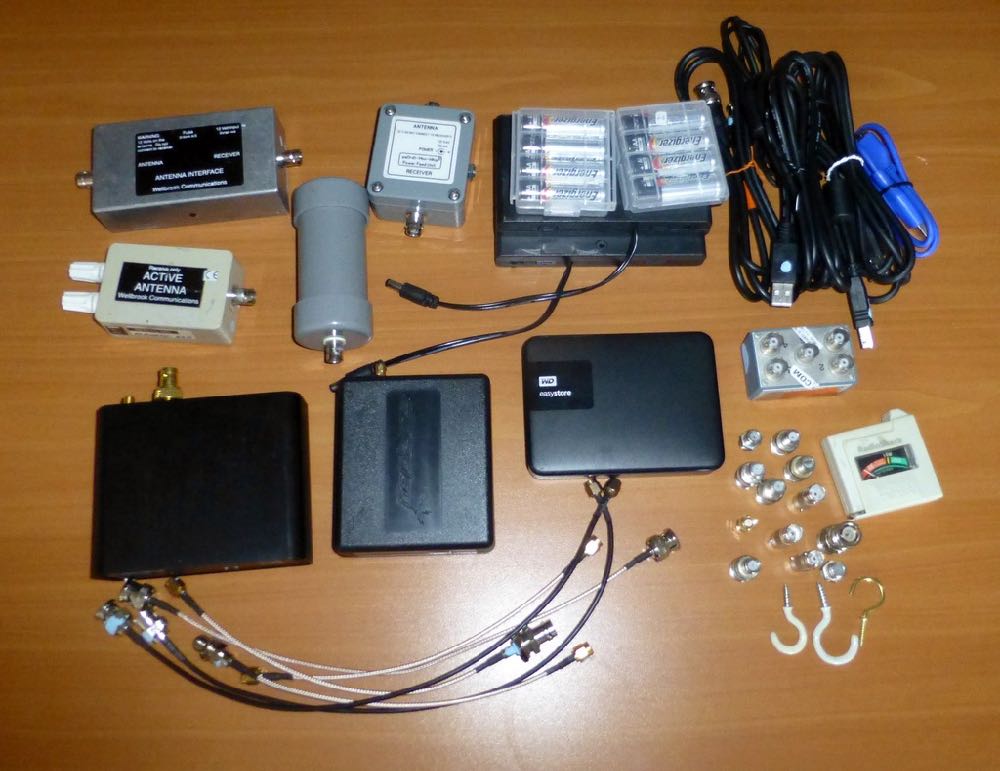
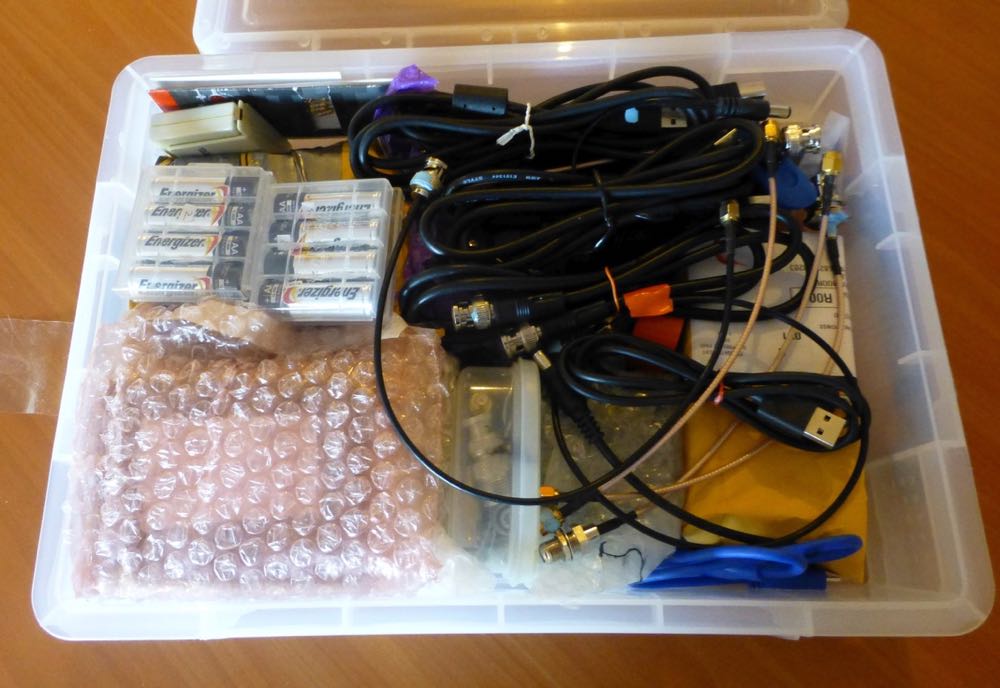
Contents of the DX box, clockwise from upper left: the two pieces of the Wellbrook ALA-100LN, the two pieces of the PA0RDT mini-whip, two 8xAA battery boxes and a set of batteries, USB and coax cables, a passive 4-way antenna splitter, battery tester, various adapters and cup hooks (for securing wires), 4TB hard drive, the SDRPlay RSP1, the Elad FDM-2, and more short patch cords.
My mobile DX shack is rounded out with everything that is needed to connect the parts together. I have at least four of every adapter and patchcord, since I know they won’t be easy to replace on the road. For lead-ins, I have 12-foot and 50-foot lengths of lightweight coax with BNC connectors. I also have a few F-to-BNC adapters so I could buy some standard TV coax if needed. A 4 TB hard drive provides plenty of space the SDR recordings I plan to make. (Before leaving, I fill it with videos that I can delete after I watch them or when I need space.) For DX references, I download various station lists online so that I have them available even if I don’t have an Internet connection. It’s also important to keep those lists with the SDR files from the trip so that if I’m listening to the files years from now I’ll have references which were current at the time.
Airport Security
A common concern for traveling DXers is getting through airport security. When I went to Colombia in 2016, I wrapped my DX gear in clothing for protection and then stuffed everything into my backpack. Security didn’t like what they saw and I had to empty the bag so that every single item could be examined and swabbed for explosive residue. The TSA lady was very nice about it, but I wanted to minimize the chance of that happening again.
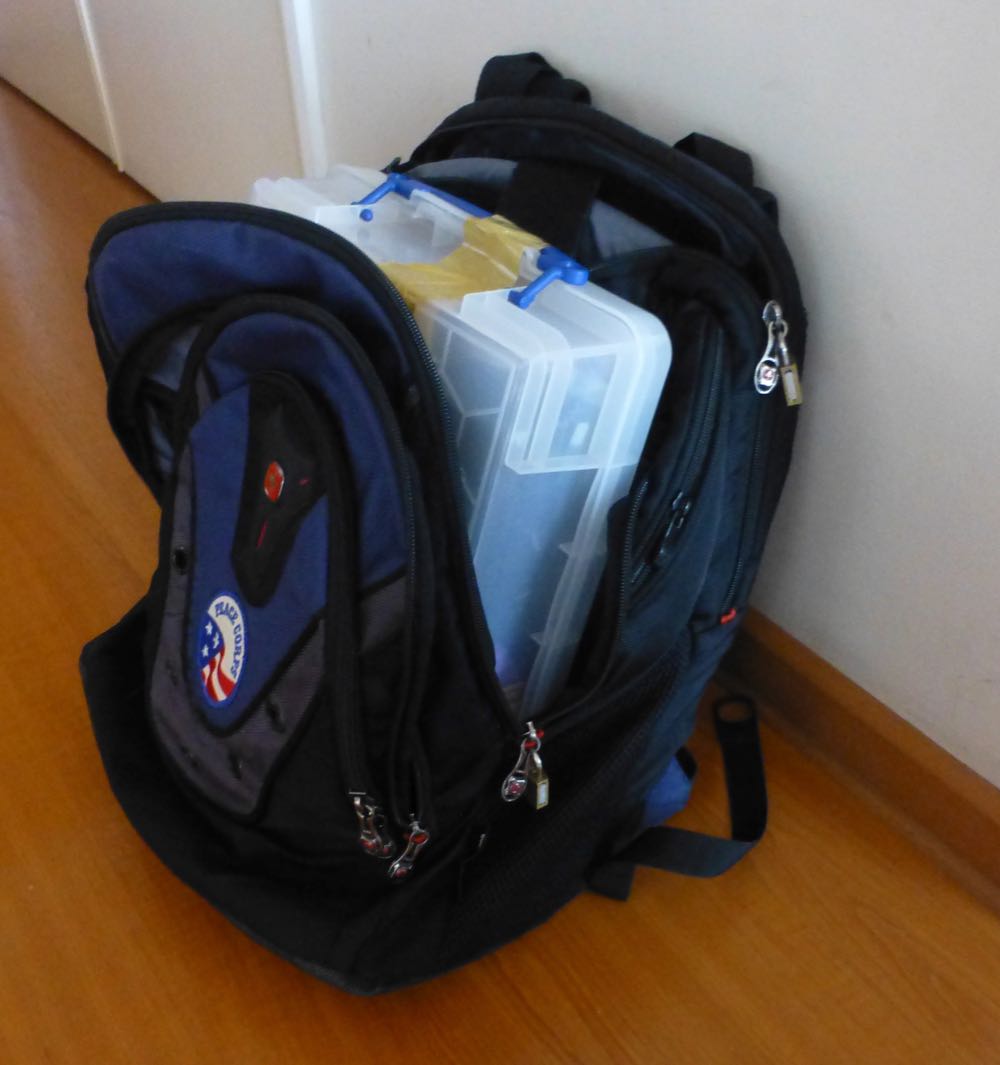
At an office supply store I found a plastic storage box that fits inside the main pocket of my backpack. My SDRs, antenna components, and hard drive get wrapped in bubble wrap and all placed together in the box along with small cables, adapters, etc. Larger items – the wire, coax, and stakes for the loop – get packed in my checked bag.
The DX Box packed and ready to go.
At the airport, I slide the box out of my backpack, place it into a cloth shopping bag, and then send it through the X-Ray machine on its own so that the agent can get a close look at the contents. So far in about a dozen security checks in the USA, Peru, and Mexico, the box of gear hasn’t caused so much as a pause on the conveyor belt. And, if the box would get pulled for a closer look, at least I won’t have to empty the entire backpack again.
Most of my equipment fits in this plastic box which slides into my backpack.
Where to DX
A mobile DX shack isn’t worth anything without a suitable place to DX from. Hotels may work if you have a balcony where you can put a small antenna, but more likely than not there’ll be problems with RF noise. The best hotels are ones that are a collection of cottages or bungalows or that otherwise have an open yard-like space for an antenna. My favorite place to find possible DXing sites is on AirBnB. It’s often easy to find AirBnBs that are on the edge of town or even in the countryside with lots of space. Of course, since I don’t have a car, I need to make sure I can get there using public transportation.
While visiting Huanchaco, Peru with DX friends Karl Forth and John Fisher, we had a beach-front apartment with an adjoining rooftop terrace. We had excellent results with an oblong loop and the ALA-100LN on the terrace.
The key to selecting a DX location is to examine all the photos very carefully. Is there open space for the antennas? Are there trees or other potential supports? Is there a gazebo, terrace, or other space that could be used for DXing? Google satellite view and Google street view can be very helpful in scouting out a location (And it’s surprising how much of South America is now on Google Street View.) And, I always look for possible noise sources. One place I almost rented in Colombia turned out to have high voltage power lines running next door when I found it on Street View.
I always tell the hotel staff or AirBnB host what I’m doing so that they understand why the gringo has wires running around. And I make sure not to put my antennas or coax anywhere that might interfere with the employees or other guests. Most of the time I’m able to erect the antenna near my room and run the lead-in into my room through a window. Then I can leave my laptop running all night to make scheduled SDR recordings. That’s the Holy Grail of DXing – catching the overnight DX while you sleep. But if my room turns out to have too much RF noise (as has been the case a few times), then I head out to the gazebo or terrace to DX using battery power. That does mean I have to stay up late or get up early since I can’t leave the laptop outside on its own. But, some of the best DX that I’ve had has come from running off full battery power in gazebos.
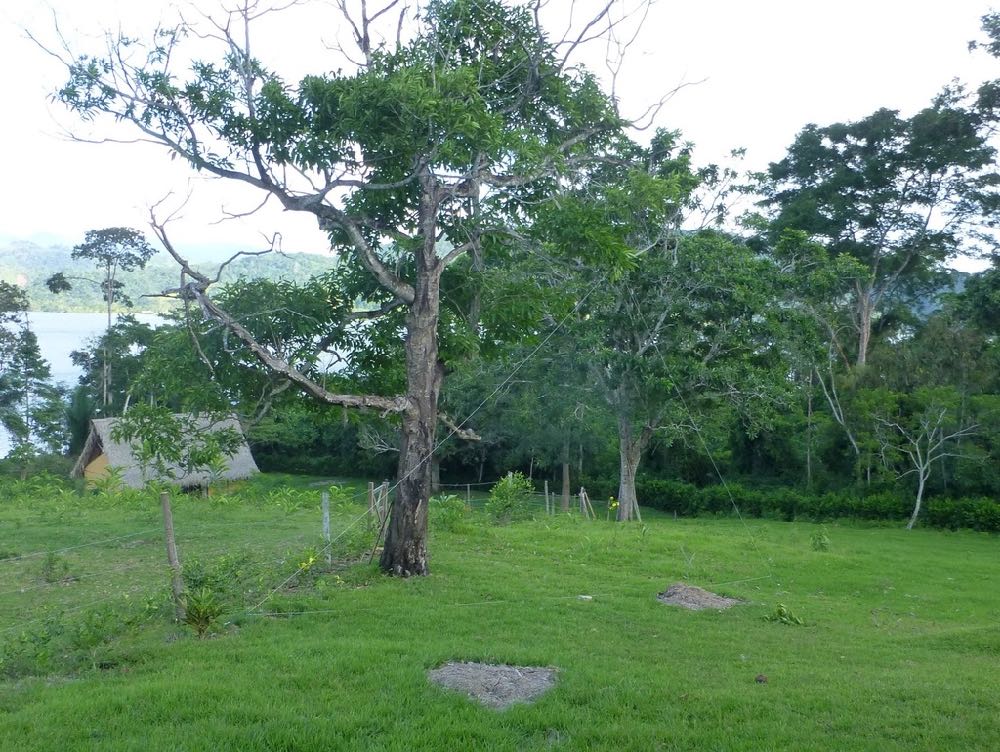
My delta loop had plenty of space at the Posada de Sauce ($25/night with breakfast) in the jungle near Tarapoto, Peru. The lodge was totally powered by solar panels and was one of the quietest places I’ve ever DXed from.
Antenna security is another consideration. At one place I stayed I wasn’t comfortable leaving my expensive antenna components unattended outside all night. And then there was what happened on my first trip to Colombia in 2010. I knew that a place I would be staying at for two nights had an open field right behind it, so on that trip I took 500 feet of thin insulated wire for a mini beverage-on-the-ground. DXing was great the first night but terrible the second. When I went out the next morning to wind up the wire I learned why. The worker who had been weed-wacking the hotel gardens the previous day had also done the field, and in doing so he had cut my wire in three places. He had, however, very nicely tied the wires back together.
Share the DX
DXing off battery power in the gazebo in the Mauro Hilton Hostel in the mountains above Manizales, Colombia. The antenna was the PA0RDT thrown in a tree. I had great DX with the loop from my room, but I came here to enjoy the views one evening.
Finally, if you take an SDR on a trip and get some good DX, make a selection of your files available for download. Other DXers will enjoy hearing what the band sounds like somewhere else. Several dozen of my files from Peru, Ecuador, and Colombia are available for download in a shared Google Drive folder. If you see something you want, be sure to download it now. The winter DX season is just starting here in deep South America and in the coming weeks I’ll be replacing some of those older files with ones made in Argentina and maybe in Uruguay and southern Brazil. I’ve found a lot of places to stay that look to be perfect for a vagabond DXer.
The PA0RDT miniwhip – see the email address at the bottom of the article for ordering information. I highly recommend getting the original PA0RDT. There are several cheaper versions for sale, but DXers have reported quaility control problems with those.
Don, thank you so much for sharing your travel DXing expertise. This article is absolutely brilliant and so informative for anyone who wishes to make SDR field recordings. I love how carefully you’ve curated and distilled your portable setup and have given priority to having antennas for all occasions. I also think carrying spare parts and, especially, a spare SDR makes a lot of sense.
Post Readers: As we mentioned in a previous post, Don is an author and has recently published “Following Ghosts in Northern Peru: In the Footsteps of 19th Century Travelers on the old Moyobamba Route” which is available in Kindle and print formats via Amazon.