Category Archives: International Broadcasting

Shortwave Radio Recordings: Radio Vilnius 1990-1991

Shortwave Radio Audio Archive contributor, Richard Langley, has digitized another set of historic off-air recordings–this time, documenting the independence of Lithuania through Radio Vilinus.

Many thanks to Richard for the following guest post and archived audio:


Cathedral in Vilnius, seen in 1912 - Source: Public Domain via WikiMedia Commons

Radio Vilnius 1990-1991

On 11 March 1990, Lithuania was the first Soviet republic to declare its independence. The Soviet Union issued an ultimatum to the Lithuanian authorities to renounce independence or suffer the consequences.

On 17 March 1990, Lithuania rejected the demand and the Soviet Union responded by applying economic sanctions and occupied parts of Vilnius, the capital city. In January 1991, the Soviets launched a larger scale operation against Lithuania. On 11 January, Soviet military units seized several building in Vilnius and elsewhere. On 12 January, civilians congregated outside some strategically important buildings such as those of the Supreme Council (the Seimas Palace), the Radio and Television Committee, the Vilnius TV Tower, and the main telephone exchange in an attempt to prevent them from falling into the hands of the Soviet military. In the early hours of 13 January, tanks and soldiers attacked the TV tower. Fourteen Lithuanians and one Russian soldier died.

Subsequently, Soviet forces surrounded and entered the Radio and Television Committee building and forced the TV station off the air. Shortly thereafter, a small TV studio in Kaunas was used to resume TV transmissions and put out a call for help. Radio transmissions were also affected. Although Soviet forces were in the vicinity of the Supreme Council building, they retreated instead of attacking. The occupation and military raids continued for several months following the attacks.

Lithuania-FlagSubsequent Lithuanian-Russian negotiations resulted in the signing of a treaty on 31 January. A referendum on independence held on 9 February overwhelmingly supported the full and total independence of Lithuania. Other republics of the Soviet Union declared their independence and following the resignation speech by Mikhail Gorbachev on 25 December, the Soviet Union was dissolved the next day. The last Russian troops left Lithuania on 31 August 1993.

Radio Vilnius, the external service of Lithuanian Radio, transmitted news about events in Lithuania and the other Baltic republics even at the height of the Soviet attacks. The broadcasts were made, in part, using transmitters elsewhere in the Soviet Union. However, there was a temporary interruption in these broadcasts after the occupation of the Radio and TV Centre by Soviet troops early in the morning of 13 January. They resumed on 25 January.

Radio Nederland’s “Media Network” programs of 20 January 1991 and 14 January 1992 featured reports on Radio Vilnius and the Soviet occupation. The sound files of these programs are available on the Web (“Media Network Vintage Vault“).

I have six recordings of Radio Vilnius English Service shortwave broadcasts between March 1990 and January 1991. These were received in Hanwell, New Brunswick, Canada, using a Sony ICF-7600D receiver and supplied wire antenna draped around the listening room.

Recording 1 (30 minutes):

28 March 1990, 22:00 UTC, 11770 kHz (00m:00s – 00m:55s)

Strong signal. Interval signal (IS) and station identification (ID) but the transmission was cut off in mid-sentence: “This is Radio Vilnius. Hello and welcome to our daily broad” All that could be heard faintly on this frequency then was Radio Liberty in Russian (“Govorit Radio Svoboda”). Initially could hear nothing on Radio Vilnius parallel frequencies until about four minutes into the broadcast when a very faint signal on 12060 kHz could be heard (not recorded).

29 March 1990, 22:00 UTC, 12060 kHz (00m:55s – 02m:04s)

Weak signal. IS, station identification, and first part of “News About Lithuania.” Radio teletype interference. Checked other frequencies.

3 April 1990, 22:00 UTC, 17665 kHz (02m:06s – 30m:02s)

Improved signal. Receiver briefly switched to other frequencies to check quality during the recording. IS, ID, “News About Lithuania,” report on the occupation of the Lithuanian Prosecutor’s Office on Friday night (30 March), music, sports news, “Lithuanian by Radio.”

Recording 2 (45 minutes):


9 April 1990, 22:00 UTC, 11770 kHz

Strong signal. Some co-channel interference from Radio Liberty. Receiver briefly switched initially to other frequencies to check signal quality during the recording. IS, ID, “News About Lithuania,” report about the Lithuanian Mission in Moscow, “Around Lithuania,” program in Esperanto (begins around 23m:08s) — a regular feature at the end of Monday broadcasts from Radio Vilnius in English. Interesting sign-off statement: “It’s goodbye and good luck.” On the recording, the Radio Vilnius transmission is followed at 29m:29s (on the same frequency), by the first approximately 15 minutes of a transmission from pro-Moscow Radio Minsk in Belorussian (now usually referred to as Belarusian). The transmission begins with the IS and ID (“Havorits Minsk … Radyjostancyja Saviecki Bielaru?”), followed by a news program.

Recording 3 (32 minutes):


11 January 1991, 23:00 UTC, 7400 kHz

Strong signal. Recording actually starts at about 22:58 UTC with music, the tail-end of a transmission on this frequency, likely from Radio Kiev. Some transmitter hum. Then, Radio Vilnius IS and ID. “We’re still hold up and we hope you can still hear us.” “News About Lithuania” including occupation news, commentary, and reports from the neighbouring Baltic states. Receiver briefly switched to other usual frequencies to check on signal quality (9750, 15180, 17690, and 17720 kHz; 6100 kHz not heard). Transmission ends with “And that’s all we have for our today’s broadcast, we hope not the last one, from Radio Vilnius in the Republic of Lithuania.” This is followed by the transmission schedule and contact information. After about 45 seconds, the Radio Minsk transmission begins with IS and ID.

Recording 4 (45 minutes):


12 January 1991, 23:00 UTC, 9750 kHz

Strong signal. Initial mix-up of interval signals. The first IS is believed to be that of Moskovskaya Radio, the Russian Service of Radio Moscow, followed by a bit of the Radio Moscow World Service IS, and then finally the Radio Vilnius IS. The transmission begins with the statement “We’re still broadcasting from Vilnius.” This is followed by the Lithuanian news reporting on the acts of aggression of the Soviet occupying forces and “Correspondents’ Reports.” The latter includes a report that the exam session at Vilnius University has been postponed to allow students to help protect buildings from the occupation forces, including the Radio and Television Building, and a report on the restrictions on travel. The reports were interrupted with “some news just come in” about a group trying to break into the building of the Council of Ministers. The announcer subsequently reported that the attackers had been put off and so the conflict has been neutralized. The broadcast ends with the statement “We hope to be with you tomorrow again” followed by the transmission schedule and contact information. The Radio Vilnius transmission is followed by the one from Radio Minsk. News organizations reported that Soviet troops entered the Radio and Television Building about 15 minutes after this Radio Vilnius transmission.

Recording 5 (29 minutes):


13 January 1991, 23:00 UTC, 9750 kHz

Strong signal on this and other frequencies usually received except 17690 kHz; only background noise on that frequency. However, there was no Radio Vilnius transmission on any frequency. It had been replaced by light classical and contemporary orchestral music. No IS or announcement of any kind. Music was faded out at 29m:03s before ending. During the recording, the receiver was briefly tuned to other Radio Vilnius frequencies to check on signal quality.

Recording 6 (29 minutes):


30 January 1991, 23:00 UTC, 7400 kHz

Strong signal. The recording begins with a few seconds of music from the previous transmission on this frequency. Then, after about one minute (there was no IS), the Radio Vilnius transmission starts with the beginning of the patriotic song “Lietuvninkai Mes Esam Gim?” (Lithuanians We Are Born) and an introduction stating that the broadcast is coming “from the capital of the independent Republic of Lithuania.” This is followed by “News About Lithuania” including items on further acts of violence by Soviet troops and severe winter weather. Then, there are reports on Lithuanian-Polish relations and the work of the commission on Soviet aggression. Next is an eye-witness report on the attack on the TV tower on the night of 13 January, a report on the current feelings of Lithuanians under occupation, and how music and the arts keep the people going. During the recording, the receiver was briefly tuned to other Radio Vilnius frequencies to check on signal quality. In addition to 7400 kHz, only 9750 and 17690 kHz could be heard.


Richard: Thank you so kindly for sharing these amazing off-air recordings.

Click here to listen to other recordings by Richard Langley.

Andrew Lack sworn-in as CEO of the Broadcasting Board of Governors

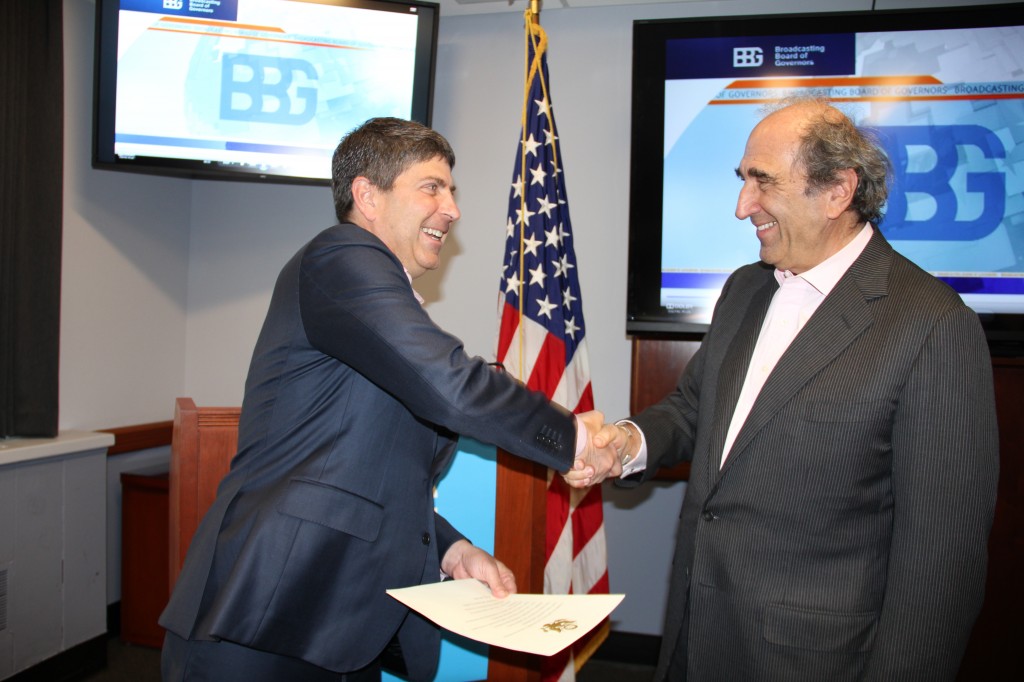
Jeff Shell, Chairman of the Broadcasting Board of Governors, congratulates Andy Lack after swearing him in as the first ever CEO of U.S. international media. (Image Source: BBG Press Release)

Jeff Shell, Chairman of the Broadcasting Board of Governors, congratulates Andy Lack after swearing him in as the first ever CEO of U.S. international media. (Image Source: BBG Press Release)

Below, you’ll find the full press release from the BBG regarding Andy Lack’s appointment. At the end of the press release I’ve noted another article from the NY Times.

(Source: BBG Press Release)

WASHINGTON – Respected journalist and media executive Andrew Lack was sworn-in today as the Chief Executive Officer and Director of the Broadcasting Board of Governors, the federal agency that oversees the five networks and broadcasting operations of U.S. international media. Those networks include the Voice of America, Radio Free Europe/Radio Liberty, Radio and TV Martí, Radio Free Asia, and the Middle East Broadcasting Networks.

Lack is the first-ever CEO of U.S. international media. Creating the position of a CEO has been a key objective of the agency’s governing board and the Administration.

“We are at a unique time in the extraordinary history of this agency. The 21st Century’s global war on information is increasingly threatening to our country and our values,” said Lack. “I am lucky to join a great group of journalists and news professionals spread across the globe who care so deeply about our critical role in that battle.”

Lack’s selection follows an almost year-long search process that began in October 2013.

“To say we are fortunate that Andy has agreed to accept this challenge is a huge understatement,” said Jeff Shell, Chairman of the BBG. “He is an experienced media executive, a respected journalist, and an energetic and inspirational leader. We are grateful that Andy has decided to serve his country and lead the BBG at this critical juncture.”

Prior to being selected by the BBG, Lack served as the Chairman of the Bloomberg Media Group. He joined Bloomberg in October 2008 as CEO of its Global Media Group and was responsible for expanding television, radio, magazine, conference and digital businesses.

Previous to joining Bloomberg, Lack was Chairman and CEO of Sony Music Entertainment, where he led the company’s roster of prominent international artists and vast catalog of recorded music from around the world. Before joining Sony Music Entertainment, he was president and chief operating officer of NBC, where he oversaw entertainment, news (including MSNBC and CNBC), NBC stations, sales and broadcast and network operations. He was responsible for expanding the Today show to three hours and creating the show’s street-side studio in New York’s Rockefeller Center.

From 1993 to 2001, Lack was president of NBC News, which he transformed into America’s most-watched news organization through NBC Nightly News, Meet the Press, Today and Dateline NBC.

Before going to NBC, Lack spent much of his television career at CBS News. After joining in 1976, within a year, he became a prominent producer for 60 Minutes and subsequently, senior executive producer of CBS Reports. Lack’s broadcasts at CBS earned numerous honors, including 16 Emmy Awards and 4 Alfred I. DuPont-Columbia University Journalism Awards.

Lack received a bachelor’s degree from the College of Fine Arts at Boston University, where he is currently a trustee.

SWLing Post contributor, Richard Cuff also notes this article about Andrew Lack from the NY Times. An excerpt:

Before Mr. Lack’s appointment, day-to-day international broadcasting operations were overseen by a board that had become known more for its dysfunction than for managing broadcast programs that reach more than 200 million people every week. Now, with Mr. Lack at the helm, the feeling in the agency and in Congress is that the broadcasting board is better positioned to counter the increasing hostile and suspicious views of Americans aboard, and more forcefully engage international rivals such as China and Russia in the high-stakes information war.

I was particularly drawn to to a quote by Ted Lipien, a former VOA staffer and outspoken critic of the BBG. Mr Lipen states:

“I’m quite optimistic, and if anyone can turn the organization around, it’s [Andrew Lack], given his background,” […]“But he faces immense challenges.”

Indeed, “immense challenges” may even be an understatement.

Bon courage to you, Mr. Lack! Let’s certainly hope for the best.

Seeking a recording of the VOA Greece Station ID

GreeceMapMy friend, Gary Wise (W8EEY), recently wrote with an inquiry; I’m hoping an SWLing Post reader can help…

Gary writes:

“As you might know I was the Station Manager of the VOA Greece Transmitting Station when it closed down in 2006. I’ve been contacted by one of the Greek employees. They are planning a reunion of former employees in April and would like to put together an audio montage of station sounds. They have some material, but would like to find a recording of the Greece Station ID (and possibly the one from Rhodes too). This was a male announcer stating that “This transmission came to you from Greece” or words to that effect.

Would you have such a thing, or know who might? I know the crew would greatly appreciate anything you might have along these lines.”

I don’t believe we have a recording of this in the SW Radio Audio Archive, nor in my local archives.

Does anyone out there have a recording of the VOA Greece Station ID? Please comment below or contact me.

Shortwave Radio Recordings: Radio Berlin International, Final episode of DX-tra

Radio_Berlin_International.svg

Many thanks to Shortwave Radio Audio Archive contributor, Richard Langley, who writes:

[The following is a] recording of the penultimate English broadcast from Radio Berlin International (RBI) and the last broadcast in the particular time slot. It was also the last broadcast of the popular DX program DX-tra.

RBI ceased broadcasting at the end of the day on 2 October 1990, the day before German reunification took place.

In addition to the final episode of DX-tra, the recording features the news (in progress as the recording starts a minute or two after 00:45), Commentary, RBI Press Review, and Spotlight on Sport. There are several “goodbye” songs including “The Final Countdown” by the Swedish hard rock band Europe, and “Goodbye Blue Sky” by Pink Floyd and some announcer goodbye comments like “the voice of the disappearing German Democratic Republic,” “that was it,” and “the last day of the good old GDR.”

The 45-minute recording ends with the familiar RBI interval signal and, at 01:30 UTC, the first part of the German-language transmission, also the last in its time slot.

This recording was made in Hanwell, NB, Canada, with a Sony ICF-7600D receiver and supplied wire antenna draped around Richard’s home office. This recording begins around 0045 UTC, October 2, 1990 on a frequency of 9,730 kHz.

Click here to download this recording as an MP3, or simply listen via the embedded player below:

Yes, there is a shortwave…!

Virginia letter Dash

Dear Editor—

I am 8 years old. Some of my little friends say there is no shortwave. Uncle DX Dash! says, “If you see it on the SWLing Post, it’s so.” Please tell me the truth, is there a shortwave?

Virginia E. Layer
330 Independence Ave., S.W.

Virginia, your little friends are wrong. They have been affected by the skepticism of a digital age. They do not believe what can’t be heard or seen on their smart phone. They think that nothing can be which is not comprehensible by Google. They seek credit cards, not QSL cards.

Yes, Virginia, there is a shortwave. It exists as certainly as sound and circuits and tubes exist, and you know that these abound and give to your life its highest beauty and joy. Alas! how dreary would be the world if there were no shortwave! It would be as dreary as if there were no Virginias. There would be no heterodynes, no band openings, no propagation to make tolerable this existence. It would be a world without London Calling.

Not believe in shortwave! You might as well not believe in the ionosphere. You might get your papa to hire men to listen to all of the wi-fi radios of the world, but even if you did not hear shortwave, what would that prove? The most real things in the world are those that neither children nor men can see. Did you ever see ground waves dancing on the lawn? Of course not, but that’s no proof that they are not there. Nobody can casually conceive or imagine all the wonders there are heard and unheard in the listening world. For that, you must wear headphones.

No shortwave! Thank goodness! It lives, and lives forever. A thousand years from now, Virginia, nay 10 times 10,000 years from now, shortwave will continue to make glad the hearts of listeners.


Happy Holidays from your friends at Dashtoons and the SWLing Post!

With apologies to The New York Sun.  Our tongue-in-cheek editorial borrows from the timeless classic, “Is There a Santa Claus?” printed in the September 21, 1897, issue of The New York SunClick here to read the original

The Spectrum Monitor: only $24 for a year’s subscription

December14Cover.1On occasion, the things you enjoy most, you forget to share with your friends. Not sure why this happens, but this is certainly the case with the Spectrum Monitor magazine (TSM). I’m long overdue to properly pitch TSM to my readers, which I feel is an absolute bargain at just $24 per year.

Why? Many of you may recall that it was only July of last year when we learned about the closure of The Monitoring Times magazine.  I had always loved the magazine–not only were the management and editors a great group, but the magazine content was some of the best in the communications business when I began writing features and reviews for MT. But the owners of MT, Bob and Judy Grove, were ready to retire; ultimately, they decided to close their magazine down rather than sell it off.

Shortly after the announcement, MT‘s managing editor, Ken Reitz (KS4ZR), decided to make a go of a new publication. Albeit wholly digital, this magazine was to cover the same scope and content depth as MT, and would be known as The Spectrum Monitor (TSM).

In January of this year, TSM launched, and like many SWLing Post readers, I was eager to see if the content met the benchmark MT had set for so many years.

I needn’t have worried.  Ken had corralled many excellent contributors, in many cases drawing upon previous writers for MT.  And in the past year, I don’t believe it’s a stretch to say that in many respects, TSM not only met that benchmark, but has actually even exceeded itTSM is now–unquestionably–a good, solid, thoroughly enjoyable publication. 

Each issue is packed with topics covering the radio spectrum: shortwave, ham radio, vintage radio, pirate radio, scanning, public service, satellite, AM/medium wave and host of digital/mobile technologies, as well. Really, everything a listener could hope for.

November2014Cover Initially, I had my doubts.  I frankly wasn’t sure whether I’d like reading a “digital-only” radio publication, or whether other readers would. I confess to being a bit “old school;” as a radio listener, I like to hold a radio in my hands, to physically tune it; as a reader, I prefer holding a printed publication in hand, to turn the (paper) pages…How would I feel with an e-reader or laptop, instead? Would reading that way feel like work?

But TSM soon swayed me toward the digital as both reader and as a columnist. As a writer, there was less stress on word count. If it was a bit short, or lengthy– as my October column was–I soon found it mattered less. In a digital publication, page count is comparatively irrelevant as long as content is worthwhile and captivating for the reader.  And as a reader, I appreciated that the columnists that I was reading would have the freedom to write at length, too.

Secondly, a digital publication gave its writers an opportunity to infuse columns with a multi-media element–something I’d become accustomed to as a blogger here on the SWLing Post. When I published a review of a radio, I could include actual audio clips in the article. If I wrote about pirate radio, for example, I could embed actual pirate radio recordings. Brilliant! And, again, more fun for the reader.

Also, including links or references to external websites is a cinch in a digital format, and quite easy for the reader to check out. Instead of copying a long gangly URL from a printed page, you simply click on a link as you would on a website, such as on this one. Second nature, really.

FEB2014CoverFinally, in a digital publication, I found writers could use more full-color images in their articles. I really enjoy the addition of the images; they make articles come to life…

So, I soon learned to relax with the e-reader just as I had with the printed Monitoring Times.  No pages to turn, but then again, not so different from reading…well, a blog like this.  I’ve received excellent feedback from TSM readers, too, many of whom admitted their initial bias against a “digital” magazine had since been withdrawn completely.

I continue to enjoy reading TSM every month.  And although–due to time constraints–I’m no longer TSM‘s primary shortwave radio columnist, I still enjoy writing for TSM when time permits, so you will see my reviews and features pop up in TSM now and again.

But why take my word for it?  Check it out for yourself–it’s one of the best magazines for the radio enthusiast, digital or print…And at only $24 annual cost, it’s a terrific and affordable last minute Christmas gift for a friend, family member, or–let’s be honest–for yourself.

Afraid to commit to a one year subscription? Individual issues of TSM are available online for $3 each. If you like what you’re reading (you will), you can then purchase a one year subscription, and the cost of your issue will be refunded.

If you’re lucky enough to receive a subscription to TSM in your stocking, I can assure you that you’re in for a real treat.  Happy reading!

An SWL perspective on US/Cuba relations

WFL_015Many thanks to SWLing Post contributor, London Shortwave, who has posted an article on his blog regarding US/Cuba relations after Presidents Barack Obama and Raul Castro announced, last Tuesday, the re-establishment of relations. London Shortwave has included recordings from the VOA, Radio Marti and Radio Havana Cuba.

Click here to read the full article on London Shortwave’s blog.