Shortwave listening and everything radio including reviews, broadcasting, ham radio, field operation, DXing, maker kits, travel, emergency gear, events, and more
I’m happy to relay that David Goren’s Shortwave Shindig will once again broadcast live from the Winter SWL Fest in Plymouth Meeting, Pennsylvania.
Tune in on Friday, February 27, 2015 from 22:00-23:00 EST (that’s 03:00-04:00 UTC, February 28) on 7,570 kHz.
Since I will be at the Winter SWL Fest and even a part of the Shortwave Shindig live broadcast, I’m hoping a few SWLing Post readers will record the show and share with us.
Also, if you’re in the Plymouth Meeting area, please consider joining us at the Winter SWL Fest.
Today is World Radio Day, a time “to remember the unique power of radio to touch lives and bring people together across every corner of the globe,” UNESCO reminds us. As shortwave radio listeners, we understand this power of information without borders.
Here are a few ways you can celebrate World Radio Day 2015…
Ears To Our World (ETOW)
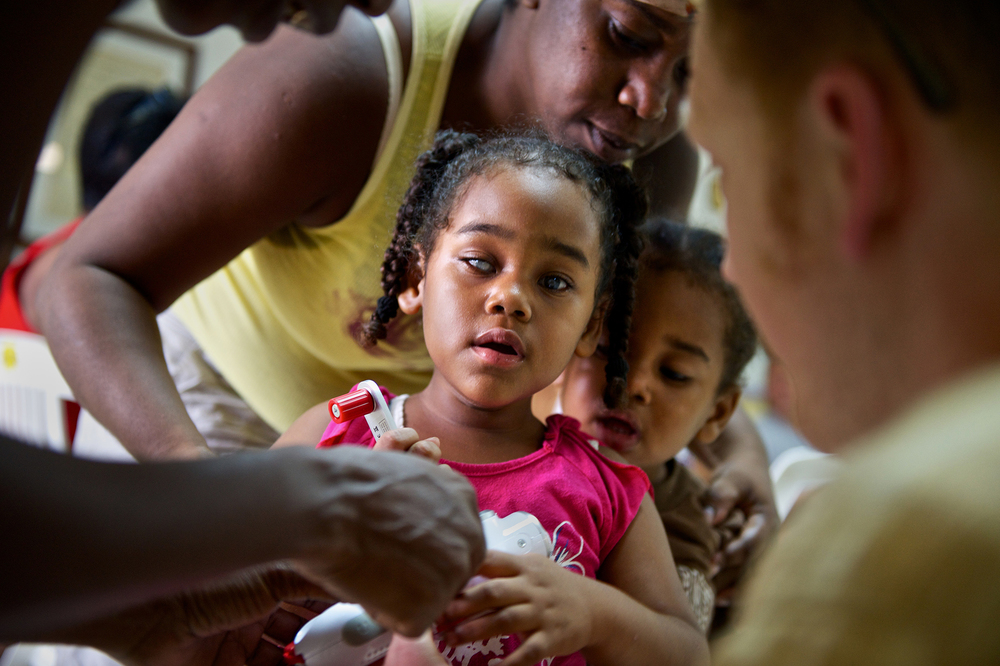
In Belize, ETOW works with visually impaired children through our partner and friends at the Belize Council for the Visually Impaired. Photo by ETOW volunteer/supporter, David Korchin (K2WNW). Click to enlarge.
Of course, at my non-profit, Ears To Our World, we celebrate the unique power of radio everyday as well.
Indeed, we’re in the process of preparing at least another 100 radios for Sierra Leone, where children are receiving education over the airwaves as schools have been closed in an effort to stop the spread of Ebola.
If you can get on the air today, there are a few events happening around the world you might be able to catch:
Alexanderson Alternator Station SAQ
Alexanderson alternator in the SAQ Grimeton VLF transmitter.
SWLing Post reader, Greg (VA7BC), passes along this announcement from the ARRL:
“The World Heritage Grimeton Radio SAQ in Sweden plans to fire up its Alexanderson alternator on 17.2 kHz on the occasion of UNESCO World Radio Day, Friday, February 13. The station will begin tuning at 1430 UTC, and a message will be transmitted at 1500 UTC.
A message with a theme of “peace” has been put together by more than 200 citizens of Varberg, Sweden, via the “Varberg Calling for Peace” project.
SAQ will not be issuing QSL cards nor post a list of reports, but it will accept brief listener reports. The Grimeton site’s Amateur Radio station SK6SAQ will be active, using a special event World Radio Day call sign — 7S6WRD. Frequencies: 7035 kHz or 14,035 khz, CW, and 3755 kHz SSB. QSL to 7S6WRD via SM bureau.“
If any SWLing Post readers are able to record the SSB transmission on 3,755 kHz, I would love to add the audio to our audio archive.
Asia-Pacific Broadcasting Union relay
The Southgate ARC reports that ABU members will particiapte in a round-the-world broadcast relay:
“On Friday 13 February 2015, participating broadcasters around the globe will devote at least half-an-hour of their programming to the WRD 2015 themes “Innovation and youth in radio”.
The main organisers, the European Broadcasting Union, in partnership with the ABU and other broadcasting unions, will also offer three short optional pre-recorded radio features devoted to Radio and Youth, Radio and Innovation and the History of Humanitarian Use of Radio: UN Radio.
The segments can be used whole or in part in a time slot of each station’s choice. Most of the features will also be available with scripts in French, Russian, Spanish, Arabic and Chinese, thanks to the UN.
Speeches by UN personalities will also be available ready to use on air, plus a one-hour rights-free concert live from Geneva by the UN Jazz Orchestra will be made available.
Organisers say that, as this will be a relay following the world’s time zones, there will be a succession of radio stations each handing over to the next participant throughout the day.
To give listeners around the world the chance to follow this special WRD program, the broadcasts will be put on an Internet stream, coordinated via the EBU in Geneva.
“The ITU International Amateur Radio Club station in Geneva will use the special call 4U0ITO to mark World Radio Day on Friday, February 13
The ARRL report this event also marks the kickoff for the International Telecommunication Union 150th anniversary.
International Amateur Radio Union President Tim Ellam, VE6SH, will inaugurate special call sign 4U0ITU at 0900 UT. He will be accompanied by ITU Secretary General Houlin Zhao, other elected officials and VIPs.
The IARC will use the 4U0ITU call sign until the World Radiocommunication Conference 2015, November 2-27.
World Radio Day commemorates the first broadcasts of UN Radio in 1946.”
Send listener reports to your favorite shortwave broadcasters
Many of your favorite shortwave broadcasters will dedicate a portion of their programming to World Radio Day.
This is the perfect day, as a listener, to let your favorite broadcasters know you’re listening! Send in a proper QSL report–mention the time, frequency and type of programming you heard. Give the broadcaster a proper signal report as well (click here to read about the universally accepted SINPO code). Broadcasters love to hear about any insight you pulled from their news items or reports–the more detail, the better. And thank them for broadcasting over shortwave.
You can typically find contact information on the broadcaster’s website. If you have any difficulty, please comment and I, or another reader/contributor, will try to help.
Happy World Radio Day!
It’s been fun to see how World Radio Day has grown over the years. I believe it’s a wonderful reason to celebrate all that we love about radio.
To celebrate World Radio Day 2013, UNESCO asked me to record why I believe radio is relevant today. Here was my response:
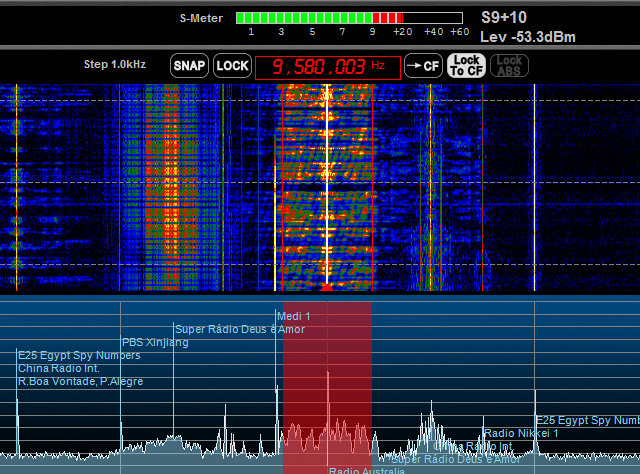
It appears it may have indeed been a transmitter glitch that kept Radio Australia from broadcasting into North America with their typical blowtorch signal on 9,580 kHz yesterday.
After publishing a post about this yesterday, I received quite a few reports confirming that RA could not be heard in North America. I even received a report from Mike in New Zealand who couldn’t hear RA on 9,580 kHz with his Yaesu FT-817.
I did, however, receive two reports from listeners stating that they could hear a very faint signal from RA on 9,580 kHz–long after I had tuned off frequency. This might explain the carrier I saw on my spectrum display yesterday. Perhaps Shepparton turned down the power on 9,580 kHz for maintenance purposes?
Either way, I’m simply happy to hear my old friend back on 9,580. Since we are officially under the new (reduced) broadcast plan, I hope this means that we’ll at least Radio Australia until they change the plan again.
Many thanks to SWLing Post reader, David, who passes along this announcement from Radio Australia via Pacific Beat:
On Sunday, Radio Australia’s shortwave signal to Asia will be turned off, another result the ABC says of recent government funding cuts.
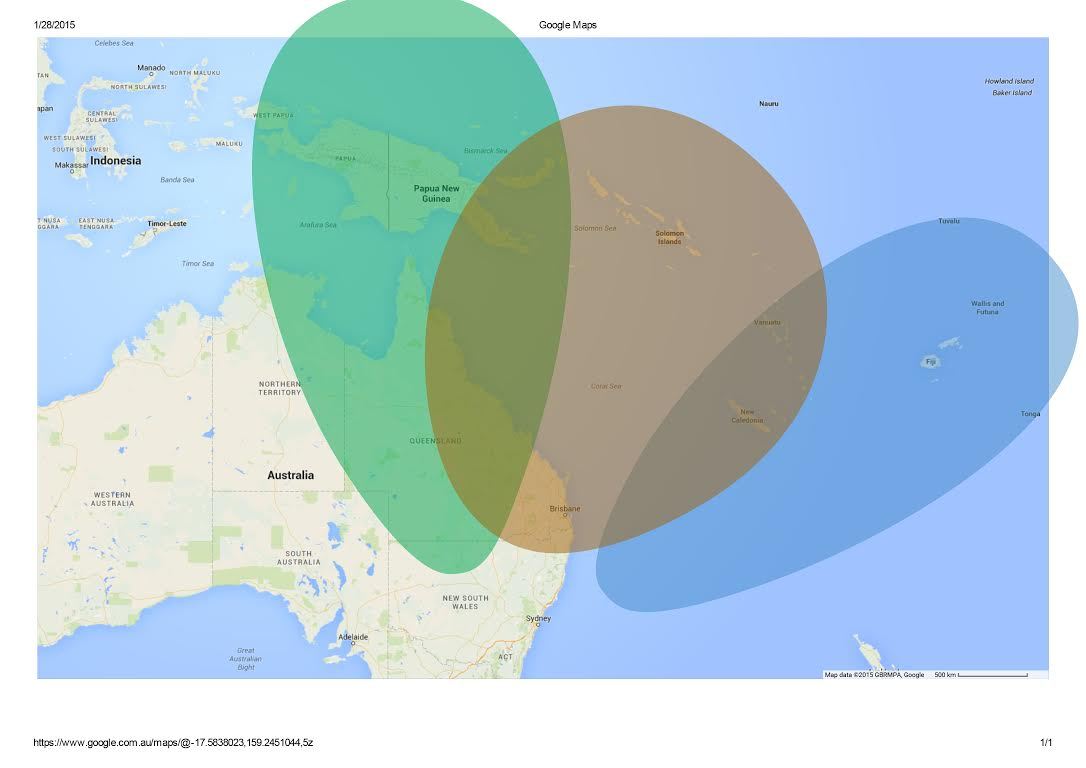
Shortwave broadcasting into the Pacific will continue, but signal strenth outside Papua New Guinea, Solomon Islands and Fiji may be degraded.
Alex Oliver from the Lowy Institute has contributed evidence to Australian parliamentary inquiries and committees on foreign affairs, defence and trade for many years.
So does she view the switch off as a big step back from international broadcasting by Australia, or simply the retirement of some old technology.
Shortwave Radio Audio Archive contributor, Richard Langley, has digitized another set of historic off-air recordings–this time, documenting the independence of Lithuania through Radio Vilinus.
Many thanks to Richard for the following guest post and archived audio:
Radio Vilnius 1990-1991
On 11 March 1990, Lithuania was the first Soviet republic to declare its independence. The Soviet Union issued an ultimatum to the Lithuanian authorities to renounce independence or suffer the consequences.
On 17 March 1990, Lithuania rejected the demand and the Soviet Union responded by applying economic sanctions and occupied parts of Vilnius, the capital city. In January 1991, the Soviets launched a larger scale operation against Lithuania. On 11 January, Soviet military units seized several building in Vilnius and elsewhere. On 12 January, civilians congregated outside some strategically important buildings such as those of the Supreme Council (the Seimas Palace), the Radio and Television Committee, the Vilnius TV Tower, and the main telephone exchange in an attempt to prevent them from falling into the hands of the Soviet military. In the early hours of 13 January, tanks and soldiers attacked the TV tower. Fourteen Lithuanians and one Russian soldier died.
Subsequently, Soviet forces surrounded and entered the Radio and Television Committee building and forced the TV station off the air. Shortly thereafter, a small TV studio in Kaunas was used to resume TV transmissions and put out a call for help. Radio transmissions were also affected. Although Soviet forces were in the vicinity of the Supreme Council building, they retreated instead of attacking. The occupation and military raids continued for several months following the attacks.
Subsequent Lithuanian-Russian negotiations resulted in the signing of a treaty on 31 January. A referendum on independence held on 9 February overwhelmingly supported the full and total independence of Lithuania. Other republics of the Soviet Union declared their independence and following the resignation speech by Mikhail Gorbachev on 25 December, the Soviet Union was dissolved the next day. The last Russian troops left Lithuania on 31 August 1993.
Radio Vilnius, the external service of Lithuanian Radio, transmitted news about events in Lithuania and the other Baltic republics even at the height of the Soviet attacks. The broadcasts were made, in part, using transmitters elsewhere in the Soviet Union. However, there was a temporary interruption in these broadcasts after the occupation of the Radio and TV Centre by Soviet troops early in the morning of 13 January. They resumed on 25 January.
Radio Nederland’s “Media Network” programs of 20 January 1991 and 14 January 1992 featured reports on Radio Vilnius and the Soviet occupation. The sound files of these programs are available on the Web (“Media Network Vintage Vault“).
I have six recordings of Radio Vilnius English Service shortwave broadcasts between March 1990 and January 1991. These were received in Hanwell, New Brunswick, Canada, using a Sony ICF-7600D receiver and supplied wire antenna draped around the listening room.
28 March 1990, 22:00 UTC, 11770 kHz (00m:00s – 00m:55s)
Strong signal. Interval signal (IS) and station identification (ID) but the transmission was cut off in mid-sentence: “This is Radio Vilnius. Hello and welcome to our daily broad” All that could be heard faintly on this frequency then was Radio Liberty in Russian (“Govorit Radio Svoboda”). Initially could hear nothing on Radio Vilnius parallel frequencies until about four minutes into the broadcast when a very faint signal on 12060 kHz could be heard (not recorded).
29 March 1990, 22:00 UTC, 12060 kHz (00m:55s – 02m:04s)
Weak signal. IS, station identification, and first part of “News About Lithuania.” Radio teletype interference. Checked other frequencies.
3 April 1990, 22:00 UTC, 17665 kHz (02m:06s – 30m:02s)
Improved signal. Receiver briefly switched to other frequencies to check quality during the recording. IS, ID, “News About Lithuania,” report on the occupation of the Lithuanian Prosecutor’s Office on Friday night (30 March), music, sports news, “Lithuanian by Radio.”
Strong signal. Some co-channel interference from Radio Liberty. Receiver briefly switched initially to other frequencies to check signal quality during the recording. IS, ID, “News About Lithuania,” report about the Lithuanian Mission in Moscow, “Around Lithuania,” program in Esperanto (begins around 23m:08s) — a regular feature at the end of Monday broadcasts from Radio Vilnius in English. Interesting sign-off statement: “It’s goodbye and good luck.” On the recording, the Radio Vilnius transmission is followed at 29m:29s (on the same frequency), by the first approximately 15 minutes of a transmission from pro-Moscow Radio Minsk in Belorussian (now usually referred to as Belarusian). The transmission begins with the IS and ID (“Havorits Minsk … Radyjostancyja Saviecki Bielaru?”), followed by a news program.
Strong signal. Recording actually starts at about 22:58 UTC with music, the tail-end of a transmission on this frequency, likely from Radio Kiev. Some transmitter hum. Then, Radio Vilnius IS and ID. “We’re still hold up and we hope you can still hear us.” “News About Lithuania” including occupation news, commentary, and reports from the neighbouring Baltic states. Receiver briefly switched to other usual frequencies to check on signal quality (9750, 15180, 17690, and 17720 kHz; 6100 kHz not heard). Transmission ends with “And that’s all we have for our today’s broadcast, we hope not the last one, from Radio Vilnius in the Republic of Lithuania.” This is followed by the transmission schedule and contact information. After about 45 seconds, the Radio Minsk transmission begins with IS and ID.
Strong signal. Initial mix-up of interval signals. The first IS is believed to be that of Moskovskaya Radio, the Russian Service of Radio Moscow, followed by a bit of the Radio Moscow World Service IS, and then finally the Radio Vilnius IS. The transmission begins with the statement “We’re still broadcasting from Vilnius.” This is followed by the Lithuanian news reporting on the acts of aggression of the Soviet occupying forces and “Correspondents’ Reports.” The latter includes a report that the exam session at Vilnius University has been postponed to allow students to help protect buildings from the occupation forces, including the Radio and Television Building, and a report on the restrictions on travel. The reports were interrupted with “some news just come in” about a group trying to break into the building of the Council of Ministers. The announcer subsequently reported that the attackers had been put off and so the conflict has been neutralized. The broadcast ends with the statement “We hope to be with you tomorrow again” followed by the transmission schedule and contact information. The Radio Vilnius transmission is followed by the one from Radio Minsk. News organizations reported that Soviet troops entered the Radio and Television Building about 15 minutes after this Radio Vilnius transmission.
Strong signal on this and other frequencies usually received except 17690 kHz; only background noise on that frequency. However, there was no Radio Vilnius transmission on any frequency. It had been replaced by light classical and contemporary orchestral music. No IS or announcement of any kind. Music was faded out at 29m:03s before ending. During the recording, the receiver was briefly tuned to other Radio Vilnius frequencies to check on signal quality.
Strong signal. The recording begins with a few seconds of music from the previous transmission on this frequency. Then, after about one minute (there was no IS), the Radio Vilnius transmission starts with the beginning of the patriotic song “Lietuvninkai Mes Esam Gim?” (Lithuanians We Are Born) and an introduction stating that the broadcast is coming “from the capital of the independent Republic of Lithuania.” This is followed by “News About Lithuania” including items on further acts of violence by Soviet troops and severe winter weather. Then, there are reports on Lithuanian-Polish relations and the work of the commission on Soviet aggression. Next is an eye-witness report on the attack on the TV tower on the night of 13 January, a report on the current feelings of Lithuanians under occupation, and how music and the arts keep the people going. During the recording, the receiver was briefly tuned to other Radio Vilnius frequencies to check on signal quality. In addition to 7400 kHz, only 9750 and 17690 kHz could be heard.
Richard: Thank you so kindly for sharing these amazing off-air recordings.