Category Archives: New Products

ELAD introduces new products

Elad FDM-S3

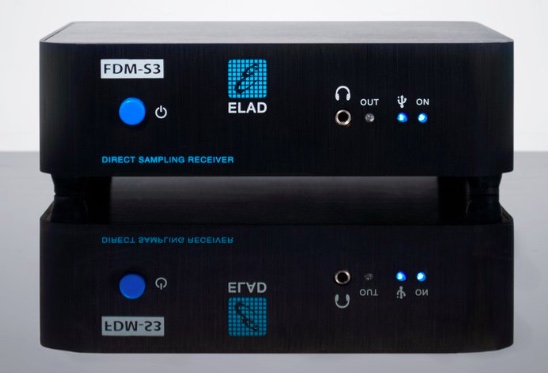
Many thanks to SWLing Post contributor, Mike Hansgen (K8RAT), who notes that Italian manufacturer, ELAD, has introduced a new speaker, an amplifier and the FDM-S3 SDR is now available to purchase.

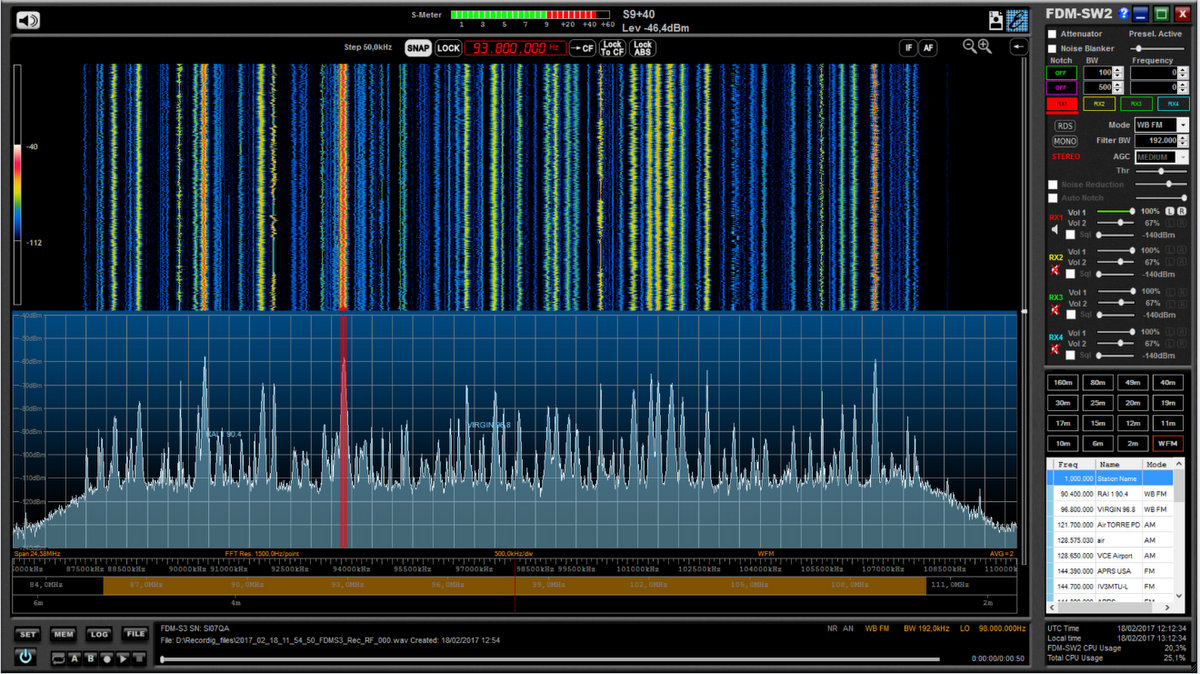
Elad-FDM-S3 Screenshot

The ELAD FDM-S3 was first announced last year, but has only recently started shipping. We know its processing bandwidth is impressive–wide enough to include the entire FM broadcast band! The price is 949.90 EUR.

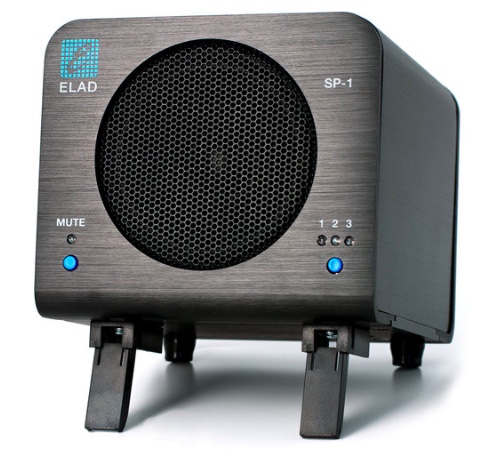
ELAD has also introduced a matching amplified speaker–the SP1:

ELAD SP-1 Speaker Front

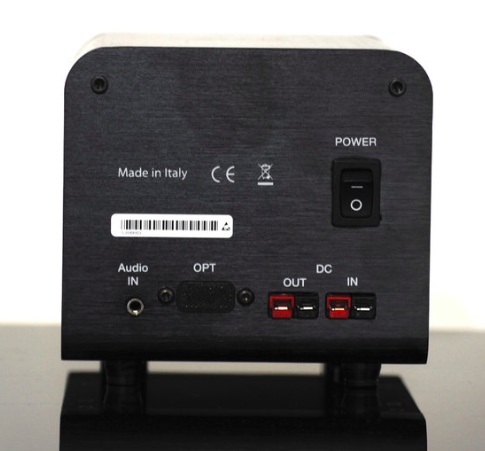
ELAD SP-1 Speaker Back

If I owned an FDM-DUO transceiver, I would grab this matching speaker! Knowing ELAD, I imagine the audio is impressive.  The price of the SP-1 is 140.30 EUR.

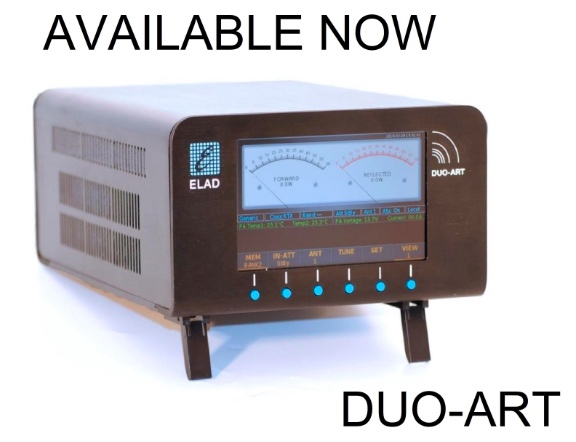
And finally, ELAD has also posted a photo of what appears to be a new amplifier:

Elad Duo art amplifier

I have no details about the SP1 speaker or DUO-ART amplifier–and few details about the FDM-S3–but I will meet with ELAD at the 2018 Hamvention in a few days and gather more details.

Follow the tag ELAD for updates.

A review of the supercompact Sangean WR-7 FM Radio and Bluetooth speaker

Folks have been known to say that good things come in small packages.  And, do you know what? They’re sometimes right. [Spoiler alert: This review features a good thing which comes in a small package.]

I’ve been in the process of evaluating some pretty complicated pieces of communications equipment lately. So when Sangean approached me a few weeks ago and asked if I would check out their latest FM radio and Bluetooth speaker––a comparatively simple piece of kit––I thought, Well, why not? Because while I prefer “enthusiast grade” radios, sometimes it’s nice to check out something super-simple and purpose-built from a company I’ve grown to trust. Plus, it didn’t hurt that Sangean actually bothered to include FM radio on what would otherwise simply be just another Bluetooth speaker.  Ah, yes; a worthy addition.

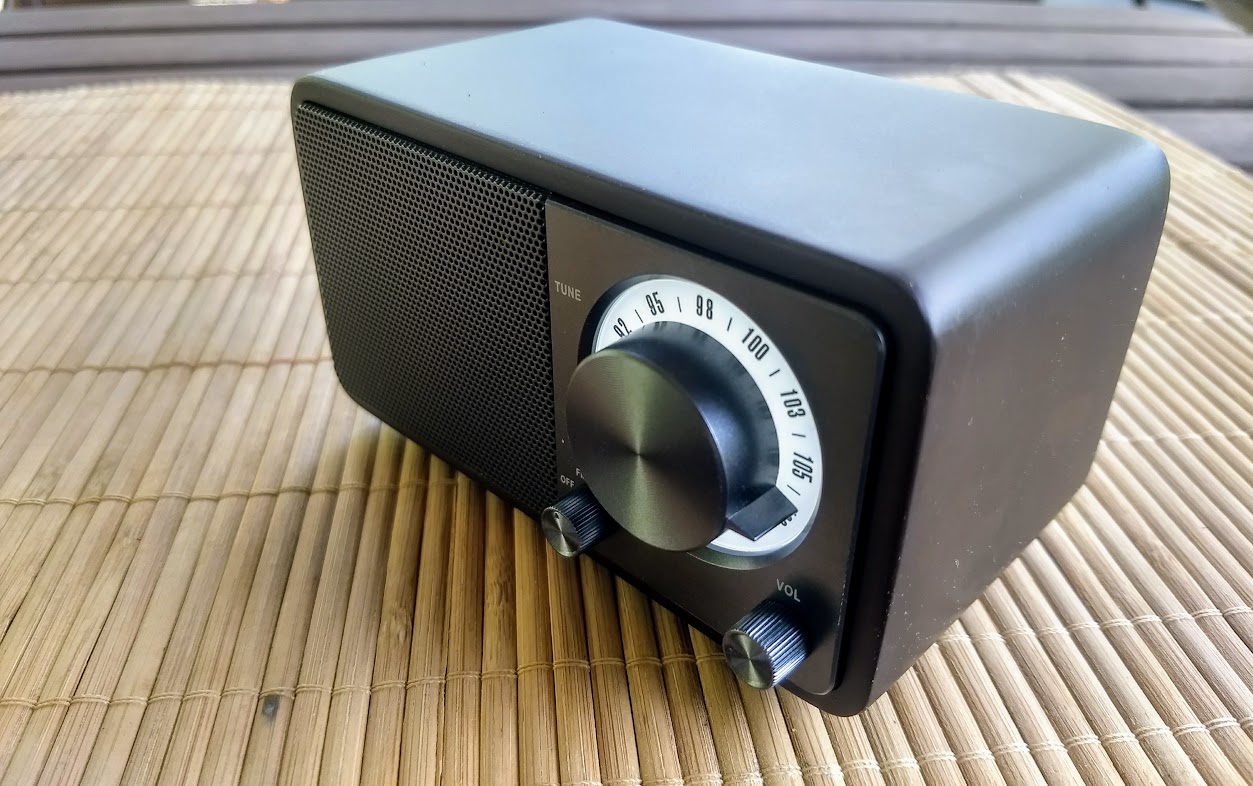
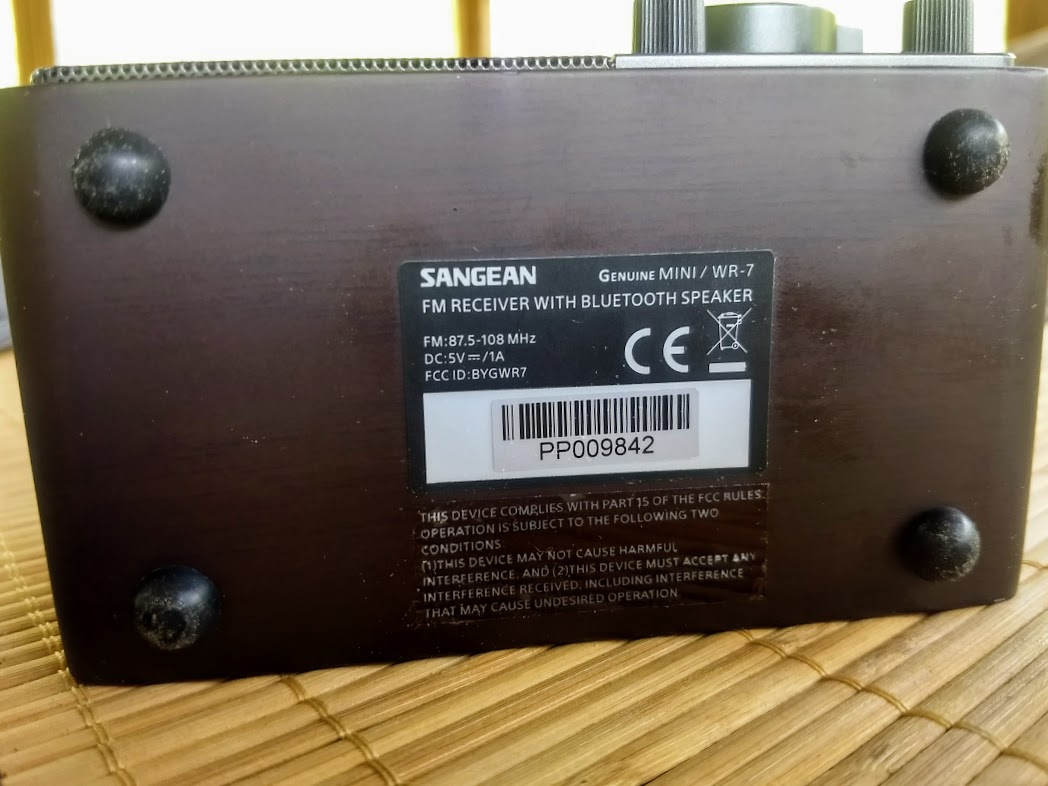
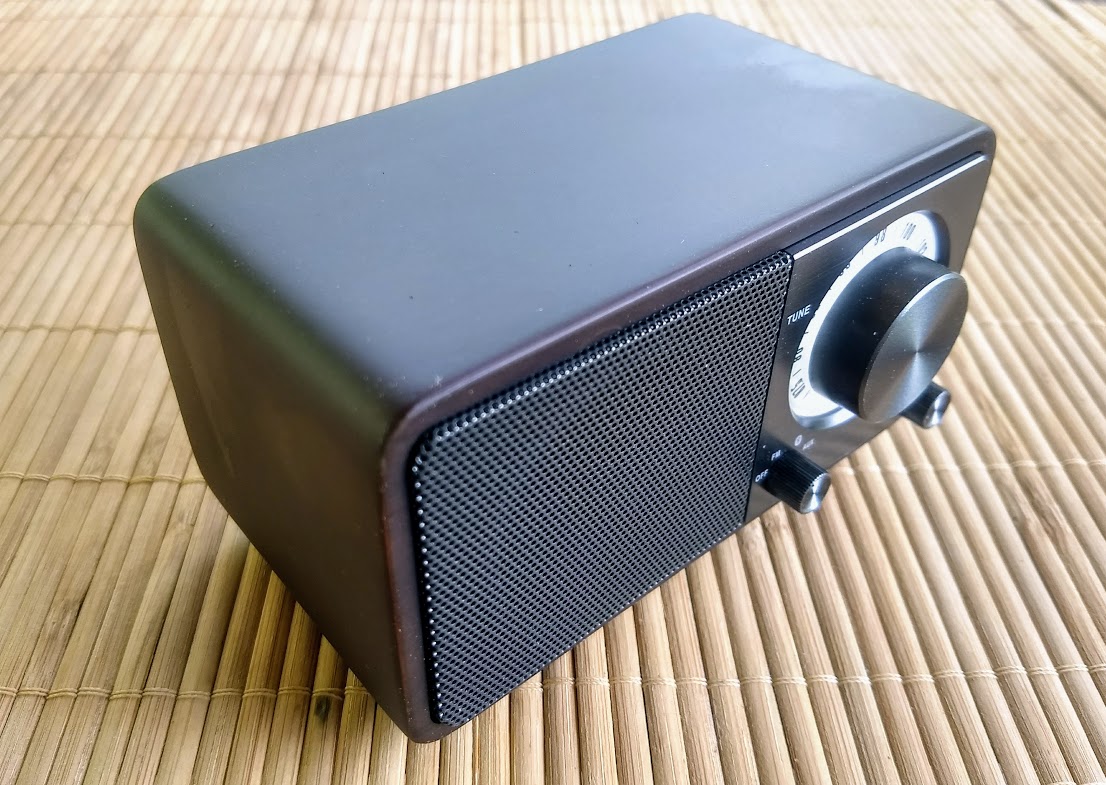
Sangean dispatched the sample radio and I received it within a few days. I was expecting something roughly on the scale of a Tivoli Model One.  Instead, when I opened the box, what I found was a radio only slightly larger than my diminutive  Muzen OTR, a little radio that fits the palm of your hand. To be fair, it could only be called…cute.

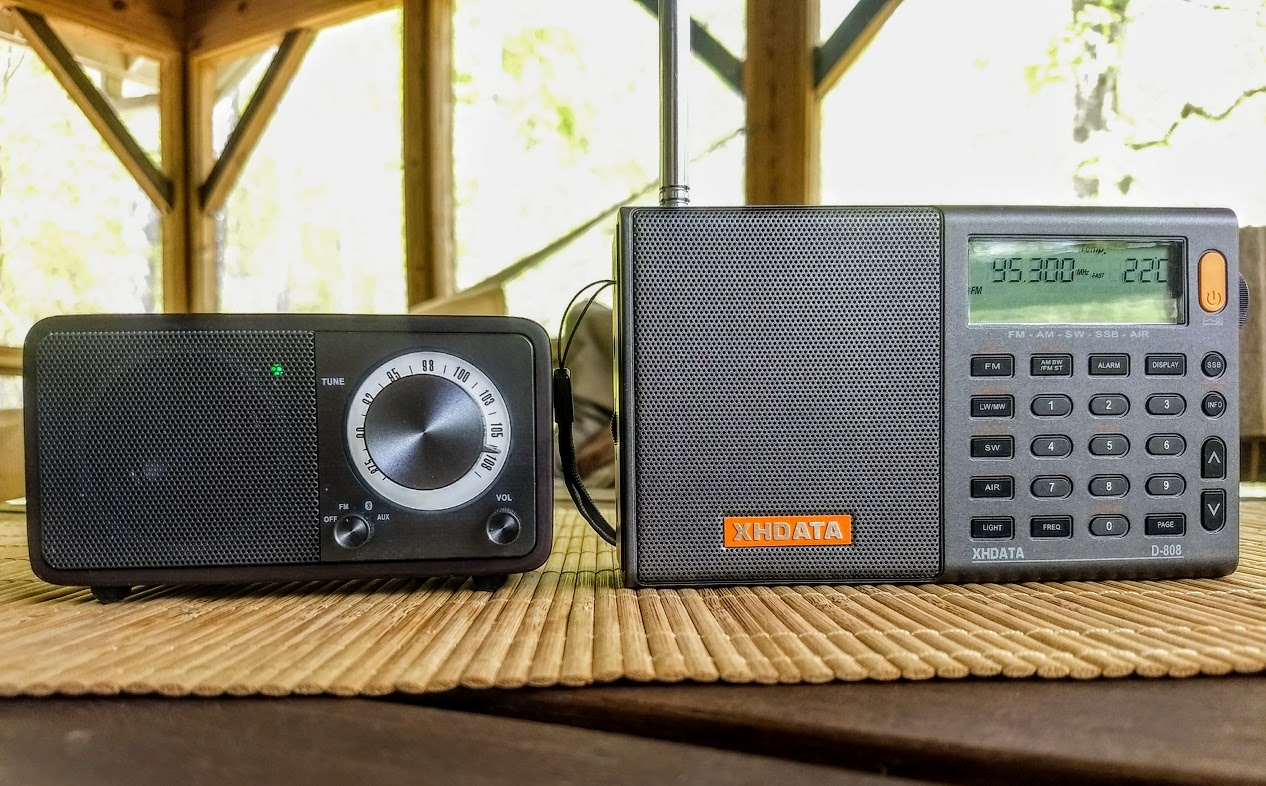
By my measurements, the tiny Sangean WR-7 is about 2 1/2″ tall, 4 5/8″ wide, and 3″ deep (if you include the tuning knob in that last dimension). It’s mini by almost any standard.

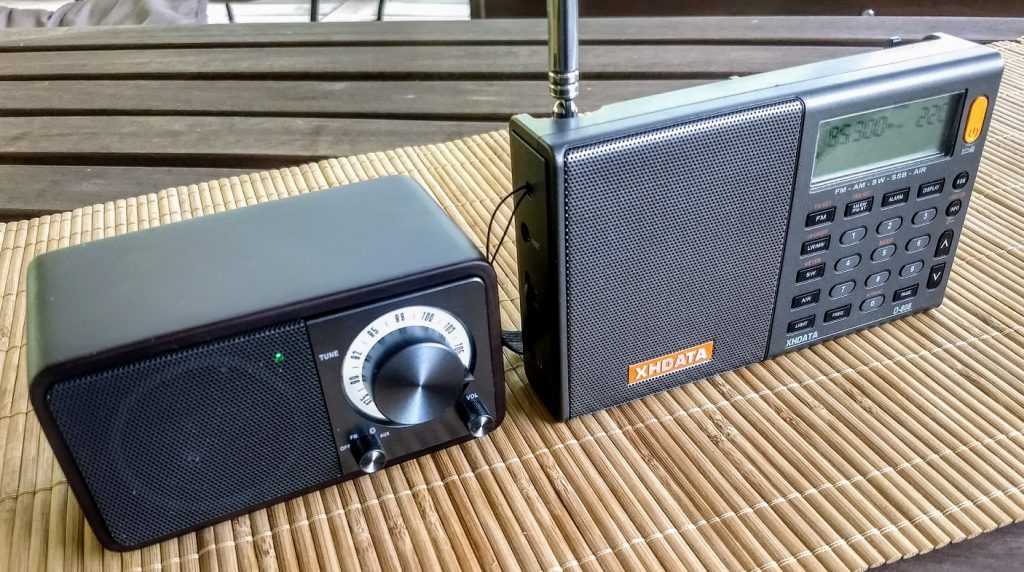
For this photo I placed it next to my handy XHDATA D-808 compact radio.  And here’s how they compare:
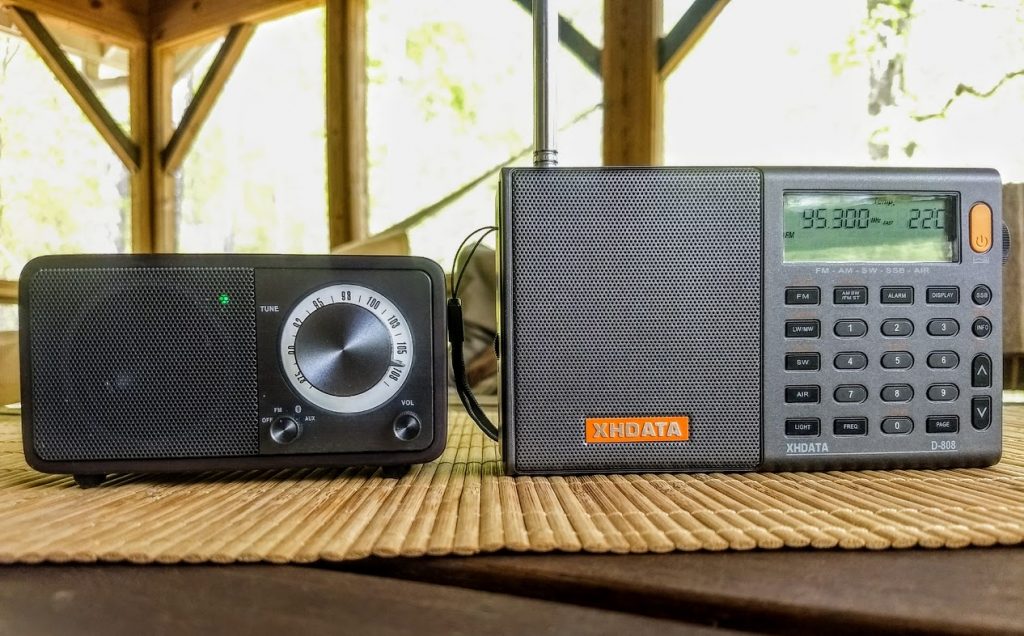
Though wee, the WR-7 feels weighty (14.4 oz), solid, and substantial in the hand.

Turns out the chassis is solid––solid wood. Sangean has two options: walnut and dark cherry. Of course, my sample is a black version which may appear later in the year.
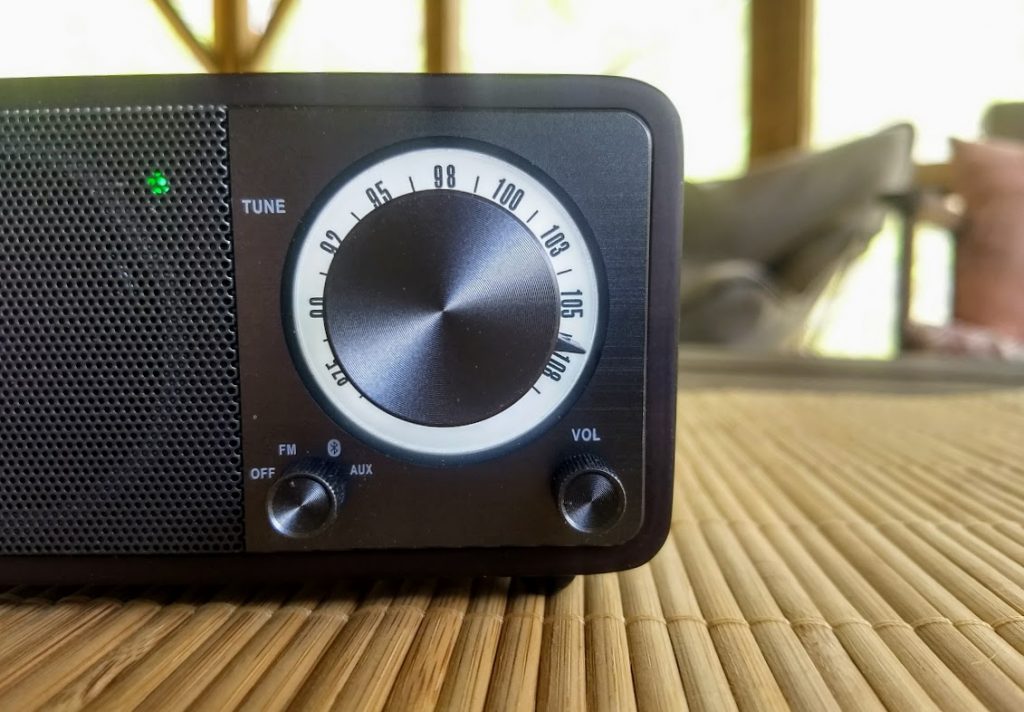
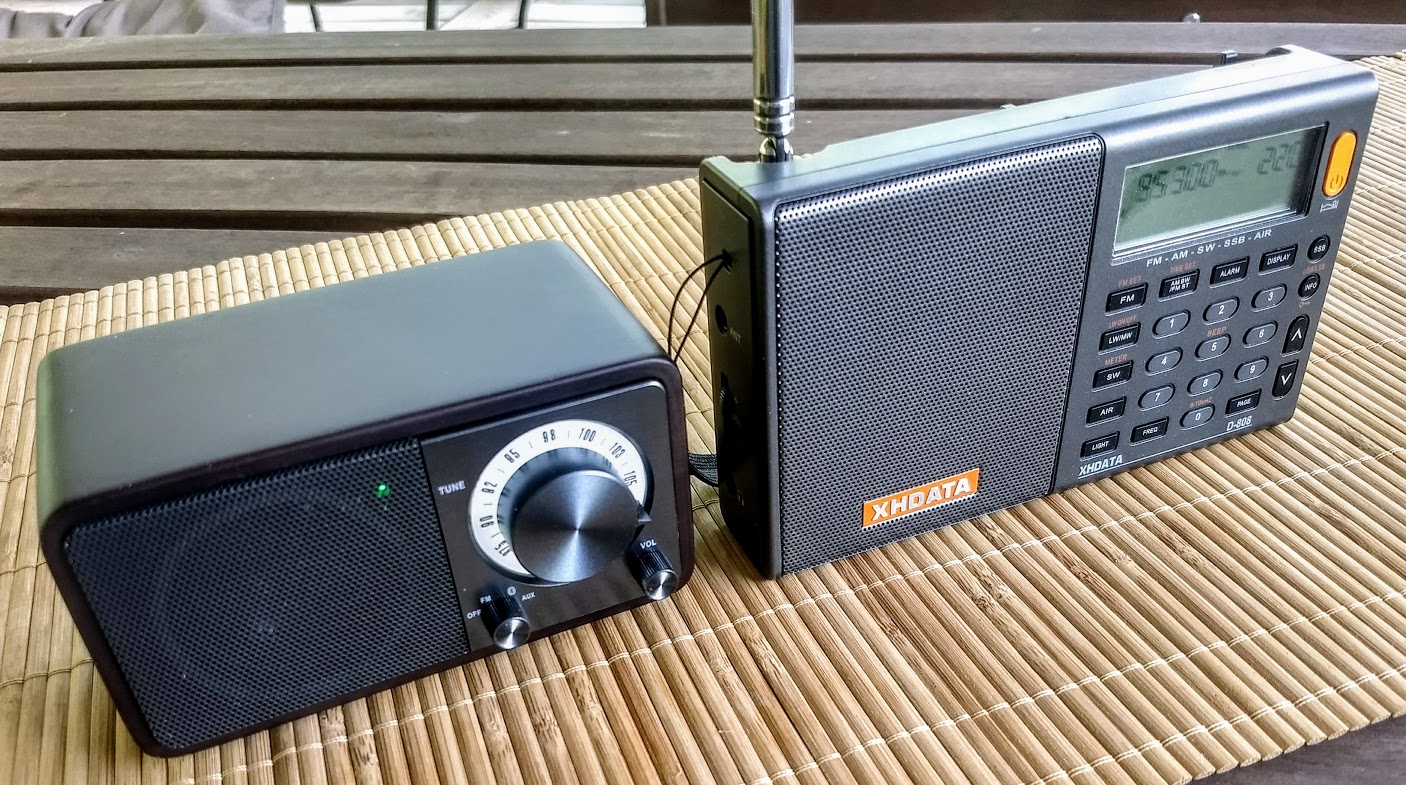
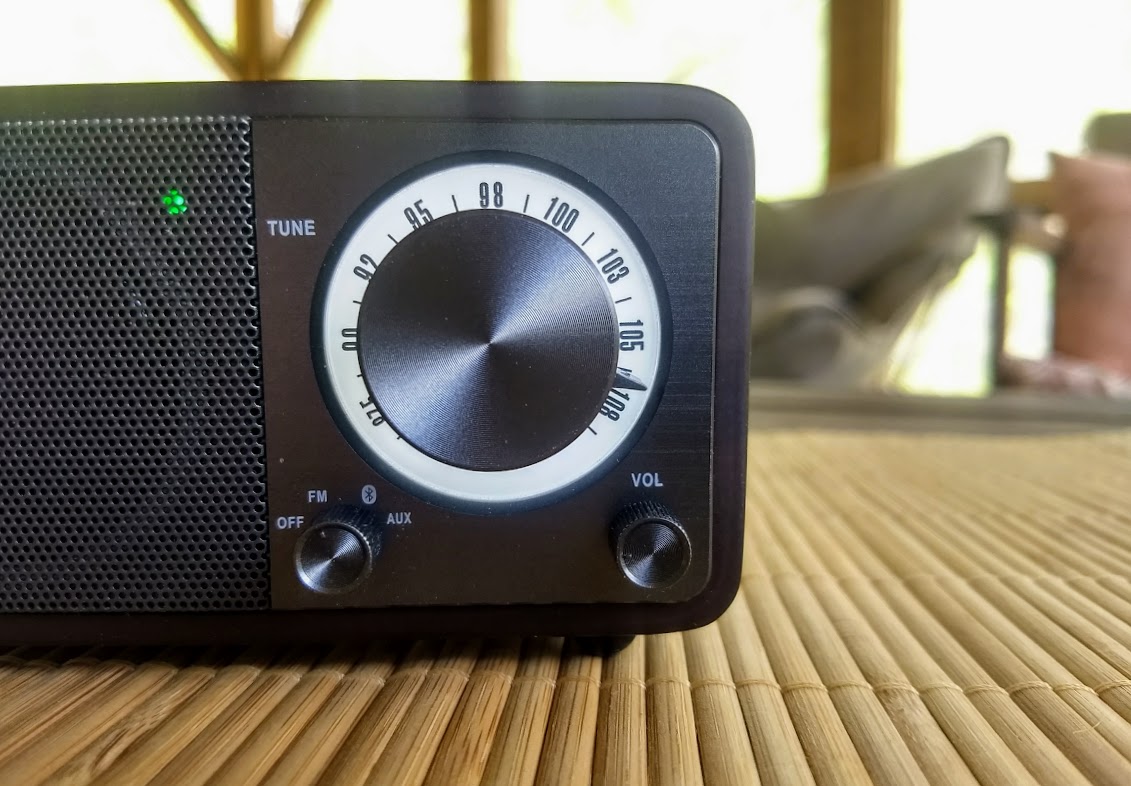
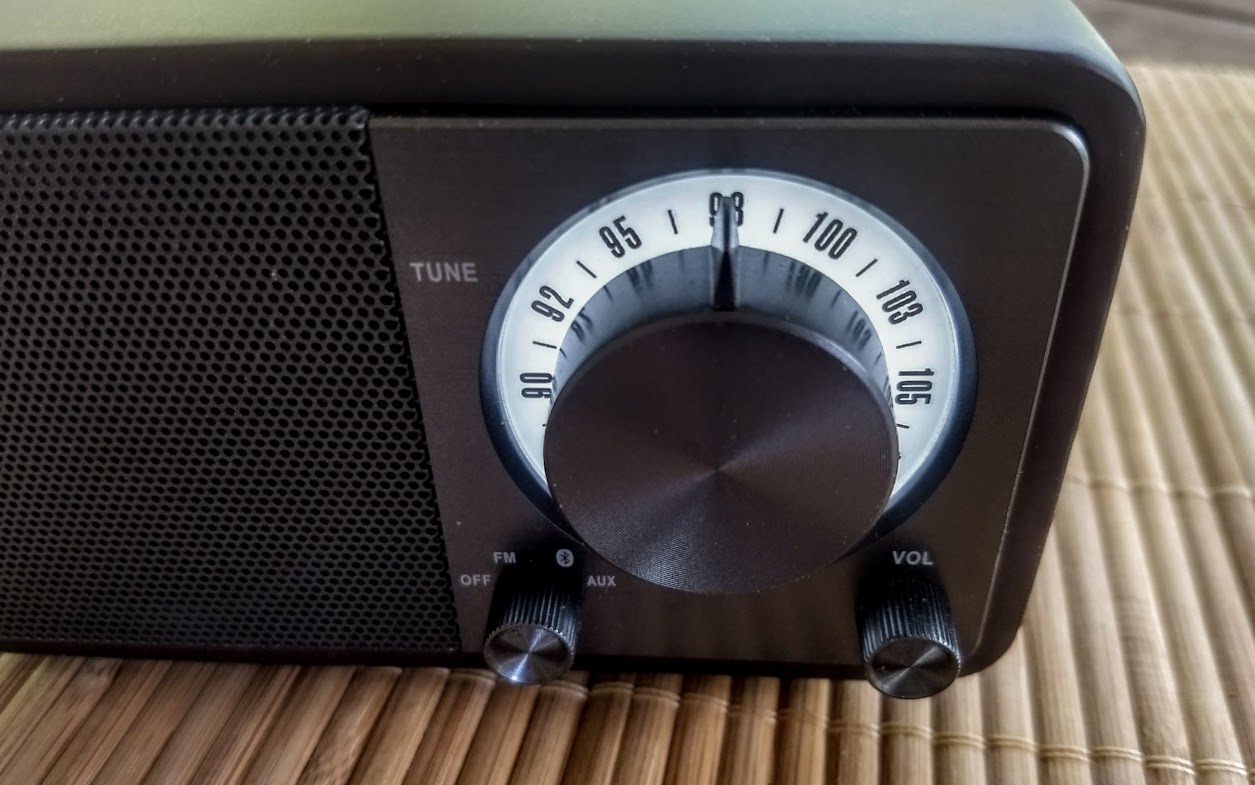
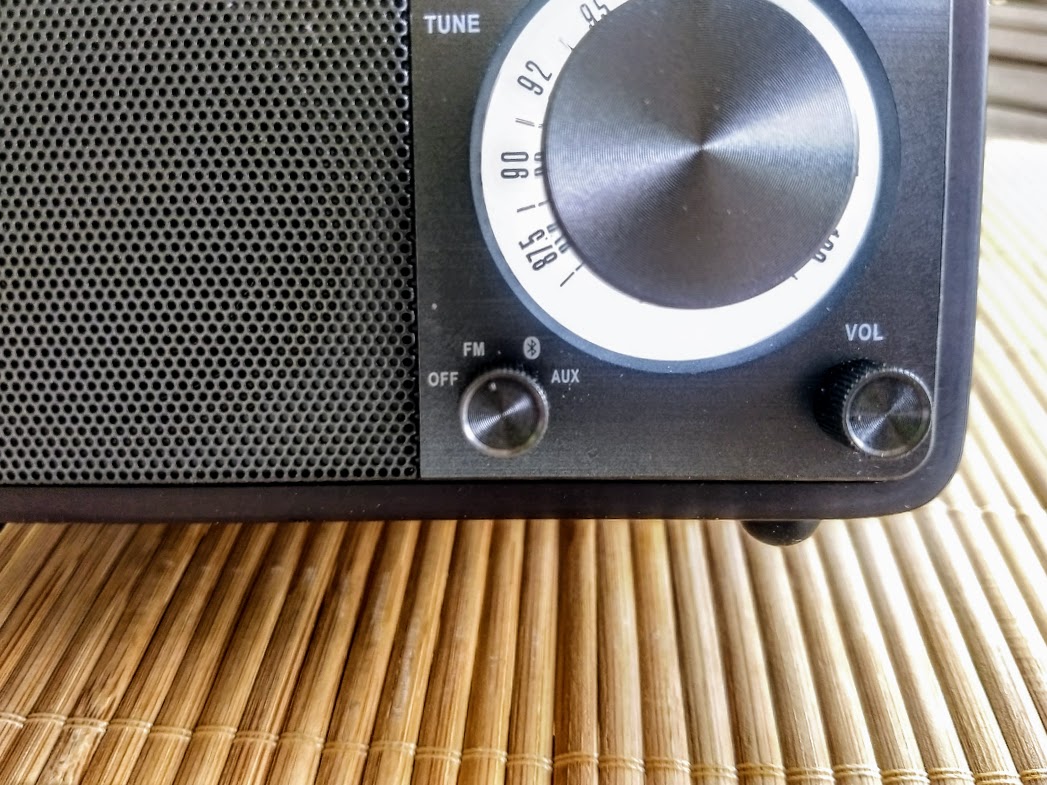
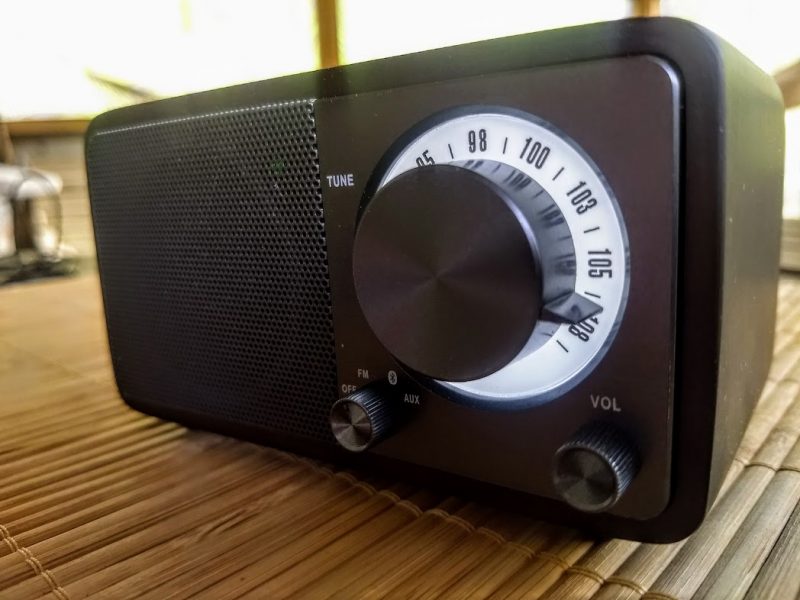
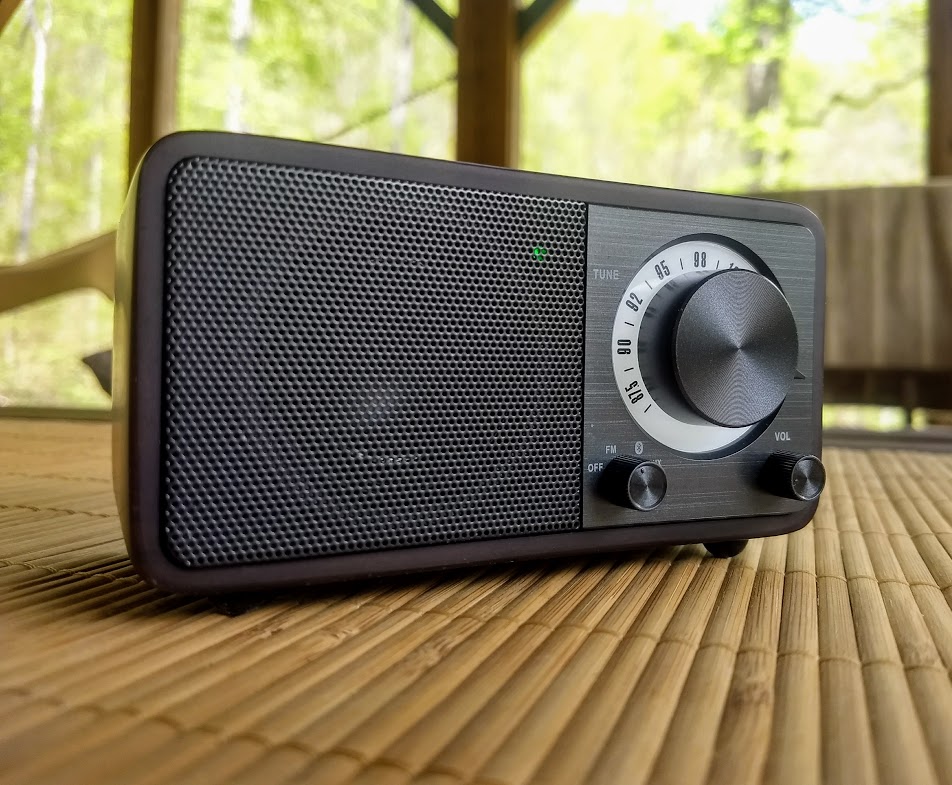
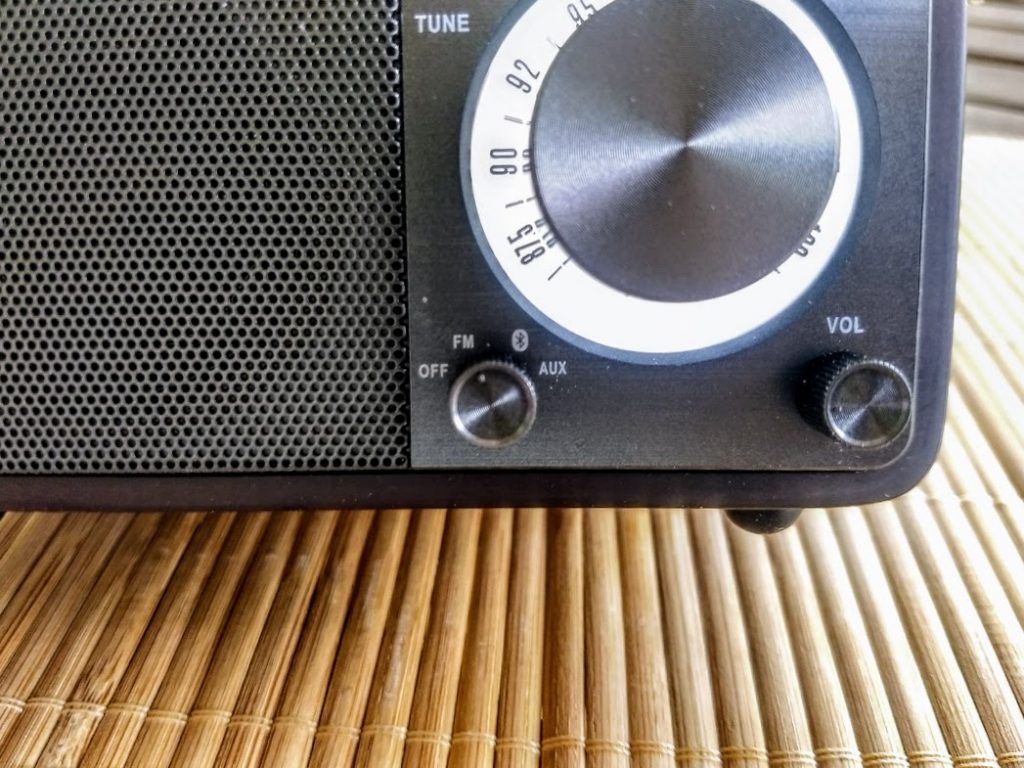
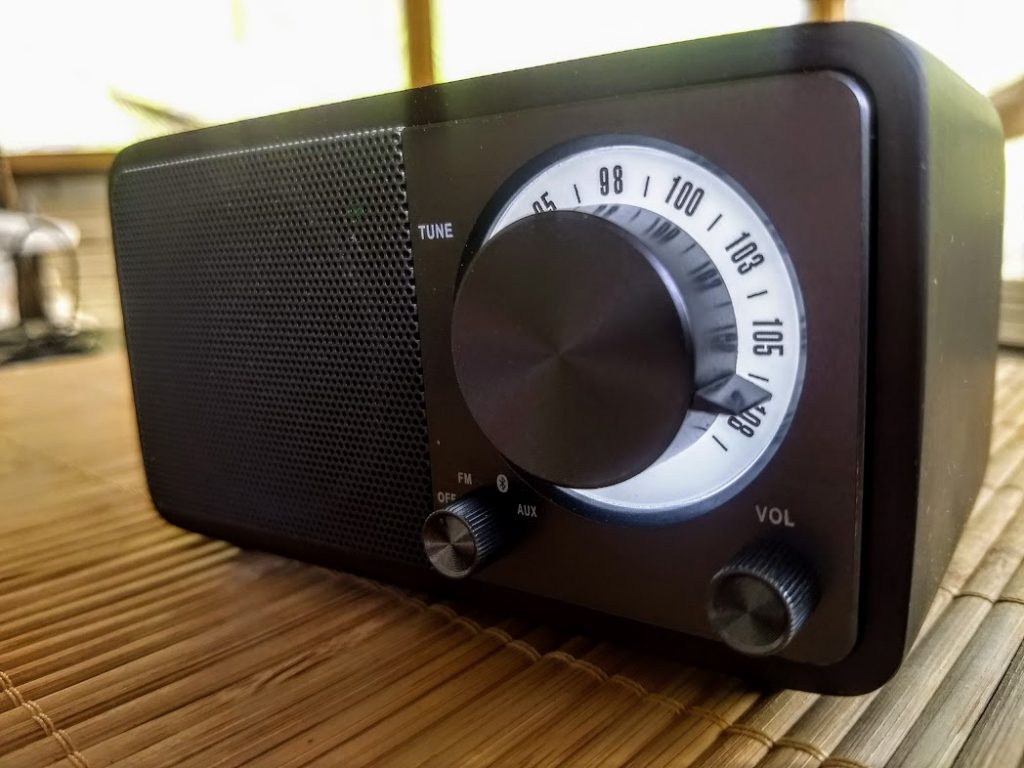
And the WR-7 is as simple to operate as it is to…well, hold in your hand. There’s one knob to turn the radio on and select the source (FM, Bluetooth, or the analog AUX input), and another knob for volume.  Just as these photos show.

The tuning knob is the largest knob and moves fluidly across the dial. The analog dial is white with black frequency markings, and is backlit. From my tests, the FM dial is fairly accurate, although the frequency marking steps are a bit odd: 2 or 3 MHz increments starting at 87.5 and ending at 108 MHz.

There is a green LED lamp hidden behind the speaker grill that acts as the FM signal strength indicator. This LED turns blue when in Bluetooth mode.

Performance
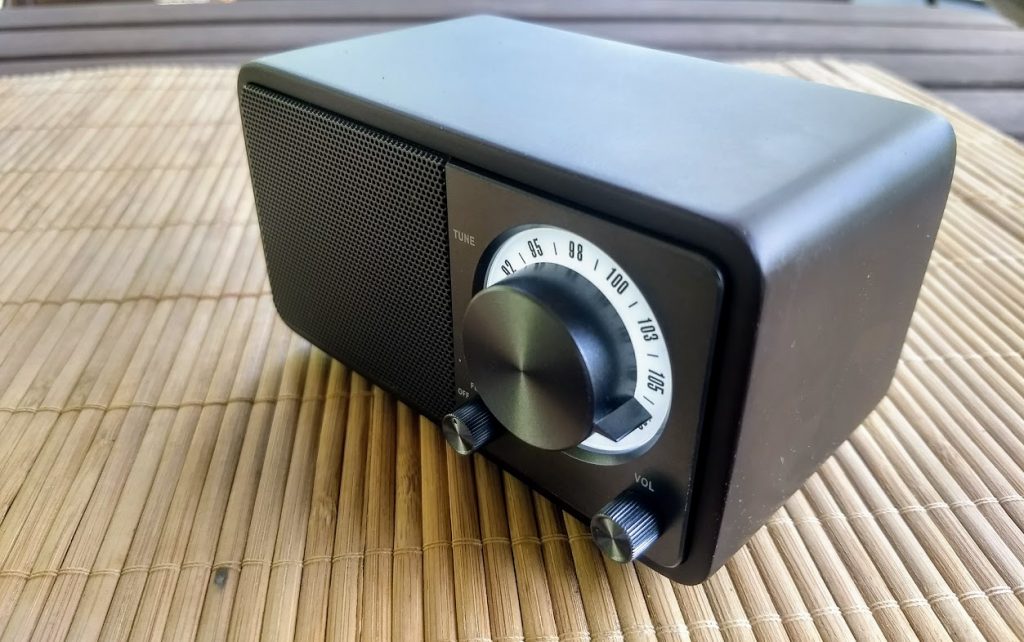
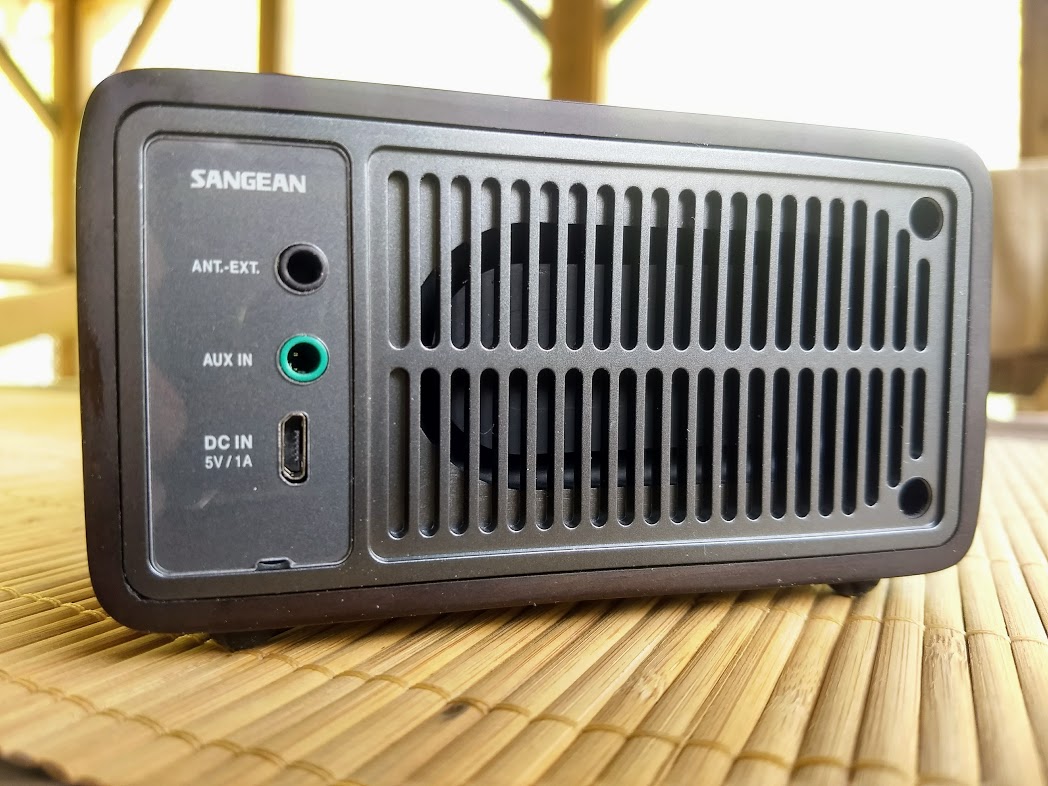
There’s not a lot to report on here and, perhaps, that’s why I halted my other evaluations to fit this one in. This radio needs no owner’s manual (though it does ship with one). All you need is a USB charging cable––yep, the same type that likely charges your mobile phone.  And, of course, it ships with one. It also ships with a lightweight cloth-like carrying bag.
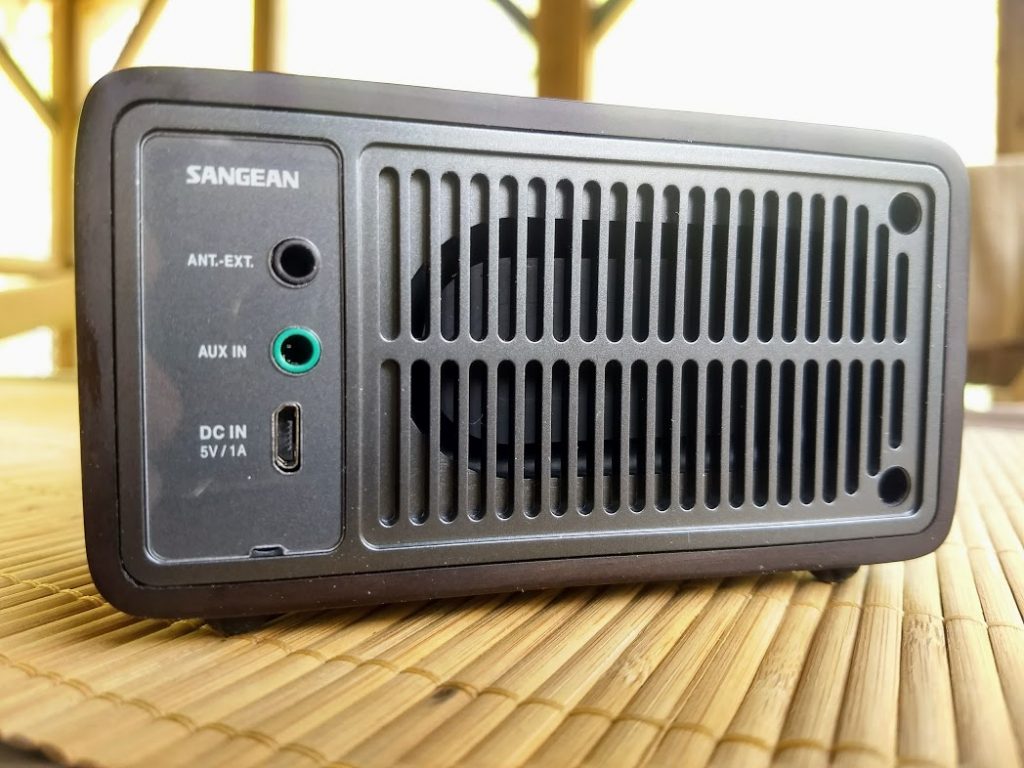
You might have noticed that the WR-7 doesn’t have a telescoping whip antenna.  That’s okay, because it also ships with an external wire antenna (which I actually prefer on this type of mini tabletop radio).
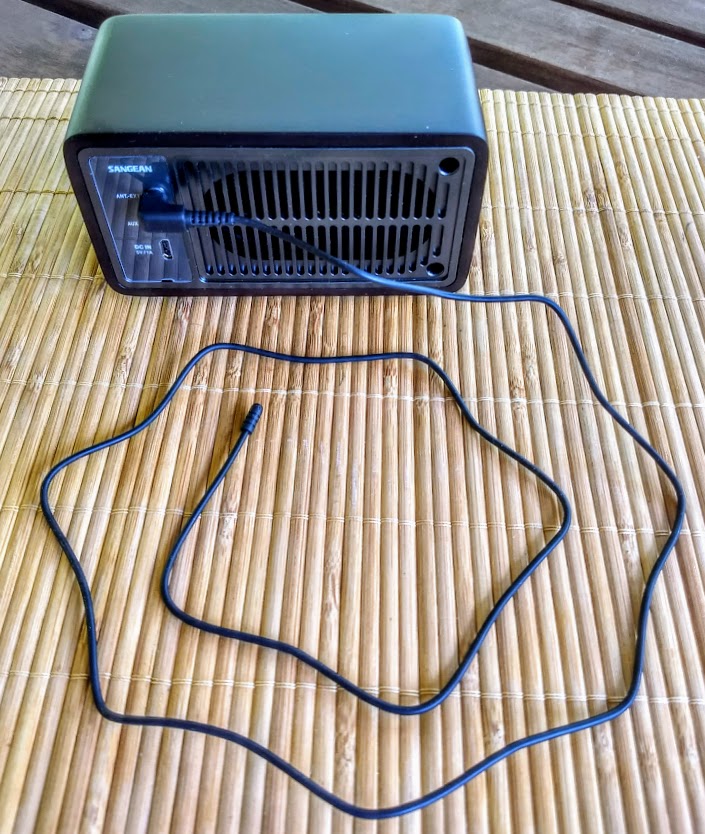
The WR-7 has an internal 2600 mAh Lithium-Ion Battery that provides this tiny rig with up to 36 hours of operation between charges. While I haven’t tested this claim yet, I can tell you that its battery life is incredibly good––especially acknowledging that the audio amplifier must be using quite a bit of the battery.

FM
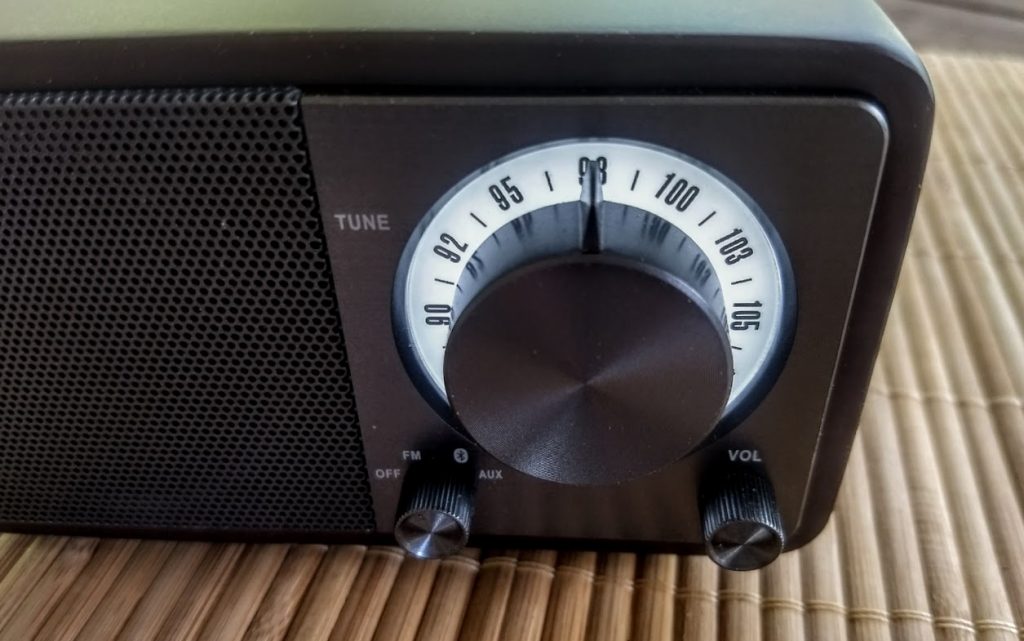
The WR-7 receives the FM broadcast band from 87.5 to 108 MHz.  While the dial is analog, I know there’s a DSP chip inside because I can hear frequency steps while I tune across the band. There is no muting between frequency steps, so the experience of tuning feels somewhat analog. As I mentioned earlier, the dial layout is a little quirky, but overall the frequency markings are pretty close to accurate. I found my benchmark stations with little difficulty.
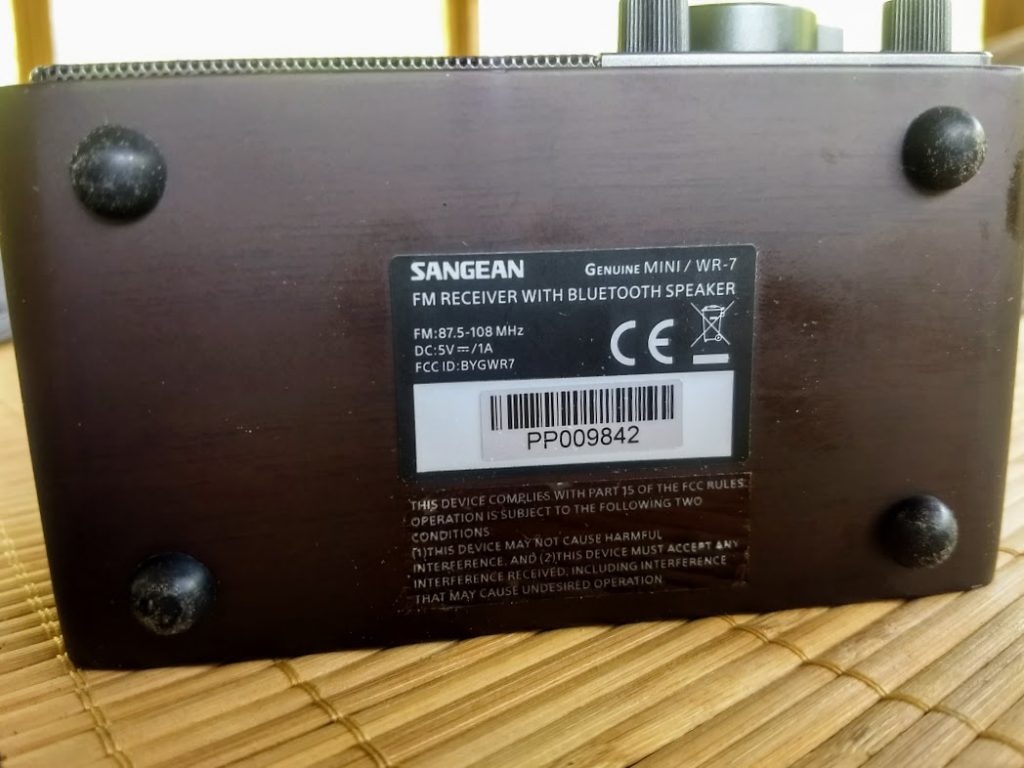
In terms of sensitivity, the FM receiver is quite good in the WR-7.  I could receive almost all of my local stations with the external FM antenna connected. Of course, you’ll want to connect the FM wire antenna.

With the external antenna connected, I could receive all of my benchmark distant and weak stations as well on the WR-7. While reception is very good, it isn’t quite as good as on my XHDATA D-808, C. Crane CC Skywave SSB, or Tecsun PL-660––the lock isn’t quite as stable––but I probably could have tweaked this by moving the external wire antenna.

Audio fidelity
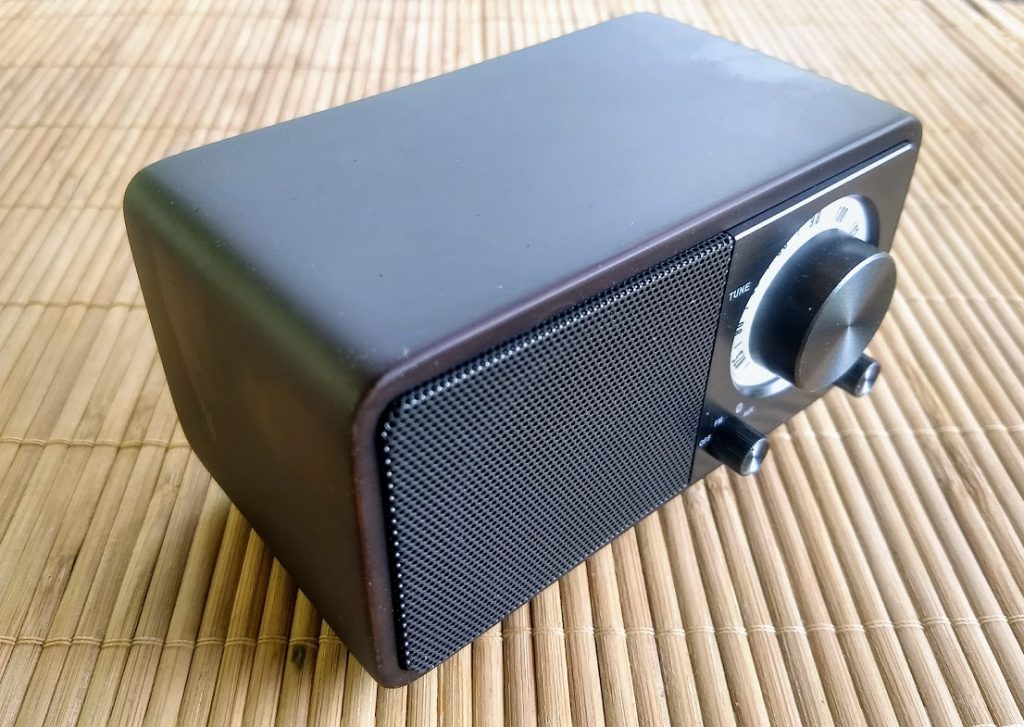
Thing is, with even a decent FM signal, you’ll be mighty impressed with the audio fidelity of the WR-7. It easily manages to sound like a radio three to four times its size. Truly, the bass that emanates from this tiny speaker is incomprehensibly deep–only limited by the size of the acoustic chamber.

The sound is rich and room-filling when the volume is turned up.

And speaking of turning up the volume, this is one little radio you’ll probably peg at its highest volume setting from time to time. In fact, I rather wish this radio would allow the volume level to reach even a notch higher…but I expect this was a design choice at Sangean. With the volume turned up all the way, the sound is room-filling, but not distorted. While testing the WR-7, I tuned it to a variety of stations and played a wide range of music through it via Bluetooth: I never noticed bass-heavy songs distorting the audio. I suspect if the volume could be increased even further, the audio would indeed distort a bit.

In short: though you might occasionally turn up the volume on the WR-7 all the way, you’ll be pleased with the results––even across the room!

Bluetooth
I’m not sure what to say about Bluetooth; to me this is a technology that seems to work quite well for wireless connections between mobile devices. The WR-7 has built-in Bluetooth Technology Version 4.1, and it worked flawlessly with all of my mobile devices as well as my shack’s PC.

For a full week, I used the WR-7 as the speaker for my shack computer, and it was most impressive. In fact, it makes for a nice compact external speaker to pair with my SDR applications. AM audio, piped through Bluetooth into the WR-7, is a treat.

For a few nights, I even streamed OTR productions of “Buck Rogers in the 25th Century” with my shack computer, connected to the WR-7 via Bluetooth. The WR-7 was actually in the adjoining room, yet the Bluetooth connection was strong and never dropped the audio. The resulting sound was nothing short of amazing: if you closed your eyes, it almost sounded like a valve set from 1939.

And that’s another thing about the WR-7 worth noting: It’s so small and so simple in design, it fits in anywhere, and isn’t in the least obtrusive, all while filling the room with its warm, rich sound.

Summary

Every radio has its pros and cons. When I begin a review of a radio, I take notes from the very beginning so that I don’t forget some of my initial impressions. Here is the list I formed over the time I’ve spent evaluating the WR-7.

Pros: 

  • Superb, room-filling, rich audio especially considering its very compact package
  • Very good FM sensitivity
  • Internal battery powers it for dozens of hours between charges
  • Easy to recharge via any 5VDC USB source
  • Easy Bluetooth connection and brilliant audio
  • Simple operation

Cons:

  • Volume and selection knobs could be slightly small for some users’ hands
  • Volume range more limited than most, upper volume capped
  • Although it does come with a nice lightweight carrying pouch for traveling, you might wish for a little extra protection in a suitcase or carry-on bag
Radios like the Sangean WR-7 give me hope that consumer electronics might be heading back in what is, in my humble opinion, the right direction: that is, toward quality.

The WR-7 is really a quality piece of kit: it has a solid feel (imparted by solid wood), has an acoustic chamber that produces excellent audio, and you can tell that the FM receiver wasn’t simply an “add-on” feature, as it works quite well.

While you won’t see many radios like this reviewed on the SWLing Post, I’m glad I agreed to take on this one.  It was an fun exercise, and reminded me why I love doing radio reviews: sometimes these digital marvels really surprise me. That, and I’m enough of a radio and consumer electronics geek to bask in the indulgence of pure listening!

Good one, Sangean! Accolades!

Click here to view the Sangean WR-7 on Amazon.com (affiliate link).

New antenna from Bonito: The MegaDipole MD300DX wideband active dipole

Many thanks to Dennis Walter at Bonito for sharing the following product announcement:


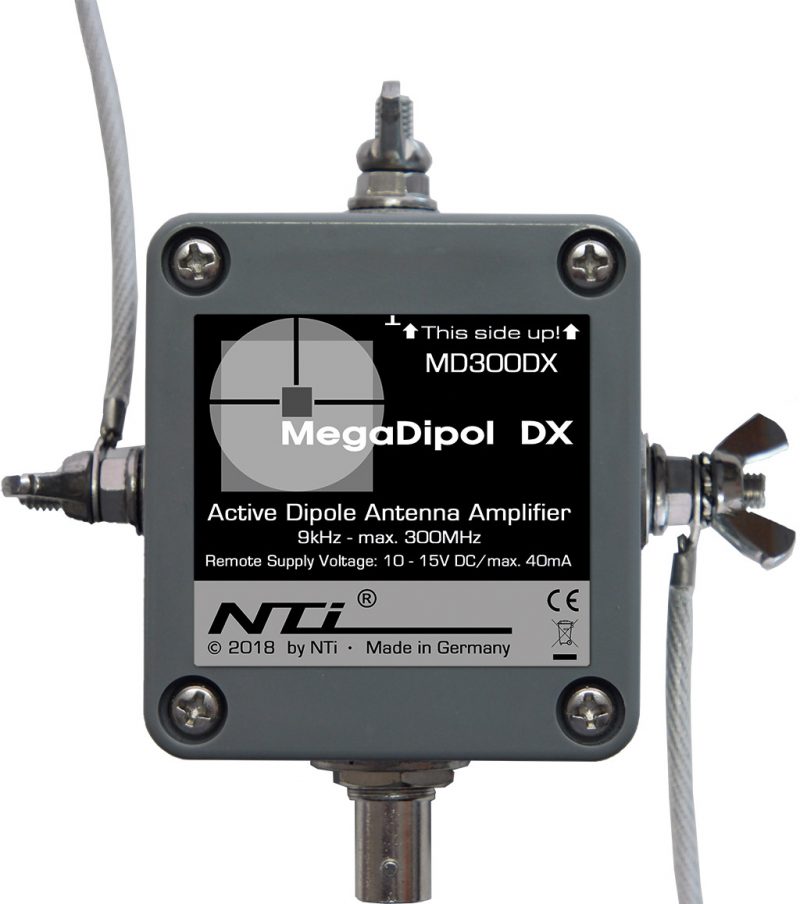
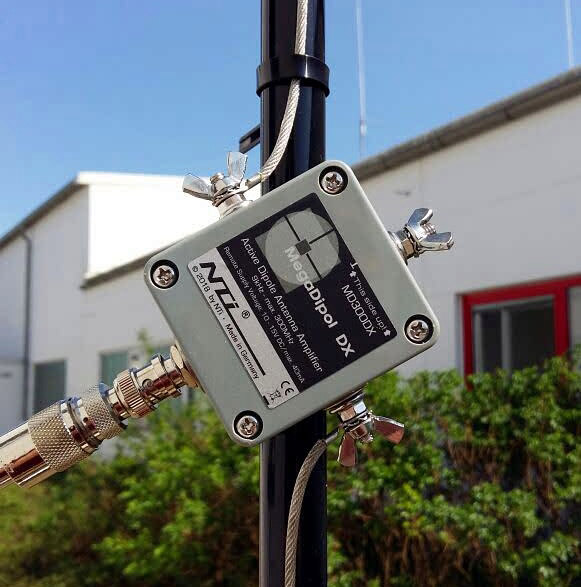
MegaDipole MD300DX wideband active dipole

The MegaDipole 300DX is a broadband active dipole with a maximum upper working frequency of 300 MHz. The dipole reacts to the electrical component (E-Field) of the electromagnetic field and will deliver best results regarding signal strength and SNR (signal -to-noise-ratio) at locations with little or no locally generated interference. Nonetheless, the receiver to be coupled to this antenna should have a high enough dynamic range so that it can effectively process the received signals.

In contrast to simple E-field antennas with only one radiating element, the symmetrical construction of the MegaDipole 300DX, will result in almost no negative resonance effects or reflections caused by the coaxial cable.

First choice for DXer

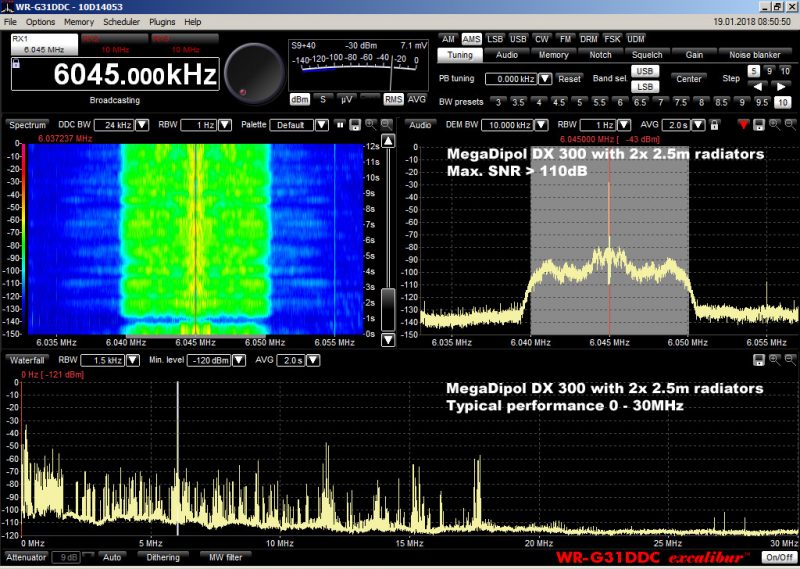
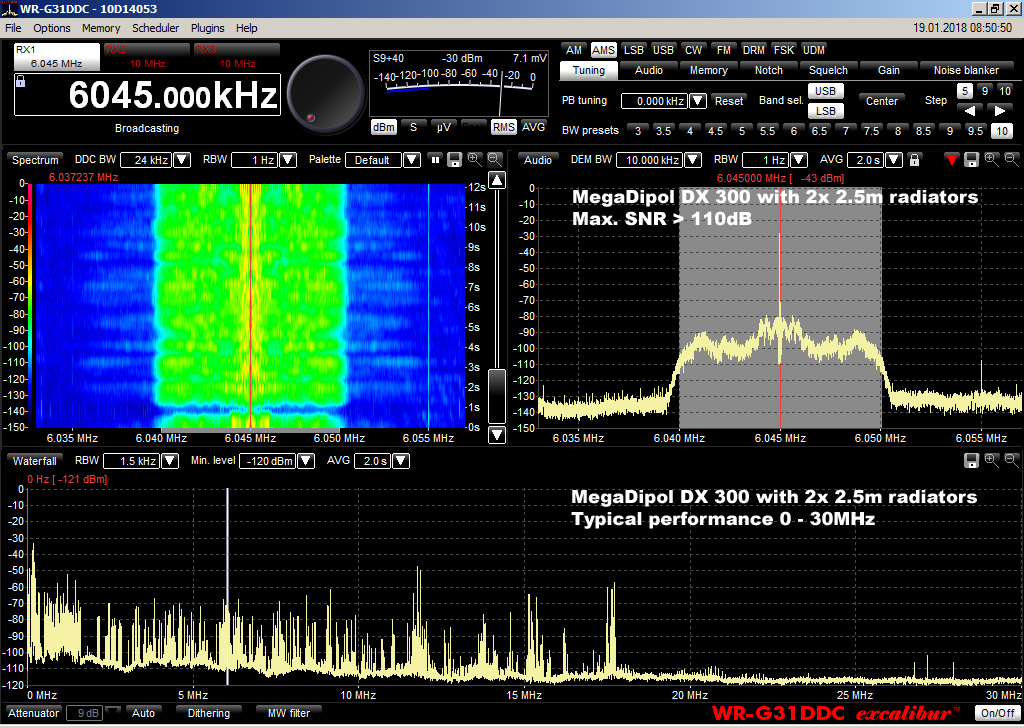
The MegaDipol MD300DX is the ideal antenna for DXers. Particularly in electrically quiet environments, it can really play to its strength in efficiently amplifying weak signals. In practical operations, a maximum signal-to-noise ratio of 110dB was achieved! (see image )

Wideband

With prodigious broadband capability and constant receive characteristics the MegaDipol MD300DX is ideal for wideband receivers, SDR’s and WEB-SDR such as KiwiSDR etc. The MegaDipol MD300DX can of course also be operated on all other receivers, including lower-end SDRs and portable world receivers.

Dual Power Power Supply

The MegaDipol is nominally supplied with 10 – 15V DC (max 40mA), however, it can be operated across a wide variety of supply voltages. The antenna can even be operated with slightly reduced IP values at the same gain with only 5 volts via USB. This offers a significant advantage in that you can supply the MegaDipol on trips away from the radio shack or DX expeditions autonomously, using a low-noise USB power-bank.

The MegaDipol has already attracted a lot of attention with its receive performance at various events such as DX-Camps, field days and in-house exhibitions. In these tests, the MD300DX surpassed the existing antennas usually by 10-15dB in the SNR.

Technical data

  • Frequency range: 9kHz – 300MHz
  • IP3: typ. +30dBm (@7.00 & 7.20MHz)
  • IP2: typ. +78dBm (@7.00 & 7.20MHz)
  • Size/weight: 98 x 90 x 38mm / 0.12kg

Whats in th Box?

  • MegaDipol MD300DX
  • Power Inserter CPI 1000DP
  • 2x 2.5m long radiating elements (PVC-coated, salt-water resistant stainless steel ropes)
  • 2 insulators for installation (weatherproof plastic material with 4.5mm fixing hole)

Coming soon: A Spectrum Analyzer function for SDRplay RSP series SDRs

[UPDATE: Click here for information about downloading Steve’s Spectrum Analyser tool.]

(Source: SDRplay)

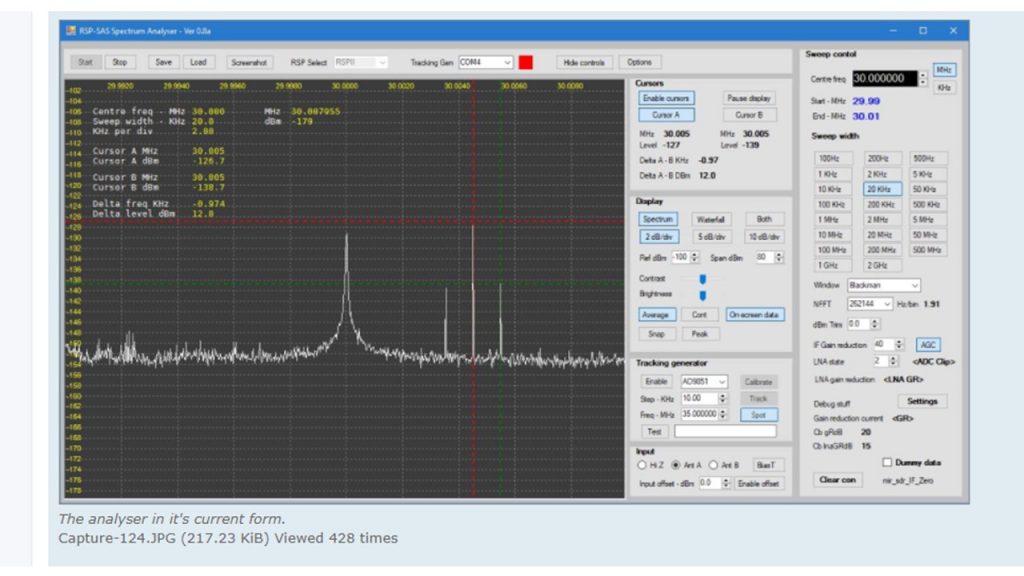
Steve Andrews contacted the SDRplay forum recently to share ideas for a new Spectrum Analyser tool for use with SDRplay RSPs. A lively discussion started, with a lot of enthusiasm and encouragement from the user community, for something optimised for these devices. Steve is progressing well with the software development and hopes to have an Alpha release of the basic tool available during May. You can follow the discussion, review progress and add your comments by joining the SDRplay forum and going to: https://www.sdrplay.com/community/viewforum.php?f=12 where we have created a section especially for the Spectrum Analyser topic.

Black Cat Systems’ 22 Meter Band Part 15 CW Beacon Kit

Many thanks to SWLing Post contributor, Robert Gulley (AK3Q), who notes that Black Cat Systems has developed a simple 22 meter beacon kit. The price is $20 shipped! A few details:

The kit includes the PCB and components, including a custom programmed microcontroller that will continuously transmit the ID / callsign of your choice, up to 8 characters, at about 13 wpm.

Small size – just 2 7/8 by 1 1/2 inches. Easy to build, just a few components, all through hole, no surface mount.

When ordering you note your callsign/ID to send and it will be pre-programmed.

Black Cat Systems has all kit details including full instructions on their website.

If you like the idea of building a beacon, you must also check out the beacon Dave (AA7EE) built recently–a true work of art!

VOK shifts broadcast schedule due to North Korea time zone change

Many thanks to SWLing Post contributor, DanH, who writes:

I put up a couple of videos on my “Willow Slough DX” YouTube channel nine hours ago that may rate at least an Arte Johnson (Laugh-in) “verrry interestink”. These are two videos of the North Korean shortwave station Voice of Korea operating with their new time zone and on their new schedule.

These are the two most recent videos of SW station receptions that I have posted during the last couple of days.

[The first video] is the VOK shortwave sign-on recorded at the newly scheduled time of 04:00, May 5, 2018 UTC on 15180 kHz. Distance: 5600 miles. Receiver: Sangean ATS-909X. Antenna: suburban 83m horizontal loop. Receiver location: Davis, California, USA. North Korea has changed its time zone to match UTC +9 which is used by South Korea. I was accustomed to tuning in Voice of Korea at 38 minutes past the scheduled hour for the English language news. Now I tune in at 8 minutes past the same hour. VOK broadcasts that were scheduled for 04:30 UTC now begin at 04:00 UTC. At the time I write this VOK shortwave programs listed on Short-Wave.info still show the old times:

Click here to view on YouTube.

[The second video] is the VOK shortwave newscast at the new time of 04:08, May 5, 2018 UTC on 15180 kHz. Some interference is heard half way through the clip:

Click here to view on YouTube.

Thanks for sharing this, Dan!  It never crossed my mind that VOK would change their international broadcast time based on the fact they shifted their country’s time zone. From a North Korean perspective, though, I suppose this makes sense. Thanks for the tip!

Click here to check out other recordings on Dan’s YouTube Channel.

Guest Post: Review of the TYT SF-401 Plus Frequency Counter/Tone Meter

Many thanks to SWLing Post contributor, Mario Filippi (N2HUN), for sharing the following guest post:


TYT Frequency Counter/Tone Meter Review

by Mario Filippi (N2HUN)
All photos courtesy of author

Most hobbyists own some type of transceiver whether it is a handheld, mobile, or base station. Some examples are amateur radio HF/VHF/UHF transceivers, Citizen’s Band radios, FRS (Family Radio Service) and GMRS (General Mobile Radio Service) handhelds.

A useful tool for the shack or the field is a frequency counter/tone meter since it can measure frequencies and analog/digital tones from transmitters/transceivers. At times ascertaining that a UUT (Unit Under Test) such as a 2 meter handheld is transmitting accurately may be indicated due to problems communicating with other stations. In addition, if the UUT transmits a sub-audible tone (either analog or digital) to access a repeater, a frequency counter/tone meter can detect the presence and verify accuracy of the CTCSS/digital tone.

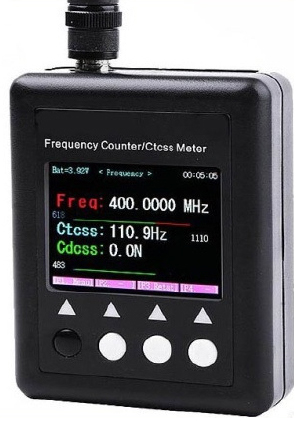
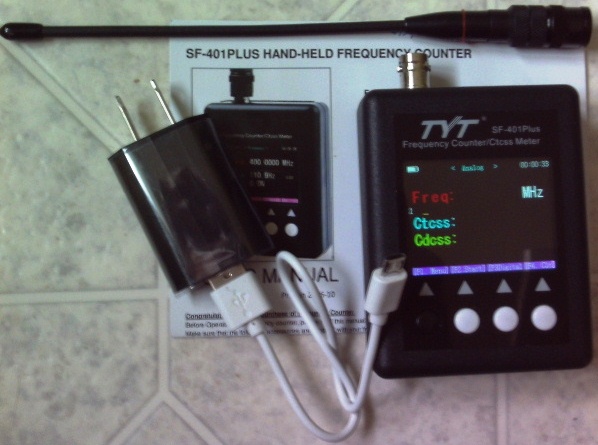
Author’s TYT SF-401Plus, includes instructions, antenna, rechargeable battery and charger/cable. Covers 27 MHz – 3 GHz

Frequency/tone meters can be purchased for less than twenty US dollars but normally do not include a rechargeable battery and BNC connector for attaching an external antenna. Having had experience with these types, the time finally came for an upgrade.

After shopping around a decision was made to purchase the Tytera TYT SF-401 Plus. This model includes an instruction sheet, antenna, internal rechargeable battery, USB charger and cable. It represents a significant improvement over my previous, inexpensive meter, as the TYT has a BNC connector to attach a larger antenna and has four control buttons on the front panel. It also has, via a system menu, options to adjust the frequency/tone offset, dimmer levels, three or four decimal display and auto power off. All these valuable features warrant a higher cost, which was about $50, but well worth it. This price fits the budget of most hobbyists. However, higher end frequency/tone meters are available and cost several hundred dollars for those requiring that level of quality.

Out of the box the TYT SF-401 Plus, when checked against an IFR FM/AM-500A communications service monitor, was right on the money as far as accuracy. Note that the IFR-500A was calibrated against a high precision internal 10 MHz crystal in an “oven” and this is my gold standard reference for frequency accuracy in my shack.

TYT accuracy checked against an IFR FM/AM-500A communications service monitor transmitting a 146.52 MHz/131.8 Hz tone. Note frequency readout to four decimal places.

Now, it was time to check typical radios around the shack using the TYT. The first radio tested for frequency accuracy was a BTECH GMRS-V1 HT which I use to communicate with the home QTH while running errands around town. See photo for results. The BTECH and TYT agreed perfectly. Note that the TYT’s display includes a battery status indicator on top left and a timer use indicator, which resets every time the TYT is turned on. If you are going to measure digital signals (not included in this review) there is an option in the Setup Menu for that. With the BTECH handheld running 2 watts the TYT could detect its’ frequency at roughly four feet away.

Confirming BTECH transmit frequency against the TYT. Output is 2 watts. TYT multicolor display is super.

For VHF/UHF operating, especially when afield with other hams or groups such as CERT (Community Emergency Response Teams), problems can ensue if one does not have the correct frequency or tone programmed, so having the TYT in your shirt pocket to confirm these parameters when trouble occurs can be a quick way to get to the problem. See photo of an Icom IC-2300H 2 meter transceiver checked against the TYT for proper offset and tone. The Icom was putting out 65 watts and a repeater with an offset of -1.3 MHz and 88.5 Hz tone was checked.

TYT confirming unusual offset (-1.3 MHz) and tone for a repeater. Icom IC-2300H was at high (65W) setting and connected to an outdoor discone antenna.

According to the instructions included with the TYT SF-401 Plus, the operating range is from 27 MHz – 3000 MHz with a note stating “27 MHz – 100 MHz it can not be guaranteed and the corresponding normal emission appliance” which I interpret as accuracy is not guaranteed in this frequency range. Well, I checked the TYT against the IFR FM/AM-500A service monitor transmitting an AM signal on CB Channel 19, 27.185 MHz, and the TYT measured it exactly. One other important note is that according to the instructions, the tone decoder operates in the 136 MHz – 174 MHz and 400 MHz – 520 MHz frequency range. So that may limit its use in certain areas of the spectrum. One other item if interest is that the TYT has a 10 dB attenuator when dealing with high power signals.

All in all, I’m very happy with this purchase, and find the TYT SF-401 Plus useful for “first pass” troubleshooting and helpful when aligning older rigs which due to age are off frequency /tone. It definitely has a use in this shack.


Wow–what a bargain tool for the radio shack! Thank you for sharing your review, Mario.  Once again, however, you have tempted me with a purchase!  I remember when frequency counters would set you back a couple hundred bucks–it’s insane to think that you can grab one for $40-50 US shipped.

SF-401 Plus Retailers:

Note that the TYT SF 401 Plus is also marketed as the Surecom SF401 Plus: