Category Archives: News

Trilingual VOA Radiogram this weekend

VOARadiogram

(Source: VOA Radiogram)

VOA Radiogram on 17 and 18 August will include our first attempt to transmit Chinese characters. (It’s part of a VOA Chinese story about the future of BlackBerry.) And there will be a VOA News story in Spanish. To view the Spanish accents and the Chinese characters, your character set should be UTF-8. In Fldigi: Configure > Colors & Fonts to change the character set.

The broadcast will also include an Flmsg VOA News story including an SVG-formatted VOA logo created by Mark Hirst in the UK. If you have Internet Explorer, and cannot see the logo, try renaming the Flmsg file with an .xhtml suffix.

If you listen to more than one broadcast of VOA Radiogram this weekend, close Flidigi and restart it between broadcasts. This is because something in Flmsg turns off the UTF-8 character set, even though Fldigi is still configured for UTF-8.

Two of this weekend’s VOA News stories on VOA Radiogram feature VOA journalists who are radio amateurs. VOA Asia correspondent Steven Herman, W7VOA (@W7VOA), is interviewed about his visit to North Korea, and George Putic, KI4FNF, wrote the story about the renewed search for extraterrestrial life.

And there will be a VOA News story about a way to keep older brains healthy — other than experimenting with digital modes.

Here is the lineup for VOA Radiogram, 17 and 18 August 2013:

3:04  MFSK16: Program preview
4:50  MFSK32: VOA Spanish logo and news re VOA app
1:46  MFSK32: VOA Chinese logo and sample text
3:26  MFSK32: VOA News re benefits of hot chocolate
1:22  MFSK32: VOA Radiogram logo and addresses
4:43  MFSK64: VOA’s W7VOA visits North Korea
1:18  MFSK32: Photo of W7VOA in Pyongyang
3:28  MFSK64/Flmsg*: VOA’s KI4FNF on search for extraterrestrials
1:18  MFSK32: Photo of Gemini Observatory
1:12  MFSK16: Closing announcements
0:16  Surprise mode of the week

*To make Flmsg work with Fldigi (both can be downloaded from w1hkj.com), in Fldigi: Configure > Misc > NBEMS — Under Reception of flmsg files, check both boxes, and under that indicate where your Flmsg.exe file is located.

As always, reception reports are much appreciated and should be sent to[email protected]

VOA Radiogram transmission schedule
(all days and times UTC)
Sat 1600-1630 17860 kHz
Sun 0230-0300 5745 kHz
Sun 1300-1330 6095 kHz
Sun 1930-2000 15670 kHz
All via the Edward R. Murrow transmitting station in North Carolina.
 

Radio Free Sarawak is back on the air!

RadioFreeSarawakThanks to Rob Wagner’s blog, The Mount Evelyn DX Report, I just learned that the clandestine station, Radio Free Sarawak, is back on the air after declaring a break on May 8, 2013 (see our previous post).

Radio Free Sarawak will broadcast daily from 11:00-12:30 UTC on 15,420 kHz.

The following is the press release from Radio Free Sarawak‘s website (via their Facebook page):

AUGUST 11, 2013: Press release, Radio Free Sarawak back on air from Monday

Sarawak’s independent radio station Radio Free Sarawak is back on air Monday 12th August following its holiday recess.

The rural radio station, which broadcasts mainly in Iban, but also in Malay has received numerous enquiries from listeners eager for information about pressing issues in the state, including the on-going plans to dam key rivers and evict thousands of native people from their lands.

“The state government has moved swiftly to try and take advantage of its dubious election wins by tripling Ministers’ own salaries (back-dating the increase by a whole year and a half) and pushing through further land grabs in native territories, including the proposed Baram Dam region” points out the UK based station head, Clare Rewcastle Brown. “Ordinary folk want to be heard on these issues and it seems their opinions may often be different from the propaganda put out on the state controlled licensed media, which only promotes the narrow interests of the super-wealthy and politically powerful”.

Radio Free Sarawak is the 2013 winner of the prestigious Pioneer of Free Media Award by the International Press Institute, which applauded the station’s efforts to bring freedom of information and freedom of speech to the isolated communities in Malaysia’s Borneo rainforest state.

The station’s call-in facility also provides an opportunity for longhouse dwellers to express their own views and concerns about the effects of deforestation, oil palm plantation, rural poverty and endemic political corruption. The radio station is linked to the online portal, Sarawak Report, which shares the same agenda to shine light on these and related issues.

Radio Free Sarawak is transmitted from London and its familiar team of DJs will be broadcasting from Monday on Short Wave 15420kHz from 7pm-8.30pm local time Monday-Saturday.

It is also available via podcast online www.radiofreesarawak.org , from where it can be downloaded via smart phone for mobile listeners or onto UBS sticks for car radio.

The local call-in line is 082-237191 and listeners are invited to get in touch with their comments and issues.

HackRF: open source SDR on Kickstarter

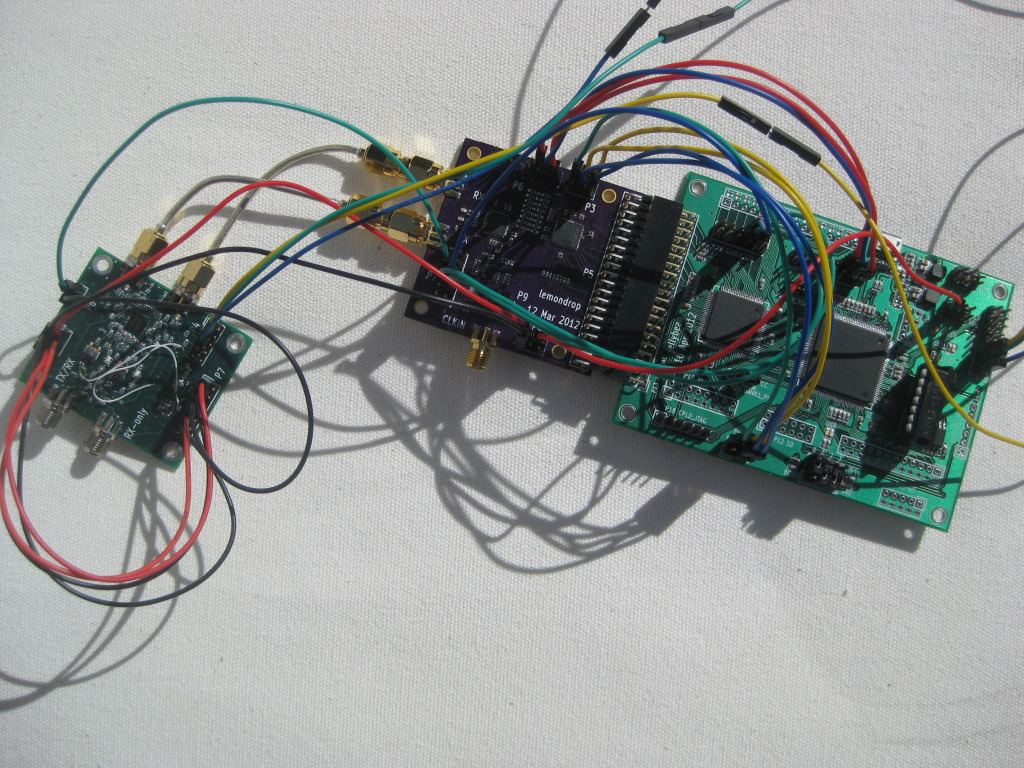
HackRF prototype (Source: ossmann.blogspot.com)

HackRF prototype (Source: ossmann.blogspot.com)

Michael Ossmann is making a business out of developing and producing open-source hardware.

His latest creation is called HackRF, and in less than a day, it has been fully backed on Kickstarter raising over $290,000 US with 25 days left to go in the campaign (at time of posting). Backers can contribute to this campaign with some confidence as Ossmann has successfully delivered products from Kickstarter in the past.

What makes HackRF unique is the fact that the stand alone unit can operate between 30 MHz and 6 GHz; a frequency range substantially wider than any SDR currently on the market. Indeed, when combined with the Ham It Up converter, the HackRF will also cover HF bands and lower.

Additionally, HackRF is a fully open-source transceiver; applications are limited only to a developer’s imagination. You could potentially use HackRF for ham radio, radio astronomy, scanning, shortwave radio listening, remote control applications, wide band monitoring, and commercial/industrial applications. If you use two HackRFs in tandem, they’ll even work in full-duplex applications.

Though the project is fully-backed, you can still support HackRF in the Kickstarter phase and save a bit on the eventual retail cost of the unit. Production units are expected to ship early 2014. Check out the HackRF Kickstarter video below:


Additional information:

VOA Radiogram, 10-11 August 2013, includes MFSK 16, 22, 32

VOARadioGram(Source: VOA Radiogram)

In this weekend’s VOA Radiogram, one VOA News item will be in the MFSK22 mode (80 words per minute), a mode we have generally not used for complete VOA News stories.

Another “feature” in this weekend’s program will be five seconds of silence whenever modes are changed. This might improve the performance of the RSID.

The Flmsg-formatted VOA News story in this weekend’s program is 9 minutes, 6 seconds long. That might seem unusually long, but it includes 4 minutes, 20 seconds for a VOA logo in SVG format as part of the html. This was created for us by Mark Hirst in the UK.

Here is the lineup for VOA Radiogram, 10-11 August 2013:

2:30  MFSK16: Program preview

3:26  MFSK22: VOA News re import of Apple products

3:12  MFSK32: Greetings to l’Associazione Italiana Radioascolto

2:10  MFSK32 image: AIR logo

9:06  MFSK32/Flmsg*: VOA News re one year of Curiosity on Mars

2:26  MFSK32 image: Curiosity tire tracks

1:10  MFSK16: Closing announcements

2:20  Surprise image, text, image of the week

*To make Flmsg work with Fldigi (both can be downloaded from w1hkj.com), in Flmsg: Configure > Misc > NBEMS — Under Reception of flmsg files, check both boxes, and under that indicate where your Flmsg.exe file is located.
VOA Radiogram transmission schedule
(all days and times UTC):
Sat 1600-1630 17860 kHz
Sun 0230-0300 5745 kHz
Sun 1300-1330 6095 kHz
Sun 1930-2000 15670 kHz
All via the Edward R. Murrow transmitting station in North Carolina.
Please send your reception reports, audio samples, screenshots, comments, ideas, suggestions to[email protected] .

Retirement Sale: Grove Enterprises liquidating inventory

grovewebheaderIt appears that Monitoring Times is not the only division of Grove Enterprises that will close shop when owners, Bob and Judy Grove, retire.

Indeed, Grove Enterprises is liquidating their entire inventory in a retirement sale. There are deals to be found in their shortwave radio selection and entire catalog of products.

Still, sad to see this reputable radio retailer close shop. I’m grateful that Universal Radio and C.Crane are still in business. I’m a strong believer in purchasing from radio retailers rather than online sources like Amazon.com. No doubt, Amazon has competitive pricing and good customer service, but frankly they could care less about the radio hobby in general.  To Amazon, shortwave radios are simply a few dozen consumer electronics products out of the tens of thousands they offer.

Universal Radio and C.Crane both support radio clubs, events and hobby-related activities–Amazon does not. Plus, pricing is often very close or even lower than that of Amazon. This is why I always purchase from them if they have what I seek.

Victor Ashe joins CUSIB after leaving the Broadcasting Board of Governors

Victor Ashe

Victor Ashe

Without a doubt, Victor Ashe has championed US international broadcasting on the Broadcasting Board of Governors and has voiced his support for continued funding of the Edward R. Murrow Transmitting Station. He will now join The Committee for U.S. International Broadcasting Advisory Board:

(Source: CUSIB Press Release)

The Committee for U.S. International Broadcasting (CUSIB – cusig.org) announced that departing Broadcasting Board of Governors (BBG) member Victor Ashe has joined CUSIB Advisory Board.

CUSIB is a nonpartisan, independent NGO supporting U.S. international broadcasting. CUSIB has worked with individual BBG members, heads of BBG entities, members of the U.S. Congress, and media to identify and correct management problems that hamper effectiveness of U.S. international broadcasting. CUSIB members were active in successfully opposing proposed cuts to Voice of America (VOA) radio and satellite television programs to China and VOA radio programs to Tibet. CUSIB also defended dozens of Radio Liberty journalists in Russia who were fired by the previous Radio Free Europe / Radio Liberty (RFE/RL) management. Some of the journalists were rehired after the BBG hired Kevin Klose and acting RFE/RL president. Klose initiated management reforms at RFE/RL.

At the BBG, Victor Ashe was a champion of accountability and transparency. He won respect of rank and file employees for his willingness to communicate with them and address serious management issues. Ashe insisted that top agency executives not ignore the problem of record low employee morale under the management of the International Broadcasting Bureau (IBB), as measured by the Office of Personnel Management (OPM) Federal Employee Viewpoint Survey (FEVS).

Ashe said in a statement: “I am honored to serve on this [CUSIB] Board and appreciate their dedication to transparency and fairness. There is still much work to do for international broadcasting by the United States due to serious management issues which still exist.” “I am hopeful the new BBG Board with the leadership of Jeff Shell will make the decisions necessary to move BBG forward,” Ashe added.

“You are listening to the Free Hellenic Radio”

TheParthenonAthensYesterday was the first day in nearly a month that I had turned on my SDR to record broadcasts. Between my travel schedule, getting the PC fixed, and near-constant summer thunderstorms, my SWLing has been limited to portables and sporadic travel listening. It felt so great yesterday to turn on the WinRadio Excalibur and do a little band-scanning. As I skimmed across the bands, I checked in with my good friend, the Voice of Greece, on 9,420 kHz. And, as I listened, I flipped on the “record” switch.

What I recorded was more than three hours of uninterrupted Greek music. Click hear to download the full recording, or listen via the embedded player below:

Three hours of music with no commentary (save a little dead air) is certainly not a typical format for the Voice of Greece, so I took note. If you’ve been reading The SWLing Post for long you’ll know that the Voice of Greece and its domestic broadcasting counterparts have been going through a major shake-up. In the wake of the government closure of ERT on June 11th, within hours, former ERT journalists defiantly got back on the air. Until courts ordered the immediate re-opening of the Greek national broadcaster, the Voice of Greece was, in a sense, a very powerful pirate radio broadcaster. Interestingly, since the shakeup in June, I learned that the Voice of Greece has barely been off-air.

Since I don’t speak or understand Greek, and since they’ve only made a few public statements in English, I turned to my friend and SWLing Post reader/contributor, Christos, for details.  He writes:

I will try to describe…the current situation regarding the ERT issue, I hope in an objective way.

…[I]n front of the Radio House in Aghia Paraskevi suburb…all the fence[s] and part of the building [are] covered by banners. Almost every [evening], concerts take place in the yard. The participant artists express their solidarity [with] those who run the ERT since 11 of June, when the government fired 2,650 employees in order to recruit some 2000 again.

The so-called occupiers of the Radio House demonstrate signs of [fatigue] as less producers and known journalists appear in the programmes. Their programme is transmitted from medium waves 729, 1008, 1260 1404 and 1512 KHz…enough to cover the whole country during night time. I checked the short wave frequency of 9420 KHz; they [host] a different musical programme…the one you receive in [the US] [hear this above]. I think that this is a dead end for those who continue, as 3,000 people in the media business have applied for job[s] in the new ERT. The vice minister responsible…will recruit only 500 of them…

Two days ago, we had a night of tension as some protesters appeared on the mountain where the antennas are located…[P]olice arrested some of them.

You can get an idea of this incident [by] watching the following two videos:

Another source of [information about] the ERT occupiers is:

http://www.ertopen.com/news-in-4-languges/english

…[T]here have not been announcements about the future of the Voice of Greece. Think that some 10 million…Greeks live in the country, and some 10 [million] more [live] abroad.

[The pace of] Greek summer…[is] slow. People go to the beaches or to their native villages. Everybody looks exhausted as the last two days the temperature reached 39 degrees Celsius which is 102.2 degrees Fahrenheit. Today the SKAI, one of the biggest private radio stations, fired 10 journalists add[ing] to [the] 50 [previously fired]. Now they repeat older programmes and there [is] no news broadcasted.

Remaining journalists in ERT refer to [the broadcasting service] as: Hellenic Radio – The Voice of Freedom, and often announce, “You are listening to the Free Hellenic Radio.”

Once again…giving you an idea [of the political] climate here…this morning the government announced the names of 2,122 teachers – public servants from technical education [–] who lost their job[s].

I hope this will be of…interest.

Christos, we thank you so much for your insight and opinions about the state of Greek national and international broadcasting!  We at The SWLing Post support freedom of press in Greece, and commiserate with those who have lost their jobs, especially in such an oppressively hot summer. Please do continue to keep us informed.

I have sincere doubts about the longevity of the Voice of Greece (or Free Hellenic Radio) on shortwave. With the serious budget cuts the new ERT must be built on, I doubt they’ll consider funding shortwave radio in Greece. I feel like it may only be a matter of time before we lose yet another shortwave broadcaster.  I certainly hope I’m wrong…

In the meantime, I’ll be dedicating more hard drive space to spectrum recordings of VOG.