Category Archives: News

Guardian article on “the rise and rise of radio”

(Source: Susanna Rustin, The Guardian)

What is it about radio that has made it so durable, and able to coexist not only through the age of television, but the age of new media too? As social networking giant Facebook prepares to float itself and raise an astonishing £5bn, what has enabled radio to stand its ground?

[…]Radio can be made at a fraction of the cost of television, meaning that programme-makers, DJs and entrepreneurs can all have a crack at it. Commercial broadcasters as well as the BBC value it as an incubator for future TV talent. Added to which, radios themselves are cheap, and all over the place: by people’s beds, in the bathroom, in the car.

“Despite the fact you think we’re a visually saturated culture, there are all sorts of places where you get radio and nothing else. The technology of radio is cheap, simple and idiot-proof, and older listeners in particular are going to be very reluctant to let it go,” says [Mark] Damazer.

[…]There is a confidence among many of those who work in radio that what they do will carry on. We remain attached to radio and its rhythms, to the hum and the sound of it. And we get attached to the people who present it, when we don’t violently take against them. Radio is personal.

Couldn’t have said it better myself. Another article filed under “why radio?”

Read Rustin’s full article at The Guardian website.


The Voice of America turns 70

(Source: Diplomatic Courier)

“The news may be good. The news may be bad. We shall tell you the truth.” – William Harlan Hale; February 1, 1942

Such began the first broadcast of a small team of dedicated men transmitting live from a claustrophobic New York City studio into Nazi Germany.  Their group had no name, although their first broadcast was titled Stimmen aus Amerika—Voices from America. The equipment they used was borrowed.  They had no direction as to what they would broadcast, except the truth.  At that moment, the United States stepped into a role as guardian of the power of ideas and honest messenger of information to all corners of the world.

From the very beginning, the Voice of America has held at its core the mission to present to the world the policies and culture of the United States, while reporting on global news events accurately, clearly, and objectively.  It has been one of the U.S.’s most effective public relations initiatives. All around the world, the Voice of America is highly respected as an honest and fair messenger, and in many places, as the only comprehensive source of news free from propaganda.  From Nazi Germany to Communist Eastern Europe to Kim Jong Il’s North Korea, VOA has often been the only connection to the outside world that people of repressive regimes have. […]

Today, VOA broadcasts through the Internet, television, and a network of AM, FM, and shortwave radio signals. The approximately 1500 hours of programs per week include features on American culture, learning English, international news, discussion programs, and regionally focused programs to address the needs of the local populations.  VOA broadcasts in 43 languages, televising programs in 26 of those, and reaches 141 million people weekly. All this makes VOA one of the largest multimedia news organizations in the world.

Read the full story at the Diplomatic Courier website.

NPR explains space weather and the CME heading our way

(Source: SpaceWeather.com)

I think this is one of the best, simple explanations of space weather that I’ve seen lately:

(Source: NPR)

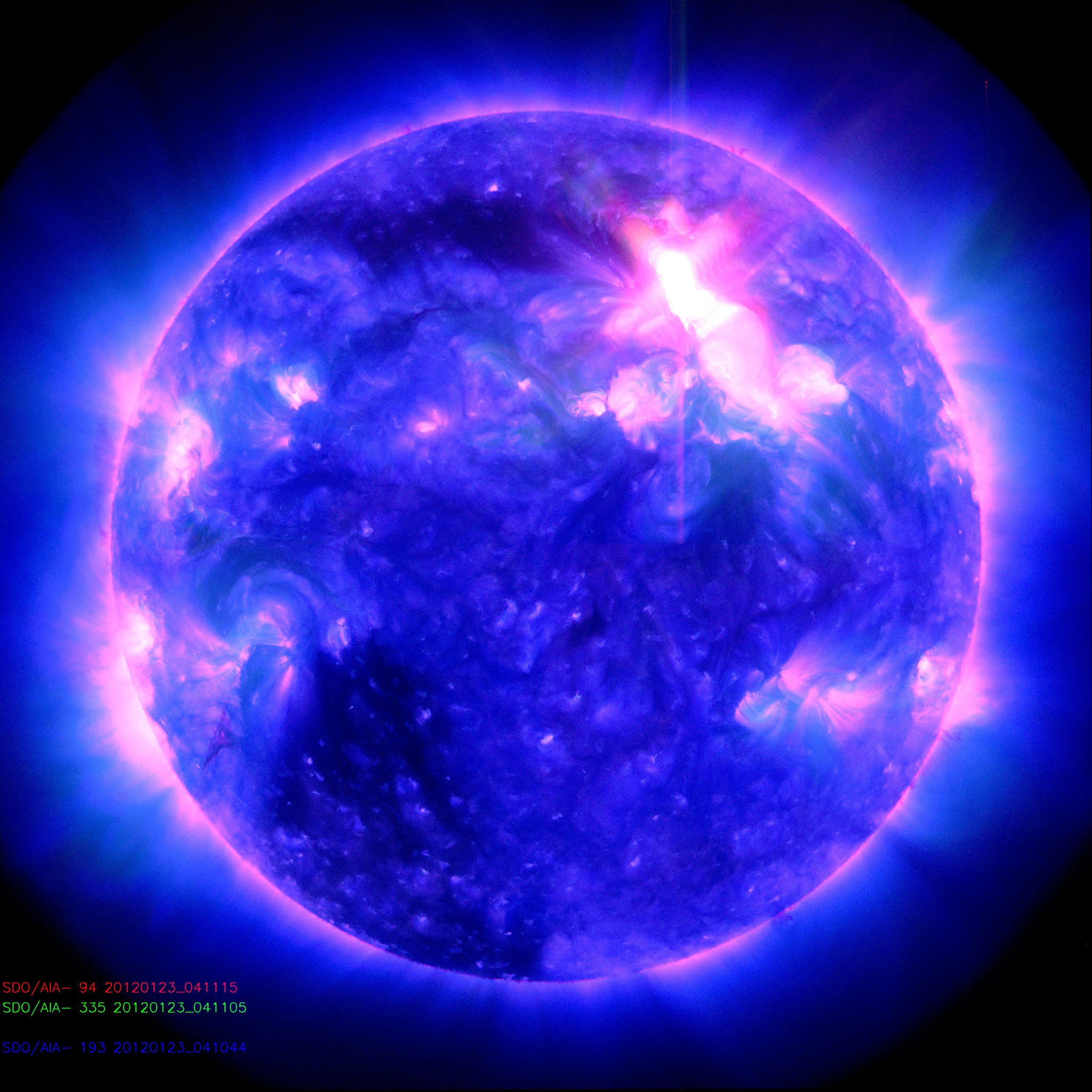
Space weather, as it is called, originates with solar magnetic activity. The sun is a giant spinning ball of charged particles. In addition to its spin, the heat released from the core through nuclear fusion eventually sets the upper layers of the sun into a kind of boiling motion called convection. All that motion — spin and convection — means lots of charged particles streaming this way and that. Since current (the flow of charges) produces magnetic fields, the outer domains of the sun are ruled by magnetism. Magnetic fields are the source of all those cool images of giant flares erupting in planet-spanning arcades of super-hot plasma. It’s also the source of so-called Coronal Mass Ejections or CMEs, which are, essentially, the space storms that space weather is all about.

CMEs are eruptions of matter and magnetism from the sun into space. A typical CME will blow 10 billion kilograms (about 22 billion pounds) of solar plasma into space along with enough energy to represent a flotilla of 220 aircraft carriers moving at 500 km/s. The fact the CME’s are quite common says a lot about the power locked up in an ordinary star like the sun.

While 1 to 3 CMEs may occur every day, we only the notice the ones that slam into the Earth on their journey across the solar system. When a CME crosses the Earth it runs into our planet’s own magnetic field. Charged particles from the CME get trapped by the Earth’s magnetic field and stream down toward the planet’s surface near the poles.

When those CME particles, running down magnetic field lines, strike atmospheric gas atoms, the collisions cause the atoms to light up like Christmas tree bulbs. That is the origin of the simmering walls of color we called aurora. There was a time when pretty lights were all there was to space weather. Those days are over.

Read the full article on NPR’s website.

Large Coronal Mass Ejection (CME) to hit earth January 24th

(Source: SpaceWeather.com)

CME‘s have a very negative effect on shortwave radio. This particular CME is the largest to hit earth in 7 years–certain high-flying airplanes may even be re-routed. On the positive note, the strong ensuing geo-magnet storms should create some beautiful aurorasin northern latitudes. More details:

(Source: Space Weather)

The Solar and Heliospheric Observatory (SOHO) and NASA’s STEREO-B spacecraft detected a CME rapidly emerging from the blast site: movie. Analysts at the Goddard Space Weather Lab say the leading edge of the CME will reach Earth on Jan. 24 at 14:18UT (+/- 7 hours). Their animated forecast track shows that Mars is in the line of fire, too; the CME will hit the Red Planet during the late hours of Jan. 25.
This is a relatively substantial and fast-moving (2200 km/s) CME. Spacecraft in geosynchronous, polar and other orbits passing through Earth’s ring current and auroral regions could be affected by the cloud’s arrival. In addition, strong geomagnetic storms are possible, so high-latitude sky watchers should be alert for auroras.


NPR stories expose internet tracking (while shortwave remains immune)

This morning, NPR’s (National Public Radio’s) Weekend edition aired two intriguing stories sharing one strong common thread. First, “CIA Tracks Public Information For The Private Eye“–a look inside the CIA’s Open Source Center:

Secrets: the currency of spies around the world. The rise of social media, hash-tags, forums, blogs and online news sites has revealed a new kind of secret, those hiding in plain sight. The CIA calls all this information “open source” material, and it’s changing the way America’s top spy agency does business.

While you must listen to or read the full story to fully appreciate it, its gist is that this featured department of the CIA essentially uses readily-available public information in order to unlock and predict all sorts of activities they’ve traditionally tracked through covert operations. It’s a paradigm shift in how they’ve traditionally done business. Though not surprising, if you know the nature of the internet, it is fascinating nonetheless.

The second story, “Technological Innovations Help Dictators See All” dealt with the flip side:

As technology gets better–and cheaper–it’s becoming easier for authoritarian governments to watch and record their populations’ every move. John Villasenor of the Brookings Institution joins host Rachel Martin to discuss the phenomenon.

This discussion covers a real and growing problem:  the online Big Brother phenomenon.  Many people feel secure and anonymous online, but are not.  Moreover, as tracking technologies get better, I fear it will give these governments even more control over (and methods to intimidate) their people.

[Incidentally, NPR’s Fresh Air did a story in December 2011 which focused on tracking technologies regimes use–it’s a must-listen, as well.]

I hope international broadcasters are listening to stories like these. It’s more clear than ever that VOA, BBC World Service, Radio Australia, Radio France International, Radio Netherlands Worldwide, and the like still hold the key to getting uncensored information into oppressed countries without bringing harm to listeners, namely, via broadcasts over shortwave radio.

For, as we’ve often said, shortwave radio is impossible to track, works at the speed of light, is everywhere, and requires very simple and affordable technology on behalf of the listener. Let’s keep it alive and well:  burgeoning democracies rely upon it.

Yet more supporting stories for our ongoing series, “Why shortwave radio?

Ian McFarland CDs now available as a digital download

Ian McFarland (photo courtesy: DXer.ca)

Want to do something good for yourself, your knowledge of SWL–and, in the process, help others? Let me tell you how…

Ian McFarland has made available his excellent shortwave radio CD series for download on DXer.ca (an already excellent site, if you haven’t yet visited). This CD set includes a series on interval signals, foreign language recognition, a look back at shortwave history, the state of international broadcasting today, and even a bonus antenna series.  I purchased these the moment I heard that they had become available as MP3 downloads in December.

And how, exactly, are you helping someone else by enjoying these programs?  Fully 100% of the proceeds benefit Ian’s favorite charity, a food bank and soup kitchen in Duncan, British Columbia.

It’s a win-win, and you need to be one of those winners! What are you waiting for? Click here to go to the DXer.ca online store!

Description of CD’s from DXer.ca:
Series 1 – Were you a shortwave listener back in 1974? If you were a regular listener to RCI’s popular SWL Digest program, which went off the air in March of 1991 in the wake of a devastating budget cut at RCI, then you may remember the SW station Idents & Interval Signals Series that was featured on this award-winning program.

That series featured over 100 identification and interval signals from SW stations around the world. Many of the ident signals heard in that long-running series are no longer on the air. If you feel nostalgic about the “good old days” of SWLing, you’ll be interested to know that this unique series is now available in an autographed two-CD set.

Series 2 – CD#1: The Foreign Language recognition course + A bonus CD of classic McFarland.

Ever feel like you could do better with radio listening on the SW, MW and LW bands if you could only identify the language? Help has arrived with the release of Ian McFarland’s foreign language-recognition course. CD One of this series contains 55 language samples analyzed by noted linguist, the late Dr. Richard E. Wood.  You’ll be pinning down DX faster than ever with this concise and complete audio series CD. A second bonus CD contains three flashback shows in their entirety from the Ian McFarland catalog of classics.

Series 3 – Yesterday and Today:  20 Years of SW Broadcasting. In what they feel is their “finest work ever,” Ian McFarland joins Bob Zanotti, Kim Eilliot of VOA, Jef White of WRMI, and a cast of listeners from the 20th Anniversary Kulpsville, PA, SWLing Winterfest in 2007. They combine a 2009 live forum with a flashback to 1989 – The joint SWL Digest-Swiss SW Merry-go-round program devoted to the International Radio Days conference in West Berlin in 1989.

Bonus Download Series A – The Ian McFarland Antenna Series – A must-listen for SWL’s, DXers, and radio enthusiasts at all levels, this 11-part study series covers all things made of solid and stranded copper wire. From the most basic random wire to the windom and the beverage antennas, Ian discusses the most common types of radio antennas, protecting your antennas and equipment with lightning arrestors, and some antenna book references. The McFarland Antenna series was first aired in the seventies, and this is the first time in almost twenty-five years that these recordings have been available in a high quality MP3 download. Two dollars provides one hour of interesting and informative listening on the subject.

Radio Bulgaria, another broadcaster down: can shortwave be saved?

Yesterday, a message from Radio Bulgaria floated around the shortwave community that indicated the broadcaster may stop all shortwave broadcasts soon. Upon hearing this, my heart sunk.

Radio Bulgaria is no BBC World Service or Voice of America, nor is it the go-to station for the latest in international news.  However, what this unique little station does, and does remarkably well, is provide their listeners with news that is relevant to their part of the world. Like shortwave broadcasters of old, Radio Bulgaria draws listeners in, interacts with them, tells them about life in their ever-changing country.  Radio Bulgaria was once a mouthpiece for its government; after the Berlin wall fell, it became a true community-based station with both domestic and international listeners.  In short, Radio Bulgaria is a traditional shortwave station with accompanying warmth and charm.

Alas, my heart sunk a bit further this morning upon reading another, more substantiating, message; this time, from Ivo Ivanov, Radio Bulgaria’s frequency manager (via Mike on Cumbre DX):

BULGARIA / Dear listeners and friends of the short waves and Radio Bulgaria, / With a huge regret to inform you very bad news. After more than 75 years in the world broadcasting from January 31, 2012 at 2200 UT, Radio Bulgaria cease broadcasting on short and medium waves. The solution is that Radio Bulgaria is not necessary now its short waves and medium waves listeners. The reason –– no money for broadcast on short and medium waves. And who listens to short waves today? Already has internet. Maintaining the short waves was “Mission Impossible”! Hope dies last. As a frequency manager in the last 19 years my main task was to provide best quality signal of Radio Bulgaria in worldwide coverage. There will be no short waves, there will be no frequency manager. For all people who work in Radio Bulgaria that bad news is shock and horror Beginning of the end. But expect your moral support. Please send e-mail to:

Albanian section: <albanian @ bnr.bg>
Bulgarian section: <bulgarian @ bnr.bg>
English section: <english @ bnr.bg>
French section: <french @ bnr.bg>
German section: <german @ bnr.bg>
Greek section: <greek @ bnr.bg>
Russian section: <russian @ bnr.bg>
Serbian section: <serbian @ bnr.bg>
Spanish section: <spanish @ bnr.bg>
Turkish section: <turkish @ bnr.bg>

and from January 14, 2012:

Thank you and goodbye,
Ivo Ivanov

P.S. SW txs Kostinbrod & Padarsko will be destroyed in the next few months.

Heartbreaking.  It sounds as though the decision was swift, with little regard for those good station operators and others who work at Radio Bulgaria, nor for those who listen to its broadcasts.

Is this a sign of the times?

Weak Economy + Strong Internet = Shortwave Closures

This is, sadly, a prime example of what is happening to many international broadcasters. It’s that combination of shortwave radio listenership being on the decline (in parts of the world connected to the internet; my apologies to our kind readers who are the exception) while our weak global economy forces belt-tightening in governments and other organizations which support international broadcasters. Shortwave programs, which can be costly, often find themselves “justifiably” lopped off.  After all, it’s much more difficult to gather listener numbers than to track internet users and outlets over the internet. But most heartbreaking, those who actually listen to and rely upon shortwave are the least able to protest these closures. These listeners tend to be people who have no internet, and often live in remote, impoverished parts of the world.

Imagine you live in central Africa, for example, and tune into your radio every day for your world news.  Then one day, you attempt to tune in a favorite station program, but find only static…Have you made an error?  You tune again, but the station is nowhere to be found.  Then the next week, another favorite is absent…and another…

Here, in North America, I have very little ground to stand upon when complaining about shortwave closures. I have excellent internet access and some local radio, internet and TV outlets to turn to for news, music and more. When I stand up for shortwave broadcasters and protest closures, it’s for those I just mentioned, those without a voice.

Here in the US, I can’t help but draw an unlikely analogy.  I grew up in a small blue-collar town that manufactured furniture–lots of it. My father worked for a furniture factory his entire life. Indeed, almost everyone I knew had someone in their immediate family who built furniture. Something strange happened in the 1990s, though; suddenly, it became cheap, very, very cheap, to manufacture furniture abroad. As our local manufacturers started competing with others whose prices were supported by cheap foreign labor, locals felt the pull to move much of their manufacturing abroad too.

We put all of our eggs in the least expensive, most convenient basket. Today, in our little hometown, there are massive factories that have been sitting dormant for nearly a decade. They have no equipment inside, they have no skilled labor to build things. But that’s not the worst of it:  now, we couldn’t manufacture something if we needed to.  We’ve exported our entire infrastructure. Family and friends are without jobs, and this is the reason.  The same could be said of many, many other industries throughout the world.

Let me be clear: I’m no opponent of international trade–just like I’m certainly no opponent of the internet–but if we invest everything in the internet, we may very well lose our ability and means––our infrastructure––to broadcast over shortwave, should we need to do so in the future.  Already, there are many examples in which we need to do so.

I urge you to contact Radio Bulgaria via email (above) and sign the online petition at Save Radio Bulgaria. Whether or not we can stop this closure, I am uncertain, but we can make our voices heard.