Category Archives: Nostalgia

Archivist seeks copy of “A Brief Statement of Shortwave Programs to Target Areas”

Many thanks to UNT Archivist, Maristella Feustle, who writes with the following inquiry :

I’m in search of some historical literature cited in a 1970 dissertation.

Might anyone have access to a copy of the OWI’s “A Brief Statement of Shortwave Programs to Target Areas,” dated November 1, 1942? Thanks!

Post readers: If you happen to have a copy of this document or know its location, could you please comment with details? Many thanks!

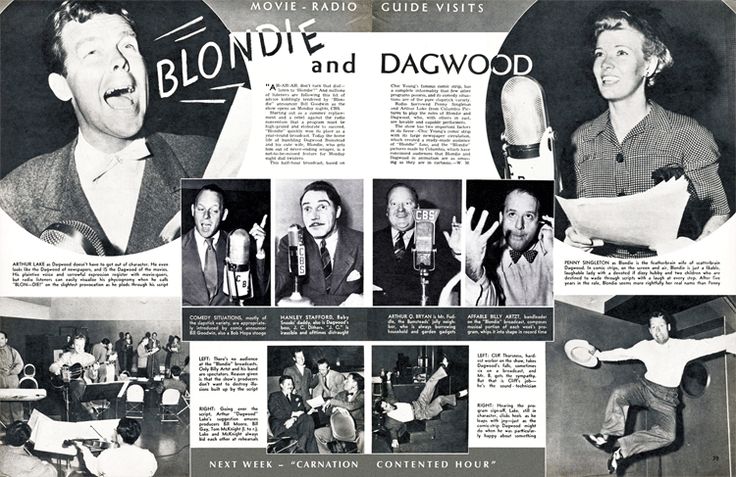
When Dagwood decided to become a radio repair technician

Many thanks to SWLing Post contributor, Dave Zantow, who shares a link to this 1947 “Blondie & Dagwood” episode #21. Dave notes that the part of the episode with a radio slant starts at approx. 24:22:

Click here to view on YouTube.

Thanks, Dave! I’m not sure I’ve ever watched an episode of Blondie and Dagwood, although I’ve certainly read hundreds of the comic strips and listened to many episodes of the OTR shows.

In fact, if you’d like to listen to some of the Blondie and Dagwood radio shows, the Internet Archive has a collection of 42 episodes that you can stream or download.

I’ve embedded the Internet Archive Playlist below for your convenience:

The story of a 1970s CB Radio QSL card print house

Many thanks to SWLing Post contributor, Ulis (K3LU), who shares the following story of a popular CB Radio QSL Card design and print house:

73s and 88s :: The Ballad of Runnin Bare and Lil White Dove

We set a custom screensaver on Our AppleTV. Told it to pull images from Flickr tagged with “British Columbia.” After my wife and kids and I spent a few weeks in Vancouver and in various places on Vancouver Island, it had become one of our favorite places. We missed it.

And so, at night, after a show or movie ended and the AppleTV sat idle for a few minutes, a slideshow would automatically begin. The Parliamentary Buildings in Victoria, the Inner Harbor, the wild, rocky, tidepool-rich shores of Tofino, the murals of Chemainus.

Then, every once in a while, an illustration of some sort. I couldn’t tell what. A one-panel comic? Some kind of advertisement or flyer? It would be gone from the screen before I could really get a good look. Weeks would go by and I wouldn’t see it until, once again, there it was. It looked old, like something from the 60s or 70s. And it had numbers on it, like a code or a message: 73s and 88s.

It was the numbers that got me. Like the park rangers in The Shining calling for Wendy Torrance on the radio: “This is KDK-1 calling KDK-12. KDK-1 calling KDK-12. Are you receiving me?” They seemed to be saying something. But what? I had to find out. So, I took to Google, and began my search.[…]

Click here to continue reading the full article.

FYI: Although the CB Radio landscape is quite different than it was in the 70s, most modern shortwave radio receivers can tune to CB channels. Here’s a quick tutorial from our archives.

Trans-Oceanic spotted in 1959 film “On the Beach”

Many thanks to SWLing Post contributor, Mario Filippi (N2HUN), who writes:

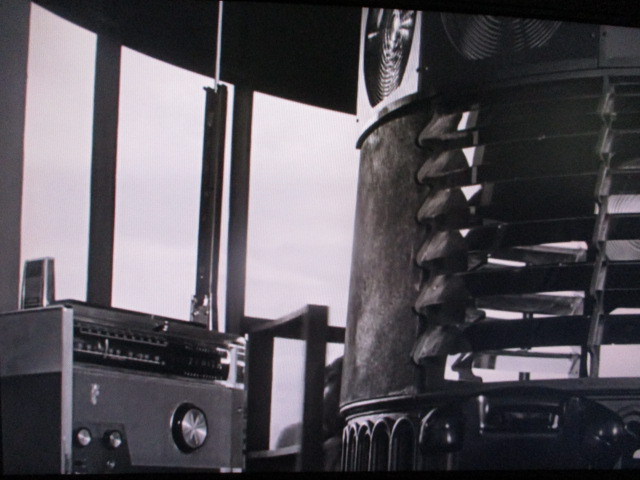
Maybe this is old news but in the 1959 film “On the Beach” which was from the book by Nevil Shute, there is a Zenith transoceanic shortwave radio in this clip from the film. It is inside the lighthouse and appears just about five minutes into the film.

Big stars in this one, Gregory Peck, Ava Gardner, Fred Astaire and Anthony Perkins.

Thanks for the tip, Mario! I love classic films, but I don’t think I’ve seen On the Beach. I’ll put this on my watch list!

I’ll add this post to our ever growing archive of radios in film!

Bruce’s passion for SWLing and single transistor regenerative receivers

Many thanks to SWLing Post contributor, Bruce (VE3EAR), who shares the following:

I live in the village of Saltford, ON, Canada, near the eastern shore of Lake Huron. It’s a quiet location signal wise, and I’m lucky that I have enough property to erect some big antennas. My two favourites are a 1200 foot long terminated Beverage, aimed at 50 degrees true, which targets Europe and the UK. The other is a 333 foot perimeter delta-loop, apex up and oriented north-south. Both antennas are fed with RG-6 coaxial cables and impedence-matching transformers.

I use the loop with a recently acquired Airspy HF+ Discovery SDR and the Gqrx SDR software, in my iMac. I like to listen to amateur activity on 160, 80, and 40 metres, along with the few shortwave broadcast station that are still on the air. I also like to listen to the trans-Atlantic air traffic control stations in Shannon, Ireland and Gander, Canada.

I once heard a U2 spy plane returning from a mission over Russia!

My other hobby is designing and building simple, one transistor regen receivers, most of which tune the AM broadcast band, although I have built a couple covering the lower portion of the HF broadcast bands as well, just for a challenge. All my receivers are built breadboard style.

My favourite of them is one based upon the Vackar oscillator, with the addition of a diode detector and “Benny”, as is used in crystal radios.

Here is the schematic of the Vackar circuit:

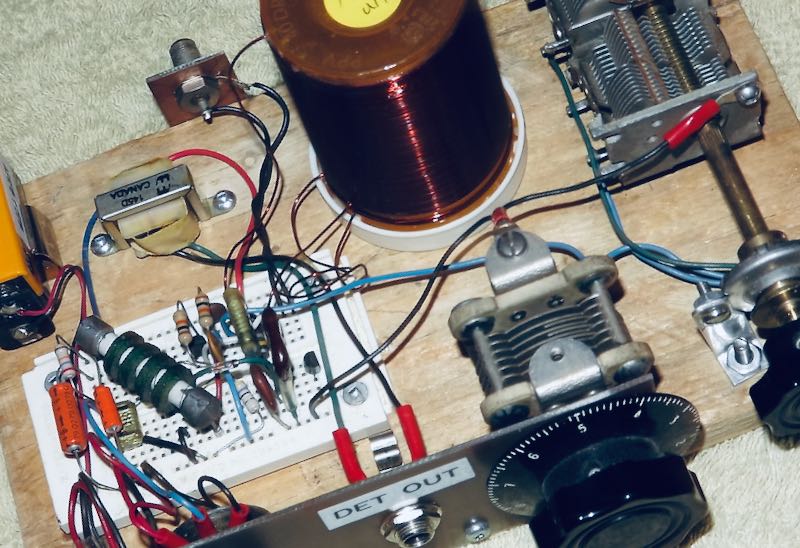
The diode and “Benny” connect to the collector of the transistor, then to a pair of home made headphones using two telephone earpiece elements installed in a pair of hearing protectors. The receiver is both very selective and very sensitive. Here is a pic:

Most of the electronics are on a proto-board, which allowed easy component substitutions during the build. When I had it optimized, I decided to leave it that way! The controls, left to right, are on-off switch, regen, fine tuning, main tuning, and range selector switch, hidden behind the reduction drive. Audio is taken from the DET OUT jack, to either the headphones described above, or to an audio amplifier for listening with a speaker.

Bruce, it sounds like you certainly have an excellent spot and excellent antennas for DXing! I love regen receivers as well and radio design can hardly be more simple.

Thank you for sharing!

Radio Waves: Dave Moves, IC-705 delay, High Speed Telegraphy Meet, and WWI Biplane Wireless

Radio Waves:  Stories Making Waves in the World of Radio

Because I keep my ear to the waves, as well as receive many tips from others who do the same, I find myself privy to radio-related stories that might interest SWLing Post readers.  To that end: Welcome to the SWLing Post’s Radio Waves, a collection of links to interesting stories making waves in the world of radio. Enjoy!

Many thanks to SWLing Post contributors Dave Zantow (N9EWO), Paul Evans (W4/VP9KF), and Mike Hangen (K8RAT) for the following tips:


Dave’s Radio Receiver Page Moves Again (N9EWO)

With all of the strange happenings and excessive “Pop-Up” issues on Angelfire (even more so of late), we have finally decided to move off of that web host and made the move to QSL.NET.

So “Dave’s Radio Receiver Page” new URL is :

https://www.qsl.net/n9ewo/

Please, for anyone who have web pages that have my web page linked (with the now old URL), I would appreciate the correction. Hopefully this will be the last time I will need to move the page.[…]

Please Note : Are still a few pages that still need to be transferred, but I expect to have that completed over the weekend. This has been quite a bit of work recoding all (again).

Icom IC-705 availability delayed due to Coronavirus

Paul Evans notes that Martin Lynch and Sons  (ML&S) has just updated the product page for the IC-705 with the following note: “RRP £1199.95 incl 20% VAT. Estimated delivery now July 2020 due to major component shortage.”

Icom America retailers (Universal Radio, Ham Radio Outlet, Gigaparts, etc.) have not published an estimate for availability.

QRQPoint – The meeting place for high speed telegraphy enthusiasts in Europe (Southgate ARC)

Dear OM and all CW lovers,
I will you proudly inform, that our website http://www.qrqpoint.com is now online.

The idea of this meeting place for CW enthusiasts was born by me and the webmaster, Fabian, DJ1YFK, brought it very nice to the web. Thank you Fabian!

Everybody is very kindly invited to be there QRV.

The frequency is 3567 khz. To make a sked or just to say Hello we have a little Shoutbox on the site.

I hope to see you there!

Kindest regards,

Olaf, DL1OP

In World War I, British Biplanes Had Wireless Phones in the Cockpit (IEEE Spectrum)

Pilots on reconnaissance missions could immediately call in their findings

As soon as the first humans went up in hot air balloons in the late 1700s, military strategists saw the tantalizing possibilities of aerial reconnaissance. Imagine being able to spot enemy movements and artillery from on high—even better if you could instantly communicate those findings to colleagues on the ground. But the technology of the day didn’t offer an elegant way to do that.

By the early 20th century, all of the necessary elements were in place to finally make aerial reconnaissance a reality: the telegraph, the telephone, and the airplane. The challenge was bringing them together. Wireless enthusiasts faced reluctant government bureaucrats, who were parsimonious in funding an unproven technology.

[…]One early attempt involved wireless telegraphy—sending telegraph signals by radio. Its main drawback was size. The battery pack and transmitter weighed up to 45 kilograms and took up an entire seat on a plane, sometimes overflowing into the pilot’s area. The wire antenna trailed behind the plane and had to be reeled in before landing. There was no room for a dedicated radio operator, and so the pilot would have to do everything: observe the enemy, consult the map, and tap out coordinates in Morse code, all while flying the plane under enemy fire.

Despite the complicated setup, some pioneers managed to make it work.[]


Do you enjoy the SWLing Post?

Please consider supporting us via Patreon or our Coffee Fund!

Your support makes articles like this one possible. Thank you!

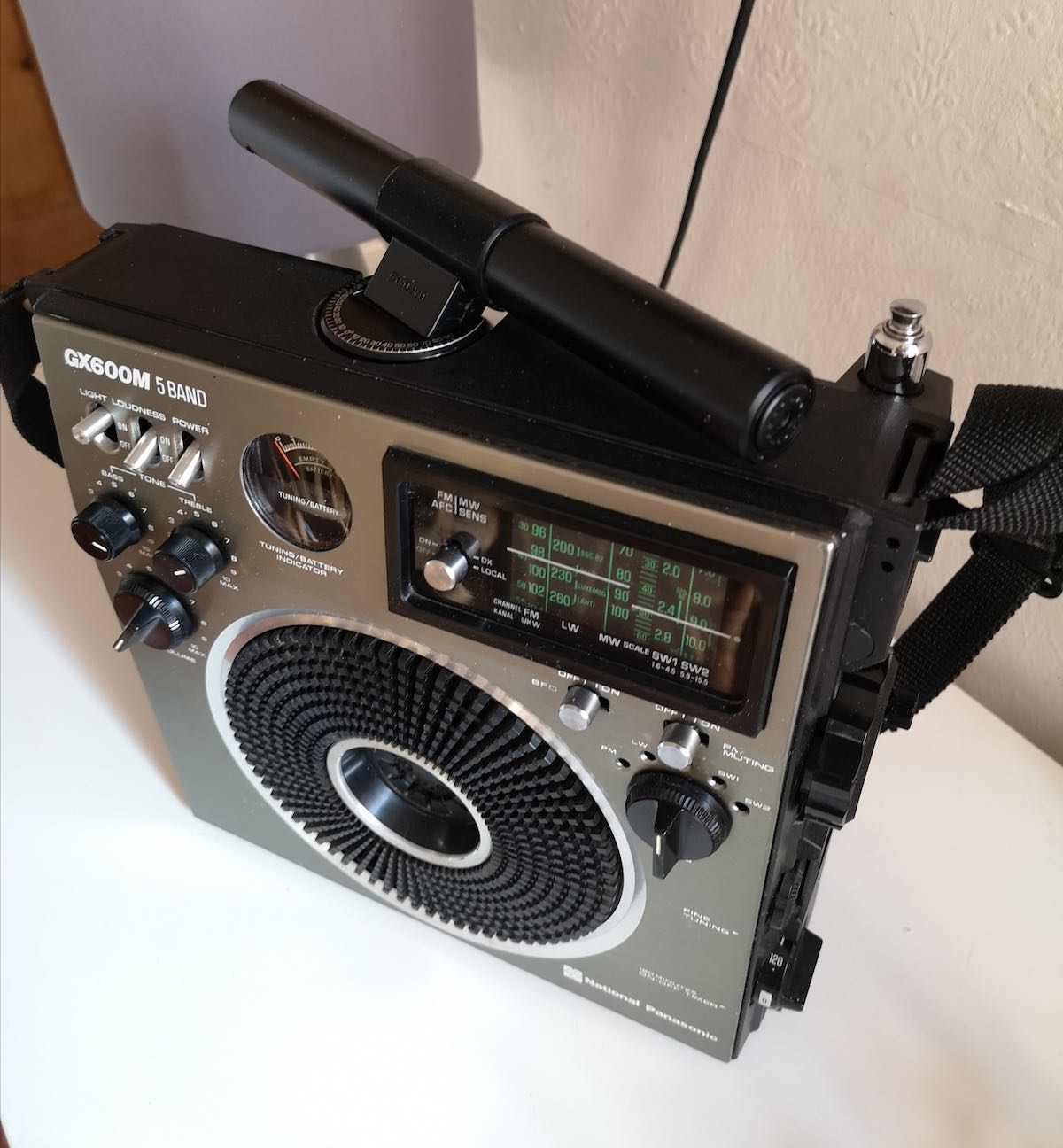
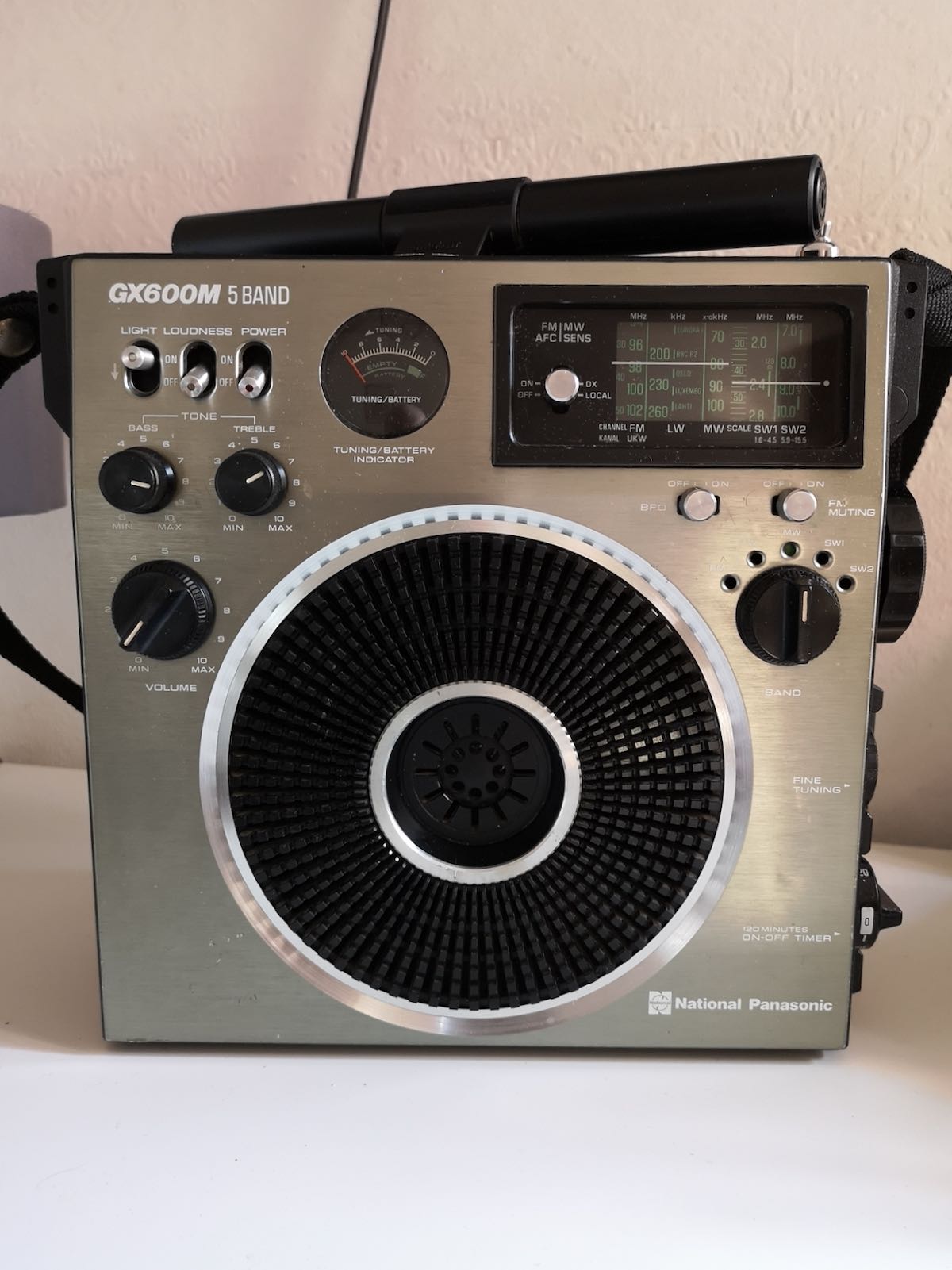
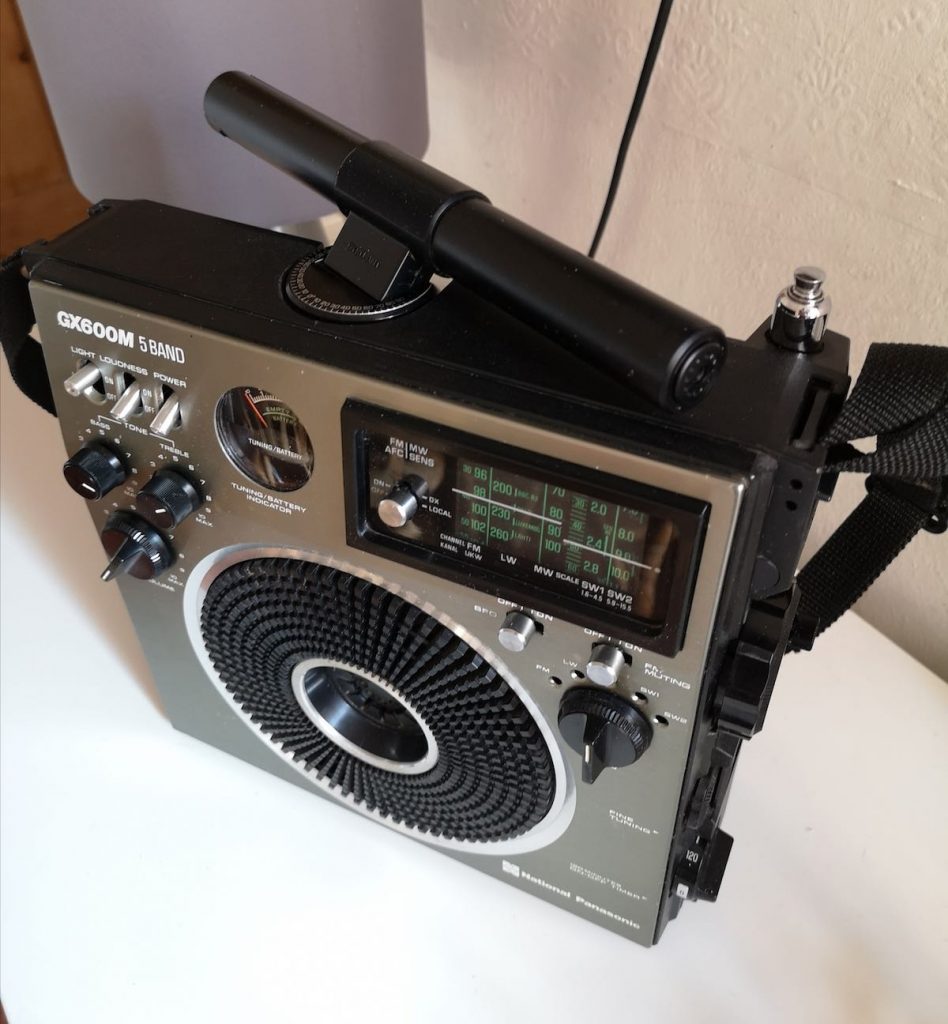
Mark loves his National Panasonic RF-1150 and could use some advice

Many thanks to SWLing Post contributor, Mark Lane, who writes:

Hi Thomas,

I have been reading the SWLing Post for a few years now but hadn’t contacted yourself since I announced my re kindled interest in SW and radio in general when I purchased a Sony ICF2001D a couple of years ago.

Well since then I had also bought a couple of modern travel radios but was hankering after something more retro.

I recently was lucky enough to receive a small bonus from work and thought it was an excellent opportunity to have another hunt for the European version of the Panasonic RF2200.

I had heard so much about this radio and really wanted a good analogue set. However, trying to find one in good condition in the UK was proving difficult to say the least.

Whilst hunting, I did find a radio that peaked my interest. I had not come across it before but was intrigued, initially by the looks and then read up on it a little. The Panasonic RF1150. After a few days of debating I took the plunge and bought one.
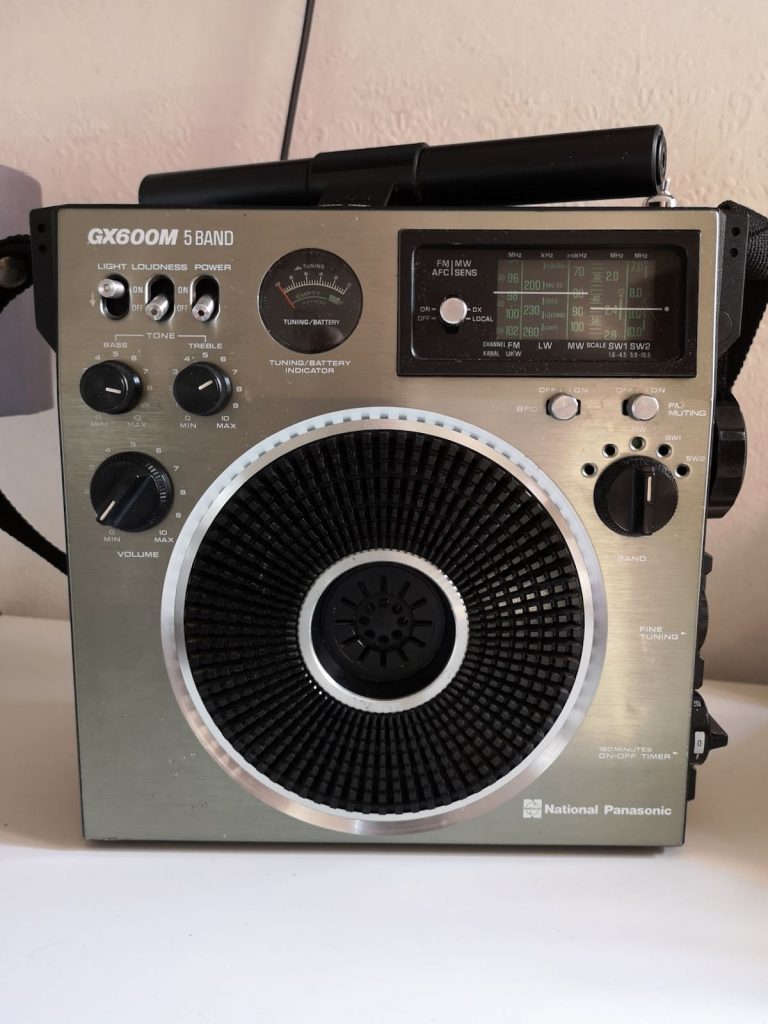
I don’t know if any other readers of the Post have or have had this radio but I must say I am very impressed with the MW and deep sound on this radio from the large speaker.

I am no expert, still learning all about radio and I am on the fence about the SW performance, but I did snag a Ham from Barcelona calling for North America on the first night of operation. I did have to work the BFO to keep the signal in check but it was enjoyable. There is something about these old receivers that keeps me listening. I do love my 2001D but it’s nowhere near as much fun as tuning the RF1150.

I just thought I would share the details of my new purchase and also wondered if anyone had any tips on maintaining a radio of this age as this is all new to me. It’s in pretty good shape but there is some crackle from a couple of the pots.

Also there is a switch in the left had side of the radio which I think is to allow input of an external device. The issue I have is that if I so much as knock this switch it turns it from ‘radio’ to ‘phono’ and it is nearly impossible to get it back. Not sure what I can do about that.

Anyway keep up the good work in helping keep radio alive!

All the best.
Mark

Thank you for sharing your find, Mark! The Panasonic RF-1150 is a handsome radio–no wonder it’s such a pleasure to operate!

The feel of tuning the RF-1150, RF-2200, and other solid state radios of that era is simply unmatched. I imagine like the RF-2200, the shortwave tuning experience especially employing the BFO, is a little “loosey-goosey.” Still, it’s incredibly fun and produces the most amazing variable het sounds!

Regarding the sticky pots and radio/phono switch, I suspect this is due to a little oxidization on the contacts. At least, if you wiggle or slightly budge the switch and the audio pops back all of the sudden, that could be the case. A very careful application of contact cleaner may solve your problems.

I have no history with the RF-1150, however, so perhaps readers can comment with their experience and advice!