Category Archives: Nostalgia

Glenn Hauser’s World of Radio reaches a milestone

Glenn Hauser’s World of Radio will air episode 2,000 this weekend.

The thirty minute World Of Radio show, which covers all things DX, debuted in 1980 on WUOT-FM in Knoxville, Tennessee, and moved to shortwave outlets two years later. Glenn Hauser has faithfully produced the show since then.

SWLing Post Executive Producer, Scott Gamble, contacted me recently and wrote:

In 1980 I was a freshman in high school when my parents gave me a shortwave radio for Christmas. This was during the heyday of international broadcasting, and it opened up an entire world of content that my teenage brain was excited to soak up. I’m not sure exactly when and where, but I soon after stumbled across Glenn Hauser’s World of Radio program immediately became a fan. Glenn’s unmistakable style and ability to jam so much news into a short broadcast provided a wealth of programming information in an era where access was nowhere near as ubiquitous as it is today. Glenn’s weekly broadcasts kept us all informed about schedules and content, and shortly after I became a subscriber to his Review of International Broadcasting publication. RIB provided a fascinating deeper dive into programming, politics and people behind the broadcasts, forever expanding my worldview and I’m sure thousands of others.

Writing about this in 2019, on the eve of the 2,000th episode of World of Radio, it is a testament to Glenn that his work has evolved so well into the digital age, and shows that even in a world where unlimited information is constantly available via the internet, curation and expert commentary are still highly valuable commodities. I still enjoy listening to WOR (as a podcast) every week. Congratulations, Glenn!

Thank you for sharing that memory with us, Scott. I also started listening to World of Radio in my youth. In the 1980s, I had no friends that were into shortwave listening and didn’t have the means to join any of the listener clubs, so World of Radio was my window into all that was DXing.

Share your WOR memories and comments to win an Eton Mini!
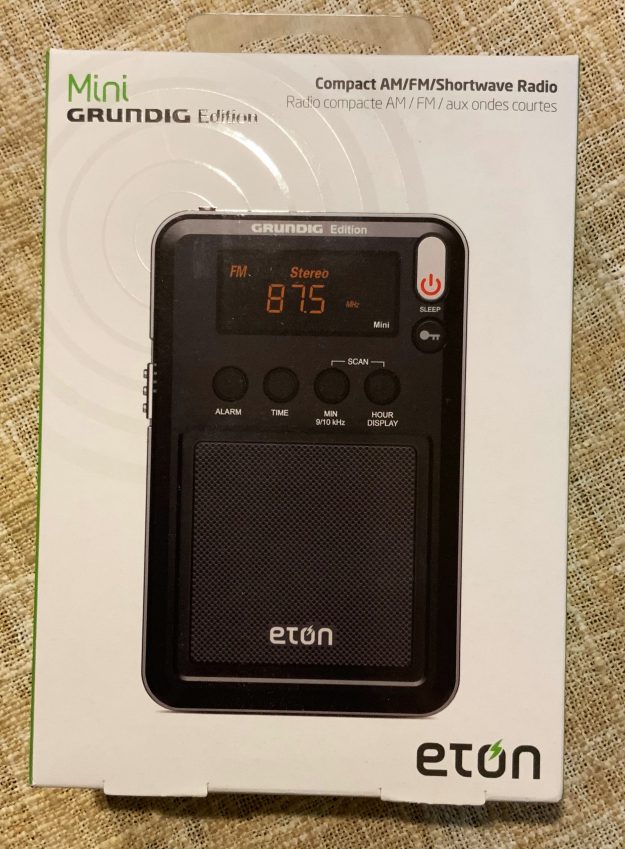
If you comment with a memory or positive message about World of Radio, you will be entered in a contest to win a Grundig Edition Eton Mini shortwave receiver. I will pick a commenter at random next Friday (September 27, 2019) and ship them their prize! (Congrats to Robert Graham who won our last giveaway).

This prize was donated by the good folks at Universal Radio.

The giveaway is open to anyone, anywhere in the world (although if international, you may be responsible for any duties/taxes paid in customs clearance).

Good luck and congratulations to Glenn Hauser and his World of Radio!


Do you enjoy the SWLing Post?

Please consider supporting us via Patreon or our Coffee Fund!

Your support makes articles like this one possible. Thank you!

A photo tour of the 2019 Shelby Hamfest

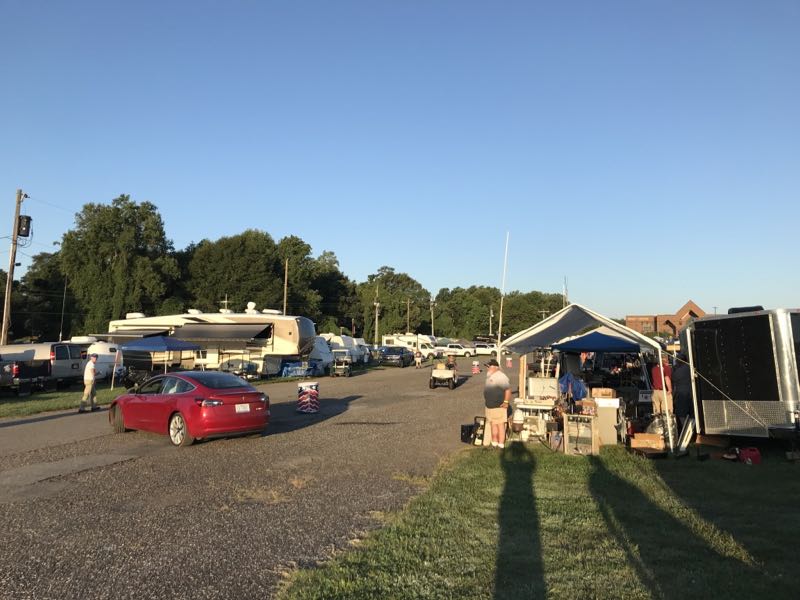
My Labor Day weekend was free of travel this year, so I was able to make another pilgrimage to the Shelby (North Carolina) hamfest with my good buddy, Vlado (N3CZ).

The Shelby Hamfest–referred to, locally, as “The Grand-Daddy of them All”–has long been regarded as one of the largest outdoor hamfests in the southeast US. This is the fourth year I’ve made a concerted effort to publish a photo tour of the event.

Weather was ideal for the hamfest–clear skies, sunshine and a dry weekend. No doubt, this was one of the reasons I believe the hamfest was well attended.

Shelby Photo Gallery

Click on the thumbnails below to enlarge or comment on the photos:

Note that if you’re viewing this post via our email newsletter, the embedded gallery (above) might not be viewable. Click here to view via web browser.


Do you enjoy the SWLing Post?

Please consider supporting us via Patreon or our Coffee Fund!

Your support makes articles like this one possible. Thank you!
History of the Armed Forces Radio Service

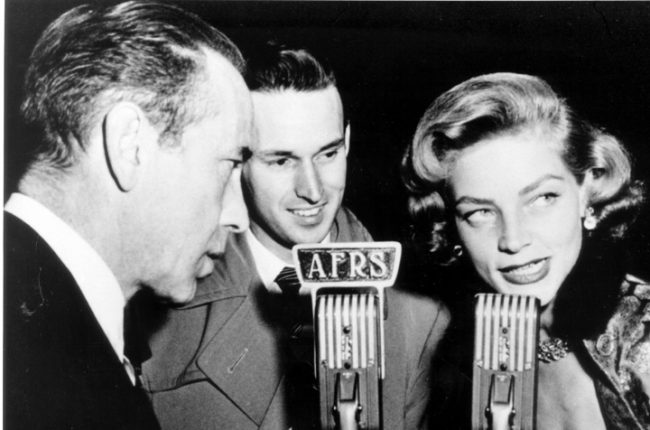
Humphrey Bogart and Lauren Bacall being interviewed by the Armed Forces Radio Service (Source: Wikipedia)

Many thanks to SWLing Post contributor, Ron, who shares this article from Radio World:

We can’t fully appreciate the importance of news from home to those who served in World War II. In the Pacific campaigns, G.I.s, sailors and Marines fought bloody island-hopping battles; as each island was cleared, garrison troops and hospitals moved in and carried on their own war against mosquitoes, isolation and boredom. The island fighters were fortunate if dated mail caught up with them before they moved on to the next target. Timely personal-level communications were pretty much absent.

Radio programming from America was available but only on shortwave. And shortwave radios were not generally available. The fortunate few had been issued “Buddy Kits” that included a radio, a small PA system and a record player for discs sent by mail. But for most there was no way to receive short-lived information such as news and sports. They were left with enemy radio propaganda such as Japan’s “Orphan Ann/Annie” (aka one of several Tokyo Roses) and the “Zero Hour” program.

No wonder that the idea of having a local island radio station doing “live from home” was so fiercely supported. Enlightened commanders saw the idea as a terrific morale-builder. The only problem was how to pull it off.

A solution, not uniquely, came from within the ranks. It started with the work of some bored but talented soldiers in the Panama Canal Zone who in 1940 built a couple of 50 W transmitters and put them on the air without authorization, labeling them “PCAN” and “PCAC.”

In Alaska, 7,500 miles northwest of Panama City, what started as programming through a loudspeaker system became a bootleg radio operation at Kodiak. Coming on the air in January 1942 and calling itself “KODK,” it delivered a whopping 15 watts to the troops. Sources with hindsight later said that the Armed Forces Radio Service (“AFRS”) was born here, when one of its progenitors visited the Alaska operations and “came up with the idea.”[…]

Click here to continue reading the full article at Radio World.

Guest Post: Missing the Static

Many thanks to SWLing Post contributor, Lou Lesko, who shares the following guest post:


Missing the Static

by Lou Lesko

Nineteen-ninety-one, my girlfriend Michelle and I were asked to house-sit her parent’s place in a remote part of Morgan Hill, south of San Jose, California. One had to drive for two miles on a dirt road through a running creek to get to the house deep in the woods. It was magical. The place ran on generators and a massive array of batteries.

We stayed in the master bedroom. Bob, Michelle’s step-father, had a shortwave radio on his bedside table. The radio was connected to a huge twenty foot high antenna stuck in the ground outside the bedroom window. Fumbling through the controls for the first time I found the BBC in London and a myriad of other broadcasts in different languages from cities all over the globe. It was mesmerizing.

Thanks to a book I found, Passport to World Band Radio, I learned that scanning to find broadcasts was called DXing. The book also listed frequencies and some of the known active times of stations around the world. It also explained the phenomena of shortwave: radio signals within a specific frequency range have properties that cause them to bounce between the ionosphere and the earth’s crust allowing efficient propagation around the globe. Conditions like weather, the electronic interferences of modern life, and solar flares all had an effect on the quality of the signal and how far it could travel.

The more I learned, the more I listened. Scrolling through the static to discover random broadcasts from radio Cuba or radio Moscow was blissful escapism that charged my imagination. At the time the BBC had 120 million weekly listeners. The largest audience of any broadcast medium in history.

It was a sad day when Michelle’s parents returned. Not only did Michelle and I have to go back to our tiny apartment—playing house was fun—I had to give up the shortwave radio.

A month later Michelle gave me a portable shortwave radio as a Christmas gift. It wasn’t nearly as powerful as the rig in Morgan Hill, but it worked fabulously well for receiving strong signals. I listened to it every night before falling asleep.

Three years later, during an annual trip to Yosemite, I wondered what the reception would be like if I were to take the portable radio up a few thousand feet way out of the range of street lights, televisions, toasters—all things electronic that impede reception of anything except the strongest signals.

I embarked on a solo hike up 12,000 feet to the top of Mammoth Peak in Tuolumne Meadows. Optimal listening time was just after sunset and into the night California time. Alone, wrapped in a subzero sleeping bag, a bitting breeze blowing, bathed the etherial pale glow of moonlight reflecting off the white granite, I turned on my radio. It was overwhelming. Every tiny turn of the dial yielded something new I had never heard before. I tuned in to almost every part of the globe.

Shortwave has faded. Its gradual decline started at the end of the cold war, Western governments no longer saw the need to shoulder the large costs associated with transmitting on shortwave frequencies. The demise was further hastened in 2001 when then BBC World Service Director Mark Byford stopped the broadcasts to North America citing the emerging Internet and satellite radio as the future for reaching audiences. He was of course correct.

Radio Garden, a web site that delivers a graphical version of what shortwave used to do, offers an animated picture of the globe dotted with internet radio broadcasters. Click on a dot, listen to a radio station in another part of the world in crystal clarity. Radio Garden is exceedingly clever and a wonder of modern technology. As are podcasts, streaming television, Facetime calls. All of it extraordinary and life altering. And yet, every once in awhile, I miss that unique thrill I used to get when I discovered a voice broadcasting from a far away place I’ve never been. Every once in awhile, I miss the static.


Lou Lesko is a writer, and a former editor-at-large for National Geographic.

Click here to visit Lou’s website.

Lou, thank you for sharing the static!

“BBC’s secret World War Two activities revealed”

Many thanks to SWLing Post contributors Fred Waterer and Mike Hansgen who share the following article from the BBC:

A new archive has revealed the BBC’s role in secret activities during World War Two, including sending coded messages to European resistance groups.

Documents and interviews, released by BBC History, include plans to replace Big Ben’s chimes with a recorded version in the event of an air attack.

This would ensure the Germans did not know their planes were over Westminster.

BBC programmers would also play music to contact Polish freedom fighters.

Using the codename “Peter Peterkin”, a government representative would provide staff with a particular piece that would be broadcast following the Polish news service.

Historian David Hendy said: “The bulletins broadcast to Poland would be deliberately short by a minute or so and then a secret messenger from the exiled Polish government would deliver a record to be played.

“The choice of music would send the message to fighters.”[…]

Click here to read the full article at the BBC.

Guest Post: The National Association of Armchair Adventurers (NAAA)

Many thanks to SWLing Post contributor, Bob Colegrove, who shares the following guest post:


National Association of Armchair Adventurers (NAAA)

as recalled by Bob Colegrove

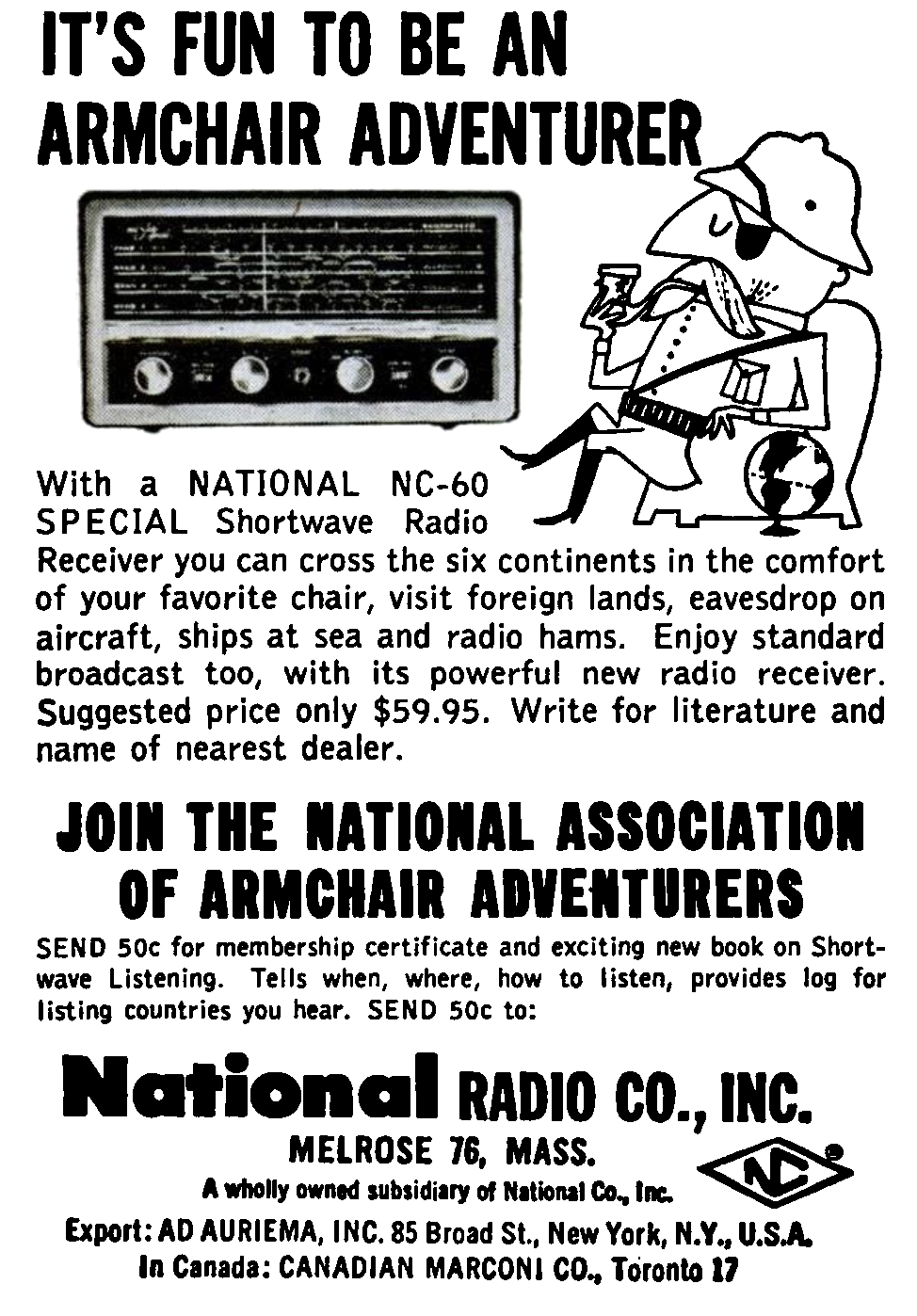
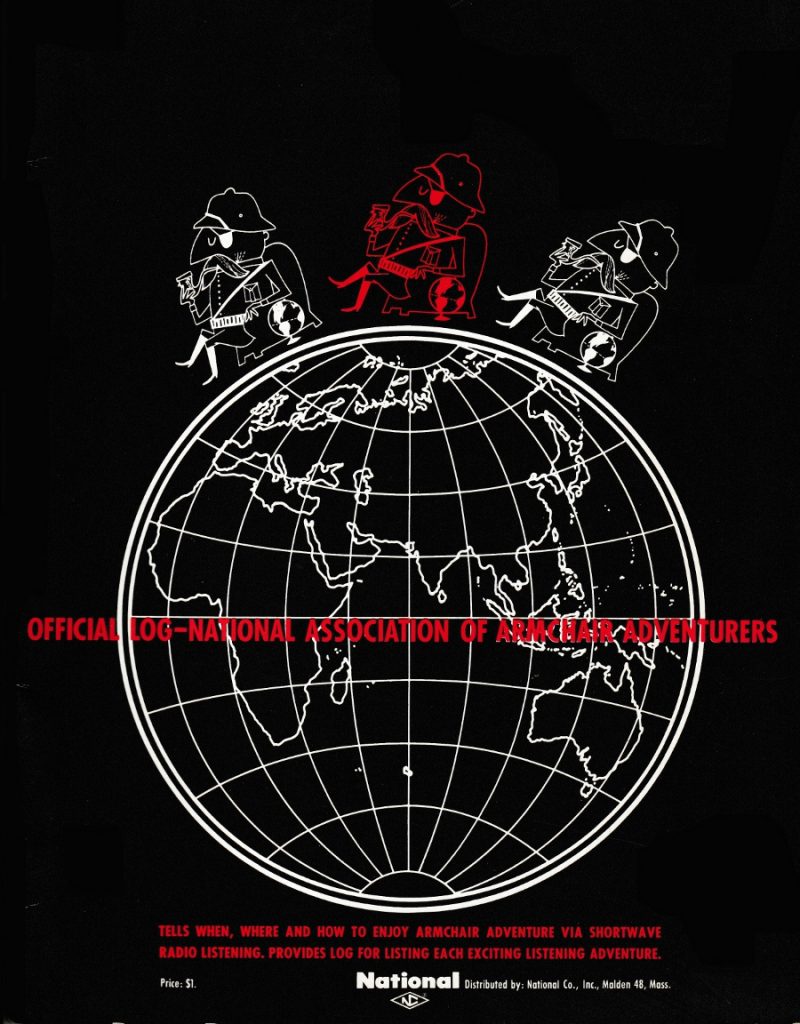
Those of you who were into SWLing in the late ‘50s or early ‘60s may remember the NAAA.  It was an engaging promotional effort by the National Radio Company to generate interest in shortwave listening.  This was done through ads run in magazines such as Popular Electronics, and displays in stores.  Yes, shortwave radios were once sold in brick and mortar stores.  The very proper gentleman depicted below, replete with khaki uniform, pith helmet, jackboots and calabash pipe is none other than Sir Oswald Davenport, Chairman of the Board, and a consummate SWLer of his time who never left the comfort of his own armchair in order to tour the world as it was virtually possible to do at that time.  For those too young to appreciate the connection, a “davenport” was a genericized trademark meaning couch or sofa in today’s parlance.

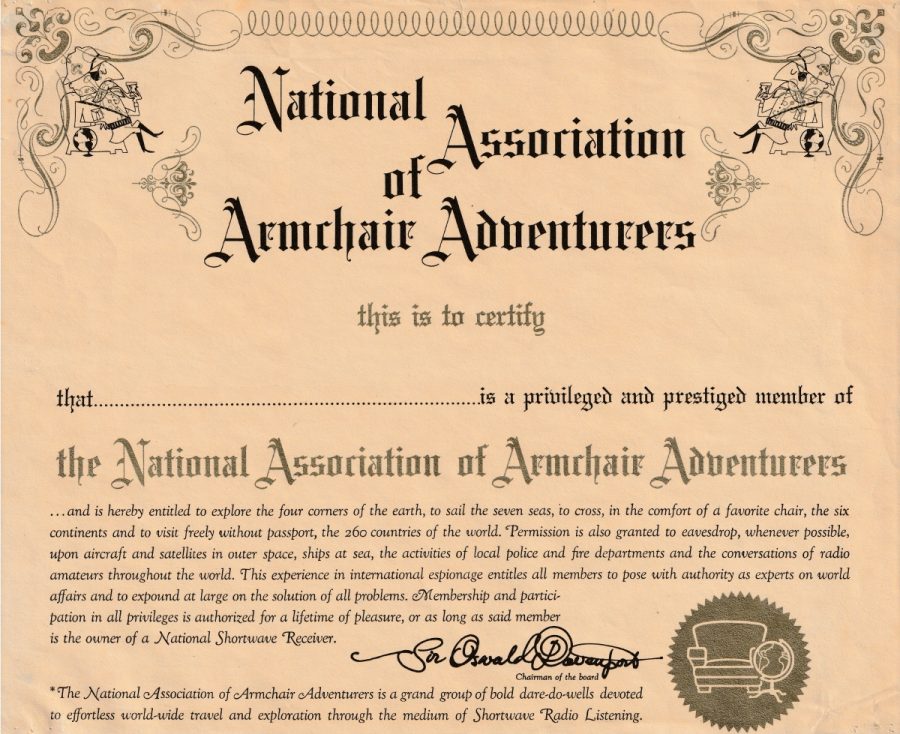
As the ad indicates, for fifty cents you were admitted to the Association.  This included a nice booklet containing an introduction to shortwave listening by Jack Gould, radio-TV critic for the New York Times, a sampler of stations ‘currently’ broadcasting around the world, log sheets and a large certificate of membership suitable for framing and signed by Sir Oswald himself.

The certificate reads, “this is to certify that (name) is a privileged member of the National Association of Armchair Adventurers… and is hereby entitled to explore the four corners of the earth, to sail the seven seas, to cross, in the comfort of a favorite chair, the six continents and to visit freely without passport, the 260 countries of the world.  Permission is also granted to eavesdrop, whenever possible, upon aircraft and satellites in outer space, ships at sea, the activities of local police and fire departments and the conversations of radio amateurs throughout the world. This experience in international espionage entitles all members to pose with authority as experts on world affairs and to expound at large on the solution of all problems.  Membership and participation in all privileges is authorized for a lifetime of pleasure, or as long as said member is the owner of a National Shortwave Receiver.”

The radio depicted in the ad was the then new National NC-60 Special, a 5-tube ac/dc, entry level receiver, which was a direct competitor of the Hallicrafters S-38E.  This writer recalls standing in front of the two mentioned receivers on display at the local ham shop in downtown Indianapolis in 1959 trying to decide on which radio to invest his hard-won sixty dollars.  The salesman wasn’t pushy, it came down to a coin flip, and the Halli came home with me. Although I’ve never regretted it, I still wonder what exotic mysteries lay behind the NC-60’s dial. Although my pen-and-ink name has long since faded, the NAAA certificate still hangs prominently in the shack.