Shortwave listening and everything radio including reviews, broadcasting, ham radio, field operation, DXing, maker kits, travel, emergency gear, events, and more
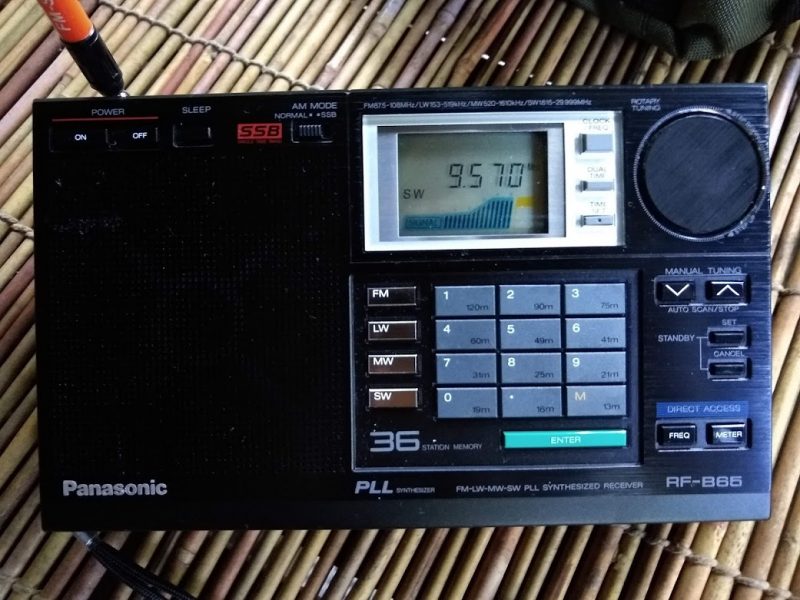
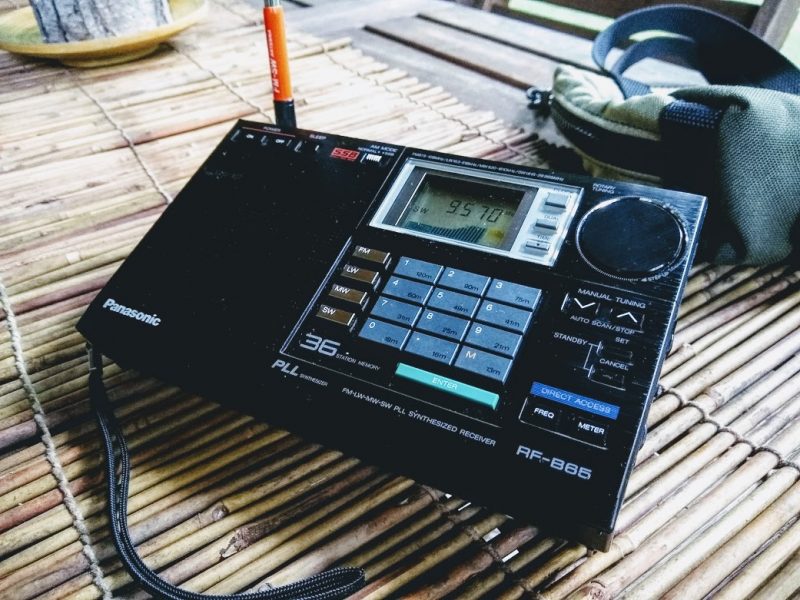
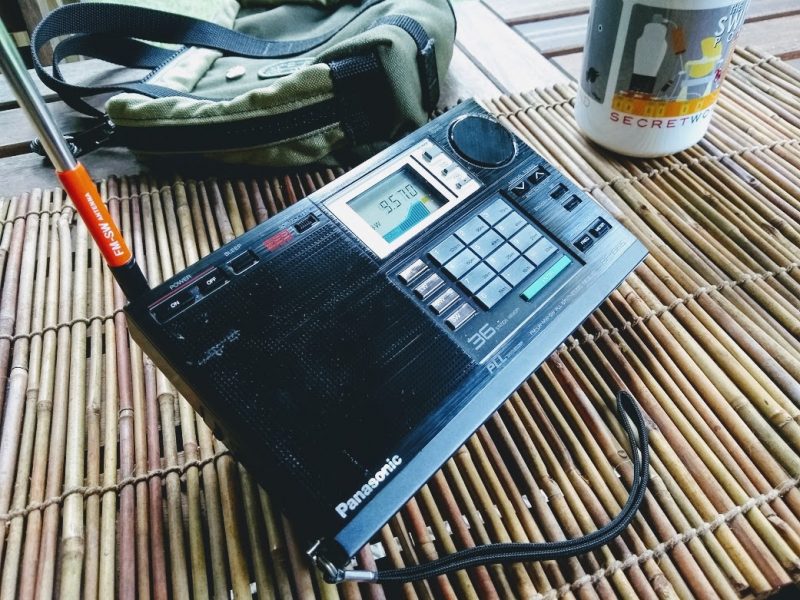
It turns out, I didn’t need to worry about the delivery time of the Panasonic RF-B65 I ordered on eBay Thursday evening. It was shipped from Washington state and arrived here yesterday (Saturday) via USPS 2 Day Priority Mail. I’m quite impressed with the delivery speed!
I haven’t had time to put the RF-B65 through the paces, but so far all appears to be in order. The unit is very clean, the battery compartment looks like new and the antenna straight and fully intact. This listing did not include a case, box or manual, but I’m fine with that.
I’ve only had the RF-B65 on the air for a few minutes to verify that everything works properly–so far, so good. This afternoon, I’ll start a “burn in” session to see if the radio will play for multiple hours on a set of fresh batteries. I’ve found in the past that if there are any capacitor issues, older portables like this could power down prematurely.
I’m hoping all will check out with the RF-B65 because I look forward to taking it on travels this week!
Two YouTube videos just crossed my path which sparked the question.
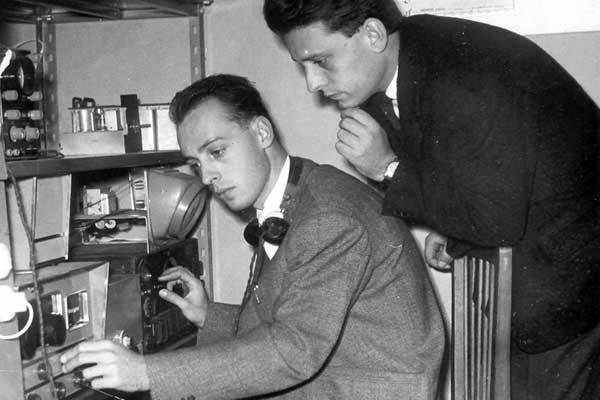
The brothers allegedly recorded transmissions from failed Russian Manned Space flights before the successful flight of Yuri Gagarin. I remember reading about these when I was growing up. The second video contains a snippet of a voice recording from a supposed female cosmonaut as she reports rising cockpit temperatures before she died.
Many thanks to SWLing Post contributor, Dan Robinson, who writes:
[This Barlow Wadley XCR-30 (above)] appears in Episode 4 of The Looming Tower on Hulu. Shown sitting in a slum in Nairobi (or a location posing as Nairobi), tuned to what sounds like Radio Australia…
Great catch, Dan! If I ever find an XCR-30 in great shape, I think I’ll snag one. I’ve always loved their simple, all-business front panel and legendary–once benchmark–performance.
Many thanks to SWLing Post contributor, Patrick, who shares the following guest post:
Dear Thomas,
Thank you for all good articles on the SWLing Post.
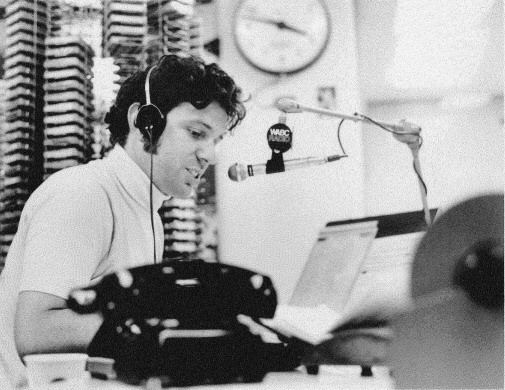
After the passing of Top 40 radio disc jockey Dan Ingram of WABC 770 AM and later WCBS 101.1 FM, the golden days of Top 40 radio in New York City, the biggest radio market in the United States has been observed in TV and articles. Since 1988, no major AM station in the New York market plays pop music.
In 1960 WABC 770 AM changed format top Top 40 with upbeat disc jockeys, taking advantage of its 50,000 Watts clear-channel undirectional transmitter with the possibility to reach distant suburbs even 100 miles away during daytime and large portions of eastern United States and Canada after sunset. Its competitors at time were Top 40 stations 1010 WINS, 570 WMCA and 1050 WMGM but with directional transmitters.
Link: News12: A look inside the WMCA Meadowlands radio tower
In the mid-1960s and on to the 1970s WABC had a long line of radio personalities like Dan Ingram, Harry Harrison, Ron Lundy, “Cousin Bruce” Bruce Morrow, and Chuck Leonard to name a few. Teenagers would enjoy listening to WABC with their transistor radios being popular. In the 1970s WABC was often No 1 or 2 in the New York radio ratings.
However, the Top 40 format was to become less popular in AM with FM stations starting to play hits. WMCA dropped its Top 40 format in the fall of 1970. Despite rivals from FM stations like WXLO 99X, soul station WBLS, album-oriented rock stations like WPLJ and WNEW-FM, WABC stayed on top until 1978 with the only notable AM competitor being 660 WNBC with an adult-leaning Top 40.
But when FM-station Mellow WKTU 92 changed format to disco and became Disco 92, an FM became the No 1 station in New York City putting down WABC to No 2 in December 1978. WABC started to play more disco but the audience became confused. With new management WABC started to aim for an older audience playing more adult contemporary songs. By 1981 WABC played more oldies and started to promote talk shows. In May 1982 it was announced that WABC would become a talk radio station. On May 10, the music ended on WABC and it was in radio called the day music died.
Video: Dan Ingram air check from 1980 on WABC in AM Stereo (Youtube)
1010 WINS dropped rock and roll music in 1965 and became an all-news station. 1050 WMGM (WHN from 1962) had various music formats until 1987 when it became all-sports.
660 WNBC was the last of the major Top 40-stations to drop music. It had various pop music formats until 1988 when it became all-sports 660 WFAN since WHN/WFAN changed to that frequency. 660 WNBC introduced shock jock Don Imus and afternoon jock Howard Stern.
Many of the disc jockeys, including Dan Ingram, would join 101.1 WCBS-FM, playing oldies with the Top 40 disc jockey upbeat. The classic Top 40 era with double-digit ratings and the nighttime signal reaching hundreds of miles away was gone.
The website Musicradio 77 has a lot of resources and memorial about WABC but also WMCA: https://musicradio77.com
Patrick
Thank you, Patrick, for the stroll down Memory Lane–and thanks for sharing the informative links and videos!
I truly appreciate honoring Dan Ingram as well–no doubt, there are many SWLing Post readers who remember him from WABC. He was and will always be a radio legend.
Post readers: Do you have any memories of AM Pop Music in New York City? Please comment!
Many thanks to SWLing Post contributor, Chris Peters, who shares the above photo for Boat Anchor Tuesdayand writes:
I was lucky enough to recently pick up both these familiar faces for $150.
Hallicrafters S-40B and SX-100
Both are in decent shape but are due for a recap and alignment.
Wow–both of these are classic sets, Chris! After a recap and alignment, I think you’ll especially be impressed with the performance that SX-100 delivers! Thank you for sharing!
Post readers: If you’d like to share a photo of your boat anchor on Boat Anchor Tuesday, simply send me an email with the photo and a short description. I’ll put it in the pipeline to publish!
Many thanks to SWLing Post contributor, John Figliozzi, who shares a link to this website which has archived radio listings from four major U.S. cities/newspapers from 1930-1960:
Who knows how many Americans realize that 100 years ago the United States was at war? After all, when about 25 people on the street in Beach Haven in the summer of 2012 were asked for a SandPaper article what war the U.S. had been involved in 200 years previously, very few could answer the War of 1812. There seems to be a flaw in the way history is taught in the U.S., and maybe math as well.
So for those who don’t remember their high school history, in 1918 the U.S. was heavily involved – with well over 4 million troops in Europe – in World War I, the “War to End All Wars,” “The Great War.”
It is easy to imagine that even a world war wouldn’t very much affect what was then a remote and rural Ocean County. But it did, in many ways. German U-boats prowled the Atlantic off the Jersey Shore; nearby Fort Dix (at first Camp Dix) was created and became one of the premier U.S. Army basic training centers in the country for decades.
Nicholas Wood of the Ocean County Cultural Heritage Commission[…]discussed two aspects of Ocean County and WWI in his 75-minute lecture/slide show at the Long Beach Island Historical Museum on Monday evening.
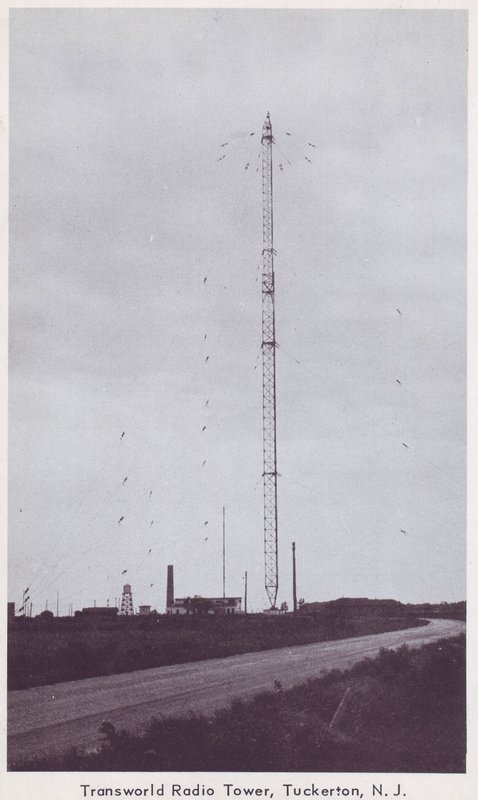
[…]The second half of Wood’s presentation discussed the once-famous but now mostly forgotten Tuckerton Radio Tower, built in 1912 by the German government.
[…]The tower was 820 feet high, making it, at the time, the second tallest structure in the world, behind only the Eiffel Tower. It was one of the first and most powerful transatlantic radio stations ever constructed. It survived until 1955, when it was torn down and sold for scrap metal and today lends its name to Little Egg Harbor’s Radio Road.[…]

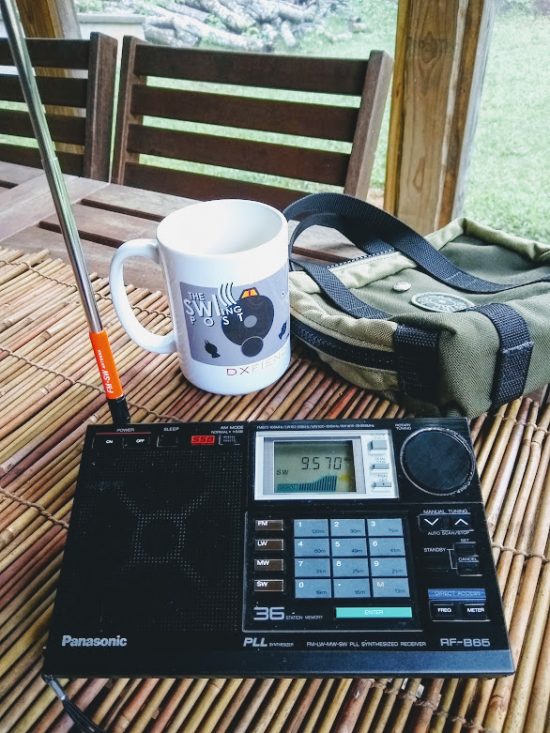 It turns out, I didn’t need to worry about the delivery time of the Panasonic RF-B65 I ordered on eBay Thursday evening. It was shipped from Washington state and arrived here yesterday (Saturday) via USPS 2 Day Priority Mail. I’m quite impressed with the delivery speed!